


Ashwagandha Supplements Market Size
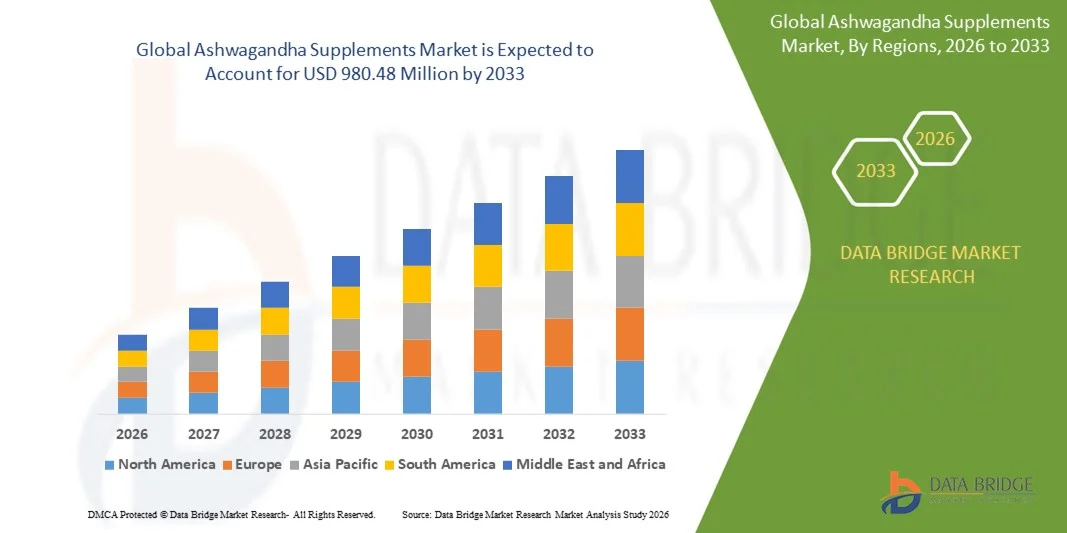
- The global ashwagandha supplements market size was valued at USD 470.92 million in 2025 and is expected to reach USD 980.48 million by 2033, at a CAGR of 9.60% during the forecast period
- The market growth is largely fueled by the increasing consumer focus on preventive healthcare, stress management, and overall wellness, driving higher adoption of herbal and adaptogenic supplements such as Ashwagandha
- Furthermore, rising consumer demand for natural, plant-based, and scientifically validated products is establishing Ashwagandha supplements as a preferred choice for managing stress, enhancing energy, and supporting cognitive health. These converging factors are accelerating product adoption across retail, online, and pharmacy channels, thereby significantly boosting market growth
Ashwagandha Supplements Market Analysis
- Ashwagandha supplements, offering adaptogenic benefits for stress relief, cognitive support, and immune enhancement, are increasingly recognized as vital components of daily wellness routines in both urban and semi-urban populations due to their convenience, multiple dosage forms, and proven efficacy
- The escalating demand for Ashwagandha supplements is primarily fueled by growing awareness of herbal wellness solutions, rising stress levels in modern lifestyles, and the increasing preference for natural alternatives over synthetic supplements. This trend is further reinforced by the availability of diverse product formats such as capsules, powders, gummies, and liquids, enhancing consumer accessibility and adoption across age groups
- North America dominated the ashwagandha supplements market with a share of 37.55% in 2025, due to increasing consumer awareness of herbal wellness and preventive health solutions
- Asia-Pacific is expected to be the fastest growing region in the ashwagandha supplements market during the forecast period due to increasing health awareness, rising disposable incomes, and a growing preference for herbal and Ayurvedic products in countries such as India, China, and Japan
- Capsule segment dominated the market with a market share of 47.56% in 2025, due to its convenience, precise dosage control, and ease of consumption. Consumers often prefer capsule forms for their portability and consistent potency, making them suitable for daily supplementation. The popularity of capsule supplements is further supported by established manufacturing standards and widespread availability in pharmacies and online stores. Capsules also integrate well into wellness routines and are often recommended by healthcare professionals due to their ease of use and minimal preparation requirements
Report Scope and Ashwagandha Supplements Market Segmentation
|
Attributes |
Ashwagandha Supplements Key Market Insights |
|
Segments Covered |
|
|
Countries Covered |
North America
Europe
Asia-Pacific
Middle East and Africa
South America
|
|
Key Market Players |
|
|
Market Opportunities |
|
|
Value Added Data Infosets |
In addition to the insights on market scenarios such as market value, growth rate, segmentation, geographical coverage, and major players, the market reports curated by the Data Bridge Market Research also include in-depth expert analysis, pricing analysis, brand share analysis, consumer survey, demography analysis, supply chain analysis, value chain analysis, raw material/consumables overview, vendor selection criteria, PESTLE Analysis, Porter Analysis, and regulatory framework. |
Ashwagandha Supplements Market Trends
Rising Consumer Preference for Natural and Plant-Based Adaptogens
- The increasing global focus on wellness and preventive healthcare is driving a notable shift toward herbal and plant-based supplements such as Ashwagandha, with consumers seeking natural solutions to manage stress, enhance energy levels, and support cognitive functions throughout their daily lives
- For instance, NutraHerb introduced a premium line of Ashwagandha extracts in 2024 targeting stress reduction and energy enhancement, strengthening its presence in the herbal supplement market and demonstrating how product innovation can encourage broader consumer adoption and brand loyalty
- Consumers are increasingly drawn to Ashwagandha for its adaptogenic properties, which help the body cope with mental and physical stress, improve overall resilience, and maintain hormonal balance, making it a preferred alternative to synthetic or chemically formulated supplements
- The variety of product formats available, such as capsules, powders, gummies, and liquid extracts, is facilitating wider adoption by providing convenient, user-friendly, and personalized ways for consumers to integrate Ashwagandha into their wellness routines
- Growing endorsement by nutritionists, wellness influencers, and healthcare professionals is enhancing credibility and consumer awareness, encouraging adoption across diverse demographic segments, including millennials and working professionals
- The trend toward natural, plant-based adaptogens such as Ashwagandha is expected to continue, supported by increasing health consciousness, lifestyle-related stress, and expanding research validating its efficacy, making it a cornerstone of the global herbal supplements market
Ashwagandha Supplements Market Dynamics
Driver
Growing Awareness of Stress Management and Preventive Healthcare
- The rising prevalence of lifestyle-related stress, anxiety, and fatigue, combined with increasing consumer focus on long-term wellness, is a key driver for the Ashwagandha supplements market as individuals seek natural adaptogenic solutions for daily stress management
- For instance, Natural Remedies launched Ashwa.30 in 2025, a clinically backed extract designed to support stress relief, enhance energy, and improve endurance, which has encouraged consumer trust and adoption in the herbal supplement sector while reinforcing the credibility of scientifically validated products
- Consumers are actively seeking adaptogenic solutions that help improve mental clarity, boost cognitive function, enhance immunity, and regulate energy levels, positioning Ashwagandha as an essential component of daily health routines and wellness regimens
- The growing availability of Ashwagandha products across retail pharmacies, e-commerce platforms, and specialty wellness stores is enhancing accessibility, enabling consistent consumption, and helping consumers easily incorporate herbal supplementation into their lifestyles
- Increasing interest in preventive healthcare practices, including natural and holistic solutions, along with the rising popularity of fitness, mindfulness, and lifestyle interventions, is driving sustained market growth and solidifying Ashwagandha’s role in modern wellness regimes
Restraint/Challenge
Quality Variability and Standardization Issues in Raw Materials
- The lack of standardized potency, variations in withanolide content, and differences in raw material quality across suppliers pose a significant challenge for manufacturers and consumers, potentially impacting the product’s efficacy and reliability
- For instance, discrepancies in withanolide content among products from various suppliers have led companies such as Herbochem to focus on producing standardized extracts with consistent concentrations, ensuring product effectiveness and maintaining consumer trust in the market
- Such inconsistencies can negatively affect product performance, consumer confidence, and repeat purchase behavior, potentially hindering the market’s overall growth and limiting adoption among first-time users
- The challenges of sourcing high-quality, contaminant-free Ashwagandha root and maintaining batch-to-batch consistency are further intensified by supply chain limitations, regional cultivation dependencies, and seasonal fluctuations in raw material availability
- Overcoming these quality and standardization challenges through rigorous testing, certification, controlled extraction processes, and supplier partnerships will be crucial to sustain consumer confidence, ensure efficacy, and support long-term growth in the global Ashwagandha supplements market
Ashwagandha Supplements Market Scope
The market is segmented on the basis of type, uses, and distribution channel.
- By Type
On the basis of type, the Ashwagandha supplements market is segmented into capsule, liquid, and powder. The capsule segment dominated the market with the largest market revenue share of 47.56% in 2025, driven by its convenience, precise dosage control, and ease of consumption. Consumers often prefer capsule forms for their portability and consistent potency, making them suitable for daily supplementation. The popularity of capsule supplements is further supported by established manufacturing standards and widespread availability in pharmacies and online stores. Capsules also integrate well into wellness routines and are often recommended by healthcare professionals due to their ease of use and minimal preparation requirements.
The powder segment is anticipated to witness the fastest growth rate from 2026 to 2033, fueled by increasing adoption among health-conscious consumers seeking customizable dosages and incorporation into smoothies or meals. For instance, companies such as Himalaya Wellness have expanded their powder product lines to cater to personalized supplementation needs and dietary preferences. Powder forms appeal to consumers who prefer natural or whole-ingredient preparations and are often marketed for versatility and enhanced bioavailability. Rising interest in Ayurvedic practices and home remedies also supports the growth of Ashwagandha powders. The segment’s growth is strengthened by educational campaigns emphasizing holistic health benefits and the ability to mix with other herbal ingredients.
- By Uses
On the basis of uses, the Ashwagandha supplements market is segmented into calming the brain, reducing swelling, lowering blood pressure, and altering the immune system. The calming the brain segment dominated the market in 2025, driven by the increasing prevalence of stress and anxiety among adults and working professionals. Consumers often use Ashwagandha supplements to support mental wellness, improve sleep quality, and enhance focus, positioning this application as a primary driver of demand. Products targeting brain calming benefits are heavily marketed for lifestyle stress management and cognitive health. The segment also benefits from scientific studies highlighting Ashwagandha’s adaptogenic properties, which strengthen consumer trust and adoption.
The segment aimed at lowering blood pressure is expected to witness the fastest CAGR from 2026 to 2033, fueled by growing awareness of cardiovascular health and natural alternatives for hypertension management. For instance, NutraHerb has launched Ashwagandha blends specifically designed to support healthy blood pressure levels. Consumers increasingly prefer herbal supplements to complement traditional therapies, encouraging product innovation in this use category. The segment’s growth is further driven by preventive health trends and recommendations from nutritionists and healthcare advisors promoting natural blood pressure regulation. The increasing prevalence of hypertension globally continues to provide a robust market opportunity for Ashwagandha supplements targeting this application.
- By Distribution Channel
On the basis of distribution channel, the Ashwagandha supplements market is segmented into hospital pharmacy, retail pharmacy, and online pharmacy. The retail pharmacy segment dominated the market in 2025, driven by easy accessibility, the ability to consult pharmacists, and the wide availability of branded and OTC products. Consumers often prefer retail pharmacies for trust, authenticity, and immediate purchase without delivery delays. Retail outlets also facilitate promotions, in-store recommendations, and bundled offers that enhance product visibility and adoption. The segment benefits from the presence of established chains and regional pharmacies, which expand consumer reach and maintain consistent stock of popular Ashwagandha products.
The online pharmacy segment is anticipated to witness the fastest growth rate from 2026 to 2033, fueled by the increasing penetration of e-commerce platforms and consumer preference for convenient home delivery. For instance, Amazon and 1mg have expanded their herbal supplement categories, making Ashwagandha products readily available with detailed product information and customer reviews. Online channels appeal to tech-savvy consumers seeking subscription services, bulk purchases, or specialty formulations. Growth is further supported by digital marketing campaigns and increasing trust in online payment and delivery systems. The segment’s rise is expected to continue as consumers prioritize convenience and access to a wider variety of Ashwagandha supplement options.
Ashwagandha Supplements Market Regional Analysis
- North America dominated the ashwagandha supplements market with the largest revenue share of 37.55% in 2025, driven by increasing consumer awareness of herbal wellness and preventive health solutions
- Consumers in the region highly value convenience, standardized dosage, and the perceived natural benefits of Ashwagandha for stress reduction and cognitive support
- This widespread adoption is further supported by high disposable incomes, a health-conscious population, and the growing preference for dietary supplements as part of daily wellness routines, establishing Ashwagandha supplements as a favored herbal product across both retail and online channels
U.S. Ashwagandha Supplements Market Insight
The U.S. Ashwagandha supplements market captured the largest revenue share within North America in 2025, fueled by the rising interest in natural adaptogens and functional foods. Consumers are increasingly prioritizing herbal solutions for mental wellness, stress management, and immune support. The growing trend of online purchases, subscription-based wellness products, and integration with fitness and lifestyle routines further propels the market. Moreover, the availability of a wide variety of capsules, powders, and liquid forms, along with endorsements by health influencers and nutritionists, is significantly contributing to market expansion.
Europe Ashwagandha Supplements Market Insight
The Europe Ashwagandha supplements market is projected to expand at a substantial CAGR throughout the forecast period, primarily driven by rising consumer awareness of herbal remedies and preventive healthcare. Urbanization and increased disposable incomes are fostering adoption, with European consumers drawn to natural supplements for stress reduction, cognitive support, and overall wellness. The market is witnessing significant growth across retail pharmacies and online platforms, with Ashwagandha being incorporated into functional foods and dietary supplement routines in countries such as Germany, France, and Italy.
U.K. Ashwagandha Supplements Market Insight
The U.K. Ashwagandha supplements market is anticipated to grow at a noteworthy CAGR during the forecast period, driven by the increasing trend of natural and herbal supplementation for stress management and mental wellness. Concerns regarding lifestyle-related health issues are encouraging consumers to choose Ashwagandha capsules and powders as part of preventive care. The country’s well-established e-commerce infrastructure, combined with growing awareness of adaptogenic herbs, is expected to continue stimulating market growth.
Germany Ashwagandha Supplements Market Insight
The Germany Ashwagandha supplements market is expected to expand at a considerable CAGR during the forecast period, fueled by rising awareness of herbal and alternative medicines and the demand for natural, eco-friendly health products. Germany’s emphasis on wellness, preventive healthcare, and sustainability promotes adoption of Ashwagandha supplements, particularly in capsule and powder forms. The integration of these supplements into daily wellness routines is becoming increasingly prevalent, with strong preference for high-quality, standardized products aligning with local consumer expectations.
Asia-Pacific Ashwagandha Supplements Market Insight
The Asia-Pacific Ashwagandha supplements market is poised to grow at the fastest CAGR during the forecast period of 2026 to 2033, driven by increasing health awareness, rising disposable incomes, and a growing preference for herbal and Ayurvedic products in countries such as India, China, and Japan. The region’s cultural familiarity with herbal medicine, supported by government initiatives promoting wellness and traditional remedies, is driving the adoption of Ashwagandha. Furthermore, the availability of diverse product forms and expanding online and retail distribution channels are increasing accessibility, allowing a wider consumer base to incorporate Ashwagandha supplements into daily health routines.
Japan Ashwagandha Supplements Market Insight
The Japan Ashwagandha supplements market is gaining momentum due to the country’s health-conscious population, rapid urbanization, and demand for natural stress-relief solutions. Japanese consumers increasingly prefer herbal supplements for cognitive support and immune health, integrated into functional foods and wellness regimens. The availability of easy-to-consume capsules and liquid forms, along with a growing interest in preventive healthcare, is driving market growth.
China Ashwagandha Supplements Market Insight
The China Ashwagandha supplements market accounted for the largest revenue share in Asia Pacific in 2025, attributed to the country’s expanding middle class, increasing health awareness, and rising disposable incomes. Herbal supplements are becoming increasingly popular among urban consumers seeking stress management, mental wellness, and immunity support. The push towards e-commerce, widespread availability of standardized Ashwagandha products, and strong local manufacturers are key factors propelling market growth in China.
Ashwagandha Supplements Market Share
The ashwagandha supplements industry is primarily led by well-established companies, including:
- Kanta Enterprises Private Limited (India)
- Konark Herbals & Health Care (India)
- Himalayan Herbaria Inc (India)
- The Bangalore Sales Corporation (India)
- RKS Health Care (India)
- Natural Holistics (India)
- A1 Oil India (India)
- His Pharmaceuticals Private Limited (India)
- Kan Phytochemicals Private Limited (India)
- Alpspure Lifesciences Private Limited (India)
- Pukhraj Herbal Mandsaur (India)
- Kumaon Exports Pvt. Ltd (India)
- Venkatesh Naturals (India)
- Unicorn Natural Products Limited (India)
Latest Developments in Global Ashwagandha Supplements Market
- In September 2025, OmniActive Health Technologies announced its proprietary root-only Ashwagandha extract, Zenroot, which demonstrated significantly enhanced bioavailability and clinically validated benefits for mood, stress, sleep, and occasional anxiety. The improved absorption, more than double that of traditional extracts, positioned the company as a leader in premium, science-backed adaptogens. This development is expected to drive higher demand for clinically validated Ashwagandha ingredients among supplement formulators and health-conscious consumers, reinforcing the trend toward evidence-based products and boosting overall market confidence in high-quality extracts
- In May 2025, Natural Remedies launched Ashwa.30, a next-generation Ashwagandha extract standardized to 15% withanolides and enhanced with an ATP-active component to support cellular energy production. This innovation provided a potent adaptogenic effect at a low daily dose, appealing to consumers seeking both stress relief and increased vitality. The introduction of Ashwa.30 strengthened the company’s market position and encouraged other manufacturers to focus on high-efficacy, science-backed formulations, accelerating growth in the premium Ashwagandha segment
- In July 2025, GNC India introduced Ayurvedic “Honeysticks,” a portable product blending Ashwagandha with Shilajit and Saffron, targeting busy consumers seeking on-the-go stress resilience, energy, and overall wellness. The launch expanded the use of Ashwagandha into convenient, lifestyle-oriented formats, appealing to younger urban consumers and those new to herbal supplements. This approach helped broaden the market reach, increase trial among new customer segments, and reinforce the trend of functional snacks and ready-to-consume supplements
- In May 2024, Herbochem launched “+91 ASHWAGANDHA,” a versatile ingredient designed for formulators to create capsules, tablets, gummies, or other forms. By providing a flexible, high-quality raw material, the company enabled supplement manufacturers to innovate with different delivery formats and tailor products to varying consumer preferences. This development encouraged expansion of the Ashwagandha product portfolio in both domestic and international markets, increasing overall market diversity and accessibility
- In August 2022, Swanson introduced Passion Fruit Orange Ashwagandha Gummies fortified with Vitamin D, targeting stress management in a consumer-friendly gummy format. The product appealed to individuals who prefer chewable supplements over traditional capsules or powders, enhancing daily compliance and creating opportunities to capture the growing segment of wellness-focused, taste-conscious consumers. This strategy strengthened Swanson’s market share and demonstrated the effectiveness of combining flavor innovation with functional benefits to drive product adoption
- In October 2021, Gaia Herbs launched a line of botanical gummies, including Ashwagandha, Sleep, and Relax Gummies, designed to reduce stress and enhance the body’s resilience to daily challenges. By leveraging Ashwagandha’s adaptogenic properties in an easy-to-consume format, the company expanded awareness of herbal supplementation among consumers seeking convenient and enjoyable wellness solutions. This initiative helped establish a precedent for premium herbal gummies and contributed to the broader trend of integrating Ashwagandha into accessible daily formats

- Interactive Data Analysis Dashboard
- Company Analysis Dashboard for high growth potential opportunities
- Research Analyst Access for customization & queries
- Competitor Analysis with Interactive dashboard
- Latest News, Updates & Trend analysis
- Harness the Power of Benchmark Analysis for Comprehensive Competitor Tracking
Global Ashwagandha Supplements Market, Supply Chain Analysis and Ecosystem Framework
To support market growth and help clients navigate the impact of geopolitical shifts, DBMR has integrated in-depth supply chain analysis into its Global Ashwagandha Supplements Market research reports. This addition empowers clients to respond effectively to global changes affecting their industries. The supply chain analysis section includes detailed insights such as Global Ashwagandha Supplements Market consumption and production by country, price trend analysis, the impact of tariffs and geopolitical developments, and import and export trends by country and HSN code. It also highlights major suppliers with data on production capacity and company profiles, as well as key importers and exporters. In addition to research, DBMR offers specialized supply chain consulting services backed by over a decade of experience, providing solutions like supplier discovery, supplier risk assessment, price trend analysis, impact evaluation of inflation and trade route changes, and comprehensive market trend analysis.
Data collection and base year analysis are done using data collection modules with large sample sizes. The stage includes obtaining market information or related data through various sources and strategies. It includes examining and planning all the data acquired from the past in advance. It likewise envelops the examination of information inconsistencies seen across different information sources. The market data is analysed and estimated using market statistical and coherent models. Also, market share analysis and key trend analysis are the major success factors in the market report. To know more, please request an analyst call or drop down your inquiry.
The key research methodology used by DBMR research team is data triangulation which involves data mining, analysis of the impact of data variables on the market and primary (industry expert) validation. Data models include Vendor Positioning Grid, Market Time Line Analysis, Market Overview and Guide, Company Positioning Grid, Patent Analysis, Pricing Analysis, Company Market Share Analysis, Standards of Measurement, Global versus Regional and Vendor Share Analysis. To know more about the research methodology, drop in an inquiry to speak to our industry experts.
Data Bridge Market Research is a leader in advanced formative research. We take pride in servicing our existing and new customers with data and analysis that match and suits their goal. The report can be customized to include price trend analysis of target brands understanding the market for additional countries (ask for the list of countries), clinical trial results data, literature review, refurbished market and product base analysis. Market analysis of target competitors can be analyzed from technology-based analysis to market portfolio strategies. We can add as many competitors that you require data about in the format and data style you are looking for. Our team of analysts can also provide you data in crude raw excel files pivot tables (Fact book) or can assist you in creating presentations from the data sets available in the report.













