


Asphalt Additive Market Size
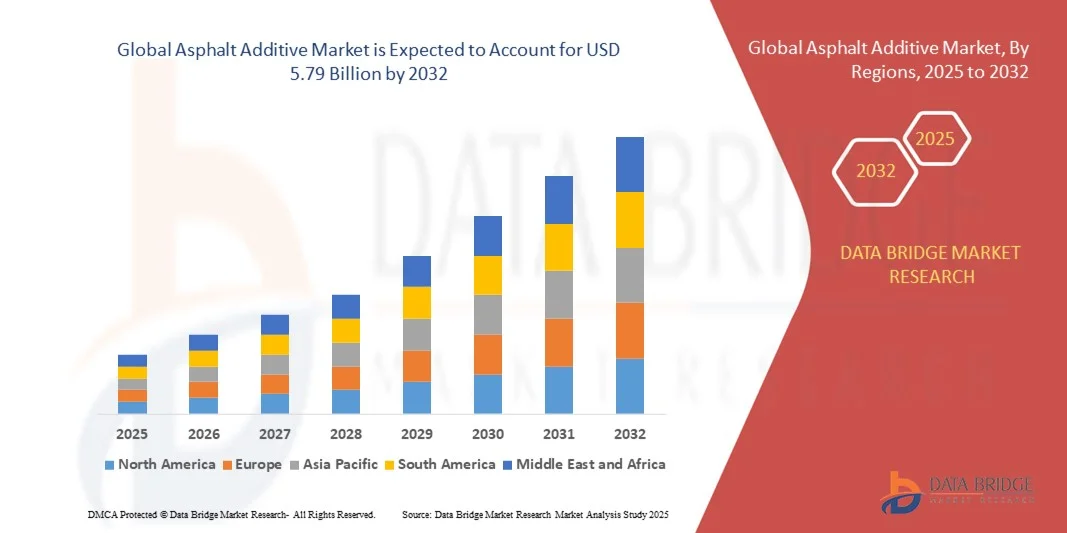
- The global asphalt additive market size was valued at USD 4.47 billion in 2024 and is expected to reach USD 5.79 billion by 2032, at a CAGR of 6.80% during the forecast period
- The market growth is largely fuelled by the increasing demand for durable and sustainable road infrastructure, growing urbanization, and rising investments in highway and road construction projects globally
- Growing emphasis on reducing road maintenance costs and improving pavement performance is driving the adoption of advanced asphalt additives
Asphalt Additive Market Analysis
- The rising demand for polymer-modified asphalt, warm mix additives, and other performance-enhancing products is shaping the market dynamics
- Technological advancements in asphalt formulations are enabling longer-lasting roads with better resistance to cracking, rutting, and temperature fluctuations
- North America dominated the asphalt additive market with the largest revenue share of 37.5% in 2024, driven by substantial infrastructure investments in highways, urban roads, and airport construction, as well as rising adoption of performance-enhancing and sustainable asphalt technologies
- Asia-Pacific region is expected to witness the highest growth rate in the global asphalt additive market, driven by expanding infrastructure projects in countries such as China, Japan, and Australia, coupled with rising urbanization and industrialization. The adoption of innovative asphalt technologies and favorable government policies promoting green and long-lasting pavements further accelerates regional market growth
- The polymeric modifiers segment held the largest market revenue share in 2024, driven by their ability to significantly enhance pavement performance, improve resistance to cracking and rutting, and extend the lifespan of roads. These additives are widely adopted in both highway and urban road projects due to their cost-effectiveness and long-term durability benefits
Report Scope and Asphalt Additive Market Segmentation
|
Attributes |
Asphalt Additive Key Market Insights |
|
Segments Covered |
|
|
Countries Covered |
North America
Europe
Asia-Pacific
Middle East and Africa
South America
|
|
Key Market Players |
|
|
Market Opportunities |
|
|
Value Added Data Infosets |
In addition to the insights on market scenarios such as market value, growth rate, segmentation, geographical coverage, and major players, the market reports curated by the Data Bridge Market Research also include import export analysis, production capacity overview, production consumption analysis, price trend analysis, climate change scenario, supply chain analysis, value chain analysis, raw material/consumables overview, vendor selection criteria, PESTLE Analysis, Porter Analysis, and regulatory framework. |
Asphalt Additive Market Trends
Increasing Adoption of Advanced Asphalt Additives for Road Durability
- The growing shift toward advanced asphalt additives, such as polymer-modified binders, warm mix additives, and crumb rubber modifiers, is transforming the road construction landscape by enhancing pavement performance and lifespan. These additives improve resistance to rutting, cracking, and thermal stresses, enabling long-lasting roads with reduced maintenance costs and lower life-cycle expenses
- Rising demand for sustainable and eco-friendly asphalt solutions is accelerating the adoption of additives that allow the use of recycled asphalt pavement (RAP) and reduce energy consumption during mixing. Such solutions are particularly effective in large-scale highway and urban road projects, where longevity, environmental compliance, and reduced carbon footprint are critical
- The cost-effectiveness and performance benefits of modern additives are making them attractive for both government and private infrastructure projects, leading to improved quality and durability of pavements, optimized project budgets, and minimized repair cycles
- For instance, in 2023, several state road authorities in the U.S. and Europe reported enhanced pavement life, reduced maintenance cycles, and improved traffic safety after implementing polymer-modified and warm mix asphalt technologies in highway and urban road projects
- While asphalt additives are improving road quality and sustainability, their impact depends on continuous innovation, regulatory support, and widespread adoption by contractors. Manufacturers must focus on localized product development, technical training, and after-sales support to fully capitalize on this growing demand
Asphalt Additive Market Dynamics
Driver
Rising Infrastructure Development and Government Initiatives
- Increasing investments in highways, urban roads, airport runways, and smart city projects are driving demand for performance-enhancing asphalt additives. Governments and private players are prioritizing durable pavements to reduce long-term maintenance costs, ensure safety, and support expanding transportation networks
- The adoption of polymer-modified, warm mix, and other specialty additives is growing as contractors seek improved road longevity, faster project completion, and reduced repair cycles. These additives also support higher efficiency in construction and maintenance operations, lowering operational expenses
- Public sector programs promoting sustainable construction, green infrastructure, and climate-resilient roads are further accelerating the use of advanced additives. Incentives, subsidies, and regulations encourage contractors to adopt eco-friendly asphalt technologies, thereby boosting demand and innovation
- For instance, in 2022, several European countries introduced incentives for using eco-friendly asphalt technologies in national highway projects, significantly boosting demand for recycled and polymer-modified asphalt additives while reducing environmental impact
- While infrastructure growth and policy support are driving market adoption, the industry still requires robust technical awareness, proper additive handling, and workforce training to ensure successful implementation and consistent performance
Restraint/Challenge
High Cost of Specialized Asphalt Additives and Limited Awareness in Emerging Markets
- The premium price of advanced asphalt additives, such as polymers and bio-based modifiers, makes them less accessible for small contractors, regional road projects, and cost-sensitive markets. This limits adoption in areas where conventional asphalt is still the norm, affecting overall market penetration
- Many emerging regions face challenges in accessing high-quality additives due to limited local production, high import costs, and lack of technical expertise. This can result in lower-quality pavements, higher maintenance requirements, and reduced road lifespan compared to projects using modern additive
- Supply chain constraints, including transportation delays, storage limitations, and inconsistent quality of additives, can affect timely project execution, disrupt planning, and increase project costs. Contractors in remote regions often struggle to maintain a consistent supply of specialized asphalt additives
- For instance, in 2023, several road construction projects in Southeast Asia experienced delays due to unavailability of polymer-modified asphalt additives, highlighting gaps in supply, logistical inefficiencies, and lack of technical knowledge
- While additive technologies continue to evolve, addressing cost, supply, and awareness challenges remains critical. Stakeholders must focus on affordable solutions, localized production, and training programs to unlock long-term market potential and ensure sustainable adoption globally
Asphalt Additive Market Scope
The market is segmented on the basis of type, applications, and technology.
- By Type
On the basis of type, the asphalt additive market is segmented into polymeric modifiers, anti-strip and adhesion promoters, emulsifiers, rejuvenators, chemical modifiers, fibres, flux oil, coloured asphalt, and others. The polymeric modifiers segment held the largest market revenue share in 2024, driven by their ability to significantly enhance pavement performance, improve resistance to cracking and rutting, and extend the lifespan of roads. These additives are widely adopted in both highway and urban road projects due to their cost-effectiveness and long-term durability benefits.
The anti-strip and adhesion promoters segment is expected to witness the fastest growth rate from 2025 to 2032, driven by increasing demand for improved asphalt-aggregate bonding, reduced moisture susceptibility, and enhanced road longevity. These additives are particularly popular for high-traffic areas and regions with extreme climatic conditions, where superior performance and durability are critical.
- By Applications
On the basis of applications, the asphalt additive market is segmented into road construction and paving, roofing, airport construction, and others. The road construction and paving segment dominated the market in 2024, fueled by large-scale infrastructure projects, government initiatives for highway modernization, and growing investments in urban and rural road networks.
The airport construction segment is expected to witness the fastest growth rate from 2025 to 2032, driven by increasing air traffic, expansion of existing airports, and stringent quality and safety requirements for runways, which demand high-performance asphalt with additives for enhanced durability and load-bearing capacity.
- By Technology
On the basis of technology, the asphalt additive market is segmented into hot mix, cold mix, and warm mix. The hot mix segment held the largest share in 2024, owing to its extensive use in highways and urban roads where high-strength, long-lasting pavement is required.
The warm mix segment is expected to witness the fastest growth rate from 2025 to 2032, driven by rising demand for energy-efficient, low-emission asphalt solutions that reduce mixing temperatures, lower fuel consumption, and support sustainable road construction practices.
Asphalt Additive Market Regional Analysis
- North America dominated the asphalt additive market with the largest revenue share of 37.5% in 2024, driven by substantial infrastructure investments in highways, urban roads, and airport construction, as well as rising adoption of performance-enhancing and sustainable asphalt technologies
- Contractors and road authorities in the region highly value the durability, cost-efficiency, and environmental benefits offered by polymer-modified, warm mix, and recycled asphalt additives
- This widespread adoption is further supported by government incentives, robust construction budgets, and advanced technical expertise, establishing North America as a leading market for high-performance asphalt solutions
U.S. Asphalt Additive Market Insight
The U.S. asphalt additive market captured the largest revenue share in North America in 2024, fueled by growing highway modernization projects, airport expansions, and urban infrastructure development. Contractors increasingly prioritize long-lasting pavements with reduced maintenance cycles, leveraging polymeric, warm mix, and anti-strip additives. In addition, the focus on eco-friendly construction practices and recycled asphalt usage is driving adoption across commercial and public road projects.
Europe Asphalt Additive Market Insight
The Europe asphalt additive market is expected to witness the fastest growth rate from 2025 to 2032, primarily driven by stringent quality and environmental regulations for roads and airports. Rapid urbanization and increasing investments in sustainable infrastructure are fostering the adoption of advanced asphalt additives. European contractors and municipalities are also attracted to the enhanced durability and performance offered by polymer-modified and rejuvenated asphalt, particularly in cold and wet climates.
U.K. Asphalt Additive Market Insight
The U.K. asphalt additive market is expected to witness the fastest growth rate from 2025 to 2032, driven by government initiatives for highway improvements, road safety programs, and the adoption of eco-friendly, energy-efficient asphalt technologies. In addition, growing urbanization, investment in airport runways, and modernization of commercial road networks are encouraging contractors to implement high-performance additives for improved longevity and reduced maintenance.
Germany Asphalt Additive Market Insight
The Germany asphalt additive market is expected to witness the fastest growth rate from 2025 to 2032, fueled by increasing awareness of sustainable road construction practices, strict quality standards, and government-backed infrastructure projects. Germany’s focus on durable, low-maintenance roads, combined with advanced research in polymer-modified and warm mix asphalt technologies, is promoting the adoption of specialized additives in both public and private projects.
Asia-Pacific Asphalt Additive Market Insight
The Asia-Pacific asphalt additive market is expected to witness the fastest growth rate from 2025 to 2032, driven by rapid urbanization, large-scale road construction, and rising industrialization in countries such as China, India, and Japan. Government infrastructure programs, smart city initiatives, and increasing awareness of long-lasting, sustainable pavement solutions are propelling market growth. Furthermore, APAC is emerging as a manufacturing hub for asphalt additives, improving accessibility and cost-effectiveness for regional contractors.
Japan Asphalt Additive Market Insight
The Japan asphalt additive market is expected to witness the fastest growth rate from 2025 to 2032 due to the country’s technologically advanced construction industry, aging infrastructure requiring renovation, and emphasis on durable, environmentally friendly roads. The integration of polymer-modified and warm mix asphalt technologies with existing infrastructure projects is enhancing pavement life and reducing maintenance cycles. In addition, Japan’s regulatory push for low-emission and energy-efficient road construction supports the growth of advanced asphalt additives.
China Asphalt Additive Market Insight
The China asphalt additive market accounted for the largest revenue share in Asia-Pacific in 2024, attributed to the country’s massive highway expansion, urbanization, and adoption of high-performance construction materials. Rising government investment in sustainable road technologies, increasing industrialization, and the emergence of domestic manufacturers producing cost-effective asphalt additives are key factors propelling market growth. The country’s focus on durable, low-maintenance roads for both urban and rural networks is further driving the adoption of specialized asphalt additives.
Asphalt Additive Market Share
The Asphalt Additive industry is primarily led by well-established companies, including:
- Nouryon (Netherlands)
- DuPont (U.S.)
- Arkema (France)
- Honeywell International Inc. (U.S.)
- Evonik Industries AG (Germany)
- Huntsman International LLC (U.S.)
- BASF SE (Germany)
- Clariant AG (Switzerland)
- KRATON CORPORATION (U.S.)
- Kao Corporation (Japan)
- Sasol LTD (South Africa)
- Ingevity (U.S.)
- Akzo Nobel N.V. (Netherlands)
- ArrMaz (U.S.)
- Berkshire Engineering (U.K.)
- Engineered Additives LLC (U.S.)
- Owens Corning (U.S.)
- Dow (U.S.)
- China Petrochemical Corporation (China)
- McAsphalt Industries Limited (Canada)
Latest Developments in Global Asphalt Additive Market
- In May 2023, Evonik, through a strategic partnership with specialty chemicals distributor Safic-Alcan, expanded its supply of advanced food additives to reach a broader consumer base in the nutraceuticals segment, enhancing market presence and accessibility. This initiative is expected to strengthen Evonik’s positioning in functional food and dietary supplement markets, driving growth across Europe and beyond
- In April 2023, Evonik launched two new wetting agents, TEGO Wet 290 and TEGO Wet 296, expanding its TEGO Wet family of coating additives. These agents can be applied across multiple substrates including wood, plastic, and metal, improving coating performance, adhesion, and versatility. The development supports increased adoption in industrial coatings and specialty applications, enhancing Evonik’s competitive portfolio
- In May 2023, Arkema announced the acquisition of Polytec PT, aimed at expanding Bostik’s product capabilities within the Arkema group to serve the rapidly growing battery and electronics sectors. This acquisition strengthens Arkema’s footprint in high-demand technology markets, enabling broader product offerings and faster market penetration in adhesive and specialty solutions
- In March 2023, Kraton Corporation initiated a significant expansion of its production capacity for styrene-butadiene-styrene (SBS) block copolymers at the Belpre, Ohio facility, targeting full operational growth by 2024. By 2025, the facility is expected to increase output by 24 kilotons per year, meeting rising global demand in adhesives, coatings, and asphalt modification markets, and supporting long-term growth strategies

- Interactive Data Analysis Dashboard
- Company Analysis Dashboard for high growth potential opportunities
- Research Analyst Access for customization & queries
- Competitor Analysis with Interactive dashboard
- Latest News, Updates & Trend analysis
- Harness the Power of Benchmark Analysis for Comprehensive Competitor Tracking
Global Asphalt Additive Market, Supply Chain Analysis and Ecosystem Framework
To support market growth and help clients navigate the impact of geopolitical shifts, DBMR has integrated in-depth supply chain analysis into its Global Asphalt Additive Market research reports. This addition empowers clients to respond effectively to global changes affecting their industries. The supply chain analysis section includes detailed insights such as Global Asphalt Additive Market consumption and production by country, price trend analysis, the impact of tariffs and geopolitical developments, and import and export trends by country and HSN code. It also highlights major suppliers with data on production capacity and company profiles, as well as key importers and exporters. In addition to research, DBMR offers specialized supply chain consulting services backed by over a decade of experience, providing solutions like supplier discovery, supplier risk assessment, price trend analysis, impact evaluation of inflation and trade route changes, and comprehensive market trend analysis.
Data collection and base year analysis are done using data collection modules with large sample sizes. The stage includes obtaining market information or related data through various sources and strategies. It includes examining and planning all the data acquired from the past in advance. It likewise envelops the examination of information inconsistencies seen across different information sources. The market data is analysed and estimated using market statistical and coherent models. Also, market share analysis and key trend analysis are the major success factors in the market report. To know more, please request an analyst call or drop down your inquiry.
The key research methodology used by DBMR research team is data triangulation which involves data mining, analysis of the impact of data variables on the market and primary (industry expert) validation. Data models include Vendor Positioning Grid, Market Time Line Analysis, Market Overview and Guide, Company Positioning Grid, Patent Analysis, Pricing Analysis, Company Market Share Analysis, Standards of Measurement, Global versus Regional and Vendor Share Analysis. To know more about the research methodology, drop in an inquiry to speak to our industry experts.
Data Bridge Market Research is a leader in advanced formative research. We take pride in servicing our existing and new customers with data and analysis that match and suits their goal. The report can be customized to include price trend analysis of target brands understanding the market for additional countries (ask for the list of countries), clinical trial results data, literature review, refurbished market and product base analysis. Market analysis of target competitors can be analyzed from technology-based analysis to market portfolio strategies. We can add as many competitors that you require data about in the format and data style you are looking for. Our team of analysts can also provide you data in crude raw excel files pivot tables (Fact book) or can assist you in creating presentations from the data sets available in the report.













