


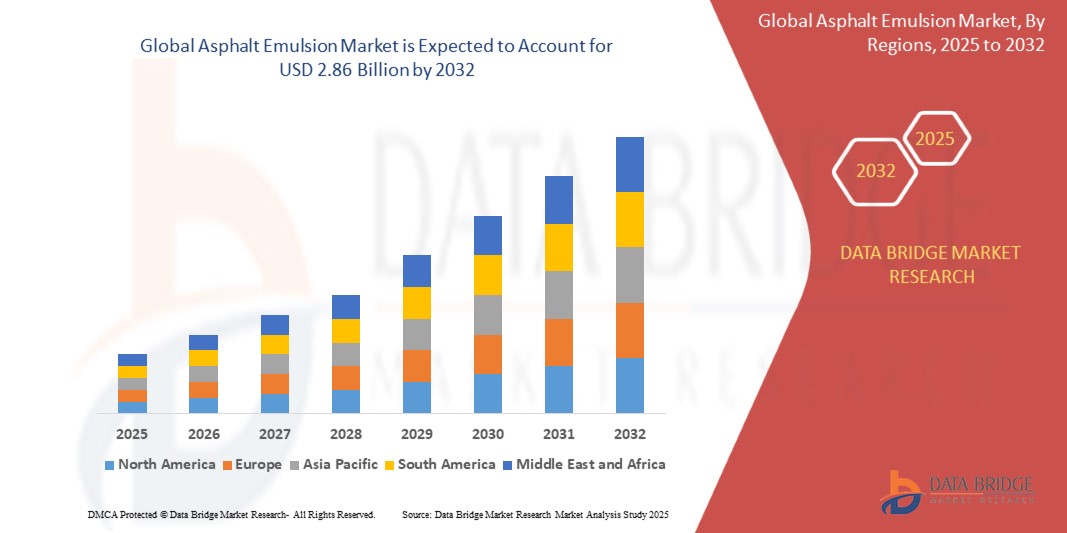
Asphalt Emulsion Market Size
- The global asphalt emulsion market size was valued at USD 1.77 billion in 2024 and is expected to reach USD 2.86 billion by 2032, at a CAGR of 6.2% during the forecast period
- The market growth is largely fueled by increasing infrastructure investments and the rising preference for sustainable, cold-mix road construction solutions that reduce energy consumption and emissions compared to traditional hot-mix methods
- Furthermore, the growing demand for cost-effective, fast-curing, and environmentally friendly materials in road maintenance and resurfacing projects is accelerating the adoption of asphalt emulsions, thereby significantly boosting the industry's growth
Asphalt Emulsion Market Analysis
- Asphalt emulsions are water-based binders formed by dispersing asphalt in water with the help of emulsifying agents, used primarily in road construction, maintenance, and roofing applications. They offer advantages such as reduced application temperatures, lower VOC emissions, and compatibility with various aggregates
- The increasing demand for asphalt emulsions is driven by government initiatives promoting green construction, growing road rehabilitation activities in urban and rural regions, and the global push toward environmentally sustainable infrastructure solutions
- Asia-Pacific dominated the asphalt emulsion market with a share of 39.31% in 2024, due to rapid infrastructure development, growing urbanization, and rising investments in sustainable road construction across emerging economies
- North America is expected to be the fastest growing region in the asphalt emulsion market during the forecast period due to increasing road rehabilitation efforts, growing preference for energy-efficient construction materials, and expanding infrastructure budgets
- SBS modified asphalt emulsion segment dominated the market with a market share of 39.1% in 2024, due to its superior elasticity, durability, and resistance to deformation under extreme temperatures. Widely used in high-traffic roadways and airport pavements, SBS-modified emulsions enhance the performance and longevity of asphalt layers, making them a preferred choice for large-scale infrastructure projects. Their compatibility with a variety of aggregates and ability to reduce rutting and cracking further drive their widespread adoption in advanced road engineering
Report Scope and Asphalt Emulsion Market Segmentation
|
Attributes |
Asphalt Emulsion Key Market Insights |
|
Segments Covered |
|
|
Countries Covered |
North America
Europe
Asia-Pacific
Middle East and Africa
South America
|
|
Key Market Players |
|
|
Market Opportunities |
|
|
Value Added Data Infosets |
In addition to the insights on market scenarios such as market value, growth rate, segmentation, geographical coverage, and major players, the market reports curated by the Data Bridge Market Research also include import export analysis, production capacity overview, production consumption analysis, price trend analysis, climate change scenario, supply chain analysis, value chain analysis, raw material/consumables overview, vendor selection criteria, PESTLE Analysis, Porter Analysis, and regulatory framework. |
Asphalt Emulsion Market Trends
Increasing Use of Low-Emission Materials
- The asphalt emulsion market is witnessing a surge in demand as sustainability initiatives encourage the use of low-emission, water-based, and environmentally friendly materials in road construction and maintenance
- For instance, companies such as Colas Group and AkzoNobel are developing and supplying eco-friendly asphalt emulsions with lower volatile organic compound (VOC) emissions, helping municipalities meet stricter environmental regulations and green building standards
- Government agencies and industry bodies are promoting cold-application and warm-mix asphalt emulsions, which reduce energy consumption and emissions during paving and maintenance compared to conventional hot-mix asphalt
- Innovation in bio-based additives and recycled materials is further reducing the carbon footprint of asphalt emulsions, appealing to both public and private sector infrastructure projects targeting climate goals
- Increased adoption of chip sealing, micro surfacing, and fog sealing technologies—enabled by advanced emulsion formulations—is driving demand for products that provide durable surfaces with minimal environmental impact
- Growing awareness of worker health and safety concerns is accelerating the market shift towards emulsions with reduced hazardous emissions, fostering adoption in urban and populated environments
Asphalt Emulsion Market Dynamics
Driver
Infrastructure Development and Urbanization
- The global focus on infrastructure development and the expansion of urban areas directly drive growth in the asphalt emulsion market, as reliable, low-maintenance paving materials are needed for new and rehabilitated roadways
- For instance, major infrastructure investments in regions such as Asia Pacific and North America—supported by public works programs and large-scale transportation projects—are boosting demand for high-performance asphalt emulsions supplied by companies such as Dow Chemical and Ergon Asphalt & Emulsions
- Urbanization leads to higher traffic volumes and the need for rapid, non-disruptive road repair solutions, making asphalt emulsions a preferred choice for maintenance and rehabilitation
- The flexibility of asphalt emulsion applications—usable in rural, peri-urban, and densely populated city environments—supports year-round roadwork and maintenance, increasing overall market consumption
- Emulsion-based techniques help reduce project timelines and enable quicker reopening of roadways, which is critical in busy urban settings with minimal tolerance for long closures
Restraint/Challenge
Fluctuating Raw Material Prices
- Volatility in the prices of bitumen, solvents, and specialty additives—key ingredients in asphalt emulsions—poses an ongoing challenge for manufacturers and end-users by impacting production costs and profit margins
- For instance, when crude oil prices rise or supply is disrupted, companies such as Shell Bitumen and BASF face higher input costs, which can result in fluctuating prices for asphalt emulsions offered to contractors and government agencies
- Market instability can deter long-term procurement contracts and force contractors to reassess budgets, especially for public infrastructure projects operating on fixed funding
- Rapid price swings may hinder the ability of smaller manufacturers to compete with established players, leading to increased market consolidation and reduced product diversity
- End-users may be reluctant to specify advanced or customized emulsion products when faced with unpredictability in pricing, potentially slowing adoption of sustainable or high-performance solutions
Asphalt Emulsion Market Scope
The market is segmented on the basis of product type and end user.
• By Product Type
On the basis of product type, the asphalt emulsion market is segmented into SBS modified asphalt emulsion, SBR modified asphalt emulsion, chloroprene rubber modified asphalt emulsion, natural rubber modified asphalt emulsion, and others. The SBS (styrene-butadiene-styrene) modified asphalt emulsion segment dominated the largest market revenue share of 39.1% in 2024, owing to its superior elasticity, durability, and resistance to deformation under extreme temperatures. Widely used in high-traffic roadways and airport pavements, SBS-modified emulsions enhance the performance and longevity of asphalt layers, making them a preferred choice for large-scale infrastructure projects. Their compatibility with a variety of aggregates and ability to reduce rutting and cracking further drive their widespread adoption in advanced road engineering.
The chloroprene rubber modified asphalt emulsion segment is anticipated to witness the fastest growth rate from 2025 to 2032, propelled by its excellent adhesion properties and resistance to oil, heat, and aging. This product type is increasingly favored in specialized applications such as waterproofing and industrial coatings. The growth is also supported by rising demand for high-performance sealing materials in both construction and automotive sectors, where chloroprene-modified emulsions deliver enhanced flexibility and durability under harsh conditions.
• By End User
On the basis of end user, the asphalt emulsion market is segmented into road construction and paving, roofing, and others. The road construction and paving segment held the largest market revenue share in 2024, driven by extensive government investments in highway and rural road development projects across emerging and developed economies. Asphalt emulsions are valued in this segment for their eco-friendly, cost-effective application methods and ability to reduce energy consumption during road resurfacing and maintenance. Their rapid curing properties and reduced emission footprint make them ideal for sustainable road construction practices.
The roofing segment is expected to witness the fastest CAGR from 2025 to 2032, spurred by growing demand for durable and waterproof roofing solutions in both residential and commercial buildings. Asphalt emulsions offer exceptional weather resistance and compatibility with various roofing substrates, which increases their adoption in modern building systems. In addition, their role in extending the life span of roof membranes while maintaining energy efficiency supports their expanding use in green building projects.
Asphalt Emulsion Market Regional Analysis
- Asia-Pacific dominated the asphalt emulsion market with the largest revenue share of 39.31% in 2024, driven by rapid infrastructure development, growing urbanization, and rising investments in sustainable road construction across emerging economies
- The region’s expanding transportation networks, increasing government focus on rural connectivity, and preference for cold mix applications are significantly contributing to market growth
- In addition, the availability of cost-efficient raw materials, large-scale public infrastructure initiatives, and the presence of key domestic manufacturers are accelerating regional adoption of asphalt emulsions
China Asphalt Emulsion Market Insight
China held the largest share in the Asia-Pacific asphalt emulsion market in 2024, supported by extensive highway expansion, robust government spending on infrastructure, and growing focus on environmentally friendly construction methods. The integration of emulsions into large-scale public projects and advancements in localized production are reinforcing market dominance.
India Asphalt Emulsion Market Insight
The India market is growing rapidly, driven by major national programs such as Bharatmala and PMGSY, which emphasize rural road development and highway modernization. The use of cold application methods in remote regions, combined with the need for cost-effective surfacing, is boosting the demand for asphalt emulsions.
Europe Asphalt Emulsion Market Insight
The Europe asphalt emulsion market is projected to grow at a moderate CAGR over the forecast period, fueled by stringent environmental regulations, growing emphasis on recycling technologies, and increased road maintenance activities. The adoption of emulsions in preventive maintenance, surface dressing, and micro-surfacing is supporting wider market uptake, especially in Western Europe.
U.K. Asphalt Emulsion Market Insight
The U.K. market is witnessing steady growth, driven by investment in road renewal, local authority maintenance programs, and a shift toward sustainable construction practices. Demand is reinforced by the use of fast-curing emulsions in urban roadworks and the integration of eco-friendly binders in public sector procurement.
Germany Asphalt Emulsion Market Insight
Germany’s asphalt emulsion market is expanding steadily, supported by the country’s advanced road maintenance systems and environmental compliance policies. High product quality standards, focus on cold recycling, and continued investment in transport infrastructure are fostering consistent demand for modified emulsions.
North America Asphalt Emulsion Market Insight
North America is projected to grow at the fastest CAGR from 2025 to 2032, driven by increasing road rehabilitation efforts, growing preference for energy-efficient construction materials, and expanding infrastructure budgets. High adoption of chip sealing, fog sealing, and cold in-place recycling is catalyzing the use of emulsified asphalt across state and local projects.
U.S. Asphalt Emulsion Market Insight
The U.S. captured the largest revenue share in the North American asphalt emulsion market in 2024, due to ongoing federal and state-level funding for infrastructure modernization, focus on cost-effective pavement preservation, and rising adoption of sustainable road surfacing methods. The presence of key emulsion producers and technological innovation in formulation are further advancing market growth.
Asphalt Emulsion Market Share
The asphalt emulsion industry is primarily led by well-established companies, including:
- BASF SE (Germany)
- Dupont (U.S.)
- SOLVAY (Belgium)
- 3M (U.S.)
- Honeywell International Inc. (U.S.)
- Corporate.Evonik (Germany)
- Huntsman International LLC (U.S.)
- GCP Applied Technologies Inc. (U.S.)
- RPM International (U.S.)
- Fosroc Inc., (U.K.)
- Dow (U.S.)
- Saint-Gobain (France)
- Arkem S.A. (France)
- Ashland Inc (U.S.), Mapei S.p.A (Italy),
- MUHU (China)
- Construction Materials Co., Ltd., (China)
- Holcim (Switzerland)
- Nouryon (Netherlands)
- KRATON CORPORATION. (U.S.)
- Ingevity (U.S.)
Latest Developments in Global Asphalt Emulsion Market
- In May 2025, Alltech Industries India Pvt. Ltd., a prominent player in asphalt road construction machinery, announced the successful launch of its first Bitumen Emulsion Plant in Assam. This milestone marks a pivotal step in the company’s expansion strategy, enhancing its footprint in the rapidly developing Northeastern region of India. The new facility is poised to strengthen the regional supply chain, reduce dependence on distant manufacturing hubs, and ensure timely availability of emulsified bitumen for local infrastructure projects. It also reflects the company’s commitment to sustainable construction by promoting the use of cold-mix technologies. As India continues to invest heavily in rural and highway connectivity programs, Alltech’s move positions it as a critical enabler in the country’s green and cost-effective road-building efforts
- In April 2024, BASF deepened its commitment to sustainable infrastructure with the launch of EcoBind, an eco-friendly emulsifier designed to meet rising global demand for green construction materials. Alongside this product launch, the company expanded its production facilities, signaling a strong investment in capacity building to serve environmentally conscious markets. As governments globally enforce stricter emission and sustainability standards, EcoBind enables road construction firms to reduce carbon footprints while maintaining high-performance outputs. BASF’s dual focus on innovation and capacity underscores its strategic positioning as a key supplier in the transition toward low-impact, regulatory-compliant infrastructure development
- In February 2024, Western Colloid, a leading name in the fluid-applied roofing sector, unveiled 298 X Asphalt Emulsion, tailored to address the challenges of gravel roof restoration and areas susceptible to ponding water. The inclusion of a fire-resistant filler improves safety and also boosts the volume solids content, enhancing the emulsion’s ability to level uneven surfaces. This advancement significantly elevates the product's utility as a high-performance fill coat, aligning with growing demand for durable, weather-resistant, and energy-efficient roofing systems. The launch fortifies Western Colloid’s position in the commercial roofing market by offering contractors a solution that merges safety, efficiency, and environmental responsibility
- In June 2022, BASF introduced B2Last, an innovative bitumen additive developed in collaboration with the Institute of Highway Engineering in Aachen. With a name derived from “bitumen to last,” the product is engineered to improve the structural integrity and lifespan of asphalt pavements. B2Last addresses a critical industry need for cost-effective maintenance solutions by reducing cracking and deformation over time. This innovation has broadened BASF’s product portfolio in the road construction chemicals segment, reinforcing its market leadership in high-performance asphalt modification and providing a competitive edge amid rising demand for durable and resilient infrastructure

- Interactive Data Analysis Dashboard
- Company Analysis Dashboard for high growth potential opportunities
- Research Analyst Access for customization & queries
- Competitor Analysis with Interactive dashboard
- Latest News, Updates & Trend analysis
- Harness the Power of Benchmark Analysis for Comprehensive Competitor Tracking
Global Asphalt Emulsion Market, Supply Chain Analysis and Ecosystem Framework
To support market growth and help clients navigate the impact of geopolitical shifts, DBMR has integrated in-depth supply chain analysis into its Global Asphalt Emulsion Market research reports. This addition empowers clients to respond effectively to global changes affecting their industries. The supply chain analysis section includes detailed insights such as Global Asphalt Emulsion Market consumption and production by country, price trend analysis, the impact of tariffs and geopolitical developments, and import and export trends by country and HSN code. It also highlights major suppliers with data on production capacity and company profiles, as well as key importers and exporters. In addition to research, DBMR offers specialized supply chain consulting services backed by over a decade of experience, providing solutions like supplier discovery, supplier risk assessment, price trend analysis, impact evaluation of inflation and trade route changes, and comprehensive market trend analysis.
Data collection and base year analysis are done using data collection modules with large sample sizes. The stage includes obtaining market information or related data through various sources and strategies. It includes examining and planning all the data acquired from the past in advance. It likewise envelops the examination of information inconsistencies seen across different information sources. The market data is analysed and estimated using market statistical and coherent models. Also, market share analysis and key trend analysis are the major success factors in the market report. To know more, please request an analyst call or drop down your inquiry.
The key research methodology used by DBMR research team is data triangulation which involves data mining, analysis of the impact of data variables on the market and primary (industry expert) validation. Data models include Vendor Positioning Grid, Market Time Line Analysis, Market Overview and Guide, Company Positioning Grid, Patent Analysis, Pricing Analysis, Company Market Share Analysis, Standards of Measurement, Global versus Regional and Vendor Share Analysis. To know more about the research methodology, drop in an inquiry to speak to our industry experts.
Data Bridge Market Research is a leader in advanced formative research. We take pride in servicing our existing and new customers with data and analysis that match and suits their goal. The report can be customized to include price trend analysis of target brands understanding the market for additional countries (ask for the list of countries), clinical trial results data, literature review, refurbished market and product base analysis. Market analysis of target competitors can be analyzed from technology-based analysis to market portfolio strategies. We can add as many competitors that you require data about in the format and data style you are looking for. Our team of analysts can also provide you data in crude raw excel files pivot tables (Fact book) or can assist you in creating presentations from the data sets available in the report.













