


What is the Asset Performance Management Market Size and Overview?
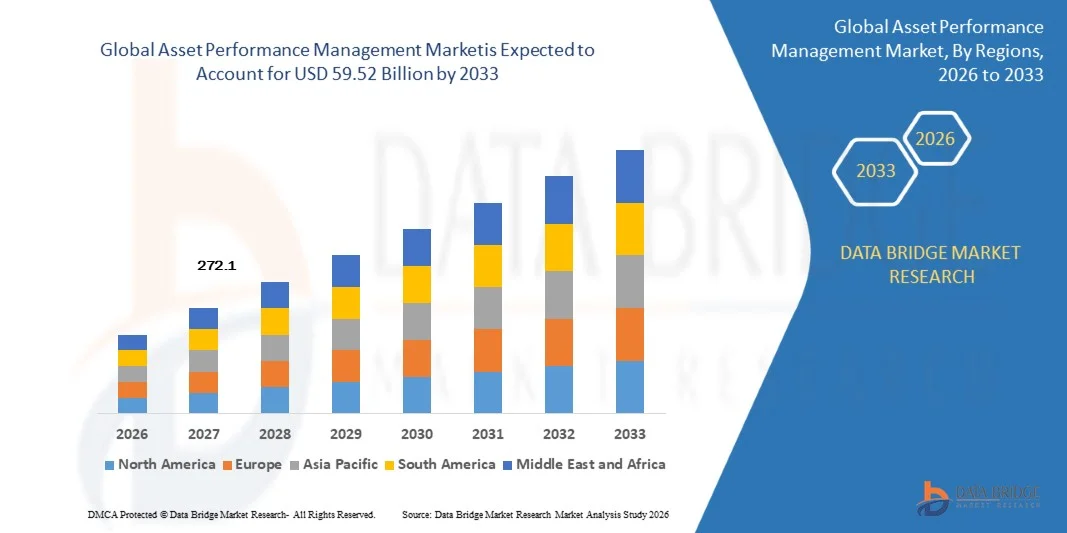
As per Data Bridge Market Research Analysis the asset performance management market was valued at USD 22.75 billion in 2025 and is expected to reach USD 59.52 billion by 2033, growing at a CAGR of 12.80% during the forecast period of 2026 to 2033. The market is witnessing robust growth owing to the increasing adoption of Industrial Internet of Things (IIoT), artificial intelligence (AI), machine learning (ML), digital twins, predictive analytics, and cloud computing technologies across asset-intensive industries. Organizations are increasingly prioritizing predictive and condition-based maintenance strategies to maximize equipment availability, reduce unplanned downtime, optimize operational expenditure, and improve asset reliability throughout the asset lifecycle.
Asset Performance Management (APM) solutions integrate real-time operational data, advanced analytics, reliability engineering, and enterprise asset management capabilities to monitor asset health, predict equipment failures, and optimize maintenance planning. Modern APM platforms leverage connected sensors, industrial automation systems, edge computing, and cloud-based analytics to deliver actionable insights that enable organizations to shift from reactive maintenance toward predictive and prescriptive maintenance models. This digital transformation is helping enterprises improve production efficiency, extend equipment lifespan, enhance worker safety, and reduce maintenance costs across manufacturing facilities, power plants, refineries, mining operations, transportation infrastructure, and utilities.
Growing investments in Industry 4.0 initiatives, smart manufacturing, industrial digitalization, and intelligent infrastructure are further accelerating market expansion. Governments and industrial enterprises worldwide are promoting digital transformation programs aimed at improving productivity, sustainability, and energy efficiency. Simultaneously, increasing complexity of industrial assets, aging infrastructure, stricter regulatory compliance, and growing emphasis on operational resilience are encouraging organizations to deploy AI-powered asset monitoring, digital twin simulations, and predictive maintenance platforms. Continuous technological innovations including generative AI, autonomous inspection technologies, computer vision, remote asset monitoring, and cloud-native APM platforms are expected to create significant growth opportunities for the asset performance management market throughout the forecast period.
Market Size & Forecast
- Market Value (2025): USD 22.75 Billion
- Expected Market Value (2033): USD 59.52 Billion
- Forecast CAGR (2026–2033): 12.80%
- Leading Region in 2025: North America
- Fastest Growing Region: Asia-Pacific
Key Market Trends & Insights
- North America dominated the asset performance management market with the largest revenue share of 38.84% in 2025, supported by widespread adoption of Industry 4.0 technologies, significant investments in industrial automation, strong presence of leading software providers, mature cloud infrastructure, and increasing deployment of AI-driven predictive maintenance solutions across manufacturing, utilities, and energy sectors.
- The solutions segment accounted for the largest market share of 67.20% in 2026, driven by growing enterprise demand for predictive maintenance software, reliability management platforms, digital twin solutions, asset health monitoring, industrial analytics, and AI-enabled maintenance optimization systems.
- Asia-Pacific is projected to register the fastest growth at a CAGR of 14.10% during 2026–2033, fueled by rapid industrialization, increasing investments in smart factories, expanding manufacturing activities across China and India, rising adoption of industrial IoT, and government-led digital transformation initiatives supporting industrial modernization.
- Cloud deployment is anticipated to witness the fastest growth with a CAGR of 14.60%, owing to increasing enterprise preference for scalable, subscription-based asset management platforms that provide real-time monitoring, remote accessibility, lower implementation costs, and seamless integration with AI, IoT, and enterprise resource planning systems.
- Manufacturing emerged as the largest end-user segment with a market share of 27.60% in 2026, supported by increasing investments in predictive maintenance, production optimization, digital factory initiatives, robotics, and intelligent manufacturing operations.
- Predictive Asset Maintenance dominated the application segment with a market share of 31.50%, owing to increasing utilization of AI, machine learning, vibration analysis, thermal monitoring, and advanced sensor technologies to detect equipment anomalies before failure occurs.
Report Scope and Asset Performance Management Market Segmentation
|
Attributes |
Asset Performance Management Key Market Insights |
|
Segments Covered |
|
|
Countries Covered |
North America
Europe
Asia-Pacific
Middle East and Africa
South America
|
|
Key Market Players |
|
|
Market Opportunities |
|
|
Value Added Data Infosets |
|
What is the Key Trend in the Asset Performance Management Market?
Trend: Rising Adoption of AI-Powered Predictive Maintenance and Digital Twin Technologies
The Asset Performance Management (APM) market is witnessing a significant shift toward AI-powered predictive maintenance and digital twin technologies as industries focus on improving asset reliability, reducing downtime, and optimizing maintenance costs. Unlike traditional preventive maintenance approaches based on fixed schedules, AI-enabled APM platforms leverage Industrial Internet of Things (IIoT) sensors, machine learning, advanced analytics, and cloud computing to monitor equipment conditions in real time and predict potential failures before they occur.
Digital twin technology is further enhancing asset management by creating virtual models of physical assets that continuously analyze operational data, simulate performance scenarios, and optimize maintenance strategies without interrupting production activities. Industries such as manufacturing, energy, utilities, oil & gas, transportation, and mining are increasingly adopting these technologies to improve asset availability, extend equipment lifespan, enhance operational efficiency, and support sustainability objectives.
For Instance,
- In June 2026, IBM Corporation expanded the capabilities of its Maximo Application Suite by integrating advanced generative AI technologies to automate maintenance planning, improve asset diagnostics, and enhance predictive maintenance workflows across industrial enterprises.
These advancements highlight the growing importance of AI-driven asset intelligence in enabling organizations to transition from reactive maintenance approaches toward predictive and data-driven asset management strategies.
Asset Performance Management Market Dynamics
Key Market Driver: Increasing Industrial Digitalization and Adoption of Industry 4.0 Technologies
Rapid industrial digitalization and the growing adoption of Industry 4.0 technologies are major factors driving the growth of the Asset Performance Management market. Manufacturing companies, utilities, transportation operators, mining companies, and energy providers are increasingly investing in IIoT, artificial intelligence, robotics, cloud computing, automation, and advanced analytics to improve asset utilization and operational efficiency.
APM solutions enable organizations to integrate operational technology (OT) with information technology (IT), allowing real-time monitoring of asset health, predictive failure analysis, and optimized maintenance planning. Increasing focus on reducing operational costs, improving safety, addressing aging infrastructure, and achieving sustainability goals is further accelerating the deployment of intelligent asset management platforms.
For Instance,
- In October 2021, ABB expanded its digital asset performance portfolio by enhancing AI-powered predictive maintenance capabilities within the ABB Ability™ Genix Asset Performance Management Suite, enabling industries to improve equipment reliability and optimize maintenance planning through real-time operational insights.
- In November 2025, Schneider Electric introduced AI-enabled predictive maintenance capabilities within its EcoStruxure platform, helping industrial customers monitor critical assets, improve maintenance efficiency, and strengthen operational resilience.
These developments demonstrate how Industry 4.0 adoption and intelligent automation are accelerating the demand for APM solutions across asset-intensive industries.
Key Restraint/Challenge: High Implementation Costs and Complex Integration with Legacy Systems
Despite the operational benefits of Asset Performance Management solutions, high deployment costs and integration challenges remain key barriers to market growth. Implementing enterprise-level APM platforms requires significant investments in IIoT sensors, cloud infrastructure, cybersecurity solutions, software integration, employee training, and system upgrades.
Many industries continue to operate legacy systems, including programmable logic controllers (PLCs), supervisory control and data acquisition (SCADA) systems, and distributed control systems (DCS), which often lack compatibility with modern AI-driven platforms. Integrating these systems requires extensive customization, data standardization, interoperability testing, and specialized technical expertise.
Additionally, concerns related to cybersecurity, data quality, workforce skill gaps, and regulatory compliance create further challenges for organizations adopting advanced asset management solutions, particularly small and medium-sized enterprises.
Key Market Opportunity: Expansion of Cloud-Based Asset Performance Management Platforms
The increasing adoption of cloud-based Asset Performance Management platforms represents a significant growth opportunity for market players. Cloud-native APM solutions provide organizations with centralized asset monitoring, remote accessibility, predictive analytics, automated reporting, and scalable deployment capabilities across multiple locations.
These platforms enable seamless integration with IIoT devices, enterprise resource planning (ERP) systems, computerized maintenance management systems (CMMS), digital twins, and AI analytics platforms. Organizations are increasingly leveraging cloud-based APM solutions to optimize maintenance schedules, improve spare parts management, enhance workforce productivity, and achieve better operational decision-making.
The rising adoption of hybrid cloud architectures, edge computing, 5G connectivity, and industrial AI is further supporting the transition toward scalable and cost-effective asset management platforms across manufacturing, energy, utilities, and infrastructure sectors.
For Instance,
- In May 2026, AVEVA Group plc expanded its CONNECT industrial intelligence platform by introducing enhanced cloud-native Asset Performance Management capabilities integrated with AI-driven analytics, enabling organizations to improve asset reliability, operational visibility, and predictive maintenance strategies.
These advancements indicate that cloud-based APM platforms are becoming a critical component of industrial digital transformation, offering organizations greater scalability, flexibility, and real-time asset intelligence.
How is the Asset Performance Management Market Segmented?
The asset performance management market is segmented on the basis of component, deployment mode, enterprise size, application, and end user.
By Component
On the basis of component, the market is segmented into solutions and services. In 2026, the solutions segment is expected to dominate the market with a market share of 67.20%, owing to the growing enterprise demand for predictive maintenance software, asset health monitoring platforms, reliability-centered maintenance (RCM) applications, digital twin solutions, AI-powered analytics, and centralized asset lifecycle management systems. Organizations across manufacturing, utilities, oil & gas, and transportation sectors are increasingly investing in integrated software platforms that enable continuous monitoring of asset conditions, optimize maintenance planning, reduce operational downtime, and improve overall equipment effectiveness (OEE). Furthermore, increasing adoption of Industrial Internet of Things (IIoT), cloud computing, and advanced analytics is accelerating deployment of intelligent asset performance solutions capable of delivering real-time operational insights.
The services segment is projected to witness the fastest CAGR of 13.70% during 2026–2033, driven by increasing enterprise demand for consulting, implementation, integration, managed services, cloud migration, employee training, and continuous technical support. As organizations expand enterprise-wide digital transformation initiatives, they require specialized expertise to integrate Asset Performance Management (APM) solutions with enterprise asset management (EAM), computerized maintenance management systems (CMMS), enterprise resource planning (ERP), supervisory control and data acquisition (SCADA), and industrial automation systems. Growing complexity of AI-enabled industrial platforms and increasing focus on long-term optimization services continue to support rapid growth of this segment.
By Deployment Mode
On the basis of deployment mode, the market is segmented into cloud and on-premises. In 2026, the cloud segment is expected to dominate the market with a market share of 59.90%, supported by increasing enterprise preference for scalable, subscription-based software platforms offering centralized asset visibility, lower implementation costs, automatic software updates, remote monitoring, and seamless integration with AI, Industrial IoT, and digital twin technologies. Cloud deployment enables organizations operating multiple facilities to access real-time operational intelligence while minimizing IT infrastructure investments and accelerating deployment timelines.
The cloud segment is also expected to register the fastest CAGR of 14.60% throughout the forecast period, owing to increasing investments in industrial cloud platforms, edge computing, hybrid cloud environments, and Software-as-a-Service (SaaS)-based asset management solutions. Growing demand for remote asset monitoring, predictive analytics, and enterprise-wide collaboration continues to strengthen cloud adoption across industrial enterprises.
By Enterprise Size
On the basis of enterprise size, the market is segmented into large enterprises and small & medium enterprises (SMEs). In 2026, the large enterprises segment is anticipated to dominate the market with a market share of 69.80%, owing to higher capital investments in industrial digitalization, extensive deployment of smart manufacturing technologies, and greater adoption of enterprise-scale predictive maintenance platforms. Large organizations typically manage geographically dispersed production facilities and highly complex industrial assets that require continuous monitoring, reliability optimization, and integrated maintenance planning. Increasing investments in AI, machine learning, industrial analytics, and digital twins are further strengthening adoption among multinational enterprises.
The small & medium enterprises (SMEs) segment is expected to witness the fastest CAGR of 13.90% during the forecast period, supported by the increasing availability of affordable cloud-based APM platforms, subscription-based pricing models, simplified implementation processes, and government initiatives promoting digital transformation among small industrial businesses. Growing awareness regarding predictive maintenance benefits and declining cloud infrastructure costs are encouraging SMEs to modernize asset management practices.
By Application
On the basis of application, the market is segmented into predictive asset maintenance, asset reliability management, condition monitoring, work order management, asset lifecycle management, and others. In 2026, the predictive asset maintenance segment is expected to dominate the market with a market share of 31.50%, owing to increasing adoption of artificial intelligence, machine learning, vibration analysis, thermal imaging, acoustic monitoring, and advanced sensor technologies that enable early identification of equipment failures. Organizations are increasingly shifting from preventive maintenance toward predictive maintenance strategies to reduce unplanned downtime, optimize maintenance scheduling, improve equipment reliability, and lower maintenance expenditure. The growing deployment of Industrial Internet of Things devices across industrial operations continues to accelerate predictive maintenance adoption.
The asset lifecycle management segment is projected to register the fastest CAGR of 13.80% during 2026–2033, driven by increasing enterprise focus on maximizing asset value throughout procurement, commissioning, operation, maintenance, refurbishment, and retirement stages. Organizations are adopting lifecycle management solutions to optimize capital investments, improve regulatory compliance, enhance sustainability performance, and extend the operational lifespan of critical industrial infrastructure.
By End User
On the basis of end user, the market is segmented into manufacturing, energy & utilities, oil & gas, mining & metals, transportation & logistics, chemicals, and others. In 2026, the manufacturing segment is expected to dominate the market with a market share of 27.60%, owing to rapid adoption of Industry 4.0 technologies, industrial automation, robotics, smart factories, and AI-driven production optimization. Manufacturers increasingly rely on Asset Performance Management platforms to improve production efficiency, reduce machine failures, optimize maintenance schedules, increase Overall Equipment Effectiveness (OEE), and minimize operational disruptions. Growing investments in digital manufacturing and connected factory initiatives continue to strengthen market demand.
The energy & utilities segment is expected to witness the fastest CAGR of 13.90% during the forecast period, driven by increasing investments in renewable energy infrastructure, smart grids, power transmission modernization, distributed energy resources, and intelligent utility asset management. Utility operators are increasingly deploying predictive maintenance platforms to improve grid reliability, optimize maintenance of transmission and distribution assets, reduce power outages, and support long-term infrastructure modernization. The expansion of renewable energy projects and aging utility infrastructure are further accelerating adoption of advanced asset performance management solutions across this sector.
Which Region Holds the Largest Share of the Asset Performance Management Market?
North America dominated the asset performance management market with the largest revenue share of 38.84% in 2025, supported by widespread adoption of Industrial Internet of Things (IIoT), advanced manufacturing technologies, industrial automation, cloud computing, and artificial intelligence across asset-intensive industries. The region benefits from the presence of leading software vendors, high digital maturity, increasing investments in predictive maintenance, and strong adoption of enterprise asset management platforms. Continuous modernization of industrial infrastructure, favorable government initiatives supporting smart manufacturing, and growing investments in renewable energy and intelligent utilities continue to strengthen regional market growth.
U.S. Asset Performance Management Market Insight
The U.S. asset performance management market continues to account for the largest share within North America due to rapid implementation of Industry 4.0 initiatives across manufacturing, oil & gas, energy, transportation, and utilities sectors. Organizations are increasingly deploying AI-enabled predictive maintenance, digital twins, industrial analytics, and cloud-native asset management platforms to improve equipment reliability, optimize maintenance operations, and minimize production downtime. Strong investments in industrial automation, semiconductor manufacturing, smart infrastructure, and industrial cybersecurity continue to accelerate adoption of advanced Asset Performance Management solutions throughout the country.
Europe Asset Performance Management Market Insight
Europe represents one of the largest regional markets for Asset Performance Management due to increasing emphasis on industrial digitalization, sustainability initiatives, energy efficiency, and smart manufacturing. Manufacturers and utility operators across Germany, France, the U.K., Italy, and Nordic countries are increasingly deploying AI-powered predictive maintenance platforms, industrial IoT technologies, and digital twin solutions to improve production efficiency while reducing maintenance costs and carbon emissions. Government support for digital transformation and increasing investments in Industry 5.0 initiatives are further supporting market expansion.
U.K. Asset Performance Management Market Insight
The U.K. asset performance management market is experiencing steady growth owing to increasing adoption of cloud computing, industrial analytics, predictive maintenance technologies, and intelligent manufacturing solutions. Organizations across energy, transportation, pharmaceuticals, utilities, and manufacturing sectors are modernizing legacy infrastructure through digital asset management platforms capable of delivering real-time operational visibility and maintenance optimization. Rising investments in smart infrastructure projects and industrial automation continue to create favorable opportunities for market participants.
Germany Asset Performance Management Market Insight
Germany remains one of Europe's leading markets due to its highly developed manufacturing sector and strong leadership in Industry 4.0 implementation. Industrial enterprises are increasingly integrating artificial intelligence, robotics, industrial IoT, digital twins, and advanced automation technologies into production facilities to optimize equipment performance and maximize operational efficiency. Automotive, machinery, chemicals, and industrial engineering companies continue investing heavily in predictive maintenance and reliability-centered maintenance strategies, supporting sustained market growth.
Asia-Pacific Asset Performance Management Market Insight
Asia-Pacific is expected to register the fastest growth throughout the forecast period due to rapid industrialization, expanding manufacturing activities, increasing investments in industrial automation, and growing government initiatives supporting digital transformation. Countries including China, India, Japan, South Korea, and Southeast Asian economies are accelerating adoption of Industrial Internet of Things, cloud computing, artificial intelligence, and predictive maintenance platforms to modernize industrial operations. Rising foreign direct investment, infrastructure development, and expansion of smart manufacturing facilities continue to generate significant opportunities for Asset Performance Management solution providers.
Japan Asset Performance Management Market Insight
Japan continues to witness substantial adoption of Asset Performance Management solutions owing to its advanced manufacturing ecosystem, aging industrial workforce, and increasing investments in automation and robotics. Companies are leveraging predictive maintenance, AI-driven analytics, digital twins, and industrial IoT technologies to improve production efficiency while addressing labor shortages and extending equipment life. Increasing investments in semiconductor manufacturing, automotive production, and smart factories continue to support long-term market expansion.
China Asset Performance Management Market Insight
China is projected to emerge as one of the fastest-growing national markets due to the continuous expansion of smart manufacturing, industrial digitalization, renewable energy infrastructure, and intelligent factory initiatives. Government programs encouraging digital transformation, widespread adoption of Industrial Internet of Things technologies, and increasing investments in artificial intelligence and industrial cloud platforms are significantly boosting demand for Asset Performance Management solutions. Growing modernization of manufacturing facilities, power generation assets, mining operations, and logistics infrastructure is expected to further accelerate market growth.
Which are the Top Companies in Asset Performance Management Market?
The Asset performance management industry is primarily led by well-established companies, including:
- IBM Corporation (U.S.)
- SAP SE (Germany)
- Siemens AG (Germany)
- Schneider Electric SE (France)
- ABB Ltd. (Switzerland)
- GE Vernova Inc. (U.S.)
- Emerson Electric Co. (U.S.)
- Honeywell International Inc. (U.S.)
- AVEVA Group plc (U.K.)
- Bentley Systems, Incorporated (U.S.)
- Rockwell Automation, Inc. (U.S.)
- Aspen Technology, Inc. (U.S.)
- Oracle Corporation (U.S.)
- Microsoft Corporation (U.S.)
- IFS AB (Sweden)
- Hexagon AB (Sweden)
- SKF AB (Sweden)
- Hitachi Energy Ltd. (Switzerland)
- Yokogawa Electric Corporation (Japan)
- Cisco Systems, Inc. (U.S.)
- Huawei Technologies Co., Ltd. (China)
- Toshiba Digital Solutions Corporation (Japan)
- C3 AI, Inc. (U.S.)
- PTC Inc. (U.S.)
- Dassault Systèmes SE (France)
Latest Developments in Asset Performance Management Market
- In June 2026, IBM Corporation expanded the capabilities of its Maximo Application Suite by integrating advanced generative AI technologies designed to automate maintenance planning, improve asset diagnostics, and enhance predictive maintenance workflows across industrial enterprises. The enhancement enables organizations to improve asset reliability while reducing maintenance costs through AI-assisted decision-making.
- In November 2025, Schneider Electric introduced new AI-enabled predictive maintenance capabilities within its EcoStruxure platform, allowing industrial customers to monitor critical assets in real time, optimize maintenance schedules, improve energy efficiency, and strengthen operational resilience across manufacturing and utility facilities.
- In March 2025, Siemens AG enhanced its Industrial Operations X portfolio with expanded digital twin and industrial AI capabilities to improve asset performance monitoring, predictive maintenance, and lifecycle optimization across manufacturing environments. The update supports organizations in accelerating digital transformation initiatives while improving production efficiency.
- In May 2026, AVEVA Group plc expanded its CONNECT industrial intelligence platform by introducing enhanced cloud-native Asset Performance Management capabilities integrated with AI-driven analytics, enabling organizations to optimize equipment reliability, improve operational visibility, and support enterprise-wide predictive maintenance strategies.

- Interactive Data Analysis Dashboard
- Company Analysis Dashboard for high growth potential opportunities
- Research Analyst Access for customization & queries
- Competitor Analysis with Interactive dashboard
- Latest News, Updates & Trend analysis
- Harness the Power of Benchmark Analysis for Comprehensive Competitor Tracking
Data collection and base year analysis are done using data collection modules with large sample sizes. The stage includes obtaining market information or related data through various sources and strategies. It includes examining and planning all the data acquired from the past in advance. It likewise envelops the examination of information inconsistencies seen across different information sources. The market data is analysed and estimated using market statistical and coherent models. Also, market share analysis and key trend analysis are the major success factors in the market report. To know more, please request an analyst call or drop down your inquiry.
The key research methodology used by DBMR research team is data triangulation which involves data mining, analysis of the impact of data variables on the market and primary (industry expert) validation. Data models include Vendor Positioning Grid, Market Time Line Analysis, Market Overview and Guide, Company Positioning Grid, Patent Analysis, Pricing Analysis, Company Market Share Analysis, Standards of Measurement, Global versus Regional and Vendor Share Analysis. To know more about the research methodology, drop in an inquiry to speak to our industry experts.
Data Bridge Market Research is a leader in advanced formative research. We take pride in servicing our existing and new customers with data and analysis that match and suits their goal. The report can be customized to include price trend analysis of target brands understanding the market for additional countries (ask for the list of countries), clinical trial results data, literature review, refurbished market and product base analysis. Market analysis of target competitors can be analyzed from technology-based analysis to market portfolio strategies. We can add as many competitors that you require data about in the format and data style you are looking for. Our team of analysts can also provide you data in crude raw excel files pivot tables (Fact book) or can assist you in creating presentations from the data sets available in the report.













