


What is the Atezolizumab Market Size and Growth Rate?
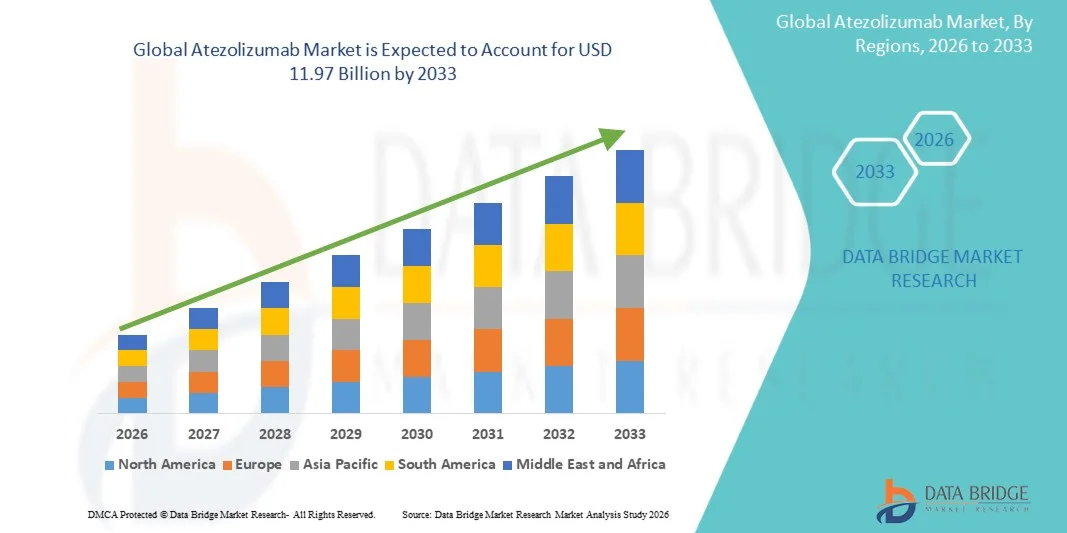
- As per Data Bridge Market Research analysis, the atezolizumab market was valued at USD 8.42 billion in 2025 and is projected to reach USD 11.97 billion by 2033, growing at a CAGR of 4.50% from 2026 to 2033.
- The market is experiencing consistent growth driven by growing manufacturing footprint, improved distribution, evolving payer and reimbursement dynamics, and expanding access to atezolizumab. In addition, the increasing use of atezolizumab across oncology indications, particularly lung cancer, hepatocellular carcinoma, and urothelial carcinoma, is supporting market expansion.
- The increasing global cancer burden, combined with rising cancer prevalence, the shift toward personalized medicine, expanding oncology indications, and continued development of immune checkpoint therapies, is supporting wider adoption of atezolizumab. Atezolizumab is a PD-L1 inhibitor, and market research identifies growing adoption of immunotherapy and clinical advancements as important factors supporting the broader immune-checkpoint inhibitor market.
Market Size & Forecast
- Global Market Value (2025): USD 8.42 Billion
- Expected Market Value (2033): USD 11.97 Billion
- Forecast CAGR (2026–2033): 4.50%
- Leading Region in 2025: North America
- Fastest Growing Region: Asia Pacific
What are the Major Takeaways of the Atezolizumab Market?
- North America dominated the atezolizumab market with the largest revenue share of 48.7% in 2025, supported by established reimbursement pathways, mature oncology infrastructure, and high patient awareness.
- Asia-Pacific is expected to be the fastest-growing region at a CAGR of 17.1% from 2026 to 2033, fueled by rising disposable incomes, healthcare infrastructure modernization, expanding healthcare access, rising cancer incidence, and targeted expansion efforts by leading players in the region.
- The PD-L1 inhibitors segment led the market with a 50% share in 2025, driven by the established clinical use of atezolizumab as a PD-L1 inhibitor and its broad application across multiple cancer indications.
- Immunomodulators are the fastest-growing drug class type, projected to register a CAGR of 16.8%, reflecting the surge in adoption of immune-modulating treatment approaches, expanding immuno-oncology research, and growing interest in combination therapies.
- The lung cancer segment dominated the clinical indication type category with a 50.56% revenue share in 2025, led by the established application of Atezolizumab in lung cancer treatment.
- Hospital pharmacies accounted for 60.0% of the market share in 2025, preferred by the intravenous administration of atezolizumab and the specialized infrastructure required for oncology treatment.
- The bladder cancer segment is the fastest-growing clinical indication category, with a CAGR of 15.1%, driven by increasing use of immune checkpoint inhibitors in urothelial carcinoma and continuing demand for advanced treatment options.
Report Scope and Atezolizumab Market Segmentation
|
Attributes |
Atezolizumab Key Market Insights |
|
Segments Covered |
|
|
Countries Covered |
North America
Europe
Asia-Pacific
Middle East and Africa
South America
|
|
Key Market Players |
|
|
Market Opportunities |
|
|
Value Added Data Infosets |
In addition to the insights on market scenarios such as market value, growth rate, segmentation, geographical coverage, and major players, the market reports curated by the Data Bridge Market Research also include in-depth expert analysis, patient epidemiology, pipeline analysis, pricing analysis, and regulatory framework. |
What is the Key Trend in the Atezolizumab Market?
- Combination therapies are increasingly gaining prominence in atezolizumab treatment, with immunotherapy being combined with chemotherapy, targeted drugs, or other immuno-oncology agents to provide complementary mechanisms of action and improve tumor response and patient survival.
- For instance, in June 2025, the Phase III IMforte trial published in The Lancet evaluated lurbinectedin plus atezolizumab as first-line maintenance therapy for extensive-stage small-cell lung cancer; the combination significantly improved progression-free and overall survival compared with atezolizumab alone.
- The development of combination regimens is expanding the potential application of atezolizumab across multiple cancer types, including lung cancer, hepatocellular carcinoma, urothelial carcinoma, melanoma, and other solid tumors.
- Pharmaceutical companies are increasingly evaluating atezolizumab with novel immuno-oncology molecules, creating opportunities for complementary mechanisms of action and potentially more durable antitumor responses across different patient populations.
- For instance, in July 2024, a Phase II study published in Journal for ImmunoTherapy of Cancer evaluated the novel IL-8 inhibitor AMY109 in combination with atezolizumab in patients with advanced solid tumors; the combination was well tolerated, with durable partial responses observed in two patients, supporting continued research into novel combination approaches designed to enhance PD-L1 inhibition.
- As pharmaceutical companies continue expanding combination strategies and investigating atezolizumab across additional tumor types, combination immunotherapy is expected to remain a core trend shaping the development and commercial potential of the atezolizumab market.
What are the Key Drivers of the Atezolizumab Market?
- The rising global prevalence of cancer is significantly increasing demand for novel immunotherapies such as atezolizumab, as the growing number of patients with lung cancer, melanoma, bladder cancer, and head and neck cancers expands the addressable patient population.
- For instance, in October 2023, the Journal of Clinical Oncology reported Phase III IMpower010 overall-survival results for adjuvant atezolizumab following chemotherapy in resected stage II–IIIA non-small-cell lung cancer, with the strongest observed overall-survival benefit in patients whose tumors had PD-L1 expression of ≥50%, supporting the use of biomarker-guided atezolizumab therapy in earlier-stage disease.
- Increasing pharmaceutical R&D for cancer immunotherapy is accelerating clinical development of atezolizumab and combination regimens, with companies investigating immune checkpoint inhibitors alongside chemotherapy, targeted therapies, and other immuno-oncology agents.
- For instance, in December 2023, the Phase III BEATcc trial published in The Lancet Oncology demonstrated that adding atezolizumab to bevacizumab plus platinum-based chemotherapy in metastatic, persistent, or recurrent cervical cancer improved median progression-free survival to 13.7 months versus 10.4 months and median overall survival to 32.1 months versus 22.8 months, supporting the expansion of atezolizumab-based immunotherapy into additional oncology indications
- With increasing cancer incidence, pharmaceutical innovation, and clinical research supporting broader immunotherapy applications, atezolizumab is expected to benefit from expanding treatment opportunities across multiple oncology indications and patient populations.
Which Factors are Challenging the Growth of the Atezolizumab Market?
- The high cost of atezolizumab treatment creates significant affordability challenges for patients and payers, particularly in emerging economies where insurance coverage and reimbursement mechanisms for high-cost cancer immunotherapies remain comparatively limited.
- For instance, in September 2023, a study published in Frontiers in Pharmacology found that atezolizumab was not cost-effective for patients with advanced non-small-cell lung cancer who were ineligible for platinum-containing treatment in the U.K.; the reported ICER was USD 128,147 per QALY, substantially above the USD 67,536 /QALY willingness-to-pay threshold.
- These affordability barriers can restrict access to atezolizumab despite its established clinical applications, particularly among patients and healthcare systems that face substantial out-of-pocket expenditure or constrained oncology treatment budgets.
- Immune-related adverse effects also remain an important challenge because atezolizumab can cause immune-mediated complications including colitis, hepatitis, endocrinopathies, pneumonitis, and nephritis, which may require additional clinical monitoring and management.
- For instance, in November 2024, a U.S. analysis published in BMJ Open concluded that atezolizumab monotherapy was not cost-effective compared with single-agent chemotherapy for NSCLC patients ineligible for platinum-containing regimens at a willingness-to-pay threshold of USD 150,000/QALY, indicating that a price reduction of more than 30% was needed to improve cost-effectiveness.
- The combination of high treatment costs, immune-related adverse effects, and variable responses to PD-L1 blockade continues to challenge wider adoption of atezolizumab, particularly where affordability, patient selection, and treatment monitoring remain critical considerations.
How is the Atezolizumab Market Segmented?
The atezolizumab market is segmented on the basis of drug class, clinical indication, distribution channel, end user.
- By Drug Class
On the basis of drug class, the atezolizumab market is segmented into PD-L1 inhibitors, PD-1 inhibitors, CTLA-4 inhibitors, immunomodulators, and other drug classes. The PD-L1 inhibitors segment dominated the market with a 50% share in 2025, supported by the established clinical role of Atezolizumab as an anti-PD-L1 monoclonal antibody. PD-L1 inhibitors have demonstrated efficacy across a range of cancer indications and are increasingly incorporated into immunotherapy-based treatment strategies. Growing cancer prevalence is increasing the demand for immune checkpoint therapies. Pharmaceutical companies are also investing in clinical research evaluating PD-L1 inhibitors in combination with chemotherapy and other anticancer therapies. Increasing healthcare expenditure and improving access to advanced cancer treatments are further supporting adoption.
The immunomodulators segment is expected to witness significant growth at a CAGR of 16.8% during the forecast period, supported by increasing research into therapies that modify immune-system activity and complement immune checkpoint treatment. The segment is supported by growing interest in immune-mediated cancer treatment approaches. Increasing investigation of combination immunotherapy is creating opportunities for complementary immune-modulating mechanisms. Pharmaceutical R&D is also expanding the development of therapies designed to improve immune responses against tumors. Growing interest in precision oncology is encouraging research into treatments tailored to tumor biology and immune status.
- By Clinical Indication
On the basis of clinical indication, the atezolizumab market is segmented into lung cancer, bladder cancer, melanoma, Hodgkin's lymphoma, head and neck cancer, and other indications. The lung cancer segment dominated the market with a 50.56% share in 2025, supported by the established use of Atezolizumab in non-small cell lung cancer and small cell lung cancer. The segment benefits from the substantial global burden of lung cancer and the increasing adoption of immunotherapy-based treatment. Atezolizumab is used in multiple lung cancer treatment strategies, including combination approaches with chemotherapy. Expanding clinical evidence is reinforcing its role in eligible patients with advanced disease. Increasing adoption of immune checkpoint inhibitors is further strengthening segment demand.
The bladder cancer segment is projected to register the fastest growth at a CAGR of 15.1% during the forecast period, supported by increasing use of Atezolizumab in urothelial carcinoma and expanding clinical applications of immune checkpoint inhibitors. The segment is benefiting from increasing adoption of immunotherapy in advanced bladder cancer. Continued clinical research and development of combination treatment strategies are creating additional opportunities for Atezolizumab. Growing cancer incidence and demand for targeted immunotherapies are supporting expansion of the patient population. Increasing awareness and access to advanced oncology treatments are further supporting market growth. The expanding role of checkpoint inhibition in urothelial carcinoma is expected to make bladder cancer one of the fastest-growing indications.
- By Distribution Channel
On the basis of distribution channel, the atezolizumab market is segmented into hospital pharmacies, retail pharmacies, and online pharmacies. The hospital pharmacies segment dominated the market with a 60.0% share in 2025, driven by the intravenous administration of Atezolizumab and the requirement for specialized oncology infrastructure. Hospital pharmacies provide centralized procurement, storage, preparation, dispensing, and coordination with infusion facilities. These pharmacies are integrated with oncology departments and provide controlled handling of high-value biologic medicines. Their proximity to oncologists and infusion centers supports appropriate administration and monitoring. Established hospital procurement and reimbursement systems further reinforce this channel.
The online pharmacies segment is projected to be the fastest-growing distribution channel at 6.2% CAGR through 2033, supported by increasing digitalization of healthcare services and growing adoption of online pharmaceutical platforms. Digital healthcare infrastructure is improving access to prescription and specialty-pharmacy services. Online channels provide greater convenience for patients and caregivers and can support medication-access and prescription-management services. Increasing integration of digital platforms with specialty pharmacy services is creating additional opportunities. However, the intravenous administration of Atezolizumab limits direct online dispensing compared with conventional oral medicines. Continued development of digital healthcare ecosystems is nevertheless expected to support expansion of this channel.
- By End User
On the basis of end user, the atezolizumab market is segmented into hospitals, homecare, specialty clinics, and other end users. The hospitals segment dominated the market with a 70.5% share in 2025, supported by the infrastructure required for intravenous infusion, oncology monitoring, laboratory testing, and management of treatment-related adverse effects. Hospitals provide integrated cancer-care services involving oncologists, pharmacists, nurses, and other specialists. Dedicated infusion centers enable controlled administration and patient observation. Established procurement systems and reimbursement structures further support hospital-based treatment. The availability of advanced diagnostic and treatment facilities strengthens the position of hospitals within the market.
The specialty clinics segment is projected to be the fastest-growing end-user segment at 5.2% CAGR through 2033, supported by increasing demand for specialized oncology and immunotherapy services. Specialty clinics provide focused cancer-care expertise and dedicated environments for treatment administration and patient monitoring. Expansion of community oncology services is improving access to immunotherapy outside major hospitals. These facilities can provide flexible outpatient treatment and specialized management of recurring immunotherapy. Growing demand for accessible and patient-centered cancer care is supporting specialty-clinic expansion. Increasing development of dedicated immunotherapy centers is further strengthening the segment. As specialized oncology networks continue to expand, specialty clinics are expected to record the fastest growth among end users.
Which Region Holds the Largest Share of the Atezolizumab Market?
- North America dominated the atezolizumab market with the largest revenue share of 48.7% in 2025, supported by established reimbursement pathways, mature oncology infrastructure, and high patient awareness.
- The region also benefits from high healthcare spending, favorable reimbursement coverage, extensive clinical trial activity, and increasing use of Atezolizumab in combination with chemotherapy and targeted agents, particularly for patients with PD-L1-positive tumors. Continued investment in specialized cancer centers and expanding immunotherapy access are expected to strengthen North America's leadership in the global market.
U.S. Atezolizumab Market Insight
The U.S. Atezolizumab market is witnessing strong growth due to broad clinical use across lung cancer, hepatocellular carcinoma, melanoma, and other oncology indications. The country’s advanced cancer-care infrastructure, high healthcare expenditure, and established immunotherapy ecosystem are supporting demand for Tecentriq. In addition, continued regulatory activity, wider use of biomarker-guided treatment, and increasing adoption of alternative administration formats are strengthening market development across oncology centers and hospitals. In September 2024, the U.S. FDA approved Tecentriq Hybreza for subcutaneous administration across all adult indications of intravenous atezolizumab.
Asia-Pacific Atezolizumab Market Insight
The Asia-Pacific Atezolizumab market is expected to witness rapid growth, driven by increasing cancer incidence, expanding healthcare infrastructure, and rising access to advanced immunotherapy across China, Japan, and other regional markets. Growing pharmaceutical investment and broader regulatory acceptance of immune checkpoint inhibitors are supporting regional adoption. In addition, increasing demand for innovative cancer treatments and clinical research activity are strengthening market opportunities across the region. Japan recorded 1,005,157 new cancer cases in 2022, with lung cancer ranking among the leading cancers, supporting demand for oncology therapies including atezolizumab.
Japan Atezolizumab Market Insight
The Japan Atezolizumab market is witnessing consistent growth due to established oncology infrastructure, increasing demand for immunotherapy, and continued expansion of Tecentriq applications. The country has a mature pharmaceutical and regulatory environment that supports the development and adoption of advanced cancer therapies. Chugai Pharmaceutical and Japanese research institutions are also contributing to clinical development and new indication opportunities. Increasing cancer prevalence is further supporting treatment demand. PMDA records show that Tecentriq received its initial Japanese approval in January 2018, followed by multiple partial-change approvals, including another approval in September 2025.
China Atezolizumab Market Insight
The China Atezolizumab market is growing rapidly, driven by the country’s substantial cancer burden, expanding oncology treatment capacity, and increasing availability of immune checkpoint therapies. Growing investment in innovative medicines and regulatory support for advanced cancer treatments are strengthening adoption across major hospitals. The large patient population and increasing demand for targeted and immunotherapy-based approaches provide significant opportunities for market expansion. China’s National Medical Products Administration approved Tecentriq in combination with Avastin for unresectable hepatocellular carcinoma in October 2020, creating an additional immunotherapy treatment option in a country containing almost half of worldwide HCC cases.
U.K. Atezolizumab Market Insight
The U.K. Atezolizumab market is experiencing steady growth, supported by established cancer treatment services, National Health Service access arrangements, and continued evaluation of atezolizumab across different oncology indications. Increasing emphasis on biomarker-selected treatment is supporting adoption in eligible patients with non-small-cell lung cancer. In addition, health technology assessment activity continues to shape access and reimbursement within the country. In June 2025, NICE recommended atezolizumab as an option for adjuvant treatment of resected NSCLC when patients have high recurrence risk and tumors with PD-L1 expression of at least 50%.
Germany Atezolizumab Market Insight
The Germany Atezolizumab market is expanding steadily due to its strong healthcare infrastructure, established oncology treatment network, and formal health technology assessment framework. Increasing use of biomarker-driven immunotherapy and continued evaluation of Tecentriq across lung cancer indications are supporting market development. Germany’s extensive specialist-care infrastructure also facilitates administration and monitoring of immune checkpoint therapies. IIn March 2025, the German Federal Joint Committee completed a benefit-assessment decision for Atezolizumab as first-line monotherapy for advanced non-small-cell lung cancer patients unsuitable for platinum-based therapy, reinforcing its position within Germany’s oncology treatment pathway.
Which are the Top Companies in Atezolizumab Market?
The atezolizumab industry is primarily led by well-established companies, including:
- F. Hoffmann-La Roche Ltd (Switzerland)
- Merck & Co., Inc. (U.S.)
- Bristol-Myers Squibb Company (U.S.)
- AstraZeneca (U.K.)
- Pfizer Inc. (U.S.)
- GSK plc (U.K.)
- Regeneron Pharmaceuticals Inc. (U.S.)
- Sanofi (France)
- Novartis AG (Switzerland)
- Amgen Inc. (U.S.)
- BeOne Medicines I GmbH (Switzerland)
- Innovent Biologics (Suzhou) Co., Ltd. (China)
- Akeso Biopharma Co., Ltd. (China)
- CSTONE PHARMACEUTICALS (China)
- Merck KGaA (Germany)
- BioNTech SE (Germany)
- CELLTRION INC. (South Korea)
- Gilead Sciences, Inc. (U.S.)
What are Latest Developments in Atezolizumab Market?
- In May 2026, Roche Pharma India announced the launch of Tecentriq SC (atezolizumab) in India, introducing the country’s first subcutaneous immunotherapy for lung cancer. The formulation can be administered in approximately seven minutes compared with conventional intravenous infusions that can take hours, potentially reducing treatment time by around 80%. The launch provides eligible patients with a more convenient administration option and may help optimize healthcare resources by allowing more patients to be treated within the same clinical capacity.
- In October 2025, Roche announced that the U.S. FDA approved Tecentriq (atezolizumab) and Tecentriq Hybreza in combination with lurbinectedin for first-line maintenance treatment of adults with extensive-stage small-cell lung cancer (ES-SCLC) whose disease had not progressed after induction therapy with Tecentriq or Tecentriq Hybreza, carboplatin, and etoposide. The approval was supported by the Phase III IMforte study, in which the combination reduced the risk of disease progression or death by 46% and the risk of death by 27% compared with Tecentriq maintenance alone.
- In September 2024, Roche announced that the U.S. FDA approved Tecentriq Hybreza, a subcutaneous formulation of atezolizumab and hyaluronidase-tqjs, providing a new administration option for eligible adult patients across all approved intravenous Tecentriq indications. The subcutaneous formulation can be administered in approximately seven minutes compared with 30–60 minutes for intravenous infusion. The approval was based on clinical evidence demonstrating comparable pharmacokinetics, safety, and efficacy to intravenous Tecentriq.
- In January 2024, Roche announced the European launch of Tecentriq SC after the European Commission granted marketing authorization for the subcutaneous formulation of atezolizumab. Tecentriq SC became the European Union’s first PD-(L)1 cancer immunotherapy available as a subcutaneous injection for multiple cancer types, including certain lung, liver, bladder, and breast cancers. The formulation reduces treatment time by approximately 80% compared with standard intravenous infusion.
- In June 2022, the European Commission approved Tecentriq as an adjuvant treatment for certain adults with early-stage non-small-cell lung cancer (NSCLC) following complete resection and platinum-based chemotherapy. The approval applied to patients with high-risk recurrence whose tumors expressed PD-L1 at 50% or higher and who did not have EGFR-mutant or ALK-positive NSCLC. In the Phase III IMpower010 study, adjuvant Tecentriq reduced the risk of disease recurrence or death by 57% in patients with PD-L1-high resected Stage II–III NSCLC compared with best supportive care.

- Interactive Data Analysis Dashboard
- Company Analysis Dashboard for high growth potential opportunities
- Research Analyst Access for customization & queries
- Competitor Analysis with Interactive dashboard
- Latest News, Updates & Trend analysis
- Harness the Power of Benchmark Analysis for Comprehensive Competitor Tracking
Data collection and base year analysis are done using data collection modules with large sample sizes. The stage includes obtaining market information or related data through various sources and strategies. It includes examining and planning all the data acquired from the past in advance. It likewise envelops the examination of information inconsistencies seen across different information sources. The market data is analysed and estimated using market statistical and coherent models. Also, market share analysis and key trend analysis are the major success factors in the market report. To know more, please request an analyst call or drop down your inquiry.
The key research methodology used by DBMR research team is data triangulation which involves data mining, analysis of the impact of data variables on the market and primary (industry expert) validation. Data models include Vendor Positioning Grid, Market Time Line Analysis, Market Overview and Guide, Company Positioning Grid, Patent Analysis, Pricing Analysis, Company Market Share Analysis, Standards of Measurement, Global versus Regional and Vendor Share Analysis. To know more about the research methodology, drop in an inquiry to speak to our industry experts.
Data Bridge Market Research is a leader in advanced formative research. We take pride in servicing our existing and new customers with data and analysis that match and suits their goal. The report can be customized to include price trend analysis of target brands understanding the market for additional countries (ask for the list of countries), clinical trial results data, literature review, refurbished market and product base analysis. Market analysis of target competitors can be analyzed from technology-based analysis to market portfolio strategies. We can add as many competitors that you require data about in the format and data style you are looking for. Our team of analysts can also provide you data in crude raw excel files pivot tables (Fact book) or can assist you in creating presentations from the data sets available in the report.













