


What is the Audio Interface Market Size and Growth Rate?
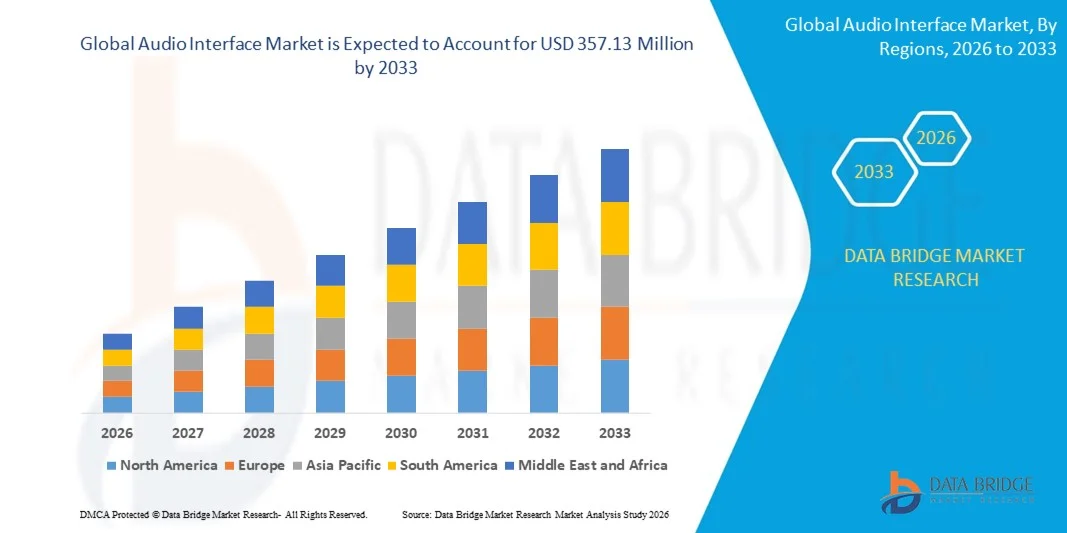
- As per Data Bridge Market Research Analysis the global Audio Interface Market size was valued at USD 224.06 million in 2025 and is expected to reach USD 357.13 million by 2033, at a CAGR of 6.00% during the forecast period.
- The market growth is largely driven by the increasing adoption of digital audio production, home recording studios, and live streaming, coupled with technological advancements in high-fidelity and low-latency audio interfaces.
- Additionally, rising demand from professional musicians, podcasters, and content creators for seamless, reliable, and multi-channel audio solutions is positioning advanced audio interfaces as essential tools in modern audio production workflows. These factors are collectively accelerating market adoption, thereby significantly contributing to industry growth.
Market Size & Forecast
Global Market Value (2025): USD 224.06 million
Expected Market Value (2033): USD 357.13 million
Forecast CAGR (2026–2033): 6.00%
What are the Major Takeaways of Audio Interface Market?
- Audio interfaces, providing high-quality analog-to-digital and digital-to-analog conversion for recording and production, are increasingly essential components of modern audio production, live streaming, and content creation setups in both professional and home studio environments due to their low-latency performance, multi-channel capabilities, and seamless integration with DAWs (Digital Audio Workstations).
- The rising demand for audio interfaces is primarily driven by the growing adoption of home recording studios, online content creation, and live streaming, coupled with the increasing need for professional-grade sound quality and ease of connectivity with multiple devices.
- North America dominated the Global Audio Interface Market with the largest revenue share of 33.3% in 2025, characterized by early adoption of digital audio technologies, high disposable incomes, and a strong presence of leading manufacturers, with the U.S. experiencing substantial growth in professional and home studio setups, driven by innovations from both established audio brands and tech startups focusing on USB-C, Thunderbolt, and wireless audio solutions.
- Asia-Pacific is expected to be the fastest-growing region in the Global Audio Interface Market during the forecast period due to increasing urbanization, rising disposable incomes, and the expanding base of independent musicians and content creators.
- The hardware segment dominated the market with the largest revenue share of 45.7% in 2025, driven by the growing demand for high-quality preamps, low-latency converters, and multi-channel recording capabilities among professional and home studio users.
Report Scope and Global Audio Interface Market Segmentation
|
Attributes |
Audio Interface Key Market Insights |
|
Segments Covered |
|
|
Countries Covered |
North America
Europe
Asia-Pacific
Middle East and Africa
South America
|
|
Key Market Players |
|
|
Market Opportunities |
|
|
Value Added Data Infosets |
In addition to the insights on market scenarios such as market value, growth rate, segmentation, geographical coverage, and major players, the market reports curated by the Data Bridge Market Research also include in-depth expert analysis, geographically represented company-wise production and capacity, network layouts of distributors and partners, detailed and updated price trend analysis and deficit analysis of supply chain and demand. |
What is the Key Trend in the Audio Interface Market?
Enhanced Convenience Through AI and Smart Software Integration
- A significant and accelerating trend in the global Audio Interface Market is the deepening integration with artificial intelligence (AI) and smart software ecosystems, such as advanced DAWs, AI-driven mixing tools, and cloud-based collaboration platforms. This fusion of technologies is significantly enhancing workflow efficiency and creative control for musicians, producers, and content creators.
- For instance, Universal Audio interfaces integrate with AI-powered plugins and software that automatically optimize audio signal chains, allowing users to achieve professional-grade sound with minimal manual adjustments. Similarly, Focusrite’s Control software enables seamless routing and real-time monitoring across multiple channels, streamlining complex studio setups.
- AI integration in audio interfaces enables features such as automatic gain adjustment, adaptive noise reduction, and intelligent latency compensation, enhancing both recording and live streaming quality. For example, some MOTU models use AI-assisted monitoring to reduce audio artifacts and improve real-time performance. Furthermore, smart software integration allows users to control interfaces and recording parameters remotely via mobile apps or cloud platforms.
- The seamless integration of audio interfaces with digital production ecosystems facilitates centralized management of recording, mixing, and streaming workflows. Through a single interface, users can control multiple hardware devices, software instruments, and effects plugins, creating a unified and highly efficient production environment.
- This trend towards more intelligent, intuitive, and interconnected audio production systems is fundamentally reshaping user expectations for recording and content creation. Consequently, companies such as Universal Audio and PreSonus are developing AI-enabled audio interfaces with features such as automatic signal optimization, real-time plugin integration, and remote software control.
- The demand for audio interfaces that offer seamless AI and smart software integration is growing rapidly across both professional studios and home recording setups, as creators increasingly prioritize convenience, efficiency, and high-quality production capabilities.
Global Audio Interface Market Dynamics
Driver
Growing Need Due to Rising Demand for High-Quality Audio Production and Home Studios
- The increasing demand for high-quality audio production across music, podcasts, live streaming, and content creation, coupled with the accelerating adoption of home studios and digital recording ecosystems, is a significant driver for the heightened demand for audio interfaces.
- For instance, in 2025, Focusrite launched an advanced USB-C audio interface with integrated AI-assisted mixing features, targeting both professional studios and independent creators. Such innovations by key companies are expected to drive the audio interface market growth in the forecast period.
- As creators seek professional-grade sound quality and efficient workflows, audio interfaces offer advanced features such as multi-channel recording, low-latency monitoring, and software integration, providing a compelling upgrade over built-in computer sound cards or basic audio equipment.
- Furthermore, the growing popularity of DAWs, virtual instruments, and online content platforms is making audio interfaces an integral component of modern production setups, offering seamless integration with other hardware and software tools.
- The convenience of plug-and-play operation, real-time monitoring, and the ability to control multiple inputs and outputs via software applications are key factors propelling the adoption of audio interfaces in both professional and home studio settings. The trend towards DIY home studios and the increasing availability of user-friendly audio interface options further contribute to market growth.
Restraint/Challenge
Concerns Regarding Compatibility, Learning Curve, and High Initial Costs
- Concerns surrounding hardware and software compatibility, coupled with the learning curve for operating complex audio interfaces, pose a significant challenge to broader market penetration. As audio interfaces rely on digital connectivity and software integration, users may encounter driver issues, latency problems, or compatibility limitations with certain DAWs, raising hesitancy among potential buyers.
- For instance, high-profile reports of driver conflicts and software glitches in some USB and Thunderbolt interfaces have made some creators cautious about adopting new devices.
- Addressing these concerns through robust cross-platform support, regular firmware updates, and user-friendly design is crucial for building consumer trust. Companies such as Universal Audio and PreSonus emphasize plug-and-play functionality, software bundles, and tutorials in their marketing to reassure potential buyers. Additionally, the relatively high initial cost of professional-grade audio interfaces compared to basic recording equipment can be a barrier to adoption for price-sensitive consumers, particularly beginners or budget-conscious home studio owners. While entry-level options from brands such as Behringer or M-Audio have become more affordable, premium features such as high channel counts, advanced preamps, or AI-assisted processing often come with a higher price tag.
- While prices are gradually decreasing, the perceived premium for advanced audio technology can still hinder widespread adoption, especially for users who do not immediately require professional-grade features.
- Overcoming these challenges through enhanced software-hardware compatibility, user education on workflow optimization, and the development of more affordable yet feature-rich audio interface options will be vital for sustained market growth.
How is the Audio Interface Market Segmented?
Audio interface market is segmented on the basis of component, application and type.
- By Component
On the basis of component, the Global Audio Interface Market is segmented into hardware, software, and solution. The hardware segment dominated the market with the largest revenue share of 45.7% in 2025, driven by the growing demand for high-quality preamps, low-latency converters, and multi-channel recording capabilities among professional and home studio users. Hardware interfaces remain essential for capturing clear audio signals and supporting complex production workflows.
The software segment is expected to witness the fastest CAGR of 22.1% from 2026 to 2033, fueled by the increasing adoption of DAWs, virtual instruments, plugin suites, and AI-powered audio tools. Software solutions provide enhanced flexibility, real-time processing, and seamless integration with multiple devices, allowing users to optimize sound quality, workflow efficiency, and post-production capabilities. The combined growth of hardware and software solutions is driving overall market expansion, as creators increasingly rely on end-to-end audio production systems.
- By Type
On the basis of type, the Global Audio Interface Market is segmented into Universal Serial Bus (USB), Firewire, Musical Instrument Digital Interface (MIDI), and Thunderbolt. The USB segment dominated the market with the largest revenue share of 48.3% in 2025, owing to its affordability, ease of use, wide compatibility with computers and DAWs, and plug-and-play functionality. USB interfaces are particularly popular among independent musicians, podcasters, and home studio enthusiasts.
The Thunderbolt segment is expected to witness the fastest CAGR of 23.4% from 2026 to 2033, driven by the increasing demand for ultra-low latency, high-speed data transfer, and multi-channel recording capabilities required in professional studios and high-end production environments. Thunderbolt interfaces are favored for their high bandwidth, reliable connectivity, and ability to handle complex recording setups, making them a preferred choice for professional audio engineers and creators working with large-scale projects.
- By Application
On the basis of application, the Global Audio Interface Market is segmented into professional and amateur. The professional segment dominated the market with the largest revenue share of 52.6% in 2025, fueled by rising demand from recording studios, live performance setups, and commercial content production. Professionals require high-fidelity, low-latency audio interfaces capable of handling multi-channel inputs and advanced processing features to deliver studio-quality sound.
The amateur segment is expected to witness the fastest CAGR of 21.8% from 2026 to 2033, driven by the rapid adoption of home studios, online content creation, podcasting, and music production by hobbyists and independent creators. Affordable and user-friendly interfaces, combined with software bundles and mobile compatibility, are encouraging enthusiasts to upgrade from basic equipment, thereby expanding market penetration in this segment. The growth in both professional and amateur applications is creating a comprehensive ecosystem that supports innovation and adoption across all user levels.
Which Region Holds the Largest Share of the Audio Interface Market?
- North America dominated the Global Audio Interface Market with the largest revenue share of 33.3% in 2025, driven by a growing demand for professional and home studio setups, content creation, and live streaming solutions.
- Consumers in the region highly value the high-quality audio performance, low-latency recording, and seamless integration offered by modern audio interfaces with DAWs, virtual instruments, and other digital production tools.
- This widespread adoption is further supported by high disposable incomes, a technology-savvy population, and the growing preference for efficient, multi-channel recording and remote collaboration, establishing audio interfaces as essential equipment for both professional studios and independent creators in North America.
U.S. Audio Interface Market Insight
The U.S. audio interface market captured the largest revenue share of 81% in 2025 within North America, fueled by the rapid adoption of home studios, content creation, and professional recording setups. Consumers are increasingly prioritizing high-quality audio production, low-latency performance, and seamless integration with DAWs and virtual instruments. The growing preference for DIY home studios, live streaming, and podcasting, combined with strong demand for AI-assisted features and software integration, further propels the audio interface industry. Moreover, the widespread adoption of USB and Thunderbolt interfaces, alongside compatibility with popular production software, is significantly contributing to the market's expansion.
Europe Audio Interface Market Insight
The Europe audio interface market is projected to expand at a substantial CAGR throughout the forecast period, primarily driven by rising demand for professional music production, live performance setups, and content creation. Increasing urbanization, higher disposable incomes, and the popularity of digital music production are fostering adoption. European consumers are drawn to interfaces offering multi-channel recording, low-latency monitoring, and compatibility with DAWs. The region is experiencing significant growth across both professional studios and home-based setups, with audio interfaces being integrated into music schools, commercial studios, and independent creator setups.
U.K. Audio Interface Market Insight
The U.K. audio interface market is anticipated to grow at a noteworthy CAGR during the forecast period, driven by the rising trend of home and professional music production, podcasting, and live streaming. Additionally, the demand for portable, user-friendly interfaces that support high-quality recording and DAW integration is encouraging both individual creators and studios to adopt these solutions. The U.K.’s strong e-commerce and retail infrastructure, combined with widespread awareness of digital audio technology, is expected to continue stimulating market growth.
Germany Audio Interface Market Insight
The Germany audio interface market is expected to expand at a considerable CAGR during the forecast period, fueled by increasing awareness of professional audio production and digital music technologies. Germany’s well-developed infrastructure, emphasis on innovation, and strong presence of audio equipment manufacturers promote the adoption of advanced interfaces, particularly in professional studios, educational institutions, and commercial recording setups. Integration with software solutions and multi-device setups is becoming increasingly prevalent, with consumers favoring high-performance, reliable, and eco-conscious products.
Asia-Pacific Audio Interface Market Insight
The Asia-Pacific audio interface market is poised to grow at the fastest CAGR of 24% during 2026–2033, driven by rising urbanization, increasing disposable incomes, and rapid adoption of music production, live streaming, and content creation in countries such as China, Japan, and India. The growing inclination toward home studios, supported by digital music education and online content platforms, is driving adoption. Furthermore, as APAC emerges as a manufacturing hub for audio equipment and components, affordability and accessibility of advanced audio interfaces are expanding to a wider consumer base.
Japan Audio Interface Market Insight
The Japan audio interface market is gaining momentum due to the country’s high-tech culture, demand for high-quality sound production, and growing popularity of home studios and live streaming. The market emphasizes low-latency, multi-channel, and AI-integrated audio solutions. Integration with other digital tools, such as DAWs, virtual instruments, and cloud-based production platforms, is fueling growth. Moreover, Japan's aging population and increasing interest in user-friendly recording equipment are expected to spur demand for intuitive and reliable audio interfaces across residential and commercial setups.
China Audio Interface Market Insight
The China audio interface market accounted for the largest market revenue share in Asia-Pacific in 2025, attributed to the country’s expanding middle class, rapid urbanization, and high technological adoption. China is one of the largest markets for digital audio production, with increasing popularity of home studios, professional music production, and content creation platforms. The push towards smart education, online content creation, and affordable high-performance audio interfaces, alongside strong domestic manufacturers, are key factors propelling the market in China.
Which are the Top Companies in Audio Interface Market?
The Audio Interface industry is primarily led by well-established companies, including:
- Focusrite (U.K.)
- Universal Audio (U.S.)
- MOTU – Mark of the Unicorn (U.S.)
- PreSonus (U.S.)
- Behringer (Germany)
- Roland (Japan)
- Steinberg (Germany)
- Avid Technology (U.S.)
- Alesis (U.S.)
- TASCAM (Japan)
- Apogee Electronics (U.S.)
- M-Audio (U.S.)
- Native Instruments (Germany)
- Antelope Audio (U.S.)
- SSL – Solid State Logic (U.K.)
- IK Multimedia (Italy)
- Cakewalk (U.S.)
- Zoom Corporation (Japan)
- Focusrite-Novation Group (U.K.)
- Arturia (France)
What are Latest Developments in Audio Interface Market?
- In April 2024, Focusrite Plc, a global leader in audio interfaces and recording solutions, launched a strategic initiative in South Africa aimed at expanding access to high-quality recording and production tools for both professional and home studio users. This initiative underscores the company’s dedication to delivering innovative, reliable audio solutions tailored to the unique needs of local creators. By leveraging its global expertise and advanced product offerings, Focusrite is addressing regional production challenges while reinforcing its position in the rapidly growing global Audio Interface Market.
- In March 2024, Universal Audio, a veteran-led company based in California, introduced the new Apollo x8p Gen 3 interface, specifically engineered for professional studios and high-end production environments. The interface provides ultra-low latency, enhanced preamps, and integrated AI-assisted plugins. This advancement highlights Universal Audio’s commitment to developing cutting-edge audio technologies that enhance workflow efficiency and sound quality for creators worldwide.
- In March 2024, PreSonus Audio Electronics successfully deployed its Studio One AI Integration Project in India, aimed at enhancing digital music production capabilities for emerging artists and content creators. This initiative harnesses advanced software and hardware solutions to provide an intuitive, high-performance recording environment, underscoring PreSonus’s dedication to supporting innovation in professional and home studios.
- In February 2024, MOTU (Mark of the Unicorn) announced a strategic partnership with Berklee Online to provide audio interface bundles and training for music production students. This collaboration is designed to enhance learning outcomes and provide hands-on experience with high-quality recording equipment, facilitating more effective music education. The initiative underscores MOTU’s commitment to driving innovation and accessibility within the audio production sector.
- In January 2024, Behringer unveiled the U-Phoria X32 USB Audio Interface at the NAMM Show 2024. This innovative interface, equipped with multi-channel USB connectivity and integrated software support, enables users to record and mix audio efficiently in both professional and home studio settings. The Behringer U-Phoria highlights the company’s commitment to integrating advanced technology into audio production systems, offering creators enhanced workflow, versatility, and sound quality.

- Interactive Data Analysis Dashboard
- Company Analysis Dashboard for high growth potential opportunities
- Research Analyst Access for customization & queries
- Competitor Analysis with Interactive dashboard
- Latest News, Updates & Trend analysis
- Harness the Power of Benchmark Analysis for Comprehensive Competitor Tracking
Global Audio Interface Market, Supply Chain Analysis and Ecosystem Framework
To support market growth and help clients navigate the impact of geopolitical shifts, DBMR has integrated in-depth supply chain analysis into its Global Audio Interface Market research reports. This addition empowers clients to respond effectively to global changes affecting their industries. The supply chain analysis section includes detailed insights such as Global Audio Interface Market consumption and production by country, price trend analysis, the impact of tariffs and geopolitical developments, and import and export trends by country and HSN code. It also highlights major suppliers with data on production capacity and company profiles, as well as key importers and exporters. In addition to research, DBMR offers specialized supply chain consulting services backed by over a decade of experience, providing solutions like supplier discovery, supplier risk assessment, price trend analysis, impact evaluation of inflation and trade route changes, and comprehensive market trend analysis.
Data collection and base year analysis are done using data collection modules with large sample sizes. The stage includes obtaining market information or related data through various sources and strategies. It includes examining and planning all the data acquired from the past in advance. It likewise envelops the examination of information inconsistencies seen across different information sources. The market data is analysed and estimated using market statistical and coherent models. Also, market share analysis and key trend analysis are the major success factors in the market report. To know more, please request an analyst call or drop down your inquiry.
The key research methodology used by DBMR research team is data triangulation which involves data mining, analysis of the impact of data variables on the market and primary (industry expert) validation. Data models include Vendor Positioning Grid, Market Time Line Analysis, Market Overview and Guide, Company Positioning Grid, Patent Analysis, Pricing Analysis, Company Market Share Analysis, Standards of Measurement, Global versus Regional and Vendor Share Analysis. To know more about the research methodology, drop in an inquiry to speak to our industry experts.
Data Bridge Market Research is a leader in advanced formative research. We take pride in servicing our existing and new customers with data and analysis that match and suits their goal. The report can be customized to include price trend analysis of target brands understanding the market for additional countries (ask for the list of countries), clinical trial results data, literature review, refurbished market and product base analysis. Market analysis of target competitors can be analyzed from technology-based analysis to market portfolio strategies. We can add as many competitors that you require data about in the format and data style you are looking for. Our team of analysts can also provide you data in crude raw excel files pivot tables (Fact book) or can assist you in creating presentations from the data sets available in the report.













