What is the Augmented Reality Headsets Market Size and Growth Rate?
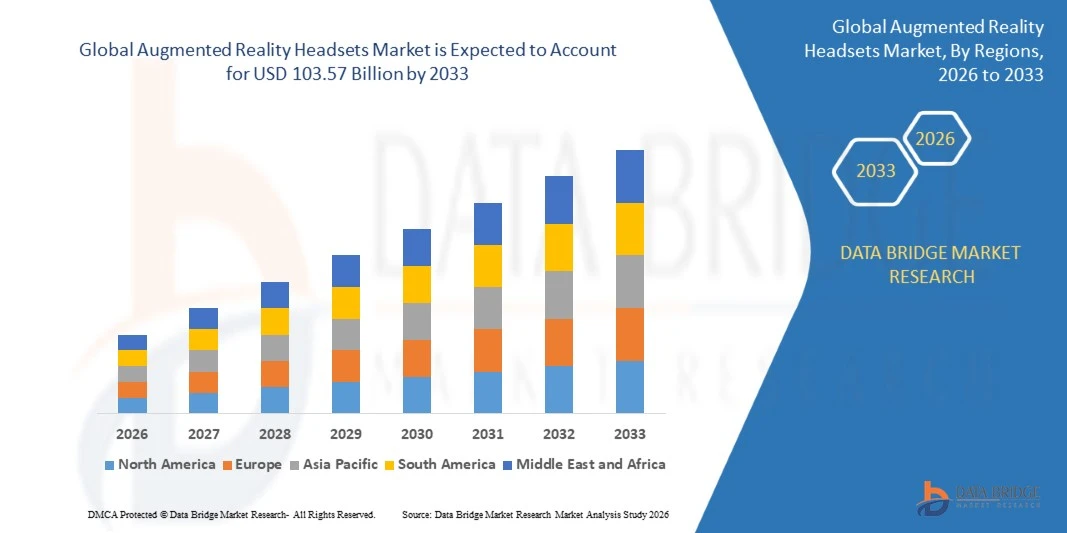
- As per Data Bridge Market Research analysis, the augmented reality headsets market was valued at USD 9.50 billion in 2025 and is projected to reach USD 103.57 billion by 2033, growing at a CAGR of 34.80% from 2026 to 2033.
- The market is experiencing rapid growth driven by rising demand for immersive digital experiences, advancements in lightweight headset designs and display technologies, and expanding applications across industrial manufacturing, healthcare, education, and enterprise collaboration.
- The increasing adoption of hands-free digital assistance, combined with growing investments in spatial computing, artificial intelligence, and wearable technologies, is encouraging businesses and consumers to adopt augmented reality headsets. Standalone and enterprise-focused headsets are gaining traction by enabling real-time information overlays, remote assistance, interactive training, and improved workplace productivity across multiple industries
Market Size & Forecast
- Global Market Value (2025): USD 9.50 Billion
- Expected Market Value (2033): USD 103.57 Billion
- Forecast CAGR (2026–2033): 34.80%
- Leading Region in 2025: North America
- Fastest Growing Region: Asia Pacific
What are the Major Takeaways of the Augmented Reality Headsets Market?
- North America dominated the augmented reality headsets market with the largest revenue share of 40.0% in 2025, supported by strong technology investments, enterprise adoption, and the presence of leading AR technology companies.
- Asia-Pacific is expected to be the fastest-growing region at a CAGR of 35.0% from 2026 to 2033, fueled by increasing investments in immersive technologies, expanding manufacturing capabilities, and rising adoption of AR devices across China, Japan, India, and South Korea.
- The standalone AR headsets segment led the market with a 50.0% share in 2025, driven by integrated computing capabilities, portability, and reduced dependence on external devices.
- Smartphone-enabled AR headsets are the fastest-growing product type, projected to register a CAGR of 22.3%, reflecting the surge in widespread smartphone adoption and lower entry costs.
- The waveguide displays segment dominated the display technology category with a 35.0% revenue share in 2025, led by its ability to direct digital images into the user's field of view while maintaining a compact form factor.
- Wireless connectivity accounted for 60.0% of the market share in 2025, preferred by demand for portable headsets that allow users to move freely without physical connections to computers or other external equipment.
- The 5G-enabled devices segment is the fastest-growing connectivity category, with a CAGR of 25.0%, driven by growing interest in connected AR applications that require rapid data transfer and access to remote computing resources.
Report Scope and Augmented Reality Headsets Market Segmentation
|
Attributes |
Augmented Reality Headsets Key Market Insights |
|
Segments Covered |
|
|
Countries Covered |
North America
Europe
Asia-Pacific
Middle East and Africa
South America
|
|
Key Market Players |
|
|
Market Opportunities |
|
|
Value Added Data Infosets |
In addition to the market insights such as market value, growth rate, market segments, geographical coverage, market players, and market scenario, the market report curated by the Data Bridge Market Research team includes in-depth expert analysis, import/export analysis, pricing analysis, production consumption analysis, and pestle analysis. |
What is the Key Trend in the Augmented Reality Headsets Market?
- Augmented reality headset manufacturers are increasingly integrating artificial intelligence, spatial computing, and see-through displays to deliver more natural, context-aware digital experiences while keeping users connected to their physical surroundings.
- For instance, in June 2025, Snap Inc. announced plans to launch lightweight, immersive Specs in 2026, featuring see-through lenses, machine learning, and AI assistance to bring digital experiences into the physical world.
- Advanced optical systems and compact computing components are enabling manufacturers to develop wearable devices that combine digital information with real-world environments.
- Technology companies are increasingly focusing on hands-free interaction, real-time translation, navigation, and voice-controlled AI assistance to improve the usability of AR headsets and glasses.
- For instance, in September 2024, Meta unveiled Orion, an AR glasses prototype combining a conventional glasses form factor with holographic displays and immersive digital experiences, with employee and selected external testing supporting further product development.
- As manufacturers continue to improve display quality, wearable comfort, and contextual AI capabilities, the development of lightweight AR devices is expected to accelerate, strengthening their potential across consumer and enterprise applications.
What are the Key Drivers of the Augmented Reality Headsets Market?
- The growing adoption of digital transformation technologies across industrial and commercial environments has significantly increased demand for AR headsets that support hands-free workflows, remote assistance, and immersive employee training.
- For instance, in January 2024, Gartner identified training as the most prominent use case among AR head-mounted display adopters, highlighting measurable benefits in knowledge retention, workplace efficiency, and time savings.
- Healthcare providers, manufacturers, and educational institutions are integrating AR headsets into their operations to improve visualization, streamline complex procedures, and provide interactive learning experiences.
- For instance, in May 2025, Google outlined how its Android XR platform and Gemini AI could support smart glasses and headsets through contextual assistance, real-time language translation, navigation, and hands-free information access.
- With businesses increasingly prioritizing operational efficiency, interactive training, and real-time digital guidance, AR headsets are expected to remain an important tool for improving productivity and enabling next-generation workplace experiences.
What Factors are Challenging the Growth of the Augmented Reality Headsets Market?
- Advanced augmented reality headsets require substantial investment in optical waveguides, high-resolution displays, sensors, processors, and compact power systems, increasing manufacturing costs and retail prices.
- For instance, in January 2024, Axios reported that Apple's Vision Pro headset launched at USD 3,500, with its high price, limited battery life, and bulky design identified as challenges to broader consumer adoption
- These high costs, combined with limited battery life, comfort concerns, and complex software integration, can restrict adoption among smaller enterprises, educational institutions, and price-sensitive consumers.
- Organizations must also address challenges involving application compatibility, employee training, data privacy, and integration with existing IT infrastructure before deploying AR headsets at scale.
- For instances, in September 2023, the U.S. National Institute of Standards and Technology (NIST) published research identifying inconsistent standards and difficulties in collecting eye-tracking data across AR systems, complicating reliable evaluation and comparison of headset performance
- The high upfront costs and ongoing implementation requirements associated with AR headsets continue to challenge widespread adoption, particularly among smaller organizations and consumers, slowing market penetration despite growing interest in immersive computing technologies.
How is the Augmented Reality Headsets Market Segmented?
The augmented reality headsets market is segmented on the basis of product type, display technology, connectivity, and end user.
- By Product Type
On the basis of product type, the augmented reality headsets market is segmented into standalone AR headsets, tethered AR headsets, and smartphone-enabled AR headsets. The standalone AR headsets segment dominated the market with 50.0% share in 2025, owing to integrated computing capabilities, portability, and reduced dependence on external devices. These headsets combine displays, processors, sensors, and tracking systems within a single device. Their independent operation supports applications in industrial maintenance, healthcare training, education, and interactive experiences. Improvements in spatial tracking and onboard processing are expanding their functionality. Manufacturers are also focusing on ergonomic designs and intuitive controls to improve user comfort.
The smartphone-enabled AR headsets segment is projected to witness growth at an estimated CAGR of 22.3% from 2026 to 2033, driven by widespread smartphone adoption and lower entry costs. These devices can use compatible smartphones to provide processing power and connectivity, reducing the need for dedicated computing hardware. Their affordability may make entry-level AR experiences more accessible to consumers and educational institutions. Adoption depends on smartphone compatibility, optical quality, and the availability of suitable AR applications. However, limited processing performance, battery constraints, and dependence on external devices can restrict advanced functionality.
- By Display Technology
On the basis of display technology, the augmented reality headsets market is segmented into waveguide displays, Micro-LED displays, Micro-OLED displays, liquid crystal displays (LCD), laser-based displays, and other display technologies. The waveguide displays segment is estimated to hold a leading position, with 35.0% share in 2025, owing to its ability to direct digital images into the user's field of view while maintaining a compact form factor. Waveguides enable manufacturers to develop lightweight glasses with transparent optics. Their compact design supports wearable applications across industrial operations, healthcare, and consumer electronics. Improvements in optical efficiency and image clarity are helping address limitations associated with earlier AR displays. Increasing demand for wearable designs is encouraging further development of waveguide technology.
The Micro-LED displays segment is estimated to register the fastest growth at CAGR of 30.0% from 2026 to 2033, driven by its potential to deliver high brightness, energy efficiency, and long operating life. These characteristics are particularly valuable for AR headsets used in outdoor environments and industrial settings. Micro-LED technology can improve visibility when digital content must remain clear under bright ambient lighting. Its compact architecture also supports the development of smaller optical systems. Continued improvements in manufacturing yield and pixel integration may help reduce production costs over time. However, fabrication complexity and challenges in achieving consistent display quality remain barriers to widespread adoption.
- By Connectivity
On the basis of connectivity, the augmented reality headsets market is segmented into wired connectivity, wireless connectivity, smartphone-connected devices, Wi-Fi and Bluetooth-enabled devices, and 5G-enabled devices. The wireless connectivity segment is estimated to account for 60.0% share in 2025, supported by demand for portable headsets that allow users to move freely without physical connections to computers or other external equipment. Wireless operation is especially useful in industrial maintenance, warehouse operations, healthcare training, and collaborative work environments. Bluetooth and Wi-Fi support communication with compatible devices, peripherals, and enterprise networks. Improvements in wireless protocols and onboard processing are helping enhance usability. Wireless headsets can also reduce cable-related restrictions during training and field operations.
The 5G-enabled devices segment is projected to witness the fastest growth at CAGR of 25.0% from 2026 to 2033, driven by growing interest in connected AR applications that require rapid data transfer and access to remote computing resources. High-bandwidth connectivity can support remote expert assistance, cloud-based rendering, and real-time collaboration. Industrial operators may use connected headsets to access live equipment information and receive guidance from specialists in other locations. Healthcare and field-service applications can also benefit from faster communication between users and remote support teams. The expansion of 5G infrastructure is creating opportunities for connected AR solutions in supported locations. However, performance depends on network coverage, service availability, and application requirements.
- By End User
On the basis of end user, the augmented reality headsets market is segmented into individual consumers, commercial enterprises, healthcare institutions, manufacturing companies, educational institutions, government and military organizations, and automotive and aerospace companies. The commercial enterprises segment dominated the market with 40.0% share in 2025, supported by the use of AR headsets for remote assistance, employee training, maintenance, and workflow guidance. Businesses can provide workers with digital instructions without requiring them to interrupt physical tasks. AR headsets also enable remote specialists to guide on-site employees through complex procedures. Manufacturing, logistics, utilities, and field services are important areas of enterprise adoption. Organizations are increasingly evaluating AR systems to improve productivity and reduce operational errors.
The individual consumers segment is estimated to register strong growth at CAGR of 28.0% from 2026 to 2033, driven by increasing demand for lightweight, accessible, and user-friendly AR devices. Consumer applications include interactive entertainment, navigation, communication, digital content, and AI-assisted experiences. Improvements in optical displays and voice-controlled interfaces are making wearable AR products more practical for everyday use. Partnerships between technology companies and consumer electronics brands are also expanding product awareness. Greater availability of compatible applications can encourage adoption beyond technology enthusiasts. Nevertheless, affordability, battery life, comfort, and social acceptance remain important factors influencing demand.
Which Region Holds the Largest Share of the Augmented Reality Headsets Market?
- North America dominated the augmented reality headsets market with the largest revenue share of 40.0% in 2025, supported by strong technology investments, enterprise adoption, and the presence of leading AR technology companies.
- The region also benefits from advanced technological infrastructure, significant research and development spending, and the presence of major technology companies investing in AR hardware and software. Growing demand for industrial training, remote assistance, healthcare visualization, and AI-powered wearable devices continues to strengthen North America's leadership in the global market.
U.S. Augmented Reality Headsets Market Insight
The U.S. augmented reality headsets market is witnessing strong growth due to rising investments in immersive computing, artificial intelligence, and advanced wearable technologies. The country’s mature technology ecosystem, along with increasing adoption of AR headsets across healthcare, manufacturing, defense, and enterprise applications, is driving market demand. In addition, growing emphasis on remote assistance, workforce training, and real-time digital visualization is accelerating headset adoption among businesses and technology-focused consumers.
Asia-Pacific Augmented Reality Headsets Market Insight
The Asia-Pacific augmented reality headsets market is expected to witness rapid growth, driven by expanding manufacturing capabilities, increasing digital transformation investments, and rising adoption of wearable technologies across countries such as China, Japan, and India. Growing demand for smart manufacturing, immersive training, and connected workplace solutions is supporting regional market expansion. In addition, advancements in display components, electronics production, and AI-enabled applications are encouraging AR headset development and adoption across commercial and consumer sectors.
Japan Augmented Reality Headsets Market Insight
The Japan augmented reality headsets market is witnessing consistent growth due to rising investments in robotics, industrial automation, and advanced wearable computing technologies. Manufacturers, healthcare providers, and educational institutions are increasingly adopting AR headsets for equipment maintenance, workforce training, visualization, and remote assistance. Moreover, the country’s strong electronics industry and growing focus on improving workplace productivity through digital transformation are further contributing to market growth.
China Augmented Reality Headsets Market Insight
The China augmented reality headsets market is growing rapidly, driven by expanding electronics manufacturing, increasing investments in artificial intelligence, and rising government support for industrial digitalization. Growing adoption of AR technologies across manufacturing, healthcare, education, and consumer electronics is significantly boosting market demand. In addition, strong domestic supply chains, advancements in optical display components, and increasing integration of intelligent wearable devices are positioning China as an important market for augmented reality headsets.
U.K. Augmented Reality Headsets Market Insight
The U.K. augmented reality headsets market is experiencing steady growth, supported by rising adoption of immersive technologies across healthcare, education, manufacturing, and professional services. Increasing investments in digital training infrastructure and growing demand for remote collaboration solutions are contributing to market expansion. Furthermore, integration of artificial intelligence, spatial computing, and advanced visualization technologies is improving headset functionality and supporting the U.K.’s development of innovative AR applications.
Germany Augmented Reality Headsets Market Insight
The Germany augmented reality headsets market is expanding steadily due to the country’s strong industrial manufacturing base, advanced engineering capabilities, and increasing adoption of Industry 4.0 technologies. Automotive manufacturers, industrial companies, and training institutions are increasingly utilizing AR headsets for assembly guidance, equipment maintenance, quality inspection, and workforce development. Continuous advancements in industrial digitalization, connected production systems, and AI-powered visualization, along with growing demand for operational efficiency, are further driving market growth in Germany.
Which are the Top Companies in Augmented Reality Headsets Market?
The augmented reality headsets industry is primarily led by well-established companies, including:
- Microsoft Corporation (U.S.)
- Magic Leap, Inc. (U.S.)
- Vuzix Corporation (U.S.)
- RealWear, Inc. (U.S.)
- Apple Inc. (U.S.)
- Meta Platforms, Inc. (U.S.)
- Snap Inc. (U.S.)
- Lenovo Group Limited (China)
- Seiko Epson Corporation (Japan)
- Sony Group Corporation (Japan)
- HTC Corporation (Taiwan)
- Qualcomm Incorporated (U.S.)
- TCL Technology Group Corporation (China)
- XREAL (China)
- Rokid Corporation (China)
- ASUSTeK COMPUTER INC. (Taiwan)
- Samsung Electronics Co., Ltd. (South Korea)
- Kopin Corporation (U.S.)
- Lumus Ltd. (Israel)
What are Latest Developments in Augmented Reality Headsets Market?
- In September 2025, Meta unveiled its Ray-Ban Display AI glasses alongside the Meta Neural Band, introducing a full-color, high-resolution in-lens display with AI assistance, messaging, photo previews, and translation features. The wristband uses electromyography (EMG) to interpret subtle muscle movements as commands, demonstrating advances in hands-free interaction and wearable display technology.
- In September 2024, Meta introduced Orion, a prototype of its augmented reality glasses designed to combine a conventional glasses form factor with holographic displays and contextual AI. The prototype supports interactive digital content, hands-free communication, and visual assistance while allowing users to see their physical surroundings. Meta made the device available to employees and selected external audiences to support further development toward future consumer AR products.
- In January 2023, TCL RayNeo announced its RayNeo X2 augmented reality glasses at CES, featuring binocular full-color Micro-LED optical waveguide displays and interactive capabilities. The device demonstrated how advanced display technology could support navigation, real-time information, and digital content overlays while maintaining a glasses-style design. This development highlighted efforts to make AR headsets more practical for everyday wearable computing.
- In November 2022, Qualcomm Technologies introduced its Snapdragon AR2 Gen 1 platform, specifically designed for augmented reality glasses. The multi-chip architecture was developed to support slimmer, high-performance AR wearables, with Qualcomm reporting 50% lower power consumption and 2.5 times better AI performance compared with its stated reference platform. The announcement also identified collaborations with device manufacturers working on next-generation AR products.
- In May 2021, Snap introduced its next-generation Spectacles, its first glasses designed to bring augmented reality experiences directly into the user's field of view. The device incorporated dual 3D waveguide displays, hand tracking, spatial tracking, cameras, microphones, and built-in speakers. Designed primarily for AR creators using Lens Studio, the glasses enabled developers to build interactive digital experiences anchored to the physical environment. This launch supported experimentation with lightweight AR hardware and creator-focused applications.

- Interactive Data Analysis Dashboard
- Company Analysis Dashboard for high growth potential opportunities
- Research Analyst Access for customization & queries
- Competitor Analysis with Interactive dashboard
- Latest News, Updates & Trend analysis
- Harness the Power of Benchmark Analysis for Comprehensive Competitor Tracking
Data collection and base year analysis are done using data collection modules with large sample sizes. The stage includes obtaining market information or related data through various sources and strategies. It includes examining and planning all the data acquired from the past in advance. It likewise envelops the examination of information inconsistencies seen across different information sources. The market data is analysed and estimated using market statistical and coherent models. Also, market share analysis and key trend analysis are the major success factors in the market report. To know more, please request an analyst call or drop down your inquiry.
The key research methodology used by DBMR research team is data triangulation which involves data mining, analysis of the impact of data variables on the market and primary (industry expert) validation. Data models include Vendor Positioning Grid, Market Time Line Analysis, Market Overview and Guide, Company Positioning Grid, Patent Analysis, Pricing Analysis, Company Market Share Analysis, Standards of Measurement, Global versus Regional and Vendor Share Analysis. To know more about the research methodology, drop in an inquiry to speak to our industry experts.
Data Bridge Market Research is a leader in advanced formative research. We take pride in servicing our existing and new customers with data and analysis that match and suits their goal. The report can be customized to include price trend analysis of target brands understanding the market for additional countries (ask for the list of countries), clinical trial results data, literature review, refurbished market and product base analysis. Market analysis of target competitors can be analyzed from technology-based analysis to market portfolio strategies. We can add as many competitors that you require data about in the format and data style you are looking for. Our team of analysts can also provide you data in crude raw excel files pivot tables (Fact book) or can assist you in creating presentations from the data sets available in the report.