


What is the Augmented Reality Packaging Market Size and Overview ?
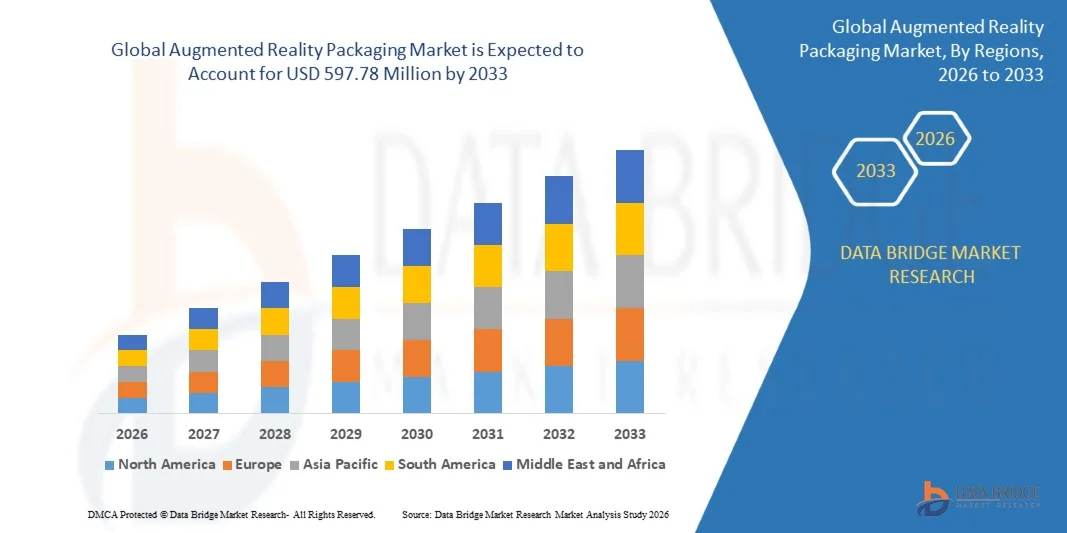
- As per Data Bridge Market Research analysis, the augmented reality packaging market was valued at USD 358.50 million in 2025 and is projected to reach USD 597.78 million by 2033, growing at a CAGR of 6.60% from 2026 to 2033. The market is experiencing consistent growth driven by increasing demand for interactive packaging solutions, rising adoption of digital marketing technologies, and growing focus on enhancing consumer engagement through immersive brand experiences.
- The increasing penetration of smartphones, advancements in augmented reality platforms, and the growing adoption of smart packaging solutions are accelerating market growth. AR-enabled packaging is transforming traditional packaging into interactive communication platforms by enabling real-time product information, authentication features, promotional campaigns, and improved customer experiences. Companies are increasingly leveraging marker-based AR, markerless AR, QR code-enabled packaging, and WebAR technologies to strengthen brand differentiation and improve consumer connectivity.
Market Size & Forecast
- Global Market Value (2025): USD 358.50 Million
- Expected Market Value (2033): USD 597.78 Million
- Forecast CAGR (2026–2033): 6.60%
- Leading Region in 2025: North America
- Fastest Growing Region: Asia Pacific
Key Market Trends & Insights
- North America dominated the augmented reality packaging market with the largest revenue share of 35.8% in 2025, supported by strong adoption of advanced packaging technologies, increasing investments in digital marketing solutions, and the presence of major consumer goods and technology companies integrating AR experiences into packaging
- The AR-enabled labels segment led the market with a 32% share in 2025, driven by their cost-effectiveness, ease of integration with existing packaging structures, and widespread adoption across food & beverages, cosmetics, healthcare, and consumer goods industries
- Asia-Pacific is expected to be the fastest-growing region at a CAGR of 12.8% from 2026 to 2033, fueled by rapid digital transformation, increasing smartphone penetration, growing adoption of smart packaging solutions, and rising investments by brands in immersive consumer engagement technologies across China, India, Japan, and South Korea
- Tags & smart packaging are the fastest-growing packaging type, projected to register a CAGR of 14.5%, reflecting the surge in adoption of connected packaging technologies, digital identifiers, and traceability solutions
- The marker-based AR segment dominated the technology category with a 55% revenue share in 2025, led by widespread adoption of QR codes, printed markers, and image recognition technologies in packaging applications
- App-based AR accounted for 48% of the market, preferred by brands seeking customized AR applications with advanced interactive capabilities
- The e-commerce platforms segment is the fastest-growing application category, with a CAGR of 17.0%, driven by rapid growth in online shopping and increasing demand for enhanced digital product experiences
Report Scope and Augmented Reality Packaging Market Segmentation
|
Attributes |
Augmented Reality Packaging Key Market Insights |
|
Segments Covered |
|
|
Countries Covered |
North America
Europe
Asia-Pacific
Middle East and Africa
South America
|
|
Key Market Players |
|
|
Market Opportunities |
|
|
Value Added Data Infosets |
In addition to the market insights such as market value, growth rate, market segments, geographical coverage, market players, and market scenario, the market report curated by the Data Bridge Market Research team includes in-depth expert analysis, import/export analysis, pricing analysis, production consumption analysis, and pestle analysis. |
What is the Key Trend in Augmented Reality Packaging Market ?
Trend: Growth in Interactive & Connected Packaging Experiences
Brands are increasingly adopting augmented reality packaging solutions to transform traditional packaging into interactive digital platforms that improve consumer engagement, product education, and brand storytelling. AR-enabled packaging allows customers to access virtual demonstrations, product information, promotional content, and personalized experiences through smartphones and connected devices. The integration of WebAR, QR codes, and digital identifiers is further expanding adoption across food & beverages, cosmetics, healthcare, and retail sectors by enabling seamless consumer interaction without requiring specialized hardware. For instance, in August 2024, Coca-Cola launched its limited-edition Coca-Cola x Marvel packaging campaign, featuring scannable QR codes on bottles and cans that unlocked augmented reality (AR) animation experiences with Marvel characters, demonstrating how global brands are leveraging AR-enabled packaging to create interactive consumer engagement and strengthen brand communication.
The growing shift toward immersive customer experiences and connected packaging solutions is accelerating the adoption of augmented reality technologies across multiple consumer industries.
Augmented Reality Packaging Market Dynamics
Key Market Driver: Increasing Demand for Enhanced Consumer Engagement & Digital Brand Experiences
The rising focus on improving customer interaction and delivering differentiated product experiences is driving the adoption of augmented reality packaging solutions. Companies are integrating AR technologies into packaging to provide real-time product information, virtual product demonstrations, authentication features, and interactive marketing campaigns. The rapid growth of smartphone penetration, advancements in computer vision technology, and increasing investments in digital transformation strategies are enabling brands to use packaging as a direct communication channel with consumers. For instance, in March 2022, Hershey India launched its HerShe campaign featuring limited-edition packaging with QR codes that connected consumers to digital experiences, including personalized content and augmented reality filters, demonstrating how brands are using AR-enabled packaging to strengthen consumer interaction and create immersive brand experiences.
The demand for personalized, immersive, and digitally connected consumer experiences remains a major growth driver for the augmented reality packaging market.
Key Restraint/Challenge: High Implementation Costs and Technology Integration Complexity
A significant challenge in the augmented reality packaging market is the high cost associated with developing and integrating AR-enabled packaging solutions. Implementation requires investments in AR software development, digital content creation, packaging redesign, data management systems, and compatibility testing across multiple devices. Small and medium-sized businesses often face difficulties adopting AR packaging due to limited budgets, technical expertise requirements, and the need for continuous content updates to maintain consumer engagement. For instance, a April 2023 study published in Food Packaging and Shelf Life highlighted that the adoption of smart packaging technologies is limited by high manufacturing costs, expensive materials, complex technologies, and labour-intensive implementation requirements, creating barriers for widespread adoption among smaller manufacturers.
Although AR packaging offers strong engagement benefits, cost and technical integration challenges continue to restrict adoption, particularly among cost-sensitive businesses.
Key Market Opportunity: Integration of AR with Smart Packaging and Digital Product Identification Technologies
The integration of augmented reality with smart packaging technologies, including QR codes, NFC, RFID, and digital product identifiers, presents significant growth opportunities for market participants. These technologies enable brands to provide product traceability, authenticity verification, sustainability information, and interactive consumer experiences throughout the product lifecycle. Increasing regulatory focus on transparency and the adoption of connected packaging solutions across retail and consumer goods industries are further creating opportunities for AR-based packaging platforms. For instance, in August 2024, GS1 promoted the adoption of GS1 Digital Link QR Codes, enabling brands to connect physical packaging with web-based digital information, including product details, traceability data, regulatory information, and consumer engagement experiences through a single QR code.
The convergence of AR, smart packaging, and digital identification technologies is expected to create new growth opportunities by transforming packaging into a connected digital platform.
Augmented Reality Packaging Market Scope
The augmented reality packaging market is segmented on the basis of packaging type, technology, deployment mode, application, and end user.
- By Packaging Type
On the basis of packaging type, the augmented reality packaging market is segmented into AR-enabled labels, flexible packaging, rigid packaging, folding cartons, corrugated boxes, and tags & smart packaging. The AR-enabled labels segment dominated the market with 32% share in 2025, owing to their cost-effectiveness, ease of integration with existing packaging structures, and widespread adoption across food & beverages, cosmetics, healthcare, and consumer goods industries. These labels enable brands to incorporate QR codes, image recognition markers, and interactive digital content without significant packaging redesign. They provide consumers with access to product information, promotional campaigns, authentication features, and immersive brand experiences through smartphones. Their low production complexity and compatibility with conventional printing processes support large-scale adoption among manufacturers. Increasing demand for connected packaging and digital consumer engagement solutions is further strengthening segment growth. Their scalability and affordability continue to make AR-enabled labels the most widely deployed packaging format globally.
The tags & smart packaging segment is projected to register the fastest growth at a CAGR of 14.5% from 2026 to 2033, driven by increasing adoption of connected packaging technologies, digital identifiers, and traceability solutions. Smart packaging integrates QR codes, NFC, RFID, and digital links to provide real-time product information and interactive experiences. Growing demand for product authentication, supply chain visibility, and sustainability communication is accelerating adoption. These solutions enable brands to establish direct communication channels with consumers throughout the product lifecycle. Increasing regulatory focus on transparency and digital product information is further supporting market expansion. The integration of AR capabilities with smart packaging is expected to transform packaging into a connected digital platform.
- By Technology
On the basis of technology, the augmented reality packaging market is segmented into marker-based AR, marker-less AR, AR applications, head-mounted displays (HMDs), and other technologies. The marker-based AR segment dominated the market with 55% share in 2025, supported by widespread adoption of QR codes, printed markers, and image recognition technologies in packaging applications. Marker-based AR provides a simple and economical approach for brands to integrate digital experiences with physical packaging. It allows consumers to access product information, virtual demonstrations, promotional content, and interactive campaigns by scanning packaging elements through smartphones. The technology requires limited infrastructure investment compared with advanced AR systems. Food & beverage, retail, and personal care companies extensively use marker-based AR for marketing and customer engagement initiatives. Its compatibility with existing packaging formats continues to drive its leading market position.
The marker-less AR segment is expected to witness the fastest growth at a CAGR of 16.2% from 2026 to 2033, driven by advancements in artificial intelligence, computer vision, and object recognition technologies. Marker-less AR enables consumers to interact with products without requiring predefined visual markers on packaging. This technology provides more natural and immersive experiences through direct recognition of objects and environments. Increasing smartphone AR capabilities and improved software platforms are supporting wider adoption. Brands are increasingly exploring marker-less AR for virtual product demonstrations, personalized experiences, and digital shopping solutions. Growing demand for seamless consumer interactions is expected to accelerate segment growth.
- By Deployment Mode
On the basis of deployment mode, the augmented reality packaging market is segmented into app-based AR, web-based AR, and cloud-integrated AR platforms. The App-based AR segment dominated the market with 48% share in 2025, due to early adoption by brands seeking customized AR applications with advanced interactive capabilities. Dedicated AR applications provide greater control over consumer experience, loyalty integration, and personalized marketing campaigns. Brands utilize mobile applications to deliver product demonstrations, promotional games, virtual experiences, and additional product information. High smartphone penetration and improvements in mobile AR technologies continue to support adoption. Consumer goods companies have widely adopted app-based AR for branded packaging campaigns. However, application download requirements remain a limitation compared with browser-based solutions.
The web-based AR segment is projected to register the fastest growth at a CAGR of 15.8% from 2026 to 2033, driven by increasing preference for app-free AR experiences and improved accessibility through mobile browsers. WebAR reduces consumer adoption barriers by eliminating the need for application installation. Brands are increasingly using browser-based AR for packaging campaigns, product visualization, and interactive marketing programs. Advancements in smartphone processing capabilities and browser compatibility are improving user experience. The technology enables scalable deployment across multiple consumer segments. Growing demand for instant and frictionless digital interactions is expected to accelerate WebAR adoption.
- By Application
On the basis of application, the augmented reality packaging market is segmented into mobile & tablet devices, web-based AR, retail stores, showrooms & experiential marketing, and e-commerce platforms. The mobile & tablet devices segment dominated the market with 60% share in 2025, supported by widespread smartphone adoption and accessibility of AR-enabled mobile technologies. Mobile devices provide consumers with a convenient platform to interact with AR-enabled packaging through scanning and recognition features. Brands use mobile AR solutions for product education, promotional campaigns, virtual demonstrations, and personalized experiences. The availability of smartphones worldwide has expanded the consumer base for AR packaging applications. Retail and consumer goods companies continue to prioritize mobile-based AR due to lower hardware requirements and broad accessibility. The segment remains the primary interaction channel between consumers and augmented reality packaging solutions.
The e-commerce platforms segment is expected to witness the fastest growth at a CAGR of 17.0% from 2026 to 2033, driven by rapid growth in online shopping and increasing demand for enhanced digital product experiences. AR packaging solutions help consumers access detailed product information, authenticity verification, and interactive demonstrations during online purchase journeys. The integration of AR with e-commerce platforms reduces purchase uncertainty and improves customer engagement. Growing investments in digital retail transformation are supporting adoption among brands and online marketplaces. The expansion of omnichannel strategies is further increasing demand for immersive shopping experiences. Rising consumer expectations for interactive online purchasing are accelerating segment growth.
- By End User
On the basis of end user, the augmented reality packaging market is segmented into food & beverages, healthcare & pharmaceuticals, personal care & cosmetics, consumer goods, retail & e-commerce, electronics, and other industries. The food & beverages segment dominated the market with 35% share in 2025, driven by increasing adoption of AR packaging for brand storytelling, product education, and consumer engagement campaigns. Food and beverage companies are using AR-enabled packaging to provide nutritional information, promotional content, product authentication, and interactive experiences. High consumer interaction frequency and strong competition among food brands are supporting adoption. Major beverage companies are transforming packaging into digital marketing channels to improve customer engagement. Increasing demand for differentiated packaging solutions is further strengthening segment growth. The ability of AR packaging to enhance brand loyalty continues to support market dominance.
The personal care & cosmetics segment is projected to register the fastest growth at a CAGR of 16.5% from 2026 to 2033, driven by increasing demand for personalized experiences, virtual product demonstrations, and digital beauty solutions. Cosmetic brands are integrating AR technologies to provide virtual try-on experiences, product education, and customized recommendations. Growth of online beauty platforms and digital marketing strategies is increasing adoption of AR-enabled packaging. Consumers increasingly prefer interactive purchasing experiences before product selection. Brands are using AR packaging to improve differentiation and strengthen customer relationships. Rising investments in digital transformation within the beauty industry are expected to accelerate segment expansion.
Augmented Reality Packaging Market Regional Analysis
North America dominated the augmented reality packaging market with the largest revenue share of 35.8% in 2025, supported by strong adoption of advanced packaging technologies, increasing investments in digital marketing solutions, and the presence of major consumer goods and technology companies integrating AR experiences into packaging. The region benefits from early implementation of augmented reality solutions, smartphone-based interactive packaging experiences, and connected packaging platforms across food & beverages, healthcare, cosmetics, and retail sectors. Growing investments in digital transformation, personalized consumer engagement, and e-commerce integration are accelerating market development. Increasing adoption of WebAR, QR code-enabled packaging, and digital product identification solutions is further strengthening regional growth. Rising focus on product transparency, brand differentiation, and immersive customer experiences continues to support North America's leading position in the global augmented reality packaging market.
U.S. Augmented Reality Packaging Market Insight
The U.S. augmented reality packaging market is witnessing strong growth due to increasing adoption of smart packaging technologies, digital marketing strategies, and interactive consumer engagement solutions across food & beverages, retail, healthcare, and cosmetics sectors. The country’s advanced technology ecosystem, strong presence of consumer brands, and high smartphone penetration are driving demand for AR-enabled labels, WebAR solutions, and connected packaging platforms. In addition, increasing investments in digital product identification and immersive shopping experiences are accelerating AR packaging adoption among brands. GS1 U.S. promoted the adoption of 2D QR codes powered by GS1 Digital Link, enabling brands to connect physical packaging with digital product information, traceability data, and consumer engagement experiences.
Europe Augmented Reality Packaging Market Insight
The Europe augmented reality packaging market remains a significant contributor to global revenue, driven by increasing demand for sustainable packaging solutions, product transparency, and advanced consumer interaction technologies. The region benefits from strong regulatory focus on digital product information, smart packaging adoption, and sustainability communication across consumer industries. Growing investments in connected packaging technologies, QR-based product identification, and digital consumer experiences are supporting market expansion across food, healthcare, and retail sectors. European Union’s Ecodesign for Sustainable Products Regulation (ESPR) entered into force, establishing the framework for Digital Product Passports (DPPs) that connect physical products and packaging with digital information on sustainability, recyclability, and lifecycle data, creating opportunities for connected packaging solutions.
U.K. Augmented Reality Packaging Market Insight
The U.K. augmented reality packaging market is experiencing steady growth, supported by increasing adoption of digital retail solutions, smart packaging innovations, and immersive brand experiences. Rising investments in connected packaging technologies and growing demand for product authentication, traceability, and consumer engagement solutions are contributing to market development. Furthermore, integration of QR codes, WebAR platforms, and digital product information systems is improving packaging functionality and customer interaction. GS1 UK highlighted the transition toward 2D barcodes and QR codes on packaging to enable businesses to provide enhanced product information, sustainability details, and consumer engagement features.
Germany Augmented Reality Packaging Market Insight
The Germany augmented reality packaging market is expanding steadily due to the country’s strong manufacturing base, advanced packaging industry, and increasing adoption of Industry 4.0 technologies. Consumer goods manufacturers and packaging companies are increasingly utilizing AR solutions for product information, brand communication, and digital customer experiences. Continuous innovation in smart packaging, sustainability initiatives, and digital supply chain technologies is further supporting market growth in Germany. Germany-based packaging company Krones highlighted the use of digital solutions, including connected packaging technologies, to improve product information, traceability, and consumer interaction across packaging processes.
Asia-Pacific Augmented Reality Packaging Market Insight
The Asia-Pacific augmented reality packaging market is expected to witness rapid growth, driven by increasing smartphone penetration, expanding e-commerce adoption, and rising investments in digital consumer engagement solutions across China, India, Japan, and South Korea. Growing adoption of smart packaging technologies, QR-enabled experiences, and interactive marketing campaigns is supporting regional market expansion. In addition, the presence of large consumer goods manufacturers and rapidly growing digital retail ecosystems is accelerating AR packaging adoption across multiple industries. According to GSMA’s Mobile Economy Asia Pacific 2023 report, Asia-Pacific had 1.36 billion mobile internet subscribers in 2022, highlighting the region’s strong smartphone connectivity ecosystem and creating a favorable digital foundation for smartphone-based augmented reality packaging experiences.
Japan Augmented Reality Packaging Market Insight
The Japan augmented reality packaging market is witnessing consistent growth due to increasing adoption of advanced packaging technologies, digital retail experiences, and consumer engagement platforms. Japanese consumer goods companies are increasingly integrating AR, QR codes, and connected packaging solutions to provide product information, improve brand interaction, and enhance customer experiences. Moreover, Japan’s strong technology ecosystem and focus on innovation in retail and manufacturing are supporting market development. Japan introduced initiatives promoting the use of digital technologies and QR code-based product information systems to improve consumer access to product data and traceability.
China Augmented Reality Packaging Market Insight
The China augmented reality packaging market is growing rapidly, driven by expanding e-commerce platforms, increasing digital consumer engagement, and widespread adoption of QR code-based technologies. Growing investments in smart packaging, retail digitalization, and interactive marketing campaigns are significantly boosting AR packaging demand across food, beverages, cosmetics, and consumer goods industries. In addition, the country’s large smartphone user base and strong technology ecosystem are accelerating adoption of mobile-based AR experiences. China’s National QR Code Comprehensive Service Platform continued supporting the expansion of unified QR code applications, strengthening digital identification and consumer interaction capabilities across industries.
Augmented Reality Packaging Market Share
The augmented reality packaging industry is primarily led by well-established companies, including:
- Zappar Ltd. (U.K.)
- Blippar Group Ltd (U.K.)
- Scopely Explore. (U.S.)
- Avery Dennison Corporation (U.S.)
- Amcor plc (Switzerland)
- Tetra Pak International S.A. (Switzerland)
- Ball Corporation (U.S.)
- Sealed Air Corporation (U.S.)
- Huhtamaki Oyj (Finland)
- Mondi (U.K.)
- Smurfit Westrock plc (Ireland)
- Constantia Flexibles (Austria)
- SIG Group AG (Switzerland)
- CCL Industries (Canada)
- Esko-Graphics BV (Belgium)
- Kezzler AS (Norway)
- Scanbuy, Inc. (U.S.)
- DMRC LLC (U.S.)
Latest Developments in Augmented Reality Packaging Market
- In September 2025, Digital Link launched its AI-powered conversational packaging solution “Cleo,” enabling consumers to interact directly with products through QR code-enabled packaging experiences. The solution allows consumers to scan packaging QR codes and access AI-driven product information, creating a more interactive connection between physical products and digital content. This launch represents the evolution of smart packaging from static information sharing toward personalized, conversational consumer engagement
- In May 2024, Jones Soda expanded its augmented reality packaging initiatives by introducing interactive AR experiences accessed through product packaging, allowing consumers to engage with digital content using smartphone cameras. The company moved beyond traditional packaging by using AR technology to provide interactive brand experiences and strengthen customer engagement
- In April 2023, Zappar launched its Accessible QR technology, enabling packaging to provide improved accessibility and digital product information for blind and partially sighted consumers. The solution enhances traditional QR codes by allowing users to scan packaging from greater distances and access product details through smartphone accessibility features. The technology was initially implemented on Unilever’s Persil laundry products in the U.K., providing information related to product usage, safety, and recycling
- In April 2022, Nextech AR Solutions and Bothwell Cheese launched an AR-enabled smart packaging experience using QR code-triggered holograms on cheese labels across retail stores in Canada. The ARitize CPG solution transformed product packaging into an interactive consumer experience by allowing shoppers to scan packaging and access augmented reality holographic content. The launch demonstrated how consumer packaged goods companies are adopting AR technology to enhance product storytelling, increase engagement, and create digital interactions directly from packaging
- In March 2022, Wana Brands and August Allen launched an augmented reality packaging experience for cannabis products using WebAR technology, allowing consumers to interact with 3D digital content through QR codes printed on product packaging. The AR-enabled packaging experience transformed product labels into interactive digital touchpoints, enabling customers to scan packaging and view immersive 3D animations related to product flavors. The launch demonstrated the growing adoption of app-free augmented reality solutions in consumer-packaged goods by reducing user barriers and improving engagement through smartphone-based experiences.

- Interactive Data Analysis Dashboard
- Company Analysis Dashboard for high growth potential opportunities
- Research Analyst Access for customization & queries
- Competitor Analysis with Interactive dashboard
- Latest News, Updates & Trend analysis
- Harness the Power of Benchmark Analysis for Comprehensive Competitor Tracking
Data collection and base year analysis are done using data collection modules with large sample sizes. The stage includes obtaining market information or related data through various sources and strategies. It includes examining and planning all the data acquired from the past in advance. It likewise envelops the examination of information inconsistencies seen across different information sources. The market data is analysed and estimated using market statistical and coherent models. Also, market share analysis and key trend analysis are the major success factors in the market report. To know more, please request an analyst call or drop down your inquiry.
The key research methodology used by DBMR research team is data triangulation which involves data mining, analysis of the impact of data variables on the market and primary (industry expert) validation. Data models include Vendor Positioning Grid, Market Time Line Analysis, Market Overview and Guide, Company Positioning Grid, Patent Analysis, Pricing Analysis, Company Market Share Analysis, Standards of Measurement, Global versus Regional and Vendor Share Analysis. To know more about the research methodology, drop in an inquiry to speak to our industry experts.
Data Bridge Market Research is a leader in advanced formative research. We take pride in servicing our existing and new customers with data and analysis that match and suits their goal. The report can be customized to include price trend analysis of target brands understanding the market for additional countries (ask for the list of countries), clinical trial results data, literature review, refurbished market and product base analysis. Market analysis of target competitors can be analyzed from technology-based analysis to market portfolio strategies. We can add as many competitors that you require data about in the format and data style you are looking for. Our team of analysts can also provide you data in crude raw excel files pivot tables (Fact book) or can assist you in creating presentations from the data sets available in the report.













