


What is the Augmented Reality / Virtual Reality Gaming Market Size and Growth Rate?
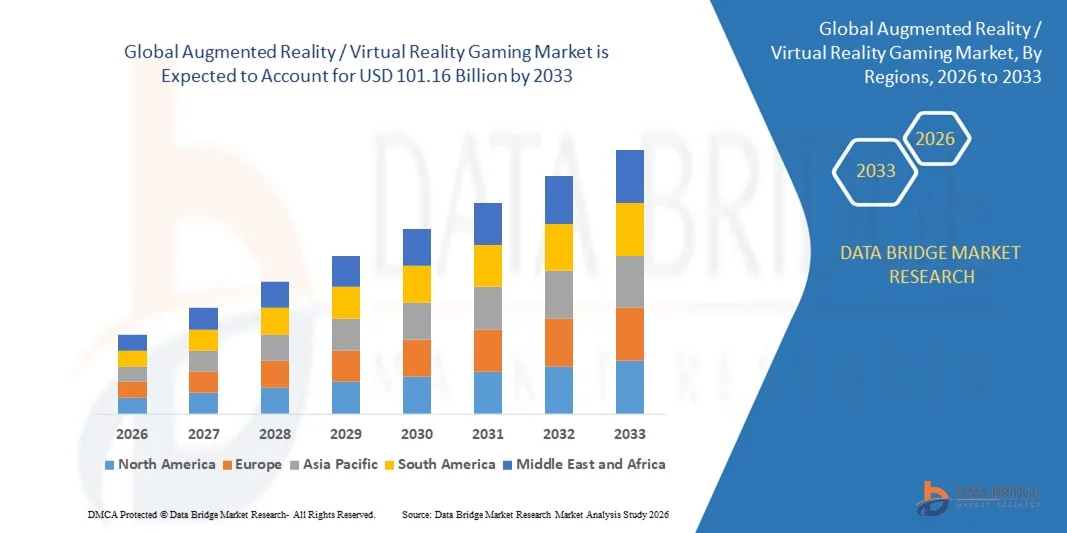
- As per Data Bridge Market Research Analysis the global augmented reality / virtual reality gaming market size was valued at USD 25.15 billion in 2025 and is expected to reach USD 101.16 billion by 2033, at a CAGR of 19.0% during the forecast period
- The market growth is largely fueled by the rapid advancement of immersive technologies and increasing adoption of high-performance gaming hardware such as virtual reality headsets, motion sensors, and haptic feedback devices, enabling more realistic and interactive gaming experiences across multiple platforms
- Furthermore, rising consumer interest in immersive entertainment, expanding esports ecosystems, and continuous investments by gaming companies in developing advanced interactive content are establishing augmented reality and virtual reality gaming as a key segment of the global gaming industry. These converging factors are accelerating the adoption of immersive gaming technologies, thereby significantly boosting the industry's growth
Market Size & Forecast
- Global Market Value (2025): USD 25.15 Billion
- Expected Market Value (2033): USD 101.16 Billion
- Forecast CAGR (2026–2033): 19.0%
What are the Major Takeaways of Augmented Reality / Virtual Reality Gaming Market?
- Augmented reality and virtual reality gaming platforms provide immersive digital environments that enable players to interact with virtual elements in real time, offering enhanced realism, spatial interaction, and highly engaging gameplay experiences across consoles, personal computers, and mobile devices
- The escalating demand for augmented reality and virtual reality gaming is primarily driven by technological advancements in graphics processing, motion tracking, and display technologies, along with increasing popularity of immersive multiplayer gaming experiences and growing investments by major technology and gaming companies in immersive content development
- Asia-Pacific dominated the augmented reality / virtual reality gaming market with a share of around 50% in 2025, due to increasing smartphone and PC penetration, expanding gaming communities, and rapid adoption of AR/VR hardware and software solutions
- North America is expected to be the fastest growing region in the augmented reality / virtual reality gaming market during the forecast period due to strong demand for high-end gaming hardware, cloud-based augmented reality and virtual reality platforms, and immersive multiplayer experiences
- Hardware segment dominated the market with a market share of 57.9% in 2025, due to the increasing adoption of AR/VR headsets, motion sensors, haptic devices, and controllers that enhance immersive gaming experiences. Gamers prioritize high-quality hardware for realistic graphics, responsive tracking, and interactive gameplay, contributing to consistent market demand. Hardware innovations, such as lighter headsets and advanced motion-sensing technology, further boost adoption
Report Scope and Augmented Reality / Virtual Reality Gaming Market Segmentation
|
Attributes |
Augmented Reality / Virtual Reality Gaming Key Market Insights |
|
Segments Covered |
|
|
Countries Covered |
North America
Europe
Asia-Pacific
Middle East and Africa
South America
|
|
Key Market Players |
|
|
Market Opportunities |
|
|
Value Added Data Infosets |
In addition to the market insights such as market value, growth rate, market segments, geographical coverage, market players, and market scenario, the market report curated by the Data Bridge Market Research team includes in-depth expert analysis, import/export analysis, pricing analysis, production consumption analysis, and pestle analysis. |
What is the Key Trend in the Augmented Reality / Virtual Reality Gaming Market?
Growing Integration of Mixed Reality and Immersive Gameplay Technologies
- A major trend in the augmented reality / virtual reality gaming market is the increasing integration of mixed reality technologies that blend physical and digital environments to create highly immersive gaming experiences. This technological evolution is transforming gaming from traditional screen-based interaction into spatial environments where players can interact with virtual objects and characters in real time
- For instance, Meta Platforms introduced the mixed reality headset Meta Quest 3, which enables players to experience games that combine real-world surroundings with digital elements. Such innovations are strengthening the immersive gaming ecosystem and encouraging developers to design more interactive and environment-aware gaming experiences
- Game developers are increasingly creating titles that utilize advanced motion tracking, gesture recognition, and spatial mapping technologies to deliver more realistic gameplay mechanics. These capabilities allow players to move naturally within gaming environments, improving engagement and creating deeper emotional connections with virtual worlds
- The growth of immersive gaming is also supported by advancements in graphics processing units and game engines that enable detailed rendering of virtual environments. These technological improvements are enabling developers to build complex virtual worlds with high visual fidelity and smooth real-time interaction
- Gaming studios are expanding their focus on multiplayer immersive experiences where players can interact socially within virtual environments. This is strengthening the development of shared virtual spaces that enhance collaboration, competition, and community-driven gaming experiences
- The growing convergence of augmented reality, virtual reality, and mixed reality technologies is shaping the future of the gaming industry by creating new forms of digital entertainment. This trend is reinforcing the role of immersive technologies in transforming gaming experiences and driving long-term growth in the augmented reality / virtual reality gaming market
Augmented Reality / Virtual Reality Gaming Market Dynamics
Driver
Growing Demand for Immersive Gaming Experiences
- The increasing demand for immersive and interactive gaming experiences is a major factor driving the augmented reality / virtual reality gaming market. Gamers are increasingly seeking entertainment platforms that provide deeper engagement, realistic interaction, and highly responsive virtual environments that extend beyond traditional gaming formats
- For instance, Sony Interactive Entertainment launched the advanced virtual reality headset PlayStation VR2 designed for the PlayStation 5 gaming console. This device enables high-resolution visuals, eye tracking, and haptic feedback features that significantly enhance immersion and realism during gameplay
- The rapid expansion of esports and online multiplayer gaming is encouraging developers to adopt immersive technologies that allow players to compete and interact within fully virtual environments. This shift is increasing the appeal of virtual reality and augmented reality gaming platforms among both casual and professional gamers
- Advancements in graphics processing technology and game development engines are also supporting the creation of detailed virtual environments that improve player engagement. These innovations are enabling developers to design games that offer realistic physics, dynamic environments, and interactive storytelling elements
- The growing consumer interest in next-generation gaming platforms that provide realistic and interactive experiences continues to strengthen this driver. As immersive technologies become more accessible and content libraries expand, the demand for augmented reality and virtual reality gaming solutions is expected to rise steadily
Restraint/Challenge
High Cost of AR and VR Gaming Devices
- The augmented reality / virtual reality gaming market faces challenges due to the relatively high cost associated with advanced gaming hardware such as virtual reality headsets, motion controllers, and specialized computing systems. These costs can create barriers for many consumers who may be interested in immersive gaming but are unable to invest in premium devices
- For instance, Apple introduced the mixed reality headset Apple Vision Pro with advanced display technology, spatial computing capabilities, and precision sensors. Although the device demonstrates the technological potential of immersive computing, its high price limits widespread consumer adoption in gaming markets
- High-performance virtual reality gaming systems often require powerful personal computers or gaming consoles capable of supporting complex graphical processing and real-time interaction. This increases the overall cost of ownership for users who must invest in both hardware and compatible gaming infrastructure
- Manufacturers also face challenges related to producing high-quality displays, sensors, and motion-tracking components required for immersive gaming devices. These components require advanced engineering and specialized materials, which contribute to higher manufacturing and retail prices
- The market therefore faces ongoing pressure to balance technological advancement with affordability in order to achieve wider consumer adoption. Reducing hardware costs while maintaining performance and immersion remains a key challenge influencing the expansion of the augmented reality / virtual reality gaming market
How is the Augmented Reality / Virtual Reality Gaming Market Segmented?
The market is segmented on the basis of components, connecting device, organization size, application, and industry vertical.
- By Components
On the basis of components, the augmented reality / virtual reality gaming market is segmented into hardware and software. The hardware segment dominated the market with the largest revenue share of 57.9% in 2025, driven by the increasing adoption of AR/VR headsets, motion sensors, haptic devices, and controllers that enhance immersive gaming experiences. Gamers prioritize high-quality hardware for realistic graphics, responsive tracking, and interactive gameplay, contributing to consistent market demand. Hardware innovations, such as lighter headsets and advanced motion-sensing technology, further boost adoption. Compatibility with multiple gaming platforms and continuous technological improvements strengthen the hardware segment's dominance.
The software segment is expected to witness the fastest growth from 2026 to 2033, fueled by rising demand for AR/VR content, interactive gaming applications, and subscription-based gaming services. For instance, companies such as Unity Technologies provide powerful development engines that enable game developers to create high-quality AR/VR experiences. Increasing investments in immersive game design, multiplayer functionality, and AI-driven environments contribute to software adoption. The software segment benefits from scalable updates, frequent content releases, and cloud-based integration, allowing gamers and enterprises to continuously enhance gameplay experiences.
- By Connecting Device
On the basis of connecting device, the market is segmented into gaming consoles, PCs and desktops, and smartphones. The PC and desktop segment dominated the market in 2025, driven by its superior processing power, high-resolution graphics, and compatibility with advanced AR/VR headsets. Gamers often prefer PCs for competitive and high-fidelity gaming experiences, and the ability to customize hardware components enhances performance. PC-based AR/VR gaming also supports immersive simulations and multiplayer interactions that attract hardcore gamers and esports enthusiasts. The integration of powerful GPUs and low-latency systems further consolidates its market leadership.
The smartphone segment is projected to witness the fastest growth from 2026 to 2033, fueled by increasing smartphone penetration, affordability, and the rise of mobile AR/VR gaming applications. For instance, Niantic has popularized AR-based mobile games that engage millions of users globally. Smartphones offer convenience, portability, and easy access to AR/VR experiences without additional hardware investments. The segment benefits from continuous improvements in mobile processors, cameras, and sensors, enabling richer interactive gameplay and casual gaming adoption.
- By Organisation Size
On the basis of organization size, the augmented reality / virtual reality gaming market is segmented into large enterprises and small and medium-sized enterprises (SMEs). Large enterprises dominated the market in 2025, driven by their capacity to invest in high-end AR/VR infrastructure, gaming studios, and technology partnerships. Enterprises often leverage AR/VR for creating large-scale immersive games, training simulations, and content distribution networks, which require substantial capital and technical expertise. Strategic collaborations and in-house R&D enable enterprises to maintain competitive advantage and develop cutting-edge experiences. The ability to integrate AR/VR with other technologies, such as AI and cloud computing, reinforces their dominance in the market.
The SME segment is expected to witness the fastest growth from 2026 to 2033, driven by the increasing availability of affordable AR/VR development tools, cloud-based gaming solutions, and low-cost hardware. For instance, Oculus Studios provides resources that enable smaller studios to create immersive games. SMEs focus on niche gaming experiences, interactive storytelling, and experimental AR/VR content to capture specific user segments. The segment benefits from flexible business models, scalable development platforms, and community-driven game engagement, supporting rapid adoption across regions.
- By Application
On the basis of application, the augmented reality / virtual reality gaming market is segmented into consumer and enterprise. The consumer segment dominated the market in 2025, driven by the growing popularity of immersive gaming, entertainment applications, and social AR/VR experiences. Consumers prioritize engaging gameplay, multiplayer experiences, and interactive content that enhances realism and excitement. Continuous advancements in AR/VR headsets, motion controllers, and haptic feedback devices strengthen the consumer segment. Integration with popular gaming platforms, online stores, and subscription services further fuels widespread adoption.
The enterprise segment is projected to witness the fastest growth from 2026 to 2033, fueled by rising utilization of AR/VR for training simulations, virtual collaboration, and immersive marketing experiences. For instance, Sony Interactive Entertainment delivers customized VR solutions for corporate training programs. Enterprises adopt AR/VR to improve operational efficiency, employee engagement, and customer interaction. The enterprise segment benefits from scalable AR/VR software platforms, content customization, and cross-industry integration, supporting rapid expansion in sectors beyond gaming.
- By Industry Vertical
On the basis of industry vertical, the market is segmented into entertainment and media, aerospace and defense, healthcare, education, manufacturing, retail, and others. The entertainment and media segment dominated the market in 2025, driven by high adoption of AR/VR gaming applications, immersive storytelling, and interactive media experiences. Users increasingly seek engaging, realistic content that provides full sensory immersion. The segment benefits from investments in game design, cinematic VR experiences, and esports applications, reinforcing its dominance. High consumer awareness, growing content libraries, and platform integration further contribute to its market leadership.
The healthcare segment is expected to witness the fastest growth from 2026 to 2033, driven by rising adoption of AR/VR for medical training, therapy, and simulation-based rehabilitation. For instance, Osso VR provides VR platforms for surgical training and procedural simulations. Healthcare providers leverage AR/VR to enhance learning, reduce errors, and improve patient engagement. The segment benefits from growing investments in immersive technology, increasing demand for interactive medical education, and the rising adoption of simulation-based therapy programs.
Which Region Holds the Largest Share of the Augmented Reality / Virtual Reality Gaming Market?
- Asia-Pacific dominated the augmented reality / virtual reality gaming market with the largest revenue share of around 50% in 2025, driven by increasing smartphone and PC penetration, expanding gaming communities, and rapid adoption of AR/VR hardware and software solutions
- The region’s cost-effective technology development, rising investments in game studios, and supportive government initiatives for digital entertainment are accelerating market expansion
- Availability of skilled developers, rising consumer disposable income, and growing esports and immersive content platforms are contributing to increased AR/VR gaming adoption across the region
China Augmented Reality / Virtual Reality Gaming Market Insight
China held the largest share in the Asia-Pacific Augmented Reality / Virtual Reality Gaming Market in 2025, owing to its position as a global leader in gaming and digital technology development. The country’s strong information technology infrastructure, large gamer base, and active investment in augmented reality and virtual reality startups are major growth drivers. In addition, rising consumer interest in mobile and console-based augmented reality and virtual reality games, along with government support for digital entertainment innovation, is boosting market expansion.
India Augmented Reality / Virtual Reality Gaming Market Insight
India is witnessing the fastest growth in the Asia-Pacific region, fueled by a rapidly growing smartphone user base, increasing internet penetration, and rising investments in augmented reality and virtual reality game development. Government initiatives such as Digital India and growing esports tournaments are strengthening augmented reality and virtual reality gaming adoption. In addition, expanding mobile gaming platforms, rising youth engagement, and local game development studios are contributing to robust market growth.
Europe Augmented Reality / Virtual Reality Gaming Market Insight
The Europe Augmented Reality / Virtual Reality Gaming Market is expanding steadily, supported by high consumer spending on gaming, strong technological infrastructure, and a focus on immersive entertainment experiences. The region emphasizes high-quality game content, cross-platform augmented reality and virtual reality solutions, and integration with cloud gaming services. Increasing investment in independent and AAA game studios, along with supportive regulations for digital innovation, is enhancing market development.
Germany Augmented Reality / Virtual Reality Gaming Market Insight
Germany’s Augmented Reality / Virtual Reality Gaming Market is driven by advanced technology adoption, strong game development ecosystems, and rising interest in immersive entertainment. The country has well-established gaming studios and research and development collaborations, fostering innovation in augmented reality and virtual reality gameplay and simulation experiences. Demand is particularly strong for high-fidelity personal computer and console-based gaming, virtual reality arcades, and educational augmented reality and virtual reality applications.
U.K. Augmented Reality / Virtual Reality Gaming Market Insight
The U.K. market is supported by a mature gaming industry, growing investments in augmented reality and virtual reality content creation, and rising interest in virtual esports and entertainment experiences. Academic-industry partnerships and government-backed innovation programs are promoting augmented reality and virtual reality game development. Increasing consumer engagement with virtual reality headsets, mobile augmented reality applications, and interactive gaming platforms is strengthening the U.K.’s role in Europe’s immersive gaming landscape.
North America Augmented Reality / Virtual Reality Gaming Market Insight
North America is projected to grow at the fastest compound annual growth rate from 2026 to 2033, driven by strong demand for high-end gaming hardware, cloud-based augmented reality and virtual reality platforms, and immersive multiplayer experiences. A robust gaming ecosystem, rising esports popularity, and continuous hardware and software innovations are boosting market growth. In addition, increased adoption of augmented reality and virtual reality for simulation, education, and entertainment applications is supporting expansion.
U.S. Augmented Reality / Virtual Reality Gaming Market Insight
The U.S. accounted for the largest share in the North America Augmented Reality / Virtual Reality Gaming Market in 2025, underpinned by its advanced gaming infrastructure, strong developer ecosystem, and high consumer adoption of augmented reality and virtual reality devices. The country’s focus on technological innovation, cloud-based gaming solutions, and immersive content creation is encouraging widespread adoption. Presence of leading augmented reality and virtual reality companies, well-established distribution networks, and a vibrant gaming community further solidify the U.S.’ leading position in the region.
Which are the Top Companies in Augmented Reality / Virtual Reality Gaming Market?
The augmented reality / virtual reality gaming industry is primarily led by well-established companies, including:
- FOVE, Inc. (Japan)
- Google LLC (U.S.)
- Facebook Technologies, LLC (U.S.)
- Razer Inc. (Singapore)
- Sony Corporation (Japan)
- Carl Zeiss AG (Germany)
- AMD Global Telemedicine, Inc. (U.S.)
- GoPro, Inc. (U.S.)
- Largan Precision Co., Ltd. (Taiwan)
- NVIDIA Corporation (U.S.)
- Qualcomm Technologies, Inc. (U.S.)
- bHaptics Inc. (South Korea)
- HTC Corporation (Taiwan)
- Samsung Electronics Co., Ltd. (South Korea)
- TESLASUIT (U.K.)
What are Latest Developments in Augmented Reality / Virtual Reality Gaming Market?
- In September 2024, Ubisoft launched the virtual reality rhythm game Just Dance VR: Welcome to Dancity for the Meta Quest platform, expanding one of the most widely recognized dance gaming franchises into immersive virtual reality environments. The game enables full-body motion interaction, multiplayer participation, and social gameplay within virtual spaces, significantly enhancing user engagement. This development highlights the growing integration of popular gaming franchises with immersive technologies and supports the expansion of the augmented reality / virtual reality gaming market by attracting both existing franchise players and new virtual reality users
- In October 2023, Meta Platforms introduced the mixed-reality headset Meta Quest 3, featuring improved graphics performance, advanced Snapdragon XR2 processing capabilities, full-color passthrough technology, and enhanced spatial interaction features for immersive gaming experiences. The device enables developers to design games that blend physical and digital environments, creating more interactive gameplay experiences. This launch significantly strengthened the hardware ecosystem supporting immersive gaming and encouraged wider developer participation, accelerating innovation and user adoption across the augmented reality / virtual reality gaming market
- In June 2023, Apple unveiled the spatial computing headset Apple Vision Pro during the Apple Worldwide Developers Conference, introducing a powerful mixed-reality platform capable of supporting immersive augmented reality and virtual reality gaming applications. The device integrates advanced sensors, high-resolution displays, spatial audio, and gesture-based controls to create highly interactive virtual environments. The entry of a major technology innovator into immersive computing significantly increased industry investment and competition, encouraging rapid innovation in gaming hardware, software development, and immersive content creation within the augmented reality / virtual reality gaming market
- In May 2023, Meta Platforms expanded its collaboration with Unity Technologies to enhance development tools, software frameworks, and optimization capabilities for immersive content creation on Meta’s virtual reality platforms. The partnership focuses on simplifying game development processes, improving performance optimization, and enabling developers to create more advanced augmented reality and virtual reality gaming experiences. This collaboration strengthens the developer ecosystem by lowering barriers to entry and accelerating the creation of high-quality immersive games, which supports long-term expansion of the augmented reality / virtual reality gaming market
- In February 2023, Sony Interactive Entertainment released the next-generation headset PlayStation VR2 designed for the PlayStation 5 console, integrating advanced technologies such as eye-tracking, adaptive triggers, haptic feedback, and precise motion sensing. These features allow gamers to experience highly responsive and realistic virtual environments, improving gameplay immersion and interaction. The launch strengthened Sony’s immersive gaming ecosystem and increased consumer interest in console-based virtual reality gaming, contributing to the growing adoption of immersive gaming platforms in the augmented reality / virtual reality gaming market

- Interactive Data Analysis Dashboard
- Company Analysis Dashboard for high growth potential opportunities
- Research Analyst Access for customization & queries
- Competitor Analysis with Interactive dashboard
- Latest News, Updates & Trend analysis
- Harness the Power of Benchmark Analysis for Comprehensive Competitor Tracking
Data collection and base year analysis are done using data collection modules with large sample sizes. The stage includes obtaining market information or related data through various sources and strategies. It includes examining and planning all the data acquired from the past in advance. It likewise envelops the examination of information inconsistencies seen across different information sources. The market data is analysed and estimated using market statistical and coherent models. Also, market share analysis and key trend analysis are the major success factors in the market report. To know more, please request an analyst call or drop down your inquiry.
The key research methodology used by DBMR research team is data triangulation which involves data mining, analysis of the impact of data variables on the market and primary (industry expert) validation. Data models include Vendor Positioning Grid, Market Time Line Analysis, Market Overview and Guide, Company Positioning Grid, Patent Analysis, Pricing Analysis, Company Market Share Analysis, Standards of Measurement, Global versus Regional and Vendor Share Analysis. To know more about the research methodology, drop in an inquiry to speak to our industry experts.
Data Bridge Market Research is a leader in advanced formative research. We take pride in servicing our existing and new customers with data and analysis that match and suits their goal. The report can be customized to include price trend analysis of target brands understanding the market for additional countries (ask for the list of countries), clinical trial results data, literature review, refurbished market and product base analysis. Market analysis of target competitors can be analyzed from technology-based analysis to market portfolio strategies. We can add as many competitors that you require data about in the format and data style you are looking for. Our team of analysts can also provide you data in crude raw excel files pivot tables (Fact book) or can assist you in creating presentations from the data sets available in the report.













