


Autoclaved Aerated Concrete (AAC) Market Size
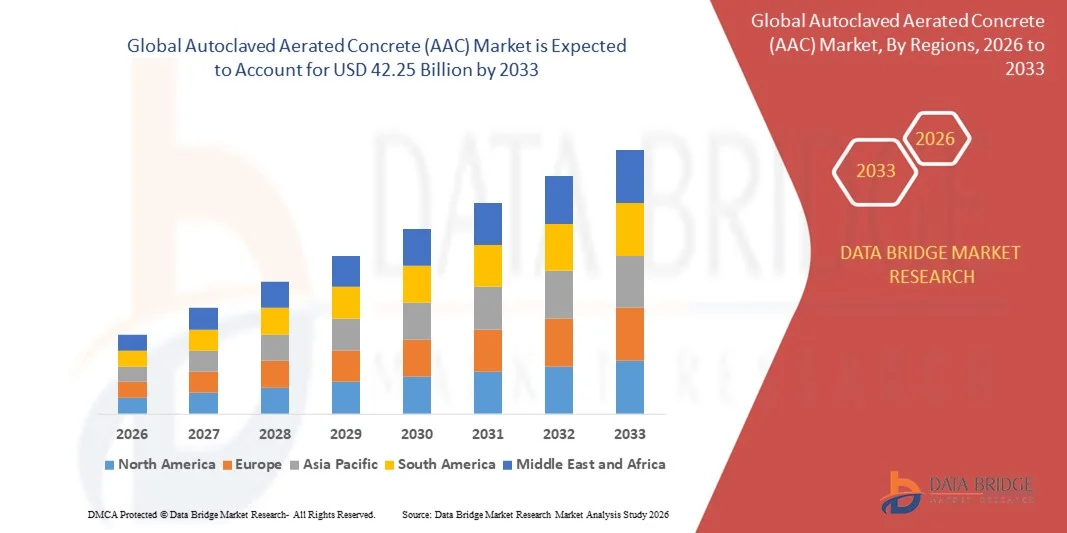
- The global Autoclaved Aerated Concrete (AAC) market size was valued at USD 19.42 billion in 2025 and is expected to reach USD 42.25 billion by 2033, at a CAGR of 10.2% during the forecast period
- The market growth is largely fueled by the rising adoption of energy-efficient, lightweight, and sustainable construction materials in residential, commercial, and industrial projects, driving increased use of Autoclaved Aerated Concrete (AAC) in modern building practices
- Furthermore, growing urbanization, government initiatives promoting green construction, and increasing investments in affordable housing and infrastructure projects are reinforcing Autoclaved Aerated Concrete (AAC) as a preferred building material. These converging factors are accelerating the adoption of Autoclaved Aerated Concrete (AAC) solutions, thereby significantly boosting the market’s growth
Autoclaved Aerated Concrete (AAC) Market Analysis
- Autoclaved Aerated Concrete (AAC), comprising lightweight, thermally efficient, and fire-resistant blocks, panels, and structural elements, is increasingly vital in modern construction due to its ease of handling, durability, and compatibility with sustainable building practices
- The escalating demand for Autoclaved Aerated Concrete (AAC) is primarily fueled by rapid urbanization, rising construction activities in residential and commercial sectors, and a growing focus on reducing building energy consumption and overall construction costs
- Asia-Pacific dominated the Autoclaved Aerated Concrete (AAC) market with a share of 47.28% in 2025, due to rapid urbanization, expanding construction activities, and growing adoption of energy-efficient and sustainable building materials
- North America is expected to be the fastest growing region in the Autoclaved Aerated Concrete (AAC) market during the forecast period due to rising infrastructure development, smart city projects, and demand for environmentally friendly construction materials
- Blocks segment dominated the market with a market share of 55.28% in 2025, due to their versatility, lightweight nature, and ease of installation in various construction projects. Builders and contractors often prefer Autoclaved Aerated Concrete (AAC) blocks for residential and commercial structures due to their superior thermal insulation, fire resistance, and soundproofing properties. The strong demand is further reinforced by blocks’ compatibility with modern construction techniques and ability to reduce overall structural load, thereby lowering project costs and construction time. In addition, the increasing adoption of sustainable and energy-efficient building materials enhances the appeal of Autoclaved Aerated Concrete (AAC) blocks in new construction projects
Report Scope and Autoclaved Aerated Concrete (AAC) Market Segmentation
|
Attributes |
Autoclaved Aerated Concrete (AAC) Key Market Insights |
|
Segments Covered |
|
|
Countries Covered |
North America
Europe
Asia-Pacific
Middle East and Africa
South America
|
|
Key Market Players |
|
|
Market Opportunities |
|
|
Value Added Data Infosets |
In addition to the insights on market scenarios such as market value, growth rate, segmentation, geographical coverage, and major players, the market reports curated by the Data Bridge Market Research also include import export analysis, production capacity overview, production consumption analysis, price trend analysis, climate change scenario, supply chain analysis, value chain analysis, raw material/consumables overview, vendor selection criteria, PESTLE Analysis, Porter Analysis, and regulatory framework. |
Autoclaved Aerated Concrete (AAC) Market Trends
Increasing Adoption of Energy-Efficient and Sustainable Construction Materials
- A significant trend in the Autoclaved Aerated Concrete (AAC) market is the growing preference for energy-efficient, lightweight, and environmentally friendly construction materials, driven by the rising need to reduce building energy consumption and carbon footprint in residential, commercial, and industrial projects. This trend is elevating Autoclaved Aerated Concrete (AAC) as a key material for modern construction practices that emphasize sustainability, thermal insulation, and reduced structural load
- For instance, companies such as Xella Group and UltraTech Cement are supplying high-quality Autoclaved Aerated Concrete (AAC) blocks and panels that meet green building standards and regulatory compliance, enabling developers to achieve energy efficiency targets and improve construction quality
- The adoption of Autoclaved Aerated Concrete (AAC) materials is increasing in urban housing projects and commercial complexes where lightweight and modular construction reduces labor costs, accelerates project timelines, and improves overall building performance. These factors are positioning Autoclaved Aerated Concrete (AAC) as a preferred choice for forward-looking construction projects
- Rapid industrialization in emerging markets is further fueling demand for Autoclaved Aerated Concrete (AAC) products as governments and private developers prioritize sustainable urbanization and affordable housing initiatives. AAC’s ability to deliver fire resistance, sound insulation, and thermal efficiency strengthens its relevance in such projects
- In high-rise residential and commercial buildings, Autoclaved Aerated Concrete (AAC) blocks and panels are being integrated into structural and non-structural elements to reduce building weight without compromising durability. This enhances design flexibility and supports modern architectural requirements
- The market is witnessing growth in infrastructure and public projects where AAC’s performance advantages, including low maintenance requirements and long-term durability, provide economic and environmental benefits. These projects reinforce AAC’s role as a modern, high-performance building material
Autoclaved Aerated Concrete (AAC) Market Dynamics
Driver
Rising Urbanization and Infrastructure Development Projects
- The Autoclaved Aerated Concrete (AAC) market is largely driven by increasing urbanization, rapid expansion of residential and commercial infrastructure, and growing investments in government and private construction projects. These factors are creating higher demand for lightweight, cost-effective, and energy-efficient building materials that can support fast-paced construction schedules
- For instance, BirlaNu Limited and Aercon AAC are expanding production capacities and forming strategic partnerships with developers to cater to rising demand in urban housing and commercial projects. These initiatives strengthen supply chains and facilitate wider adoption of Autoclaved Aerated Concrete (AAC) products
- Large-scale industrial, commercial, and housing developments are increasingly specifying Autoclaved Aerated Concrete (AAC) blocks, panels, and roof elements due to their structural reliability, fire resistance, and thermal insulation properties. This trend ensures Autoclaved Aerated Concrete (AAC) remains a core material in modern construction
- Rising awareness of sustainable construction practices is also influencing architects and builders to prefer Autoclaved Aerated Concrete (AAC) materials, as they contribute to reduced carbon emissions and energy savings in both new and retrofitted buildings
- The ongoing development of smart cities and urban infrastructure projects is further propelling the Autoclaved Aerated Concrete (AAC) market by creating consistent demand for lightweight, high-performance, and environmentally compliant building solutions
Restraint/Challenge
High Initial Production and Material Costs
- The Autoclaved Aerated Concrete (AAC) market faces challenges due to the high capital investment required for manufacturing plants, specialized autoclaving equipment, and quality raw materials such as cement, lime, and silica. These factors increase production costs and may limit adoption in cost-sensitive construction projects
- For instance, Asahi Kasei Construction Materials closed its Iwakuni plant in 2023 to optimize production and manage rising raw material and fuel costs, highlighting the operational pressures manufacturers face
- The intricate production process, which involves precise mixing, molding, curing, and autoclaving, adds complexity and extends production timelines, contributing to higher prices for end users
- The market also encounters cost-related challenges in emerging regions where low-cost alternatives are preferred, requiring Autoclaved Aerated Concrete (AAC) manufacturers to balance performance benefits with economic feasibility
- These cost constraints collectively affect market penetration, especially in price-sensitive residential and low-budget infrastructure projects, making affordability a key barrier for wider adoption
Autoclaved Aerated Concrete (AAC) Market Scope
The market is segmented on the basis of element and application.
- By Element
On the basis of element, the Autoclaved Aerated Concrete (AAC) market is segmented into blocks, beams and lintels, cladding panels, wall panels, roof panels, and floor elements. The blocks segment dominated the market with the largest revenue share of 55.28% in 2025, driven by their versatility, lightweight nature, and ease of installation in various construction projects. Builders and contractors often prefer AAC blocks for residential and commercial structures due to their superior thermal insulation, fire resistance, and soundproofing properties. The strong demand is further reinforced by blocks’ compatibility with modern construction techniques and ability to reduce overall structural load, thereby lowering project costs and construction time. In addition, the increasing adoption of sustainable and energy-efficient building materials enhances the appeal of Autoclaved Aerated Concrete (AAC) blocks in new construction projects. The market also benefits from the availability of different block sizes and densities, which provide flexibility for both load-bearing and non-load-bearing walls. Overall, blocks remain the foundational element driving the Autoclaved Aerated Concrete (AAC) market’s growth and adoption.
The beams and lintels segment is anticipated to witness the fastest growth from 2026 to 2033, fueled by rising demand in multi-story residential and commercial construction projects. Beams and lintels provide structural support while maintaining AAC’s lightweight advantages, making them an attractive choice for architects and engineers. For instance, companies such as Xella Group are increasingly offering customized Autoclaved Aerated Concrete (AAC) beams and lintels to meet modern building codes and sustainability standards. The growing trend of prefabricated construction and modular building systems further supports the adoption of Autoclaved Aerated Concrete (AAC) beams and lintels. These elements also allow for faster on-site assembly, reducing labor costs and construction timelines. In addition, their inherent fire resistance and durability make them suitable for high-rise applications and industrial structures. The combination of structural efficiency and ease of integration with other Autoclaved Aerated Concrete (AAC) components positions beams and lintels as a rapidly expanding segment in the market.
- By Application
On the basis of application, the Autoclaved Aerated Concrete (AAC) market is segmented into residential, industrial, commercial, and other applications. The residential segment dominated the market with the largest revenue share in 2025, driven by the growing demand for energy-efficient, lightweight, and environmentally friendly building materials in housing projects. Homeowners and builders often prefer Autoclaved Aerated Concrete (AAC) for walls, partitions, and roofing due to its thermal insulation, soundproofing, and fire-resistant properties. The market growth is reinforced by government initiatives promoting sustainable and green construction practices in urban and semi-urban areas. For instance, LafargeHolcim has been actively supplying Autoclaved Aerated Concrete (AAC) blocks and panels for residential projects that prioritize energy efficiency and low carbon footprint. The ease of handling, faster construction, and reduced labor requirements also make Autoclaved Aerated Concrete (AAC) an attractive choice for residential builders. Overall, residential applications continue to lead the Autoclaved Aerated Concrete (AAC) market due to widespread adoption in housing and infrastructure projects.
The commercial segment is expected to witness the fastest growth from 2026 to 2033, fueled by increasing investment in offices, retail complexes, and institutional buildings requiring durable, lightweight, and thermally efficient construction materials. Commercial projects often demand Autoclaved Aerated Concrete (AAC) panels and blocks for their structural reliability and ability to meet modern architectural designs. For instance, companies such as H+H International are providing Autoclaved Aerated Concrete (AAC) wall and cladding panels tailored for commercial applications to enhance energy efficiency and reduce construction time. The adoption is further supported by the need for cost-effective solutions that reduce material usage and overall building load. Autoclaved Aerated Concrete (AAC) materials also offer enhanced fire protection and sound insulation, making them ideal for high-occupancy commercial spaces. The combination of sustainability, cost-effectiveness, and design flexibility positions the commercial segment as the fastest-growing application area in the Autoclaved Aerated Concrete (AAC) market.
Autoclaved Aerated Concrete (AAC) Market Regional Analysis
- Asia-Pacific dominated the Autoclaved Aerated Concrete (AAC) market with the largest revenue share of 47.28% in 2025, driven by rapid urbanization, expanding construction activities, and growing adoption of energy-efficient and sustainable building materials
- The region’s cost-effective production landscape, rising investments in prefabricated and modular construction, and increasing demand for lightweight concrete solutions are accelerating market growth
- The availability of skilled labor, supportive government policies for green construction, and large-scale infrastructure development across developing economies are contributing to increased consumption of AAC
China Autoclaved Aerated Concrete (AAC) Market Insight
China held the largest share in the Asia-Pacific Autoclaved Aerated Concrete (AAC) market in 2025, owing to its strong construction industry, extensive infrastructure projects, and government initiatives promoting sustainable building materials. The country’s focus on energy-efficient residential and commercial buildings, combined with a robust manufacturing base for Autoclaved Aerated Concrete (AAC) products, is driving demand. Increasing investments in urban housing, industrial parks, and high-rise developments further support Autoclaved Aerated Concrete (AAC) adoption across multiple sectors.
India Autoclaved Aerated Concrete (AAC) Market Insight
India is witnessing the fastest growth in the Asia-Pacific region, fueled by rapid urbanization, affordable housing initiatives, and growing preference for lightweight and thermally efficient building materials. For instance, major Autoclaved Aerated Concrete (AAC) manufacturers such as Ultratech Cement are expanding production capacities to meet rising demand in residential and commercial construction. Government programs promoting sustainable construction and infrastructure modernization are also strengthening Autoclaved Aerated Concrete (AAC) market growth.
Europe Autoclaved Aerated Concrete (AAC) Market Insight
The Europe AAC market is expanding steadily, supported by stringent building regulations, strong focus on energy-efficient and eco-friendly materials, and growing investments in sustainable construction projects. The region emphasizes compliance with environmental standards, fire safety, and durability, particularly in residential and commercial buildings. Increasing adoption of prefabricated AAC panels and blocks for modern architecture is enhancing market expansion.
Germany AAC Market Insight
Germany’s Autoclaved Aerated Concrete (AAC) market is driven by its emphasis on high-quality construction materials, strong engineering and manufacturing capabilities, and commitment to sustainable and energy-efficient building solutions. Demand is particularly strong in residential and commercial sectors that prioritize fire-resistant, lightweight, and thermally insulating materials. Presence of established AAC manufacturers and advanced R&D in construction technologies further support market growth.
U.K. Autoclaved Aerated Concrete (AAC) Market Insight
The U.K. market is supported by stringent building codes, increasing investments in modern infrastructure, and growing adoption of sustainable construction practices. Rising demand for energy-efficient residential and commercial projects, coupled with the use of Autoclaved Aerated Concrete (AAC) blocks and panels in retrofitting and new construction, is driving growth. Academic-industry collaborations and innovations in lightweight concrete solutions are further strengthening the market.
North America Autoclaved Aerated Concrete (AAC) Market Insight
North America is projected to grow at the fastest CAGR from 2026 to 2033, driven by rising infrastructure development, smart city projects, and demand for environmentally friendly construction materials. The adoption of Autoclaved Aerated Concrete (AAC) in residential, commercial, and industrial construction is increasing due to its lightweight, fire-resistant, and energy-efficient properties. For instance, companies such as Aercon AAC and H+H International are expanding their production capacities to meet growing demand in the U.S. and Canada.
U.S. Autoclaved Aerated Concrete (AAC) Market Insight
The U.S. accounted for the largest share in the North America market in 2025, underpinned by strong infrastructure development, increasing green building projects, and widespread awareness of energy-efficient construction materials. The country’s focus on sustainable urban development and large-scale residential and commercial construction projects is driving Autoclaved Aerated Concrete (AAC) adoption. Presence of leading Autoclaved Aerated Concrete (AAC) manufacturers, advanced distribution networks, and favorable building codes further solidify the U.S.’s leading position in the region.
Autoclaved Aerated Concrete (AAC) Market Share
The Autoclaved Aerated Concrete (AAC) industry is primarily led by well-established companies, including:
- Buildmate (India)
- Biltech Building Elements Limited (India)
- AKG Gazbeton (Turkey)
- Aercon Florida LLC (U.S.)
- Solbet Sp Z.O.O. (Poland)
- UAL Industries Ltd (U.K.)
- H+H International A/S (Denmark)
- JK Lakshmi Cement Ltd (India)
- Xella Group (Germany)
- CSR Limited (Australia)
- UltraTech Cement Ltd (India)
- Quinn Building Products Ltd (Ireland)
- Bauroc AS (Estonia)
- Wehrhahn GmbH (Germany)
- Tarmac (U.K.)
- ACICO Group (UAE)
- HIL.in (India)
- Forterra (U.K.)
- SKM GmbH (Germany)
- Apollo Inffratech Pvt. Ltd (India)
Latest Developments in Global Autoclaved Aerated Concrete (AAC) Market
- In May 2025, BirlaNu Limited (formerly HIL Limited) commenced commercial production of autoclaved aerated concrete (AAC) blocks at its Chennai plant. This expansion increased the plant’s total capacity from 236,520 cubic meters (m³) to 448,220 m³, adding 211,700 m³ of additional production capability. The increased output is expected to strengthen the company’s market presence in southern India, address rising regional demand, and enhance its ability to supply large-scale residential and commercial projects efficiently, thereby supporting revenue growth and competitive positioning
- In 2025, Aercon AAC partnered with Indian real estate developers to accelerate project deliveries using AAC materials. This strategic collaboration enables faster supply of blocks and panels to ongoing construction projects, improving project timelines and efficiency. The partnership is anticipated to boost Aercon AAC’s market share in India, enhance customer reliance on its products, and reinforce its reputation as a reliable supplier for high-demand residential and commercial developments
- In 2025, Saint-Gobain launched a new line of higher density AAC blocks with improved structural integrity, enhancing performance by 12% compared to previous products. This product innovation is expected to attract builders and developers seeking stronger, more durable construction materials. The introduction of these advanced blocks is likely to expand Saint-Gobain’s market presence, support premium pricing strategies, and reinforce its position as an innovator in the AAC segment
- In 2024, Xella Group expanded into emerging Asia-Pacific markets, leveraging rapid urbanization and increasing construction activities. This strategic expansion resulted in a 4% increase in the company’s regional market share. By entering high-growth markets, Xella is expected to capitalize on rising demand for energy-efficient and lightweight building materials, strengthen its distribution networks, and secure a competitive foothold across the APAC region
- In April 2023, Asahi Kasei Construction Materials announced the closure of its Iwakuni Plant for autoclaved aerated concrete production due to declining earnings caused by rising raw material and fuel costs. The closure aims to optimize overall AAC production, reduce operational losses, and maintain a stable supply chain for existing customers. While this decision temporarily reduces production capacity, it is expected to improve profitability and efficiency in the long term, allowing the company to focus on high-demand and high-margin markets

- Interactive Data Analysis Dashboard
- Company Analysis Dashboard for high growth potential opportunities
- Research Analyst Access for customization & queries
- Competitor Analysis with Interactive dashboard
- Latest News, Updates & Trend analysis
- Harness the Power of Benchmark Analysis for Comprehensive Competitor Tracking
Global Autoclaved Aerated Concrete Aac Market, Supply Chain Analysis and Ecosystem Framework
To support market growth and help clients navigate the impact of geopolitical shifts, DBMR has integrated in-depth supply chain analysis into its Global Autoclaved Aerated Concrete Aac Market research reports. This addition empowers clients to respond effectively to global changes affecting their industries. The supply chain analysis section includes detailed insights such as Global Autoclaved Aerated Concrete Aac Market consumption and production by country, price trend analysis, the impact of tariffs and geopolitical developments, and import and export trends by country and HSN code. It also highlights major suppliers with data on production capacity and company profiles, as well as key importers and exporters. In addition to research, DBMR offers specialized supply chain consulting services backed by over a decade of experience, providing solutions like supplier discovery, supplier risk assessment, price trend analysis, impact evaluation of inflation and trade route changes, and comprehensive market trend analysis.
Data collection and base year analysis are done using data collection modules with large sample sizes. The stage includes obtaining market information or related data through various sources and strategies. It includes examining and planning all the data acquired from the past in advance. It likewise envelops the examination of information inconsistencies seen across different information sources. The market data is analysed and estimated using market statistical and coherent models. Also, market share analysis and key trend analysis are the major success factors in the market report. To know more, please request an analyst call or drop down your inquiry.
The key research methodology used by DBMR research team is data triangulation which involves data mining, analysis of the impact of data variables on the market and primary (industry expert) validation. Data models include Vendor Positioning Grid, Market Time Line Analysis, Market Overview and Guide, Company Positioning Grid, Patent Analysis, Pricing Analysis, Company Market Share Analysis, Standards of Measurement, Global versus Regional and Vendor Share Analysis. To know more about the research methodology, drop in an inquiry to speak to our industry experts.
Data Bridge Market Research is a leader in advanced formative research. We take pride in servicing our existing and new customers with data and analysis that match and suits their goal. The report can be customized to include price trend analysis of target brands understanding the market for additional countries (ask for the list of countries), clinical trial results data, literature review, refurbished market and product base analysis. Market analysis of target competitors can be analyzed from technology-based analysis to market portfolio strategies. We can add as many competitors that you require data about in the format and data style you are looking for. Our team of analysts can also provide you data in crude raw excel files pivot tables (Fact book) or can assist you in creating presentations from the data sets available in the report.













