


Autogenous Vaccines Market Overview
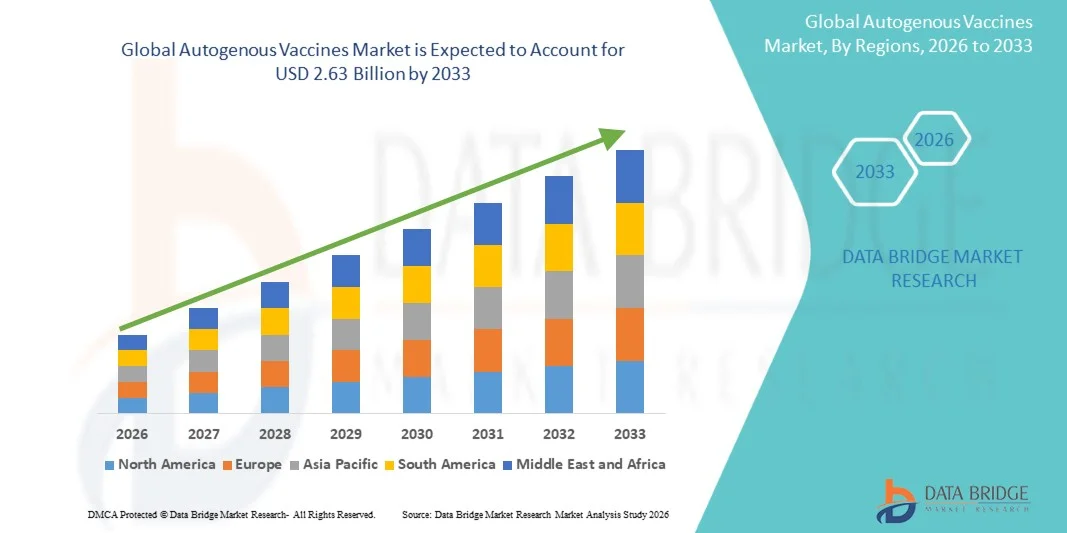
As per Data Bridge Market Research analysis, the global autogenous vaccines market was valued at USD 1.28 billion in 2025 and is projected to reach USD 2.63 billion by 2033, growing at a CAGR of 9.40% from 2026 to 2033. Growth is being driven by rising incidence of farm-specific and emerging pathogens in poultry, swine, and cattle populations, growing regulatory and industry pressure to reduce antibiotic use in animal production, and increasing demand for rapid, targeted immunization solutions that commercial vaccines cannot address.
Autogenous vaccines are custom-manufactured biologics derived from pathogens isolated directly from an affected herd or flock, enabling farm-specific protection against localized or evolving disease strains that fall outside the coverage of commercially available vaccines. Their growing adoption reflects the intensification of livestock and poultry production, rising outbreaks of antibiotic-resistant bacterial infections, and heightened biosecurity requirements across major livestock-producing regions, positioning autogenous vaccines as an increasingly essential complement to conventional immunization programs.
Key Market Trends & Insights
- North America dominated the global autogenous vaccines market with the largest revenue share of 42.60% in 2025, supported by advanced veterinary infrastructure, strong USDA regulatory oversight, and a large-scale, disease-exposed poultry and swine industry.
- The poultry segment led the market with a 38.90% share in 2025, driven by recurring outbreaks of avian influenza, Newcastle disease, and other farm-specific bacterial and viral infections requiring targeted immunization.
- Asia-Pacific is expected to be the fastest-growing region at a CAGR of 10.60% from 2026 to 2033, fueled by expanding commercial livestock and poultry production, rising disease incidence, and growing veterinary biologics manufacturing capacity in China and India.
- The bacterial vaccines segment dominates the pathogen type category with a 54.70% share in 2025, reflecting the high prevalence of farm-specific bacterial infections such as Salmonella, Clostridium, and E. coli, and the comparatively simpler regulatory pathway for bacterial autogenous vaccine production.
- The swine segment is the fastest-growing animal type, projected to register a CAGR of 10.20%, driven by rising Streptococcus suis and other antibiotic-resistant bacterial outbreaks in large-scale swine production systems.
- Livestock farming companies represent the largest end-user segment with a 58.40% share in 2025, reflecting their direct need for herd-specific disease management to reduce economic losses and improve animal health outcomes.
- Growing antimicrobial resistance concerns and tightening regulations on antibiotic use in animal production, such as the U.S. Veterinary Feed Directive and EU restrictions, continue to accelerate adoption of autogenous vaccines as a targeted, non-antibiotic disease control alternative.
Market Size & Forecast
- Global Market Value (2025): USD 1.28 Billion
- Expected Market Value (2033): USD 2.63 Billion
- Forecast CAGR (2026–2033): 9.40%
- Leading Region in 2025: North America
- Fastest Growing Region: Asia-Pacific
Report Scope and Autogenous Vaccines Market Segmentation
|
Attributes |
Autogenous Vaccines Key Market Insights |
|
Segments Covered |
|
|
Countries Covered |
North America
Europe
Asia-Pacific
Middle East and Africa
South America
|
|
Key Market Players |
|
|
Market Opportunities |
|
|
Value Added Data Infosets |
In addition to the insights on market scenarios such as market value, growth rate, segmentation, geographical coverage, and major players, the market reports curated by the Data Bridge Market Research also include in-depth expert analysis, geographically represented company-wise production and capacity, network layouts of distributors and partners, detailed and updated price trend analysis and deficit analysis of supply chain and demand. |
Autogenous Vaccines Market Trends
Trend: Rising Adoption of Autogenous Vaccines Amid Antimicrobial Resistance Concerns
The growing global challenge of antimicrobial resistance (AMR) is accelerating the adoption of autogenous vaccines as livestock producers increasingly seek effective alternatives to routine antibiotic use in animal production. Farm-specific bacterial pathogens such as avian pathogenic Escherichia coli (APEC) in poultry, Streptococcus suis in swine, and Mannheimia haemolytica in cattle are demonstrating increasing resistance to conventional antimicrobial therapies, encouraging veterinarians to adopt customized vaccines developed from pathogens isolated within individual farms. Regulatory initiatives, including the European Union's restrictions on prophylactic antibiotic use in livestock and implementation of the U.S. Veterinary Feed Directive (VFD), continue to promote preventive vaccination strategies over antibiotic treatment.
For instance, in August 2024, Merck Animal Health, together with Cambridge Technologies, launched an experimental autogenous vaccine against avian metapneumovirus (aMPV) Type B using U.S. field isolates, highlighting the growing emphasis on rapid, farm-specific vaccine development for emerging disease threats. In addition, increasing adoption of precision livestock farming, improved veterinary diagnostics, and genomic pathogen sequencing is enabling faster development of customized autogenous vaccines, supporting more targeted disease management while improving animal health, productivity, and food security worldwide.
Autogenous Vaccines Market Dynamics
Key Market Driver: Rising Incidence of Farm-Specific and Emerging Disease Outbreaks
The increasing frequency of farm-specific disease outbreaks and the emergence of rapidly evolving bacterial and viral pathogens continue to drive strong demand for autogenous vaccines across poultry, swine, cattle, and aquaculture production. Outbreaks of highly pathogenic avian influenza (HPAI), Newcastle disease, avian metapneumovirus, Salmonella, and Streptococcus suis have demonstrated the limitations of conventional commercial vaccines against rapidly evolving field strains. Autogenous vaccines provide producers with customized immunization solutions developed from pathogens isolated directly from affected farms, enabling faster and more targeted disease control.
For instance, the widespread highly pathogenic avian influenza outbreaks across North America and Europe during 2024 and 2025 significantly increased demand for farm-specific vaccination strategies alongside strengthened biosecurity measures. Growing investment in veterinary diagnostics, pathogen surveillance, and precision livestock health management is further supporting rapid adoption of autogenous vaccines as an important component of modern animal disease prevention programs.
Key Restraint/Challenge: Complex Regulatory Pathways and Limited Standardization
Despite increasing adoption, autogenous vaccines continue to face regulatory and manufacturing challenges that limit broader commercialization. Unlike conventional veterinary vaccines, autogenous vaccines are typically produced under farm-specific or outbreak-specific regulatory frameworks that vary considerably between countries, creating differences in approval requirements, production timelines, and quality standards. Limited standardization of manufacturing processes and efficacy evaluation across individual vaccine batches can create variability in clinical performance and restrict wider market acceptance. Furthermore, because these vaccines are designed for individual farms rather than mass commercialization, manufacturers often encounter higher production costs, shorter manufacturing cycles, and limited economies of scale. In addition, stringent veterinary biologics regulations in several developed markets continue to increase compliance requirements for manufacturers, particularly those expanding internationally.
Key Market Opportunity: Expansion into Aquaculture, Companion Animal Care, and Emerging Markets
Autogenous vaccine technology is increasingly expanding beyond traditional poultry and swine production into aquaculture, companion animal healthcare, and other specialized veterinary applications, creating significant long-term growth opportunities. Rising disease outbreaks in farmed fish species, increasing demand for customized veterinary oncology vaccines for companion animals, and growing emphasis on precision veterinary medicine are expanding the potential application of autogenous biologics. Simultaneously, rapidly growing livestock industries across China, India, Brazil, Southeast Asia, and Latin America are increasing investment in veterinary biologics manufacturing, disease surveillance, and livestock biosecurity infrastructure. Governments are strengthening food safety initiatives and implementing antimicrobial stewardship programs, encouraging greater adoption of preventive vaccination strategies. Furthermore, advances in molecular diagnostics, whole-genome sequencing, and automated vaccine manufacturing technologies are expected to shorten development timelines, improve customization capabilities, and support broader commercialization of autogenous vaccines across both developed and emerging markets.
Autogenous Vaccines Market Scope
The autogenous vaccines market is segmented on the basis of animal type, pathogen type, disease indication, route of administration, and end user.
- By Animal Type
On the basis of animal type, the global autogenous vaccines market is segmented into poultry, swine, cattle, aquaculture, and companion animals & others.
The poultry segment dominated the market with a 38.90% share in 2025, driven by the high incidence of farm-specific bacterial and viral diseases, including avian influenza, Newcastle disease, avian pathogenic Escherichia coli (APEC), and avian metapneumovirus. Large-scale commercial poultry operations require rapid and customized disease control solutions to minimize production losses, improve flock health, and maintain food security. Increasing restrictions on antibiotic use and growing emphasis on preventive vaccination strategies continue to strengthen demand for autogenous vaccines within the poultry sector.
The swine segment is expected to witness the fastest growth at a CAGR of 10.20% from 2026 to 2033, driven by rising outbreaks of Streptococcus suis, Actinobacillus pleuropneumoniae, and other antibiotic-resistant bacterial infections. Growing adoption of precision livestock farming, improved pathogen surveillance, and increasing investment in customized herd health management programs are expected to further accelerate demand for farm-specific vaccines across commercial swine production systems.
- By Pathogen Type
On the basis of pathogen type, the market is segmented into bacterial vaccines, viral vaccines, and parasitic vaccines.
The bacterial vaccines segment led the market with a 54.70% share in 2025, owing to the widespread occurrence of farm-specific bacterial diseases across poultry, swine, and cattle production. Autogenous bacterial vaccines offer rapid customization based on pathogens isolated from affected herds or flocks, enabling targeted disease prevention while reducing dependence on antimicrobial therapies. Their comparatively shorter manufacturing timelines and well-established regulatory pathways have further contributed to widespread adoption.
The viral vaccines segment is anticipated to witness the fastest CAGR of 10.40% from 2026 to 2033, driven by increasing outbreaks of rapidly evolving viral pathogens such as avian metapneumovirus, avian influenza, and emerging farm-specific viral strains. Advances in molecular diagnostics, genomic sequencing, and pathogen characterization are enabling faster development of customized viral vaccines, supporting improved outbreak response and livestock biosecurity.
- By Disease Indication
On the basis of disease indication, the market is segmented into respiratory diseases, enteric/gastrointestinal diseases, reproductive diseases, skin & soft tissue infections, and others.
The respiratory diseases segment dominated the market with a 34.50% share in 2025, driven by the high prevalence of respiratory infections affecting poultry, swine, and cattle, including avian metapneumovirus, Newcastle disease, infectious bronchitis, and bacterial respiratory pathogens. These diseases significantly affect animal productivity, resulting in substantial economic losses for producers. Consequently, increasing demand for customized respiratory vaccines continues to support the segment's leading position.
The enteric/gastrointestinal diseases segment is expected to witness the fastest CAGR of 9.90% from 2026 to 2033, supported by the growing incidence of Salmonella, Clostridium, pathogenic Escherichia coli, and other gastrointestinal infections across livestock operations. Rising awareness regarding food safety, increasing antimicrobial resistance, and growing implementation of preventive herd health programs are expected to drive rapid growth within this segment.
- By Route of Administration
On the basis of route of administration, the market is segmented into injectable, oral, and intranasal.
The injectable segment dominated the market with a 66.30% share in 2025, owing to its established effectiveness, accurate dosing, and broad applicability across both bacterial and viral autogenous vaccine formulations. Injectable vaccines continue to provide reliable immune responses across multiple livestock species and remain the preferred administration route for individualized herd vaccination programs developed by veterinarians.
The intranasal segment is projected to witness the fastest CAGR of 9.80% from 2026 to 2033, driven by increasing preference for non-invasive mass vaccination techniques, particularly within large commercial poultry operations. Intranasal administration offers reduced animal handling stress, improved labor efficiency, and enhanced mucosal immunity against respiratory pathogens, making it an increasingly attractive option for large-scale disease prevention programs.
- By End User
On the basis of end user, the market is segmented into livestock farming companies, veterinary clinics & hospitals, veterinary research institutes, and others.
The livestock farming companies segment dominated the market with a 58.40% share in 2025, reflecting their direct responsibility for herd health management, disease prevention, and production efficiency across commercial livestock operations. Increasing investment in biosecurity measures, precision livestock management, and customized vaccination programs continues to support strong adoption of autogenous vaccines among large integrated farming companies seeking to minimize disease-related economic losses.
The veterinary research institutes segment is expected to register the fastest CAGR of 9.70% from 2026 to 2033, supported by expanding pathogen surveillance programs, increasing research into emerging livestock diseases, and growing collaboration with commercial vaccine manufacturers. Continued advances in molecular diagnostics, genomic sequencing, and veterinary immunology are expected to accelerate the development of next-generation autogenous vaccines while strengthening rapid outbreak response capabilities globally.
North America Autogenous Vaccines Market Insight
North America dominated the autogenous vaccines market and accounted for the largest revenue share of 42.60% in 2025, supported by advanced veterinary healthcare infrastructure, a highly developed livestock industry, and strong regulatory oversight by the U.S. Department of Agriculture (USDA). The region continues to experience recurring outbreaks of highly pathogenic avian influenza (HPAI), swine respiratory diseases, and other emerging livestock infections, driving demand for customized autogenous vaccines that can be rapidly developed from farm-specific pathogen isolates. The U.S. accounts for the majority of regional revenue owing to its large commercial poultry and swine industries, increasing antimicrobial stewardship initiatives, and strong collaboration between veterinary diagnostic laboratories and vaccine manufacturers. Growing adoption of precision livestock farming, molecular diagnostics, and pathogen surveillance programs is further strengthening market growth while supporting rapid outbreak response across North America.
Europe Autogenous Vaccines Market Insight
The Europe autogenous vaccines market represents a significant share of global revenue, supported by highly developed poultry, swine, and cattle industries together with stringent animal health regulations promoting disease prevention over antibiotic use. Countries including Germany, France, the U.K., Spain, and the Netherlands continue to lead regional demand owing to advanced veterinary infrastructure and strong livestock biosecurity programs. The European Union Regulation (EU) 2019/6 on veterinary medicinal products and restrictions on routine antimicrobial use have significantly accelerated interest in customized autogenous vaccination programs. Increasing collaboration between veterinary diagnostic laboratories, livestock producers, and biologics manufacturers continues to strengthen regional market growth while improving rapid response to emerging infectious disease outbreaks.
Asia-Pacific Autogenous Vaccines Market Insight
The Asia-Pacific autogenous vaccines market is expected to witness the fastest growth with a CAGR of 10.60% during the forecast period, driven by expanding commercial livestock production, increasing disease outbreaks, and rapidly growing veterinary biologics manufacturing capacity across China, India, Japan, South Korea, and Southeast Asia. The region accounts for a substantial proportion of the world's poultry and swine population, making disease prevention a critical priority for governments and livestock producers. Rising concerns regarding antimicrobial resistance, expanding food safety initiatives, and increasing investment in veterinary healthcare infrastructure are encouraging wider adoption of customized vaccination strategies. Growing domestic manufacturing capabilities, improved veterinary diagnostic services, and increasing government support for livestock biosecurity programs are expected to accelerate market growth across Asia-Pacific.
Japan Autogenous Vaccines Market Insight
The Japan autogenous vaccines market is supported by a highly developed veterinary biologics industry, advanced livestock management practices, and strict food safety regulations. Growing emphasis on precision livestock farming, rapid disease surveillance, and preventive veterinary healthcare continues to strengthen demand for customized autogenous vaccines across the country's poultry and swine industries. Government initiatives promoting animal health, antimicrobial stewardship, and sustainable livestock production are encouraging broader adoption of farm-specific vaccination programs. Continued investment in veterinary research, molecular diagnostics, and innovative biologics manufacturing technologies is expected to support stable long-term market growth.
China Autogenous Vaccines Market Insight
The China autogenous vaccines market is experiencing rapid growth, supported by the country's large-scale poultry, swine, and aquaculture industries together with increasing government investment in veterinary biosecurity and animal disease control. Rising outbreaks of African swine fever, avian influenza, and bacterial livestock diseases have accelerated demand for customized vaccination strategies capable of addressing farm-specific pathogen strains. Expanding domestic veterinary biologics manufacturing capacity, improving diagnostic laboratory infrastructure, and continued implementation of national animal disease prevention programs are improving access to autogenous vaccines across major livestock-producing provinces. Furthermore, increasing awareness regarding antimicrobial resistance and stronger government support for preventive animal healthcare are expected to sustain robust market growth throughout the forecast period.
Autogenous Vaccines Market Share
The autogenous vaccines industry is primarily led by well-established companies, including:
- Boehringer Ingelheim Animal Health GmbH (Germany)
- Zoetis Inc. (U.S.)
- Merck Animal Health (U.S.)
- Ceva Santé Animale (France)
- Elanco Animal Health Incorporated (U.S.)
- Phibro Animal Health Corporation (U.S.)
- Hipra (Spain)
- Vaxxinova International B.V. (Netherlands)
- Neogen Corporation (U.S.)
- Ceva Biovac (South Africa)
- San Vet (Canada)
- Bimeda Biologicals (Ireland)
- Newport Laboratories (U.S.)
- Huvepharma EOOD (Bulgaria)
- Indian Immunologicals Limited (India)
- Biogénesis Bagó S.A. (Argentina)
- Torigen Pharmaceuticals, Inc. (U.S.)
- Cambridge Technologies (U.S.)
- Laboratorios Hipra, S.A. (Spain)
- Virbac SA (France)
Latest Developments in Autogenous Vaccines Market
- In August 2024, Merck Animal Health, in collaboration with Cambridge Technologies, launched an experimental autogenous vaccine for avian metapneumovirus (aMPV) Type B, developed from U.S. field isolates to address a rising respiratory disease threat in commercial poultry flocks.
- In 2023, following confirmation by the USDA Animal and Plant Health Inspection Service of highly pathogenic avian influenza outbreaks affecting more than 378 million egg-laying chickens in the U.S., demand for rapid-response autogenous poultry vaccines rose significantly across the industry.
- In August 2024, Merck Animal Health, in collaboration with Cambridge Technologies, launched an experimental autogenous vaccine targeting avian metapneumovirus (aMPV) Type B, developed from U.S. field isolates to address emerging respiratory disease outbreaks in commercial poultry flocks. The launch strengthened rapid-response vaccination strategies for evolving farm-specific viral pathogens.
- In June 2024, HIPRA expanded its autogenous vaccine capabilities through continued investment in customized veterinary biologics and advanced diagnostic services, enabling faster identification of farm-specific pathogens and supporting precision vaccination programs for poultry and swine producers across Europe and Latin America.
- In 2024, Ceva Santé Animale expanded its autogenous vaccine manufacturing capacity and diagnostic network to accelerate the development of customized vaccines for livestock producers facing emerging bacterial and viral disease outbreaks. The expansion reinforced the company's position in precision veterinary immunization and outbreak management.
- In September 2023, Boehringer Ingelheim Animal Health strengthened its autogenous swine vaccine portfolio through Newport Laboratories, introducing customized vaccine solutions targeting herd-specific bacterial diseases. The initiative supported producers in addressing antimicrobial resistance while improving disease prevention across commercial swine operations.

- Interactive Data Analysis Dashboard
- Company Analysis Dashboard for high growth potential opportunities
- Research Analyst Access for customization & queries
- Competitor Analysis with Interactive dashboard
- Latest News, Updates & Trend analysis
- Harness the Power of Benchmark Analysis for Comprehensive Competitor Tracking
Data collection and base year analysis are done using data collection modules with large sample sizes. The stage includes obtaining market information or related data through various sources and strategies. It includes examining and planning all the data acquired from the past in advance. It likewise envelops the examination of information inconsistencies seen across different information sources. The market data is analysed and estimated using market statistical and coherent models. Also, market share analysis and key trend analysis are the major success factors in the market report. To know more, please request an analyst call or drop down your inquiry.
The key research methodology used by DBMR research team is data triangulation which involves data mining, analysis of the impact of data variables on the market and primary (industry expert) validation. Data models include Vendor Positioning Grid, Market Time Line Analysis, Market Overview and Guide, Company Positioning Grid, Patent Analysis, Pricing Analysis, Company Market Share Analysis, Standards of Measurement, Global versus Regional and Vendor Share Analysis. To know more about the research methodology, drop in an inquiry to speak to our industry experts.
Data Bridge Market Research is a leader in advanced formative research. We take pride in servicing our existing and new customers with data and analysis that match and suits their goal. The report can be customized to include price trend analysis of target brands understanding the market for additional countries (ask for the list of countries), clinical trial results data, literature review, refurbished market and product base analysis. Market analysis of target competitors can be analyzed from technology-based analysis to market portfolio strategies. We can add as many competitors that you require data about in the format and data style you are looking for. Our team of analysts can also provide you data in crude raw excel files pivot tables (Fact book) or can assist you in creating presentations from the data sets available in the report.












