


Automated Breast Ultrasound Systems Market Overview
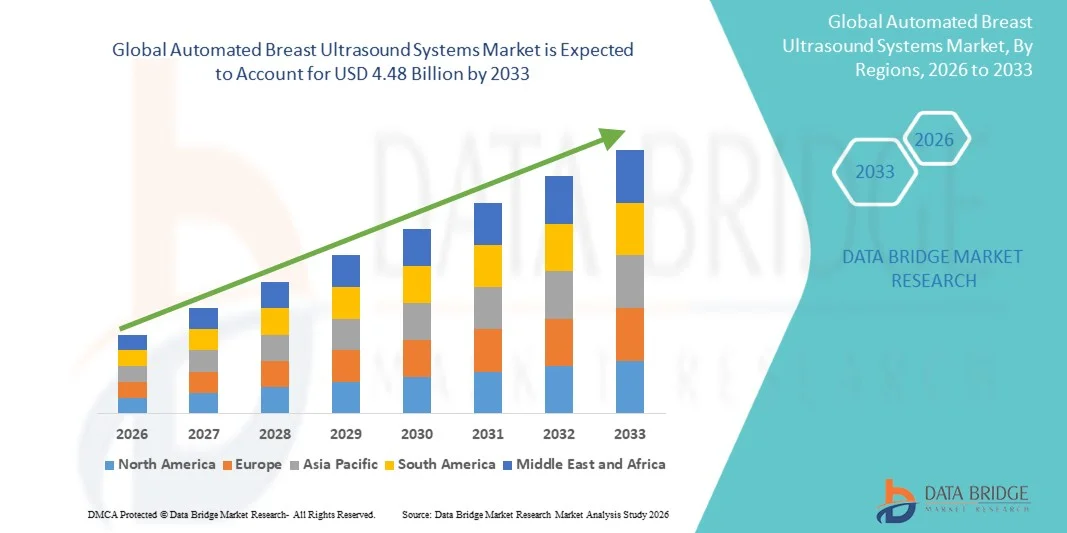
The Automated Breast Ultrasound Systems Market was valued at USD 3.68 billion in 2025 and is projected to reach USD 4.48 billion by 2033, growing at a CAGR of 2.50% from 2026 to 2033. The market is witnessing steady growth driven by the rising prevalence of breast cancer worldwide, increasing awareness regarding early detection, and growing demand for advanced, non-invasive imaging technologies for women with dense breast tissue. Rapid technological advancements in 3D imaging, artificial intelligence integration, and automated scanning capabilities are further accelerating market expansion across hospitals, diagnostic imaging centers, and specialty breast care clinics.
The increasing limitations of conventional mammography in detecting abnormalities in dense breasts, combined with supportive government screening initiatives and growing investments in women’s healthcare infrastructure, are encouraging healthcare providers to adopt automated breast ultrasound systems (ABUS). These systems offer standardized, reproducible, and radiation-free breast imaging, improving diagnostic accuracy while reducing operator dependency. In addition, the expanding use of ABUS in supplemental breast cancer screening, clinical research, and AI-assisted diagnostics is strengthening market adoption globally.
Key Market Trends & Insights
- North America dominated the Automated Breast Ultrasound Systems Market with the largest revenue share of 39.18% in 2025, supported by advanced breast cancer screening infrastructure, high adoption of AI-enabled imaging technologies, strong reimbursement frameworks, and widespread use across hospitals and diagnostic imaging centers in the U.S. and Canada.
- The Automated Breast Ultrasound System segment dominated the market with a 57.62% revenue share in 2025, driven by its strong clinical adoption in breast cancer screening, particularly for patients with dense breast tissue where mammography has limited sensitivity
- Asia-Pacific is expected to be the fastest-growing region at a CAGR of 7.8% from 2026 to 2033, fueled by rising breast cancer prevalence, expanding healthcare infrastructure, increasing awareness of early screening programs, and growing adoption of advanced imaging technologies in China, India, and Southeast Asia.
- The Automated Breast Volume Scanner segment is the fastest-growing product type, projected to register a CAGR of 7.4%, supported by advancements in 3D imaging, improved lesion detection capabilities, and increasing demand for automated, radiation-free supplemental screening tools.
- Hospitals dominate the end-use segment with a 52.36% revenue share in 2025, driven by high patient inflow, availability of advanced diagnostic infrastructure, and integration of ABUS systems into routine breast cancer screening workflows.
- Diagnostic Imaging Centers are the fastest-growing end-use segment, expected to register a CAGR of 7.1% from 2026 to 2033, supported by rising outpatient diagnostics demand, increasing private imaging investments, and growing preference for specialized breast screening facilities.
Market Size & Forecast
- Global Market Value (2025): USD 3.68 Billion
- Expected Market Value (2033): USD 4.48 Billion
- Forecast CAGR (2026–2033): 2.50%
- Leading Region in 2025: North America
- Fastest Growing Region: Asia-Pacific
Report Scope and Automated Breast Ultrasound Systems Market Segmentation
|
Attributes |
Automated Breast Ultrasound Systems Key Market Insights |
|
Segments Covered |
|
|
Countries Covered |
North America
Europe
Asia-Pacific
Middle East and Africa
South America
|
|
Key Market Players |
• Hologic Inc. (U.S.) |
|
Market Opportunities |
|
|
Value Added Data Infosets |
In addition to the insights on market scenarios such as market value, growth rate, segmentation, geographical coverage, and major players, the market reports curated by the Data Bridge Market Research also include in-depth expert analysis, geographically represented company-wise production and capacity, network layouts of distributors and partners, detailed and updated price trend analysis and deficit analysis of supply chain and demand. |
Automated Breast Ultrasound Systems Market Trends
Trend: Rising Demand for AI-Enabled Breast Cancer Screening and Dense Breast Imaging
The Global Automated Breast Ultrasound Systems (ABUS) Market is witnessing strong growth driven by increasing prevalence of breast cancer and the limitations of mammography in detecting tumors in dense breast tissue. According to the World Health Organization (WHO), breast cancer remains the most commonly diagnosed cancer globally, accounting for over 2.3 million new cases annually, significantly increasing demand for advanced screening technologies such as ABUS. Hospitals and diagnostic imaging centers are increasingly adopting automated breast ultrasound systems to improve early detection rates, particularly for women with dense breast composition where mammography sensitivity can drop below 50%. For example, large screening programs in the United States and Europe are integrating ABUS alongside mammography to improve diagnostic accuracy and reduce missed lesions.
Automated Breast Ultrasound Systems Market Dynamics
Key Market Driver: Rising Breast Cancer Burden and Expansion of Early Screening Programs
The primary driver of the ABUS market is the rising global burden of breast cancer and increasing emphasis on early detection through structured screening programs. In countries such as the U.S., Germany, and Japan, national screening guidelines are increasingly recommending supplemental ultrasound screening for high-risk patients with dense breast tissue. Clinical studies have shown that ABUS can improve cancer detection rates by up to 30–40% in dense breast populations when combined with mammography. In addition, expanding healthcare access in emerging economies such as India and China is increasing the number of diagnostic imaging procedures, further supporting adoption of automated imaging technologies. The growing availability of reimbursement support for breast cancer screening in developed markets is also accelerating hospital-level deployment of ABUS systems.
Key Restraint/Challenge: High Equipment Cost and Limited Skilled Radiology Infrastructure
A major challenge in the Automated Breast Ultrasound Systems Market is the high capital cost of ABUS equipment and the requirement for specialized interpretation infrastructure. Advanced systems such as 3D automated breast volume scanners require significant investment in imaging hardware, workstation software, and trained radiologists for accurate interpretation. In many developing regions, limited availability of skilled radiology professionals further restricts adoption. For example, rural healthcare centers in parts of Asia-Pacific and Africa often lack access to dedicated breast imaging specialists, leading to underutilization of advanced ultrasound technologies. Additionally, variability in regulatory approvals and reimbursement coverage across regions creates further barriers to widespread adoption.
Key Market Opportunity: Integration of AI-Based Imaging and Population-Wide Screening Expansion
The integration of artificial intelligence (AI) and machine learning into Automated Breast Ultrasound Systems presents a significant growth opportunity. AI-powered ABUS platforms can automatically detect lesions, reduce radiologist workload, and improve diagnostic consistency. Recent clinical deployments in Europe and the U.S. have demonstrated that AI-assisted breast ultrasound interpretation can reduce reading time by up to 30–50%, improving workflow efficiency in high-volume imaging centers. Furthermore, expanding government-led breast cancer screening initiatives in Asia-Pacific, particularly in China and India, are creating large-scale opportunities for cost-effective automated screening solutions. The growing adoption of 3D breast imaging in preventive healthcare programs and increasing investments by companies such as GE HealthCare, Siemens Healthineers, and Fujifilm are further accelerating innovation and global market expansion.
Automated Breast Ultrasound Systems Market Scope
The Automated Breast Ultrasound Systems market is segmented on the basis of product and enduser.
• By Product
On the basis of product, the Automated Breast Ultrasound Systems Market is segmented into Automated Breast Ultrasound System and Automated Breast Volume Scanner. The Automated Breast Ultrasound System segment dominated the market with a 57.62% revenue share in 2025, driven by its strong clinical adoption in breast cancer screening, particularly for patients with dense breast tissue where mammography has limited sensitivity. These systems are widely integrated into hospital imaging workflows and diagnostic protocols, supported by increasing demand for early and accurate cancer detection. In addition, continuous technological enhancements, including AI-assisted lesion detection and improved imaging resolution, are further strengthening segment dominance across developed healthcare systems.
The Automated Breast Volume Scanner segment is expected to witness the fastest growth at a CAGR of 7.4% from 2026 to 2033, supported by rising adoption of 3D automated imaging technologies that offer comprehensive breast tissue visualization and reduced operator dependency. These systems provide improved reproducibility and higher diagnostic confidence, making them increasingly preferred in large-scale screening programs. Growing investments in advanced imaging infrastructure and expanding awareness of early breast cancer detection in emerging economies are further accelerating segment growth globally.
• By End Use
On the basis of end use, the Automated Breast Ultrasound Systems Market is segmented into hospitals and diagnostic imaging centers. The hospitals segment dominated the market with a 52.36% revenue share in 2025, supported by high patient inflow, availability of advanced diagnostic infrastructure, and integration of ABUS systems into routine breast cancer screening and oncology workflows. Hospitals also benefit from multidisciplinary care teams, structured screening programs, and stronger reimbursement frameworks, which collectively drive higher adoption of advanced breast imaging systems.
The Diagnostic Imaging Centers segment is expected to witness the fastest growth at a CAGR of 7.1% from 2026 to 2033, driven by rising demand for outpatient diagnostic services and increasing preference for specialized breast screening facilities. These centers are rapidly adopting Automated Breast Ultrasound Systems to improve workflow efficiency, reduce examination time, and enhance screening throughput. In addition, growing private healthcare investments and increasing awareness of preventive breast cancer screening are further supporting segment expansion.
Automated Breast Ultrasound Systems Market Regional Analysis
North America dominated the Automated Breast Ultrasound Systems market and accounted for the largest revenue share of 39.18% in 2025, supported by advanced breast cancer screening infrastructure, high adoption of AI-enabled imaging technologies, strong reimbursement frameworks, and widespread use across hospitals and diagnostic imaging centers in the U.S. and Canada. The region also benefits from early implementation of structured breast cancer screening programs, strong presence of leading medical imaging companies, and continuous technological advancements in 3D ultrasound and AI-assisted diagnostics, which collectively strengthen its leadership in the global market. Increasing focus on early cancer detection and precision imaging continues to further drive regional adoption.
U.S. Automated Breast Ultrasound Systems Market Insight
The U.S. Automated Breast Ultrasound Systems market is witnessing strong growth due to rising prevalence of breast cancer, increasing demand for supplemental screening in women with dense breast tissue, and rapid adoption of AI-powered diagnostic imaging systems. The country’s advanced healthcare infrastructure, along with strong reimbursement support for breast imaging procedures, is accelerating deployment across hospitals and diagnostic imaging centers. In addition, growing integration of Automated Breast Ultrasound Systems with digital mammography and PACS systems is improving diagnostic accuracy and workflow efficiency across radiology departments.
Europe Automated Breast Ultrasound Systems Market Insight
The Europe Automated Breast Ultrasound Systems market remains a significant contributor to global revenue, supported by well-established healthcare systems, strong government-backed cancer screening programs, and increasing adoption of advanced imaging technologies. Countries such as Germany, France, and the U.K. are actively expanding breast cancer screening initiatives, particularly for high-risk and dense breast populations. In addition, rising investments in AI-enabled medical imaging solutions and growing awareness of early detection benefits are supporting continued market expansion across the region.
U.K. Automated Breast Ultrasound Systems Market Insight
The U.K. Automated Breast Ultrasound Systems market is experiencing steady growth, driven by the National Health Service (NHS) focus on early cancer detection and improved diagnostic accuracy in breast screening programs. Increasing use of advanced ultrasound systems in hospital radiology departments, along with integration of AI-based imaging support tools, is enhancing screening efficiency. Furthermore, rising demand for supplemental imaging in dense breast cases is strengthening adoption across both public and private healthcare facilities.
Germany Automated Breast Ultrasound Systems Market Insight
The Germany Automated Breast Ultrasound Systems market is expanding steadily due to strong healthcare infrastructure, high awareness of breast cancer screening, and advanced diagnostic imaging capabilities. German hospitals and specialized breast centers are increasingly adopting Automated Breast Ultrasound Systems to improve detection accuracy in dense breast tissue cases. Continuous technological innovation in medical imaging and strong support for preventive healthcare programs are further driving market growth in the country.
Asia-Pacific Automated Breast Ultrasound Systems Market Insight
The Asia-Pacific Automated Breast Ultrasound Systems market is expected to witness rapid growth, recording a CAGR of 7.8% from 2026 to 2033, fueled by rising breast cancer prevalence, expanding healthcare infrastructure, and increasing awareness of early screening programs. Countries such as China, India, and Southeast Asia are investing heavily in modern diagnostic imaging systems to improve early detection rates. In addition, growing access to healthcare services, rising medical tourism, and increasing government-led cancer screening initiatives are significantly accelerating regional market expansion.
Japan Automated Breast Ultrasound Systems Market Insight
The Japan Automated Breast Ultrasound Systems market is witnessing consistent growth due to a high aging population, increasing breast cancer screening rates, and strong adoption of advanced diagnostic imaging technologies. Japanese healthcare providers are integrating Automated Breast Ultrasound Systems with existing screening programs to improve detection in dense breast tissue cases. In addition, continuous innovation in medical imaging and strong government focus on preventive healthcare are supporting steady market development.
China Automated Breast Ultrasound Systems Market Insight
The China Automated Breast Ultrasound Systems market is growing rapidly, driven by increasing breast cancer incidence, expanding healthcare infrastructure, and rising government focus on early detection programs. The adoption of advanced imaging technologies such as AI-enabled ultrasound systems is accelerating across urban hospitals and diagnostic centers. In addition, large-scale health screening initiatives, growing awareness among women, and strong investments in medical imaging innovation are positioning China as one of the fastest-growing markets globally.
Automated Breast Ultrasound Systems Market Share
The Automated Breast Ultrasound Systems industry is primarily led by well-established companies, including:
• Hologic Inc. (U.S.)
• GE HealthCare Technologies Inc. (U.S.)
• Siemens Healthineers AG (Germany)
• Canon Medical Systems Corporation (Japan)
• Fujifilm Holdings Corporation (Japan)
• Samsung Medison Co., Ltd. (South Korea)
• Philips Healthcare (Netherlands)
• Koios Medical Inc. (U.S.)
• SonoCiné Inc. (U.S.)
• EchoNous Inc. (U.S.)
• Toshiba Medical Systems Corporation (Japan)
• Mindray Medical International Limited (China)
• SuperSonic Imagine (France)
• Carestream Health Inc. (U.S.)
• Micrima Limited (U.K.)
• Densitas Inc. (Canada)
• Trivitron Healthcare (India)
• Planmed Oy (Finland)
• United Imaging Healthcare Co., Ltd. (China)
• Shenzhen Mindray Bio-Medical Electronics Co., Ltd. (China)
Latest Developments in Automated Breast Ultrasound Systems Market
- In March 2025, GE HealthCare announced the launch of Invenia™ ABUS Premium, an advanced AI-driven automated breast ultrasound system designed to improve screening efficiency and early cancer detection in women with dense breasts. The system integrates Verisound™ AI tools, including scan quality assessment and automated nipple detection, enabling faster scanning (up to 40% improvement) and improved reproducibility of 3D breast imaging. The solution also enhances diagnostic confidence by supporting radiologists with AI-assisted lesion detection and streamlined workflow capabilities
- In March 2025, GE HealthCare confirmed that the Invenia ABUS Premium system received U.S. FDA Premarket Approval (PMA) and is being rolled out in multiple global markets. The approval marked a key regulatory milestone for next-generation automated breast ultrasound technology, strengthening its clinical adoption for supplemental screening in dense breast populations and reinforcing its position as a leading AI-enabled imaging platform in breast cancer diagnostics

- Interactive Data Analysis Dashboard
- Company Analysis Dashboard for high growth potential opportunities
- Research Analyst Access for customization & queries
- Competitor Analysis with Interactive dashboard
- Latest News, Updates & Trend analysis
- Harness the Power of Benchmark Analysis for Comprehensive Competitor Tracking
Data collection and base year analysis are done using data collection modules with large sample sizes. The stage includes obtaining market information or related data through various sources and strategies. It includes examining and planning all the data acquired from the past in advance. It likewise envelops the examination of information inconsistencies seen across different information sources. The market data is analysed and estimated using market statistical and coherent models. Also, market share analysis and key trend analysis are the major success factors in the market report. To know more, please request an analyst call or drop down your inquiry.
The key research methodology used by DBMR research team is data triangulation which involves data mining, analysis of the impact of data variables on the market and primary (industry expert) validation. Data models include Vendor Positioning Grid, Market Time Line Analysis, Market Overview and Guide, Company Positioning Grid, Patent Analysis, Pricing Analysis, Company Market Share Analysis, Standards of Measurement, Global versus Regional and Vendor Share Analysis. To know more about the research methodology, drop in an inquiry to speak to our industry experts.
Data Bridge Market Research is a leader in advanced formative research. We take pride in servicing our existing and new customers with data and analysis that match and suits their goal. The report can be customized to include price trend analysis of target brands understanding the market for additional countries (ask for the list of countries), clinical trial results data, literature review, refurbished market and product base analysis. Market analysis of target competitors can be analyzed from technology-based analysis to market portfolio strategies. We can add as many competitors that you require data about in the format and data style you are looking for. Our team of analysts can also provide you data in crude raw excel files pivot tables (Fact book) or can assist you in creating presentations from the data sets available in the report.













