What is the Automated Feeding Systems Market Size and Overview?
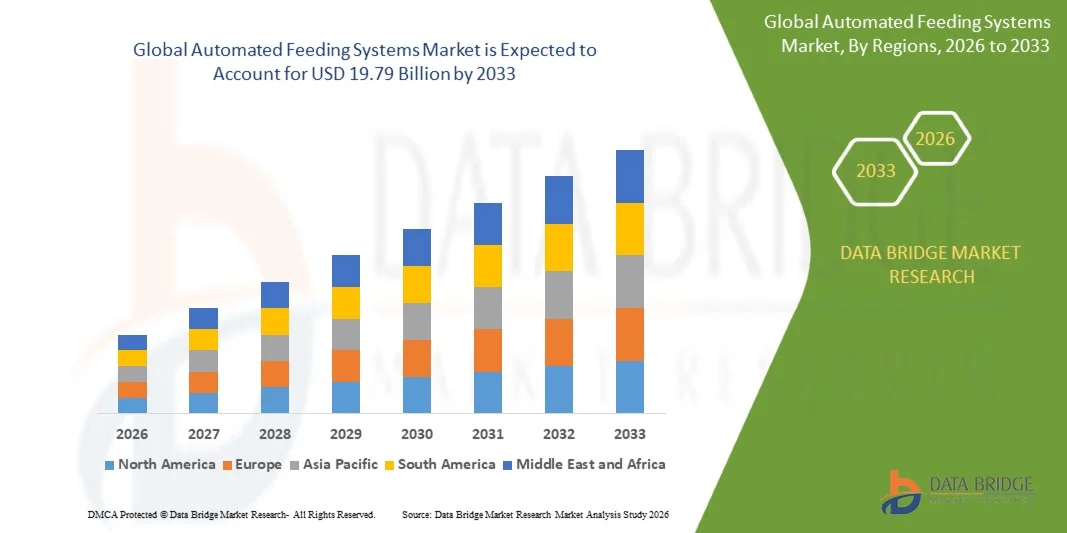
As per Data Bridge Market Research analysis, the automated feeding systems market was valued at USD 11.41 billion in 2025 and is projected to reach USD 19.79 billion by 2033, growing at a CAGR of 7.13% from 2026 to 2033. The market is experiencing steady growth driven by increasing adoption of precision livestock farming technologies, rising labor shortages in the agricultural sector, and growing demand for efficient, automated livestock feeding solutions across dairy, poultry, swine, and cattle farms.
The increasing focus on improving animal productivity, feed efficiency, and farm operational profitability, combined with the growing adoption of smart farming practices and IoT-enabled livestock management systems, is encouraging farmers to invest in automated feeding technologies. Automated feeding systems are increasingly replacing manual feeding operations by enabling precise feed distribution, reducing feed wastage, improving animal health, and lowering labor costs, making them an essential component of modern livestock production and sustainable agricultural practices.
Market Size & Forecast
- Market Value (2025): USD 11.41 Billion
- Expected Market Value (2033): USD 19.79 Billion
- Forecast CAGR (2026–2033): 7.13%
- Leading Region in 2025: Europe
- Fastest Growing Region: Asia-Pacific
Key Market Trends & Insights
- Europe dominated the automated feeding systems market with the largest revenue share 36% in 2025, primarily driven by increasing focus on sustainable agriculture, rising labor costs, and stringent regulations supporting efficient livestock production.
- Asia-Pacific automated feeding systems market is expected to witness the fastest growth rate from 2026 to 2033, supported by increasing livestock production, rising food demand, expanding commercial farming operations, and growing adoption of agricultural automation technologies.
- The dairy farm segment held the largest market revenue share of approximately 42.6% in 2025, driven by increasing adoption of robotic feeding solutions, rising demand for improved milk production efficiency, and growing labor shortages in dairy operations. Automated feeding systems are widely used in dairy farms due to their ability to optimize feed distribution, reduce wastage, and support precision livestock management.
- The poultry farm segment is projected to register the fastest growth at a CAGR of 8.1% from 2026 to 2033, driven by increasing demand for automated feeding solutions in large-scale poultry production facilities. Rising focus on maintaining consistent feed supply, improving bird health, and reducing operational costs is accelerating adoption across commercial poultry farms.
- The robotics and telemetry segment accounted for the largest market revenue share of approximately 38.9% in 2025, driven by increasing adoption of autonomous feeding robots equipped with sensors, navigation systems, and monitoring capabilities. These technologies enable precise feed delivery, real-time farm management, and improved operational efficiency.
- The RFID technology segment is expected to witness the fastest growth at a CAGR of 9.4% from 2026 to 2033, supported by increasing adoption of animal identification and monitoring systems. RFID-enabled feeding solutions help farmers track individual animal feeding patterns, optimize nutrition programs, and improve livestock productivity.
Report Scope and Automated Feeding Systems Market Segmentation
|
Attributes |
Automated Feeding Systems Key Market Insights |
|
Segments Covered |
|
|
Countries Covered |
North America
Europe
Asia-Pacific
Middle East and Africa
South America
|
|
Key Market Players |
|
|
Market Opportunities |
|
|
Value Added Data Infosets |
In addition to the insights on market scenarios such as market value, growth rate, segmentation, geographical coverage, and major players, the market reports curated by the Data Bridge Market Research also include import export analysis, production capacity overview, production consumption analysis, price trend analysis, climate change scenario, supply chain analysis, value chain analysis, raw material/consumables overview, vendor selection criteria, PESTLE Analysis, Porter Analysis, and regulatory framework. |
What is the Key Trend in the Automated Feeding Systems Market?
Trend: Rising Adoption Of Smart Farming And Precision Livestock Management Technologies
Growing adoption of digital agriculture and precision livestock farming is accelerating the deployment of automated feeding systems across dairy, poultry, swine, and cattle farms. Farmers are increasingly shifting from traditional manual feeding methods toward automated solutions that enable accurate feed distribution, reduce wastage, improve animal nutrition management, and optimize operational efficiency. The integration of sensors, data analytics, and IoT-enabled monitoring systems is further strengthening demand for advanced feeding technologies that support sustainable and profitable livestock production.
The rapid expansion of commercial livestock farming and increasing focus on improving feed conversion efficiency are creating sustained demand for automated feeding systems capable of handling large-scale farm operations. For instance, in January 2025, DeLaval announced the launch of its OptiWagon automated feeding solution designed to improve feeding efficiency in dairy farms by automating feed preparation and distribution processes. The system supports farmers in reducing labor requirements, improving feeding accuracy, and enhancing herd management efficiency, reflecting increasing industry investment in smart dairy farming technologies.
The growing transition toward automated and data-driven livestock management practices is expected to reinforce long-term demand for automated feeding systems, enabling manufacturers to benefit from increasing investments in smart farming infrastructure.
Automated Feeding Systems Market Dynamics
Key Market Driver: Increasing Demand For Labor-Efficient And Precision Livestock Farming Solutions
The livestock industry is experiencing rising demand for automation technologies due to increasing labor shortages, higher operational costs, and the need to improve farm productivity. Automated feeding systems enable precise feed delivery, reduce manual intervention, and support consistent animal nutrition, making them increasingly important for modern dairy, poultry, and livestock operations.
Major agricultural technology companies are investing in automated feeding solutions to improve farm efficiency. According to Lely, its Vector automated feeding system enables autonomous feed mixing and distribution, allowing farmers to maintain fresh feed availability while reducing labor requirements and improving feed management. These advancements are increasing adoption among large-scale dairy farms seeking improved productivity and cost optimization.
As livestock producers continue adopting automation to enhance efficiency and profitability, manufacturers of automated feeding systems are expected to benefit from sustained demand driven by precision farming trends and increasing modernization of agricultural operations.
Key Restraint/Challenge: High Initial Investment And Integration Complexity
Automated feeding systems require significant upfront investment in equipment, installation, software integration, and farm infrastructure modifications, which can limit adoption among small and medium-sized livestock producers. The requirement for technical expertise, regular maintenance, and compatibility with existing farm management systems can further create challenges for widespread implementation.
In addition, farmers may face difficulties related to system customization, employee training, and technology adoption. For instance, the European Commission highlighted that high investment costs and limited digital skills remain major barriers affecting the adoption of smart farming technologies among agricultural producers. These challenges continue to influence the adoption rate of automated solutions, particularly in developing agricultural markets.
Despite these challenges, increasing government support for agricultural digitalization, declining technology costs, and growing awareness regarding productivity benefits are expected to improve adoption rates of automated feeding systems over the forecast period.
Key Market Opportunity: Expansion Of IoT-Enabled And AI-Based Livestock Feeding Solutions
Agricultural technology companies are increasingly integrating artificial intelligence, sensors, robotics, and data analytics into automated feeding systems to improve feeding accuracy and animal performance monitoring. These advanced solutions provide real-time insights into feed consumption, animal behavior, and production efficiency, creating significant opportunities for next-generation automated feeding technologies.
Leading manufacturers are expanding their smart farming portfolios through innovative automated feeding solutions. For instance, in 2024, GEA introduced advancements in its automated feeding technologies, including digital monitoring capabilities that help dairy farmers optimize feeding processes and improve herd productivity. These developments support the growing adoption of connected feeding systems and create new opportunities for manufacturers to serve technologically advanced livestock farms.
As livestock producers increasingly prioritize automation, connectivity, and data-driven farm management, expansion of AI-enabled feeding solutions and smart farming technologies is expected to create substantial long-term growth opportunities for the automated feeding systems market.
How is the Automated Feeding Systems Market Segmented?
The market is segmented on the basis of application, technology, system, livestock, offering, point of sale, and end users.
- By Application
On the basis of application, the automated feeding systems market is segmented into dairy farm, poultry farm, swine farm, and equine farm. The dairy farm segment held the largest market revenue share of approximately 42.6% in 2025, driven by increasing adoption of robotic feeding solutions, rising demand for improved milk production efficiency, and growing labor shortages in dairy operations. Automated feeding systems are widely used in dairy farms due to their ability to optimize feed distribution, reduce wastage, and support precision livestock management.
The poultry farm segment is projected to register the fastest growth at a CAGR of 8.1% from 2026 to 2033, driven by increasing demand for automated feeding solutions in large-scale poultry production facilities. Rising focus on maintaining consistent feed supply, improving bird health, and reducing operational costs is accelerating adoption across commercial poultry farms.
- By Technology
On the basis of technology, the automated feeding systems market is segmented into guidance and remote sensing technology, robotics and telemetry, RFID technology, and others. The robotics and telemetry segment accounted for the largest market revenue share of approximately 38.9% in 2025, driven by increasing adoption of autonomous feeding robots equipped with sensors, navigation systems, and monitoring capabilities. These technologies enable precise feed delivery, real-time farm management, and improved operational efficiency.
The RFID technology segment is expected to witness the fastest growth at a CAGR of 9.4% from 2026 to 2033, supported by increasing adoption of animal identification and monitoring systems. RFID-enabled feeding solutions help farmers track individual animal feeding patterns, optimize nutrition programs, and improve livestock productivity.
- By System
On the basis of system, the automated feeding systems market is segmented into rail guided system, conveyor belt system, and self-propelled system. The self-propelled system segment held the largest market revenue share of approximately 45.2% in 2025, driven by its flexibility, mobility, and ability to operate across different farm layouts. These systems are increasingly preferred in large dairy farms due to reduced labor requirements and efficient feed distribution capabilities.
The rail guided system segment is projected to register the fastest growth at a CAGR of 8.7% from 2026 to 2033, driven by increasing installation in modern dairy facilities requiring automated and consistent feeding operations. Rail-based systems provide accurate feed delivery routes and support integration with advanced farm management technologies.
- By Livestock
On the basis of livestock, the automated feeding systems market is segmented into ruminants, swine, poultry, and others. The ruminants segment accounted for the largest market revenue share of approximately 48.5% in 2025, driven by widespread adoption of automated feeding solutions in dairy and cattle farms. Increasing focus on improving milk yield, feed efficiency, and herd management is supporting the dominance of this segment.
The poultry segment is anticipated to witness the fastest growth at a CAGR of 8.6% from 2026 to 2033, fueled by rising poultry production and increasing adoption of automated systems for maintaining consistent feeding schedules and improving production efficiency.
- By Offering
On the basis of offering, the automated feeding systems market is segmented into hardware, software, and service. The hardware segment held the largest market revenue share of approximately 62.3% in 2025, driven by high demand for automated feeders, sensors, robotic systems, conveyors, and feeding equipment required for farm automation. Hardware components remain essential for implementing automated feeding infrastructure across livestock farms.
The software segment is projected to register the fastest growth at a CAGR of 11.2% from 2026 to 2033, supported by increasing integration of artificial intelligence, data analytics, and farm management platforms. Software solutions enable real-time monitoring, predictive feeding strategies, and improved decision-making for livestock producers.
- By Point of Sale
On the basis of point of sale, the automated feeding systems market is segmented into retail stores, wholesaler, and online channel. The wholesaler segment accounted for the largest market revenue share of approximately 52.8% in 2025, driven by the preference of commercial farms and agricultural businesses for bulk equipment procurement through established distribution networks.
The online channel segment is expected to register the fastest growth at a CAGR of 12.5% from 2026 to 2033, supported by increasing digital adoption, expanding e-commerce platforms, and growing availability of agricultural automation products through online marketplaces.
- By End Users
On the basis of end users, the automated feeding systems market is segmented into calf, kid, lamb, puppy, and foal. The calf segment held the largest market revenue share of approximately 36.7% in 2025, driven by increasing adoption of automated milk and feed management systems in dairy farming operations. Automated calf feeding solutions help improve nutrition consistency, reduce labor dependency, and support better animal growth performance.
The kid and lamb segment is projected to register significant growth from 2026 to 2033, driven by increasing adoption of automated feeding technologies in small ruminant farming and growing focus on improving young livestock health and productivity.
Which Region Holds the Largest Share of the Automated Feeding Systems Market?
Europe Automated Feeding Systems Market Insight
The Europe dominated the automated feeding systems market with the largest revenue share 36% in 2025, primarily driven by increasing focus on sustainable agriculture, rising labor costs, and stringent regulations supporting efficient livestock production. Countries across the region are adopting automated feeding technologies to improve farm productivity, reduce resource wastage, and enhance animal welfare standards. The growing presence of advanced dairy farming systems and increasing investments in precision livestock farming are further supporting regional market expansion.
Germany Automated Feeding Systems Market Insight
The Germany dominated the automated feeding systems market with the largest revenue share in 2025, fueled by the country’s advanced agricultural infrastructure, high adoption of automation technologies, and emphasis on efficient livestock management. German farmers are increasingly adopting robotic feeding systems to address labor shortages and improve operational efficiency in dairy and livestock farms. In addition, Germany’s focus on digital agriculture and sustainable farming practices is encouraging the integration of smart feeding solutions.
U.K. Automated Feeding Systems Market Insight
The U.K. automated feeding systems market is expected to grow steadily from 2026 to 2033, driven by increasing demand for farm automation, rising operational costs, and the need for improved livestock productivity. Dairy and livestock producers are adopting automated feeding technologies to reduce manual labor dependency and maintain consistent animal nutrition. The growing focus on precision agriculture, animal welfare, and sustainable farming practices is expected to further accelerate adoption of automated feeding systems across the country.
North America Automated Feeding Systems Market Insight
North America automated feeding systems market is expected to witness significant growth from 2026 to 2033, supported by increasing adoption of advanced livestock management technologies, high labor costs, and strong demand for precision farming solutions. Farmers across the region are increasingly investing in automated feeding systems to improve feed efficiency, reduce operational expenses, and enhance animal productivity. The presence of large-scale dairy and livestock farms, combined with rapid integration of robotics, sensors, and farm management software, is strengthening the adoption of automated feeding technologies across commercial agricultural operations.
U.S. Automated Feeding Systems Market Insight
The U.S. automated feeding systems market accounted for the largest revenue share in North America in 2025, driven by the expansion of large-scale dairy farms, increasing labor shortages, and growing adoption of smart farming practices. Farmers are increasingly implementing robotic feeding systems, automated mixers, and sensor-based solutions to optimize feed management and improve livestock performance. Furthermore, strong investments in agricultural automation technologies and the presence of leading livestock technology providers are significantly contributing to market growth in the country.
Asia-Pacific Automated Feeding Systems Market Insight
The Asia-Pacific automated feeding systems market is expected to witness the fastest growth rate from 2026 to 2033, supported by increasing livestock production, rising food demand, expanding commercial farming operations, and growing adoption of agricultural automation technologies. Countries such as China, Japan, India, and Australia are increasingly investing in smart farming solutions to improve productivity and overcome labor challenges. Furthermore, the availability of cost-effective automation technologies and government initiatives promoting digital agriculture are supporting wider adoption of automated feeding systems across the region.
China Automated Feeding Systems Market Insight
The China automated feeding systems market is expected to witness significant growth from 2026 to 2033, attributed to the country’s large livestock production base, rapid modernization of agricultural practices, and increasing adoption of smart farming technologies. Large-scale dairy and swine farms are increasingly implementing automated feeding solutions to improve efficiency, reduce labor requirements, and enhance animal health management. In addition, China’s focus on agricultural digitalization and intelligent farming systems is accelerating demand for automated livestock technologies.
Japan Automated Feeding Systems Market Insight
The Japan automated feeding systems market is expected to grow during 2026 to 2033, driven by labor shortages, an aging agricultural workforce, and increasing demand for efficient livestock management solutions. Japanese farmers are adopting automated feeding technologies to maintain productivity while reducing dependence on manual labor. The country’s strong focus on robotics, precision agriculture, and advanced farming technologies is supporting the integration of automated feeding systems in dairy and livestock operations.
Which are the Top Companies in Automated Feeding Systems Market?
The automated feeding systems industry is primarily led by well-established companies, including:
- GEA Group Aktiengesellschaft (Germany)
- DeLaval Holding AB (Sweden)
- Lely Industries N.V. (Netherlands)
- Trioliet B.V. (Netherlands)
- AGCO Corporation (U.S.)
- BouMatic LLC (U.S.)
- Dairymaster (Ireland)
- Valmetal Inc. (Canada)
- VDL Agrotech B.V. (Netherlands)
- Pellon Group Oy (Finland)
- Fullwood Packo Ltd. (U.K.)
- Afimilk Ltd. (Israel)
- Rovibec Agrisolutions Inc. (Canada)
- Bauer Technics A.S. (Denmark)
- Sum-It Computer Systems Ltd. (U.K.)
What are Latest Developments in Automated Feeding Systems Market?
- In January 2025, DeLaval and John Deere received the 2025 AE50 Award for the Milk Sustainability Center (MSC), a digital platform that integrates crop nutrient, feed, and herd performance data to help dairy farmers optimize feeding strategies, improve nutrient use efficiency, and reduce environmental impact. The platform supports data-driven decision-making, enhancing both farm productivity and sustainability while accelerating adoption of precision livestock technologies across the automated feeding systems market.
- In January 2025, DeLaval officially launched the Milking Automation (MA) Series for conventional parlors, featuring advanced automation controls, real-time performance monitoring, cloud connectivity, and scalable functionality. The new system enables dairy producers to improve operational efficiency, enhance herd management, and modernize existing milking facilities without replacing current equipment, supporting broader adoption of automated dairy technologies.
- In December 2024, DeLaval announced the Milking Automation MA Series ahead of its rollout in 2025, introducing an advanced milking control platform designed for conventional parlors. The solution provides real-time operational insights, seamless integration with existing systems, and improved automation capabilities, enabling dairy farms to increase productivity while reducing manual intervention.
- In October 2024, DeLaval and John Deere launched the Milk Sustainability Center (MSC), a collaborative digital ecosystem that combines field, feed, crop, and animal performance data into a single platform. The solution enables dairy farmers to optimize feeding efficiency, monitor carbon emissions, and improve overall farm sustainability, strengthening the adoption of precision feeding and automated livestock management technologies.
- In March 2023, DeLaval introduced the OptiWagon autonomous feeding robot as part of the DeLaval Optimat automated feeding solution. The robot automates feed preparation and distribution while delivering customized rations multiple times per day, helping farmers reduce labor requirements, minimize feed waste, and improve livestock productivity. This innovation reinforces the growing trend toward fully automated feeding systems in modern dairy farming.

- Interactive Data Analysis Dashboard
- Company Analysis Dashboard for high growth potential opportunities
- Research Analyst Access for customization & queries
- Competitor Analysis with Interactive dashboard
- Latest News, Updates & Trend analysis
- Harness the Power of Benchmark Analysis for Comprehensive Competitor Tracking
Data collection and base year analysis are done using data collection modules with large sample sizes. The stage includes obtaining market information or related data through various sources and strategies. It includes examining and planning all the data acquired from the past in advance. It likewise envelops the examination of information inconsistencies seen across different information sources. The market data is analysed and estimated using market statistical and coherent models. Also, market share analysis and key trend analysis are the major success factors in the market report. To know more, please request an analyst call or drop down your inquiry.
The key research methodology used by DBMR research team is data triangulation which involves data mining, analysis of the impact of data variables on the market and primary (industry expert) validation. Data models include Vendor Positioning Grid, Market Time Line Analysis, Market Overview and Guide, Company Positioning Grid, Patent Analysis, Pricing Analysis, Company Market Share Analysis, Standards of Measurement, Global versus Regional and Vendor Share Analysis. To know more about the research methodology, drop in an inquiry to speak to our industry experts.
Data Bridge Market Research is a leader in advanced formative research. We take pride in servicing our existing and new customers with data and analysis that match and suits their goal. The report can be customized to include price trend analysis of target brands understanding the market for additional countries (ask for the list of countries), clinical trial results data, literature review, refurbished market and product base analysis. Market analysis of target competitors can be analyzed from technology-based analysis to market portfolio strategies. We can add as many competitors that you require data about in the format and data style you are looking for. Our team of analysts can also provide you data in crude raw excel files pivot tables (Fact book) or can assist you in creating presentations from the data sets available in the report.