


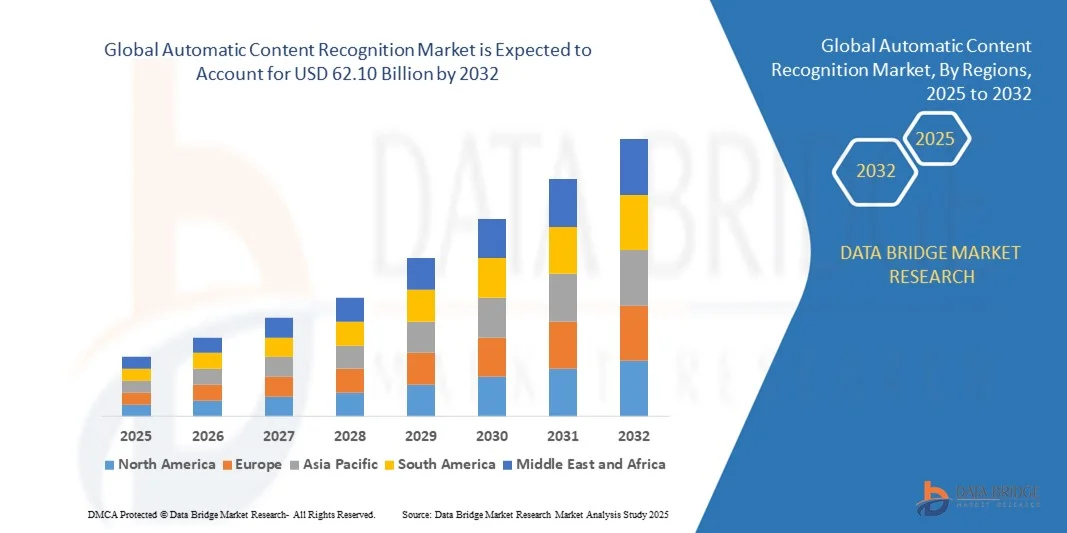
Global Automatic Content Recognition Market Size
- The global automatic content recognition market size was valued at USD 7.77 billion in 2024 and is projected to reach USD 62.10 billion by 2032, growing at a CAGR of 29.65% during the forecast period
- The market expansion is primarily driven by the increasing integration of ACR technology in smart TVs, smartphones, and streaming platforms, enabling real-time content identification and enhanced user experiences across media and entertainment sectors
- In addition, the rising demand for personalized content, audience measurement, and targeted advertising is compelling broadcasters and advertisers to adopt ACR solutions. This surge in data-driven strategies is propelling the ACR market forward, marking a significant transformation in digital media consumption and analytics
Global Automatic Content Recognition Market Analysis
- Automatic Content Recognition (ACR) technology, which enables the identification of content played on media devices through audio, video, or watermark-based signals, is becoming an essential component in media analytics, personalized advertising, and interactive TV experiences, across both consumer electronics and broadcast sectors due to its ability to deliver real-time insights and enhance user engagement
- The growing demand for ACR solutions is primarily driven by the rising consumption of digital content, increasing use of second-screen devices, and the need for data-driven decision-making in advertising, audience measurement, and content recommendation engines
- North America dominated the global automatic content recognition market with the largest revenue share of 36.6% in 2024, underpinned by widespread smart device penetration, advanced digital infrastructure, and strong presence of tech giants and streaming service providers. The U.S., in particular, is witnessing robust adoption of ACR in OTT platforms and smart TVs, fueled by innovations in AI and machine learning for content personalization
- Asia-Pacific is projected to be the fastest-growing region in the ACR market during the forecast period, owing to rapid digitalization, increasing smartphone penetration, and growing investments in media and entertainment technology across emerging economies.
- The solution segment dominated the market with the largest revenue share of 64.5% in 2024, driven by the increasing integration of ACR technologies such as watermarking, fingerprinting, and speech recognition in consumer electronics and media devices
Report Scope and Global Automatic Content Recognition Market Segmentation
|
Attributes |
Automatic Content Recognition Key Market Insights |
|
Segments Covered |
|
|
Countries Covered |
North America
Europe
Asia-Pacific
Middle East and Africa
South America
|
|
Key Market Players |
|
|
Market Opportunities |
|
|
Value Added Data Infosets |
In addition to the insights on market scenarios such as market value, growth rate, segmentation, geographical coverage, and major players, the market reports curated by the Data Bridge Market Research also include in-depth expert analysis, pricing analysis, brand share analysis, consumer survey, demography analysis, supply chain analysis, value chain analysis, raw material/consumables overview, vendor selection criteria, PESTLE Analysis, Porter Analysis, and regulatory framework. |
Global Automatic Content Recognition Market Trends
Enhanced Personalization Through AI and Voice Assistant Integration
- A significant and accelerating trend in the global Automatic Content Recognition (ACR) Market is the deepening integration with artificial intelligence (AI) and voice-controlled ecosystems such as Amazon Alexa, Google Assistant, and Apple Siri. This convergence is enhancing content discovery, personalization, and user interaction across smart devices and connected environments.
- For Instance, smart TVs equipped with ACR and integrated with voice assistants allow users to instantly identify, search, or resume shows using simple voice commands. Platforms like Amazon Fire TV and Google TV utilize ACR data alongside AI algorithms to offer personalized recommendations and enable voice-controlled media playback.
- AI-driven ACR systems are also enabling advanced features such as real-time sentiment analysis, contextual advertising, and behavioral prediction, improving targeting accuracy for brands and enriching the user experience. Companies like Gracenote and Valossa are leveraging AI to enhance metadata tagging, recognize mood and genre in content, and deliver hyper-targeted ads.
- The integration of ACR with smart speakers and home hubs provides users with a centralized interface to control media across multiple devices. Whether through Alexa-enabled devices or Siri-connected Apple ecosystems, users can access tailored content, receive interactive program information, or control playback with hands-free voice commands.
- This trend toward smarter, AI-powered content recognition and voice interface capability is reshaping how users engage with media. It’s creating a seamless, intuitive content consumption environment that adapts to user preferences and viewing habits in real time.
- As consumer demand for personalized, voice-interactive, and cross-platform content experiences continues to rise, ACR providers are increasingly embedding AI and voice control features into their solutions—driving innovation and accelerating adoption across residential, commercial, and entertainment applications.
Global Automatic Content Recognition Market Dynamics
Driver
Growing Need Due to Rising Demand for Personalized Content and Media Analytics
- The rapid proliferation of digital content consumption across streaming platforms, smart TVs, and mobile devices has created a strong need for Automatic Content Recognition (ACR) technology to enable more personalized, interactive, and data-driven media experiences. This rising demand is a key factor fueling ACR market growth globally.
- For instance, in May 2024, Gracenote (a Nielsen company) launched enhanced ACR-driven content metadata tools designed to improve viewer engagement and content discovery across connected TV ecosystems. Such innovations are reinforcing the role of ACR in shaping the future of media consumption.
- As content providers, advertisers, and broadcasters strive to better understand and engage their audiences, ACR enables real-time audience measurement, content identification, and second-screen synchronization, making it a valuable tool in the competitive digital entertainment landscape.
- Furthermore, the integration of ACR with smart home systems and connected devices such as voice assistants, streaming sticks, and smartphones is enabling cross-device synchronization, enhancing both the user experience and marketing effectiveness.
- Consumers increasingly expect seamless and personalized recommendations, contextual ads, and interactive features. ACR helps meet these expectations by automating content detection and analysis, thereby supporting targeted advertising strategies and boosting viewer satisfaction. This is particularly relevant in OTT, live sports, and interactive TV experiences, where engagement and personalization are critical to user retention.
Restraint/Challenge
Privacy Concerns and Regulatory Challenges in Data Usage
- A major challenge facing the ACR market is growing concern around user privacy and data security, as the technology relies on collecting and analyzing vast amounts of content consumption data from connected devices. This raises critical questions about how data is collected, stored, and used—particularly without explicit user consent.
- For Instance, previous controversies around smart TVs collecting viewing data without user knowledge have led to increased regulatory scrutiny and consumer wariness regarding ACR-enabled devices.
- In response, companies such as Samba TV and Zapr Media Labs have implemented more transparent privacy policies and user consent protocols, focusing on data anonymization and opt-in mechanisms to regain user trust and ensure regulatory compliance.
- Another limitation is the complex and evolving regulatory environment, especially in regions with strict data protection laws such as Europe (GDPR) and California (CCPA). Navigating these frameworks requires significant investment in legal compliance, adding operational complexity and cost for ACR vendors.
- Moreover, the technical challenge of ensuring accurate recognition across varied content types, languages, and formats can limit the effectiveness of ACR systems in global deployments.
- Addressing these challenges will require a combination of stronger privacy safeguards, transparent data practices, and technological advancements in recognition accuracy and cross-platform compatibility to sustain long-term growth in the global ACR market.
Global Automatic Content Recognition Market Scope
The market is segmented on the basis of component, content, and application.
- By Component
On the basis of component, the automatic content recognition market is segmented into solution and services components. The solution segment dominated the market with the largest revenue share of 64.5% in 2024, driven by the increasing integration of ACR technologies such as watermarking, fingerprinting, and speech recognition in consumer electronics and media devices. Solutions enable real-time content identification, audience measurement, and personalized content delivery, critical for broadcasters, advertisers, and OTT platforms.
The services segment is anticipated to witness the fastest growth rate of 19.8% from 2025 to 2032, propelled by the rising demand for installation, maintenance, customization, and consulting services. As ACR solutions become more complex and widely deployed, businesses increasingly rely on expert services to ensure seamless integration and ongoing support, driving expansion in this segment.
- By Content
On the basis of content type, the automatic content recognition market is segmented into audio, video, and image content recognition. The audio segment held the largest market share of 48.7% in 2024, attributed to the widespread use of audio fingerprinting in music identification, voice assistants, and broadcast monitoring. Audio content recognition offers swift and accurate detection, facilitating interactive user experiences and targeted advertising.
The video content segment is expected to witness the fastest CAGR of 21.5% between 2025 and 2032, fueled by the proliferation of video streaming services, social media, and OTT platforms. Video recognition technologies enable scene detection, content tagging, and improved content recommendations, making them increasingly valuable for broadcasters and advertisers.
- By Platform
On the basis of platform, the automatic content recognition market is segmented into Smart TVs, Linear TVs, Over-The-Top (OTT) platforms, and others. In 2024, Smart TVs dominated with a 42.9% market revenue share, benefitting from built-in ACR technology that enhances user interaction, content discovery, and targeted advertising. Smart TV penetration continues to grow, further solidifying this segment's dominance.
The OTT platform segment is forecast to exhibit the fastest CAGR of 22.8% from 2025 to 2032, driven by the rapid expansion of on-demand content consumption and advertisers’ increasing focus on precise audience measurement and dynamic ad insertion capabilities.
- By Technology
On the basis of technology, the automatic content recognition market is categorized by technology into Audio & Video Watermarking, Audio & Video Fingerprinting, Speech Recognition, Optical Character Recognition (OCR), and others. The audio and video fingerprinting segment led with a 46.1% share in 2024, valued for its accuracy and non-intrusive content identification used across media monitoring and copyright protection.
The speech recognition segment is expected to grow at the fastest CAGR of 20.9% between 2025 and 2032, driven by advancements in AI and natural language processing that improve voice-controlled interfaces, content transcription, and enhanced user engagement across devices.
- By Industry Vertical
On the basis of industry vertical, the automatic content recognition market is segmented into verticals such as Media & Entertainment, IT & Telecommunication, Automotive, Retail & E-commerce, Audience Measurement, Content Filtering, IT & Telecommunication Electronics, Government & Defense, and others. The Media & Entertainment vertical dominated the market with a 50.4% share in 2024, owing to the high demand for audience analytics, content personalization, and advertising optimization in broadcast and streaming services.
The automotive vertical is projected to witness the fastest CAGR of 22.3% from 2025 to 2032, as integration of ACR in connected cars grows, enhancing infotainment systems and voice-based content recognition for a better user experience.
- By End Use
N the basis of end use, the automatic content recognition market is divided into audience measurement, content enhancement, broadcast monitoring, content filtering, ad-tracking, and others. The audience measurement segment held the largest market share of 41.6% in 2024, driven by broadcasters’ and advertisers’ need for detailed viewer insights to optimize content programming and advertising strategies.
The ad-tracking segment is expected to record the fastest CAGR of 23.0% from 2025 to 2032, due to increasing reliance on accurate ad exposure measurement and performance analysis across digital and traditional media platforms, ensuring better return on advertising investments.
Global Automatic Content Recognition Market Regional Analysis
- North America dominated the global Automatic Content Recognition (ACR) market with the largest revenue share of 36.6% in 2024, driven by widespread adoption of smart TVs, OTT platforms, and advanced broadcast monitoring solutions.
- Consumers and businesses in the region prioritize accurate content identification, personalized advertising, and enhanced viewer engagement, fueling demand for robust ACR technologies such as audio fingerprinting and watermarking.
- The region’s dominance is supported by high technological penetration, extensive media and entertainment industry presence, and significant investments in digital advertising and audience measurement solutions. Additionally, the presence of key ACR technology providers and strong regulatory frameworks for copyright protection further propel market growth, establishing North America as a leading market for ACR adoption across residential and commercial sectors.
U.S. Automatic Content Recognition Market Insight
The U.S. ACR market captured the largest revenue share of 82% in 2024 within North America, driven by rapid adoption of smart TVs, OTT platforms, and advanced broadcast monitoring technologies. The increasing demand for personalized content, targeted advertising, and real-time audience measurement is fueling market growth. Consumers and broadcasters are leveraging ACR to enhance viewer engagement through interactive content and synchronized advertising. Furthermore, the robust presence of key technology providers and a strong digital infrastructure support extensive deployment of ACR solutions across residential and commercial sectors.
Europe Automatic Content Recognition Market Insight
The Europe ACR market is projected to expand at a significant CAGR throughout the forecast period, bolstered by increasing digitalization in media consumption and stringent copyright enforcement policies. Rising investments in OTT services and broadcast monitoring systems drive the adoption of ACR technologies. European broadcasters and advertisers are increasingly relying on ACR for accurate audience measurement and personalized ad delivery. Additionally, the growing preference for connected devices and smart TVs in both residential and commercial settings supports sustained market growth.
U.K. Automatic Content Recognition Market Insight
The U.K. ACR market is expected to grow at a noteworthy CAGR during the forecast period, driven by the rise of OTT content consumption and digital advertising. Increasing use of smart TVs and connected devices, combined with a thriving media and entertainment industry, is creating demand for efficient content recognition solutions. The U.K.’s strong regulatory framework for content rights management and data privacy also encourages adoption of ACR for content filtering and broadcast monitoring.
Germany Automatic Content Recognition Market Insight
The Germany ACR market is anticipated to grow steadily, fueled by the country’s well-established broadcasting infrastructure and increasing investments in digital media technologies. Germany’s focus on innovation and strong regulatory environment regarding copyright protection is driving demand for sophisticated ACR solutions such as watermarking and fingerprinting. The integration of ACR with smart TV platforms and advertising technologies is gaining traction, particularly in commercial applications and audience measurement.
Asia-Pacific Automatic Content Recognition Market Insight
The Asia-Pacific ACR market is poised to witness the fastest CAGR of 25% from 2025 to 2032, propelled by rapid digital transformation and the growing popularity of OTT services in countries like China, India, and Japan. Increasing smartphone penetration, rising disposable incomes, and government initiatives supporting smart technologies are driving ACR adoption. The region also benefits from expanding media and entertainment sectors and growing demand for targeted advertising and content personalization across multiple platforms.
Japan Automatic Content Recognition Market Insight
Japan’s ACR market is gaining momentum due to its advanced technological landscape and high adoption rate of connected devices. The increasing consumption of digital and OTT content, combined with the country’s strong focus on innovation in broadcast technologies, fuels demand for ACR solutions. Japan’s aging population and tech-savvy consumers are accelerating the integration of ACR with smart TV platforms and IoT devices, enhancing content engagement and advertising efficiency.
China Automatic Content Recognition Market Insight
China accounted for the largest ACR market revenue share in Asia-Pacific in 2024, driven by its vast population, rapid urbanization, and high smartphone and smart TV penetration. The country’s booming OTT market, coupled with growing demand for real-time audience insights and targeted advertising, is propelling ACR adoption. Strong domestic players and government support for digital infrastructure further boost the deployment of ACR technologies across residential and commercial sectors in China.
Global Automatic Content Recognition Market Share
The Automatic Content Recognition industry is primarily led by well-established companies, including:
- Apple Inc. (U.S.)
- Audible Magic Corporation (U.S.)
- ACRCloud (China)
- Google LLC (Alphabet Inc.) (U.S.)
- IBM Corporation (U.S.)
- Microsoft Corporation (U.S.)
- Nuance Communications Inc. (U.S.)
- Clarifai Inc. (U.S.)
- Digimarc Corporation (U.S.)
- Gracenote (U.S.)
- KT Corporation (South Korea)
- Kudelski Group (Switzerland)
- ArcSoft (U.S.)
- VoiceBase (U.S.)
- Samba TV (U.S.)
- Zapr Media Labs (India)
- Valossa (Finland)
What are the Recent Developments in Global Automatic Content Recognition Market?
- In April 2023, Gracenote, a global leader in media metadata and ACR technology, launched a strategic initiative in South Africa aimed at enhancing content identification and audience measurement capabilities across broadcast and OTT platforms. This move demonstrates Gracenote’s commitment to delivering innovative ACR solutions tailored to regional media consumption patterns, helping broadcasters and advertisers optimize content engagement and targeted advertising in emerging markets.
- In March 2023, Cognitiv+, an AI-driven content recognition company based in the U.S., introduced its latest AI-powered ACR platform designed specifically for live sports broadcasting and interactive advertising. This advanced system enables real-time content tagging and personalized viewer experiences, reinforcing Cognitiv+’s dedication to leveraging artificial intelligence for smarter media content management and audience analytics.
- In March 2023, Verance Corporation successfully implemented its ACR technology in the Mumbai Digital Media Project, aimed at improving content verification and copyright enforcement across India’s rapidly growing OTT landscape. This deployment showcases Verance’s expertise in combating piracy and enhancing content security, contributing to the protection of digital assets and more effective rights management in key emerging markets.
- In February 2023, Shazam, an Apple subsidiary and pioneer in audio recognition, announced a partnership with a major global OTT platform to integrate its ACR technology for better content discovery and synchronized advertising. This collaboration aims to boost user engagement through interactive content and real-time ad targeting, underscoring Shazam’s focus on expanding the reach and capabilities of ACR in streaming services.
- In January 2023, Nielsen unveiled its next-generation ACR-enabled audience measurement solution at CES 2023, featuring enhanced cross-platform analytics and deeper insights into viewer behavior across smart TVs and mobile devices. Nielsen’s new platform highlights the company’s ongoing commitment to refining data accuracy and delivering actionable intelligence for advertisers and broadcasters, driving smarter content strategies in an increasingly fragmented media environment.

- Interactive Data Analysis Dashboard
- Company Analysis Dashboard for high growth potential opportunities
- Research Analyst Access for customization & queries
- Competitor Analysis with Interactive dashboard
- Latest News, Updates & Trend analysis
- Harness the Power of Benchmark Analysis for Comprehensive Competitor Tracking
Data collection and base year analysis are done using data collection modules with large sample sizes. The stage includes obtaining market information or related data through various sources and strategies. It includes examining and planning all the data acquired from the past in advance. It likewise envelops the examination of information inconsistencies seen across different information sources. The market data is analysed and estimated using market statistical and coherent models. Also, market share analysis and key trend analysis are the major success factors in the market report. To know more, please request an analyst call or drop down your inquiry.
The key research methodology used by DBMR research team is data triangulation which involves data mining, analysis of the impact of data variables on the market and primary (industry expert) validation. Data models include Vendor Positioning Grid, Market Time Line Analysis, Market Overview and Guide, Company Positioning Grid, Patent Analysis, Pricing Analysis, Company Market Share Analysis, Standards of Measurement, Global versus Regional and Vendor Share Analysis. To know more about the research methodology, drop in an inquiry to speak to our industry experts.
Data Bridge Market Research is a leader in advanced formative research. We take pride in servicing our existing and new customers with data and analysis that match and suits their goal. The report can be customized to include price trend analysis of target brands understanding the market for additional countries (ask for the list of countries), clinical trial results data, literature review, refurbished market and product base analysis. Market analysis of target competitors can be analyzed from technology-based analysis to market portfolio strategies. We can add as many competitors that you require data about in the format and data style you are looking for. Our team of analysts can also provide you data in crude raw excel files pivot tables (Fact book) or can assist you in creating presentations from the data sets available in the report.













