What is the Automatic Feeding Market Size and Growth Rate?
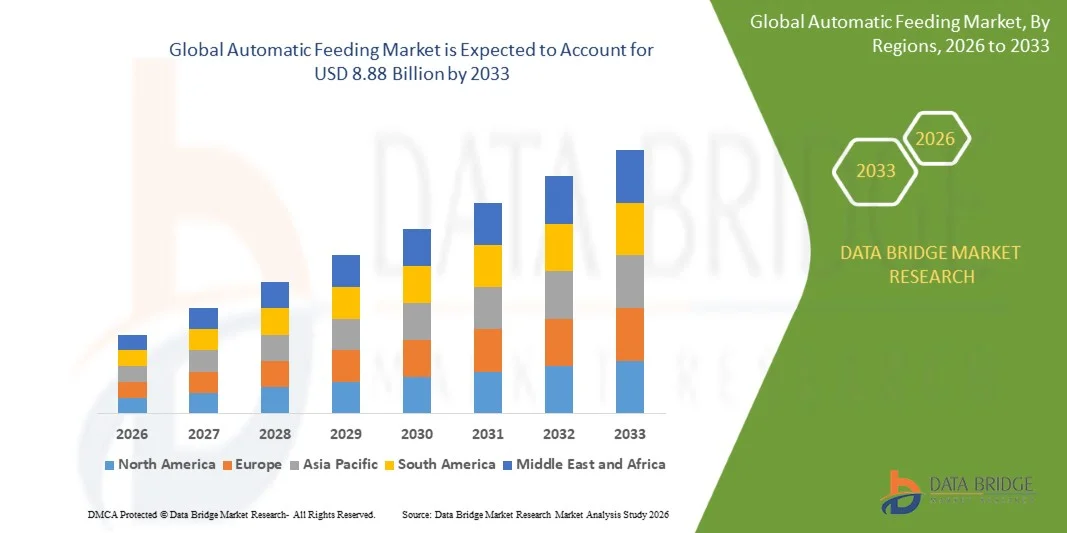
- As per Data Bridge Market Research analysis, the automatic feeding market was valued at USD 4.80 billion in 2025 and is projected to reach USD 8.88 billion by 2033, growing at a CAGR of 8.00% from 2026 to 2033.
- The market is experiencing steady growth driven by rising farm labor costs, growing average herd and flock sizes, and increasing adoption of precision livestock farming practices that improve feed conversion ratios while reducing feed wastage and on-farm spillage.
- Growing global demand for meat, dairy, and aquaculture products, alongside the expansion of large-scale industrial farming operations and government-backed farm modernization programs in emerging economies, is prompting producers to replace manual feeding routines with automated controllers, conveyors, and robotic feed-pushing systems capable of delivering consistent, round-the-clock feed.
Market Size & Forecast
- Global Market Value (2025): USD 4.80 Billion
- Expected Market Value (2033): USD 8.88 Billion
- Forecast CAGR (2026–2033): 8.00%
- Leading Region in 2025: Europe
- Fastest Growing Region: Asia-Pacific
What are the Major Takeaways of the Automatic Feeding Market?
- Europe dominated the global automatic feeding market with the largest revenue share of 34.60% in 2025, supported by large commercial dairy herds, deep automation penetration, and the strong regional presence of established feeding equipment manufacturers.
- Asia-Pacific is expected to be the fastest-growing region at a CAGR of 10.80% from 2026 to 2033, fueled by expanding commercial poultry and swine farming, rising protein consumption, and growing government support for farm mechanization in China and India.
- The conveyors segment led the feeding line category with a 33.42% share in 2025, driven by widespread use in high-density poultry and swine operations that require continuous, low-maintenance feed distribution.
- The controllers segment is the fastest-growing feeding line category, projected to register a CAGR of 9.40%, reflecting rising demand for programmable, sensor-based feed dosing across commercial farms.
- The poultry segment dominated the livestock category with a 36.75% revenue share in 2025, led by large-scale broiler and layer operations relying on automated chain and pan feeding systems to manage high-density flocks.
- The hardware segment accounted for 58.90% of the market share in 2025, supported by sustained investment in feeders, augers, conveyors, and motorized dispensing equipment across commercial livestock operations.
- The AI & machine learning-based systems segment is the fastest-growing technology category, with a CAGR of 11.30%, driven by demand for adaptive, data-driven feed formulation and predictive herd and flock management.
Report Scope and Automatic Feeding Market Segmentation
|
Attributes |
Automatic Feeding Market Market Insights |
|
Segments Covered |
|
|
Countries Covered |
North America
Europe
Asia-Pacific
South America
Middle East and Africa
|
|
Key Market Players |
|
|
Market Opportunities |
|
|
Value Added Data Infosets |
In addition to the insights on market scenarios such as market value, growth rate, segmentation, geographical coverage, and major players, the market reports curated by Data Bridge Market Research also include in-depth expert analysis, geographically represented company-wise production and capacity, network layouts of distributors and partners, detailed and updated price trend analysis, and deficit analysis of supply chain and demand. |
What is the Key Trend in the Automatic Feeding Market?
- Large commercial dairy and livestock operations are increasingly deploying autonomous, battery-powered feed-pushing and mixing robots to keep feed continuously within reach of animals while reducing dependence on manual tractor-based feeding rounds.
- For instance, Lely has extended its autonomous feed-pushing robot line-up for large-scale farms, enabling feed to be pushed back toward the feeding fence at more frequent intervals throughout the day and encouraging higher voluntary feed intake among housed cattle.
- Similarly, DeLaval's Optiwagon combines weighing, cutting, and mixing functions in a single autonomous unit that delivers freshly prepared rations directly to the feed table, reducing reliance on tractor-drawn mixer wagons and cutting daily feeding labor.
- On the poultry side, manufacturers are integrating automated weighing and monitoring directly into feeding and nesting infrastructure; Big Dutchman's nest-integrated Nesca 2.0 scale, for example, records broiler breeder body weight automatically at every nest visit and feeds the data into the farm's management system.
- As labor shortages persist and farms consolidate into larger operations, the adoption of autonomous, sensor-guided feeding equipment is expected to accelerate further, reinforcing automation as a core component of modern livestock and poultry management.
What are the Key Drivers of the Automatic Feeding Market?
- Rising global demand for animal protein, including meat, dairy, and eggs, amid population growth and rising disposable incomes is pushing producers toward larger, more intensively managed herds and flocks that are difficult to feed manually with consistent precision.
- For instance, expanding dairy farm sizes and the increasing need for continuous livestock monitoring are prompting producers across North America and Europe to adopt automated feeding and herd-management platforms that reduce labor dependency while improving traceability.
- Escalating farm labor shortages and rising wage costs, particularly in developed markets, are compelling commercial farms and dairies to invest in automated feeding, mixing, and dispensing equipment that can operate around the clock with minimal supervision.
- Growing adoption of precision livestock farming, supported by IoT-enabled sensors, real-time feed monitoring, and connected farm-management software, is helping producers reduce feed wastage, improve conversion ratios, and respond quickly to changes in herd or flock behavior.
- With global protein consumption continuing to rise and farms scaling up to meet demand, automatic feeding equipment is expected to remain essential to efficient, labor-light, and welfare-compliant livestock and poultry production.
Which Factors are Challenging the Growth of the Automatic Feeding Market?
- Advanced automatic feeding systems require significant upfront investment in feeders, conveyors, sensors, and farm-wide control infrastructure, which limits adoption among smaller farms, cooperatives, and producers in price-sensitive and emerging markets.
- The lack of standardization across feeding equipment, communication protocols, and farm-management software makes it difficult for producers to mix and match components from different vendors, often locking farms into a single manufacturer's feeding, milking, and herd-management ecosystem.
- For instance, producers adopting robotic feeding platforms from major dairy automation providers frequently find that expanding or upgrading their systems later requires continued reliance on the same vendor's proprietary software and hardware, raising long-term switching costs.
- This combination of high capital investment and limited interoperability continues to restrict adoption among small and medium-sized farms and in developing regions, slowing the pace of market penetration despite clear productivity and labor-saving benefits.
How is the Automatic Feeding Market Segmented?
The automatic feeding market is segmented on the basis of feeding line, feeding system, individual feeding equipment, livestock, component, technology, farm scale, deployment, and end user.
- By Feeding Line
On the basis of feeding line, the global automatic feeding market is segmented into controllers, mixers, distributors, and conveyors. The conveyors segment dominated the market with a 33.42% share in 2025, owing to its widespread use in high-density poultry and swine houses, where continuous, low-maintenance feed distribution is essential to managing large flocks and herds efficiently.
The controllers segment is projected to register the fastest growth at a CAGR of 9.40% from 2026 to 2033, driven by rising demand for programmable, sensor-based dosing units that allow producers to precisely calibrate feed quantity and timing across different animal groups.
- By Feeding System
On the basis of feeding system, the global automatic feeding market is segmented into conveyor feeding systems, robotic feeding systems, auger feeding systems, and chain & pan feeding systems. The chain & pan feeding systems segment led the market with a 29.85% share in 2025, supported by decades of proven reliability in broiler and layer houses and its continued use across both new and retrofitted poultry operations.
The robotic feeding systems segment is expected to witness the fastest CAGR of 10.20% from 2026 to 2033, driven by rising adoption of autonomous feed-pushing and mixing units on large dairy and livestock farms seeking to cut manual feeding rounds.
- By Individual Feeding Equipment
On the basis of individual feeding equipment, the global automatic feeding market is segmented into automatic calf feeders, equine feeders, cow feeders, and waterers. The cow feeders segment dominated the market with a 34.60% share in 2025, supported by the scale of global dairy and beef cattle operations and the central role of feeders in maintaining consistent ration delivery.
The automatic calf feeders segment is anticipated to witness the fastest CAGR of 9.80% from 2026 to 2033, driven by growing producer focus on calf health, standardized milk-replacer dosing, and early-life growth tracking on commercial dairy farms.
- By Livestock
On the basis of livestock, the global automatic feeding market is segmented into poultry, swine, ruminants, aquaculture, and equine. The poultry segment dominated the market with a 36.75% share in 2025, owing to the scale and density of global broiler and layer operations and their long-standing reliance on automated chain, pan, and auger feeding infrastructure.
The aquaculture segment is expected to witness the fastest CAGR of 10.50% from 2026 to 2033, as fish and shrimp farms scale up and increasingly adopt automated feeders and sensor-based feeding schedules to improve feed conversion and water quality management.
- By Component
On the basis of component, the global automatic feeding market is segmented into hardware, software, and services. The hardware segment dominated the market with a 58.90% share in 2025, reflecting continued capital investment in feeders, augers, conveyors, motors, and dispensing equipment across commercial poultry, swine, and dairy operations.
The software segment is expected to register the fastest CAGR of 10.80% from 2026 to 2033, driven by growing demand for feed-formulation, analytics, and herd-management platforms that help producers translate feeding data into actionable insights.
- By Technology
On the basis of technology, the global automatic feeding market is segmented into IoT-enabled systems, AI & machine learning-based systems, and conventional automated systems. The conventional automated systems segment dominated the market with a 44.20% share in 2025, as mechanical and timer-based feeders remain widely used, particularly among mid-sized farms in cost-sensitive regions.
The AI & machine learning-based systems segment is projected to witness the fastest CAGR of 11.30% from 2026 to 2033, driven by rising adoption of adaptive feeding algorithms that adjust ration size and timing based on real-time animal growth and behavior data.
- By Farm Scale
On the basis of farm scale, the global automatic feeding market is segmented into large-scale commercial farms and small & medium farms. The large-scale commercial farms segment dominated the market with a 62.15% share in 2025, supported by the higher capital capacity of large operations and their greater need for consistent, labor-light feeding across thousands of animals.
The small & medium farms segment is expected to witness the fastest CAGR of 9.10% from 2026 to 2033, driven by the growing availability of modular, retrofit-friendly automation kits and financing options that make automated feeding more accessible to smaller producers.
- By Deployment
On the basis of deployment, the global automatic feeding market is segmented into on-premise and cloud-based & connected systems. The on-premise segment dominated the market with a 55.30% share in 2025, reflecting continued producer preference for locally controlled systems that do not depend on farm internet connectivity.
The cloud-based & connected segment is expected to witness the fastest CAGR of 10.60% from 2026 to 2033, driven by rising adoption of remote monitoring, mobile alerts, and centralized feed-management dashboards across multi-site farming operations.
- By End User
On the basis of end user, the global automatic feeding market is segmented into commercial livestock farms, poultry hatcheries & breeder farms, aquaculture farms, and research institutions & universities. The commercial livestock farms segment dominated the market with a 48.75% share in 2025, owing to the scale of global cattle, swine, and poultry production and the central role automated feeding plays in daily farm operations.
The aquaculture farms segment is expected to witness the fastest CAGR of 10.00% from 2026 to 2033, driven by the rapid expansion of commercial fish and shrimp farming and growing use of automated feeders to optimize feed timing and reduce water contamination.
Which Region Holds the Largest Share of the Automatic Feeding Market?
- Europe dominated the automatic feeding market and accounted for the largest revenue share of 34.60% in 2025, supported by large-scale dairy operations, high automation penetration, and the presence of established feeding equipment manufacturers such as GEA, DeLaval, Lely, and Trioliet.
- The region also benefits from strong farm labor cost pressures, high adoption of robotic feed-pushing and precision feeding technologies, and growing use of automated systems across dairy, swine, and poultry operations. Continued focus on animal welfare standards and farm efficiency continues to reinforce Europe's leadership position in the global market.
Germany Automatic Feeding Market Insight
The Germany automatic feeding market is expanding steadily, supported by the country's large commercial poultry and swine sectors and the strong domestic presence of feeding equipment manufacturers. Farms across the country are increasingly adopting automated chain feeding, sensor-based controllers, and weighing-integrated systems to manage high-density operations. Continued investment in precision livestock technologies and government support for farm modernization are further reinforcing Germany's position as a key market for automatic feeding equipment.
Netherlands Automatic Feeding Market Insight
The Netherlands automatic feeding market is witnessing consistent growth, driven by the country's highly intensive dairy and livestock sector and its role as a global hub for feeding and farm-automation technology development. Dutch dairy farms are among the earliest adopters of autonomous feed-pushing and mixing robots, supported by strong domestic manufacturing capabilities and a farming culture oriented toward efficiency and sustainability. Ongoing innovation in connected, data-driven feeding systems continues to support market expansion in the country.
Asia-Pacific Automatic Feeding Market Insight
The Asia-Pacific automatic feeding market is expected to witness rapid growth, driven by expanding commercial poultry and swine production, rising protein consumption, and increasing government investment in farm mechanization across China, India, and Southeast Asia. Growing awareness of feed efficiency, rising labor costs in urbanizing economies, and the entry of global equipment manufacturers into the region are supporting the shift from manual to automated feeding practices across both large integrators and mid-sized commercial farms.
China Automatic Feeding Market Insight
The China automatic feeding market is growing rapidly, driven by the continued consolidation of poultry and swine production into large integrated operations and strong government focus on modernizing the country's livestock sector following recurring animal disease pressures. Rising domestic manufacturing of feeding equipment, growing adoption of AI-enabled monitoring, and increasing investment by large agribusiness groups are positioning China as one of the fastest-growing markets for automatic feeding systems globally.
India Automatic Feeding Market Insight
The India automatic feeding market is expanding at a steady pace, supported by the rapid growth of organized poultry and dairy production and rising investment in farm infrastructure. Increasing awareness of feed conversion efficiency, growing presence of integrated poultry players, and government schemes supporting dairy and livestock modernization are encouraging the gradual shift toward automated feeding equipment, particularly among mid-sized and large commercial operations.
Which are the Top Companies in Automatic Feeding Market?
The automatic feeding industry is primarily led by well-established companies, including:
- AGCO Corporation (U.S.)
- DeLaval Inc. (Sweden)
- GEA Group Aktiengesellschaft (Germany)
- Big Dutchman International GmbH (Germany)
- Lely Holding S.à r.l. (Netherlands)
- Trioliet B.V. (Netherlands)
- KUHN SAS (France)
- ROXELL (Belgium)
- VDL Agrotech (Netherlands)
- Pellon Group Oy (Finland)
- Rovibec Agrisolutions (Canada)
- Cormall A/S (Denmark)
- BouMatic LLC (U.S.)
- SKIOLD A/S (Denmark)
- Chore-Time, a CTB Inc. brand (U.S.)
- Fullwood JOZ (Netherlands)
- Afimilk Ltd. (Israel)
- JYGA Technologies (Canada)
- SKOV A/S (Denmark)
- Big Herdsman Machinery Co., Ltd. (China)
- Valmetal Group (Canada)
- Dairymaster (Ireland)
What are Latest Developments in Automatic Feeding Market?
- In 2025, Big Dutchman introduced Nesca 2.0, a nest-integrated automatic weighing solution for broiler breeder operations that records bird weight during every nest visit without manual handling, feeding the data directly into the company's Viper Touch management system to improve breeder flock uniformity monitoring.
- Roxell expanded its poultry feeding portfolio with the Fortena chain feeding system for broiler breeders in the production period, completing a full-range feeding lineup for breeder operations and reinforcing the company's total feeding-solution strategy across poultry and swine houses.
- In March 2023, DeLaval launched Optiwagon, an autonomous feeding robot that combines weighing, cutting, and mixing functions to deliver freshly prepared feed directly to the feed table, reducing dairy farms' reliance on tractor-based mixer wagons.
- Lely extended its autonomous feed-pushing robot lineup for large-scale dairy farms, enabling feed to be pushed back toward the feeding fence at more frequent intervals throughout the day and supporting higher voluntary feed intake among housed cattle.
- In October 2025, BouMatic introduced an automated feeding solution integrated with herd-management software, enabling real-time monitoring of feeding operations and giving dairy producers more detailed visibility into feed delivery and animal performance.

- Interactive Data Analysis Dashboard
- Company Analysis Dashboard for high growth potential opportunities
- Research Analyst Access for customization & queries
- Competitor Analysis with Interactive dashboard
- Latest News, Updates & Trend analysis
- Harness the Power of Benchmark Analysis for Comprehensive Competitor Tracking
Data collection and base year analysis are done using data collection modules with large sample sizes. The stage includes obtaining market information or related data through various sources and strategies. It includes examining and planning all the data acquired from the past in advance. It likewise envelops the examination of information inconsistencies seen across different information sources. The market data is analysed and estimated using market statistical and coherent models. Also, market share analysis and key trend analysis are the major success factors in the market report. To know more, please request an analyst call or drop down your inquiry.
The key research methodology used by DBMR research team is data triangulation which involves data mining, analysis of the impact of data variables on the market and primary (industry expert) validation. Data models include Vendor Positioning Grid, Market Time Line Analysis, Market Overview and Guide, Company Positioning Grid, Patent Analysis, Pricing Analysis, Company Market Share Analysis, Standards of Measurement, Global versus Regional and Vendor Share Analysis. To know more about the research methodology, drop in an inquiry to speak to our industry experts.
Data Bridge Market Research is a leader in advanced formative research. We take pride in servicing our existing and new customers with data and analysis that match and suits their goal. The report can be customized to include price trend analysis of target brands understanding the market for additional countries (ask for the list of countries), clinical trial results data, literature review, refurbished market and product base analysis. Market analysis of target competitors can be analyzed from technology-based analysis to market portfolio strategies. We can add as many competitors that you require data about in the format and data style you are looking for. Our team of analysts can also provide you data in crude raw excel files pivot tables (Fact book) or can assist you in creating presentations from the data sets available in the report.