


What is the Automatic Flexible Packaging Machines Market Size and Growth Rate?
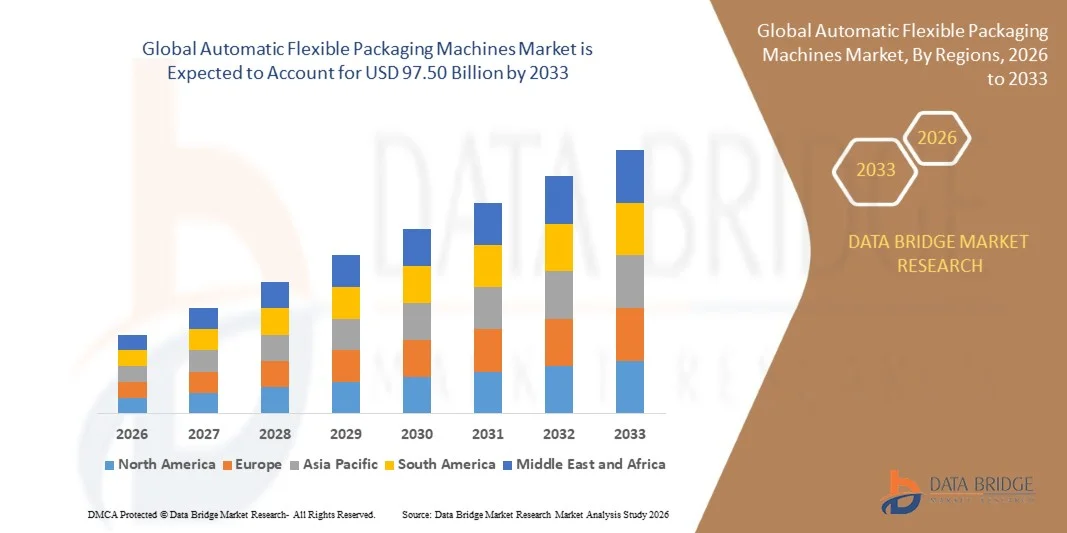
- As per Data Bridge Market Research analysis, the automatic flexible packaging machines market was valued at USD 56.75 billion in 2025 and is projected to reach USD 97.50 billion by 2033, growing at a CAGR of 7.00% from 2026 to 2033.
- The market is expanding as manufacturers increasingly adopt automated flexible packaging machines to improve production efficiency, reduce labor requirements, minimize packaging waste, and achieve consistent product quality. Advancements in servo-driven systems, smart controls, robotics, and integrated inspection technologies are further enhancing machine productivity and operational flexibility.
- The growing consumption of packaged food and beverages, rising demand for convenient pouch and sachet formats, and increasing emphasis on sustainable packaging are compelling manufacturers to upgrade their packaging lines. Automatic form-fill-seal, pouch-filling, wrapping, and sealing machines are gaining adoption by providing faster throughput, precise filling, reduced material consumption, and greater flexibility for different packaging sizes and formats.
Market Size & Forecast
- Global Market Value (2025): USD 56.75 Billion
- Expected Market Value (2033): USD 97.50 Billion
- Forecast CAGR (2026–2033): 7.00%
- Leading Region in 2025: North America
- Fastest Growing Region: Asia Pacific
What are the Major Takeaways of the Automatic Flexible Packaging Machines Market?
- North America dominated the automatic flexible packaging machines market with the largest revenue share of 35% in 2025, supported by strong food and beverage, pharmaceutical, and consumer goods manufacturing industries and high adoption of advanced automation technologies.
- Asia-Pacific is expected to be the fastest-growing region at a CAGR of 6.8%, fueled by rapid industrialization, expanding food-processing industries, rising packaged food consumption, and increasing investments in automated packaging infrastructure.
- The form-fill-seal systems segment led the market with a 42.5% share in 2025, driven by its ability to combine forming, filling, and sealing into one automated operation.
- Palletizing systems are the fastest-growing machine type, projected to register a CAGR of 8.4%, reflecting the surge in labor shortages and rising end-of-line automation requirements are encouraging manufacturers to automate pallet handling and product stacking.
- The mechanical segment dominated the technology category with a 35% revenue share in 2025, led by its established installed base, relatively straightforward operation, and suitability for repetitive high-volume packaging processes.
- Fully automatic accounted for 64.5% of the market share in 2025, preferred by increasing demand for high-speed production, lower labor dependency, and consistent packaging quality.
- The semi-automatic segment is the fastest-growing automation level category, with a CAGR of 5.5%, driven by demand from small and medium-sized manufacturers seeking automation without the capital requirements of fully automated production lines.
Report Scope and Automatic Flexible Packaging Machines Market Segmentation
|
Attributes |
Automatic Flexible Packaging Machines Key Market Insights |
|
Segments Covered |
|
|
Countries Covered |
North America
Europe
Asia-Pacific
Middle East and Africa
South America
|
|
Key Market Players |
|
|
Market Opportunities |
|
|
Value Added Data Infosets |
In addition to the insights on market scenarios such as market value, growth rate, segmentation, geographical coverage, and major players, the market reports curated by the Data Bridge Market Research also include import export analysis, production capacity overview, production consumption analysis, price trend analysis, climate change scenario, supply chain analysis, value chain analysis, raw material/consumables overview, vendor selection criteria, PESTLE Analysis, Porter Analysis, and regulatory framework. |
What is the Key Trend in the Automatic Flexible Packaging Machines Market?
- Packaging manufacturers are increasingly adopting smart, connected, and highly automated flexible packaging machines to improve production efficiency, reduce material waste, enable rapid changeovers, and support real-time monitoring across high-volume packaging operations.
- For instance, in November 2025, BOBST introduced the next-generation EXPERT K5 metallizer with AI-powered operator support and autonomous operation, automating previously labor-intensive processes while supporting flexible-packaging materials including BOPE, MDO PE, CPP, paper, and thin-gauge films.
- Digitalization, robotics, artificial intelligence, and predictive maintenance are becoming increasingly integrated into automatic packaging equipment, allowing manufacturers to improve machine uptime, optimize production parameters, and reduce unplanned downtime across flexible packaging lines.
- Advanced servo-driven systems and automated changeover technologies are enabling packaging machines to handle multiple pouch sizes, film structures, and product formats with greater precision while reducing setup time and improving overall equipment flexibility.
- Packaging machinery manufacturers are increasingly developing equipment compatible with recyclable mono-material films, thinner substrates, and sustainable packaging structures, responding to brand owners' efforts to reduce material consumption and improve packaging recyclability.
- For instance, in September 2025, DS Smith implemented BOBST Connect across its EMEA operations, using a cloud-based platform to integrate machine data and digital services for production planning, equipment monitoring, decision-making, and energy management.
- As packaging producers increasingly prioritize automation, sustainability, flexibility, and connected manufacturing, adoption of intelligent automatic flexible packaging machines is expected to accelerate, reinforcing advanced machinery as a core component of next-generation packaging production.
What are the Key Drivers of the Automatic Flexible Packaging Machines Market?
- The rapid expansion of packaged food, beverages, pharmaceuticals, personal care products, and e-commerce is significantly increasing demand for flexible packaging formats such as pouches, sachets, bags, and wraps that require high-speed automated machinery.
- For instance, in April 2025, Syntegon launched the Pack 103 flow-wrapping machine, designed specifically for small and medium-sized businesses entering automation. The machine delivers up to 175 packs per minute and supports multiple product sizes, demonstrating how manufacturers are adopting automated flexible packaging equipment to increase productivity while reducing manual packaging requirements.
- Rising labor costs, workforce shortages, and demand for consistent high-speed production are encouraging manufacturers to replace labor-intensive packaging processes with automated forming, filling, sealing, inspection, and handling systems.
- For instance, in August 2025, Syntegon showcased its SVL 2310 vertical packaging machine in India, capable of producing up to 110 bags of snacks per minute, or 220 bags per minute in its twin configuration, in response to the country's growing demand for packaged snacks and biscuits. The deployment demonstrates how rising packaged-food consumption is driving demand for high-speed, flexible automated packaging machinery.
- With manufacturers increasingly seeking higher throughput, lower material consumption, reduced labor dependency, and greater packaging flexibility, automatic flexible packaging machines will remain essential for modernizing production lines and meeting rapidly changing consumer and sustainability requirements.
Which Factors are Challenging the Growth of the Automatic Flexible Packaging Machines Market?
- Advanced automatic flexible packaging machines require significant upfront capital investment because of sophisticated servo systems, robotics, sensors, controls, inspection technologies, and integrated packaging-line infrastructure.
- For instance, in May 2021, PMMI highlighted that packaging companies faced challenges in determining the return on investment for automation and in finding skilled labor and internal resources capable of assessing automation requirements.
- These high acquisition, installation, maintenance, and training costs can restrict adoption among small and medium-sized packaging manufacturers, particularly in emerging economies where access to equipment financing remains limited.
- Shortages of skilled technical personnel can constrain the effective operation and maintenance of advanced automated packaging equipment, particularly as machines incorporate sophisticated controls, robotics, sensors, and software
- Complexity of machine integration and changeovers can limit adoption, as flexible packaging lines often need to accommodate multiple SKUs, film structures, package sizes, and product formats, increasing setup requirements and engineering complexity.
- For instance, in November 2025, PMMI reported that workforce shortages and undocumented skill loss were disrupting plant-floor performance, with packaging manufacturers increasingly requiring embedded HMIs, predictive-maintenance tools, remote OEM support, and targeted automation to address skills gaps.
- The high capital requirements, integration complexity, skilled-operator requirements, and continuing technology-upgrade costs continue to restrict adoption, particularly among smaller manufacturers and price-sensitive markets, slowing widespread deployment of advanced automatic flexible packaging machinery despite increasing demand for automation.
How is the Automatic Flexible Packaging Machines Market Segmented?
The automatic flexible packaging machines market is segmented on the basis of machine type, technology, automation level, distribution channel, and end user.
- By Machine Type
On the basis of machine type, the automatic flexible packaging machines market is segmented into filling machines, sealing machines, wrapping machines, labeling machines, cartoning machines, palletizing systems, form-fill-seal systems, blister packaging machines, and others. The form-fill-seal systems segment dominated the market with an estimated share of 42.5% in 2025, owing to its ability to combine forming, filling, and sealing into one automated operation. FFS systems are widely used for pouches, bags, sachets, and other flexible formats across food, pharmaceutical, and personal care applications. Their integrated design reduces manual intervention, labor requirements, and packaging-line complexity. High-speed operation and compatibility with different film structures further support adoption among high-volume manufacturers. Servo controls, recipe-based operation, and automated defect detection are increasingly improving their efficiency.
The palletizing systems segment is projected to be the fastest-growing machine type, with an estimated CAGR of 8.4% through 2033. Increasing labor shortages and rising end-of-line automation requirements are encouraging manufacturers to automate pallet handling and product stacking. Robotic palletizing systems can operate continuously while improving consistency and reducing workplace handling requirements. They can also accommodate multiple SKUs, package dimensions, and pallet configurations with programmable controls. Integration with conveyors, vision systems, and warehouse-management technologies is further improving end-of-line efficiency. Food, beverage, pharmaceutical, and consumer-product manufacturers are increasingly investing in automated palletizing as part of complete packaging lines.
- By Technology
On the basis of technology, the market is segmented into pneumatic, servo-driven, mechanical, electronic, and hybrid technologies. The mechanical segment is estimated to remain the dominant technology category, accounting for 35% of the market in 2025, owing to its established installed base, relatively straightforward operation, and suitability for repetitive high-volume packaging processes. Mechanical systems remain widely used where packaging operations require stable and continuous machine movements. Their mature technology and comparatively familiar maintenance requirements support adoption among established manufacturers. They are particularly relevant in applications where machine configurations remain relatively standardized. However, mechanical systems generally provide less flexibility than advanced servo-controlled equipment for frequent product and format changes.
The servo-driven segment is expected to be the fastest-growing technology category, registering an estimated CAGR of 7.0% during the forecast period. Servo technology enables precise control of filling, forming, cutting, sealing, and material movement operations. It allows packaging manufacturers to achieve faster changeovers and accommodate multiple package sizes with greater flexibility. Servo-driven systems also support improved synchronization between different machine components, reducing material losses and improving package consistency. Integration with programmable logic controllers, human-machine interfaces, sensors, and industrial Internet of Things platforms is further increasing their functionality. Rising demand for smart packaging machinery and high-speed production is encouraging manufacturers to upgrade from conventional mechanical systems.
- By Automation Level
On the basis of automation level, the market is segmented into semi-automatic and fully automatic systems. The fully automatic segment dominated the market with an estimated share of 64.5% in 2025, supported by increasing demand for high-speed production, lower labor dependency, and consistent packaging quality. Fully automatic systems can integrate product feeding, filling, forming, sealing, inspection, and material handling with limited operator intervention. Their high throughput makes them particularly suitable for large food, beverage, pharmaceutical, and consumer-goods manufacturing facilities. Automation also reduces manual errors and supports more consistent package dimensions and sealing quality. Increasing integration of robotics, sensors, machine vision, and real-time monitoring is expanding their capabilities.
The semi-automatic segment is expected to grow at an estimated CAGR of 5.5% during the forecast period, supported by demand from small and medium-sized manufacturers seeking automation without the capital requirements of fully automated production lines. Semi-automatic machines allow operators to perform selected feeding, loading, or material-handling tasks while automating critical packaging operations. They provide an intermediate solution for companies transitioning from manual packaging toward higher levels of automation. Their relatively lower investment requirements can make them attractive in price-sensitive markets. They are also suitable for manufacturers producing multiple low-volume SKUs where complete automation may not be economically justified. Small food processors, specialty-product manufacturers, and emerging pharmaceutical producers can benefit from this flexibility.
- By Distribution Channel
On the basis of distribution channel, the market is segmented into direct sales and distributors. The direct sales segment dominated the market with an estimated share of 65% in 2025, particularly for sophisticated and customized automatic packaging systems. Large manufacturers generally purchase high-value packaging equipment directly from machinery producers because these systems require detailed technical specifications and application-specific engineering. Direct sales enable equipment manufacturers to provide installation, commissioning, operator training, maintenance, and after-sales support. They also allow customers to customize machine configurations according to production volumes, package formats, and product characteristics. Long-term service agreements and spare-parts relationships further strengthen direct manufacturer-customer relationships. Large food, beverage, pharmaceutical, and consumer goods companies generally have dedicated procurement and engineering teams capable of managing direct equipment purchases.
The distributors segment is expected to be the faster-growing channel, with an estimated CAGR of 6.0% during the forecast period. Distributors provide machinery manufacturers with broader geographic reach, particularly in emerging and fragmented markets. They can offer local sales support, installation assistance, spare parts, and basic technical services closer to end users. Smaller manufacturers often prefer distributor relationships because they simplify equipment sourcing and after-sales support. Growth in food processing, pharmaceutical manufacturing, and consumer-product production in developing economies is creating additional opportunities for regional distributors. Distributor networks can also reduce the time and logistical complexity associated with purchasing equipment from overseas manufacturers.
- By End User
On the basis of end user, the market is segmented into food & beverage, pharmaceutical, chemicals, cosmetics, and others. The food & beverage segment dominated the market with an estimated share of 55% in 2025, supported by the enormous volume of packaged food and beverage products manufactured globally. Automatic flexible packaging machines are extensively used for snacks, confectionery, bakery products, frozen foods, ready-to-eat meals, sauces, dairy products, coffee, and pet food. Growing consumer demand for convenient, lightweight, resealable, and portion-controlled packaging is increasing the use of flexible formats. High-volume food manufacturers also require automated equipment capable of maintaining consistent production speeds and package quality. Rising demand for extended shelf life and improved product protection is further supporting flexible packaging adoption. The expansion of organized retail, convenience foods, and e-commerce grocery sales is creating additional demand.
The pharmaceutical segment is expected to witness the fastest growth at a CAGR of 8% during the forecast period, driven by increasing pharmaceutical production, stringent packaging requirements, and growing demand for automated and contamination-controlled packaging processes. Automatic machinery is increasingly used for pouches, sachets, blister packs, unit-dose formats, and other pharmaceutical packaging applications. Automation improves filling accuracy, product traceability, packaging consistency, and compliance with stringent quality requirements. Growing demand for generic medicines, over-the-counter products, and single-dose pharmaceutical formats is creating additional equipment requirements. Pharmaceutical manufacturers are also increasingly adopting serialization, inspection, and vision-based technologies alongside packaging machinery. Rising investments in pharmaceutical manufacturing facilities in emerging markets are further supporting demand.
Which Region Holds the Largest Share of the Automatic Flexible Packaging Machines Market?
- North America dominated the automatic flexible packaging machines market with the largest revenue share of 35% in 2025, supported by strong food and beverage, pharmaceutical, and consumer goods manufacturing industries and high adoption of advanced automation technologies.
- The region also benefits from high automation penetration, established packaging machinery manufacturers, rising labor costs, and increasing investments in sustainable and high-speed packaging technologies. Strong demand for flexible pouches, bags, films, and other lightweight formats, combined with the modernization of food and pharmaceutical production lines, continues to strengthen North America's leadership in the global market.
U.S. Automatic Flexible Packaging Machines Market Insight
The U.S. automatic flexible packaging machines market is witnessing strong growth due to rising investments in packaging automation, food and beverage production, pharmaceutical manufacturing, and advanced packaging technologies. The country’s mature manufacturing ecosystem, along with increasing adoption of high-speed, servo-driven, and digitally connected packaging systems, is driving demand across major end-use industries. In addition, growing labor costs, workforce shortages, and increasing emphasis on production efficiency are accelerating the replacement of manual packaging processes with automated flexible packaging machinery.
Asia-Pacific Automatic Flexible Packaging Machines Market Insight
The Asia-Pacific automatic flexible packaging machines market is expected to witness rapid growth, driven by expanding food-processing industries, increasing packaged-food consumption, and rising investments in manufacturing automation across countries such as China, India, and Japan. Growing demand for lightweight, convenient, and sustainable packaging formats is supporting regional market expansion. In addition, increasing labor costs, expansion of pharmaceutical and consumer goods manufacturing, and growing adoption of high-speed form-fill-seal and pouch packaging systems are accelerating machinery investments across the region.
Japan Automatic Flexible Packaging Machines Market Insight
The Japan automatic flexible packaging machines market is witnessing consistent growth due to rising investments in advanced manufacturing automation, precision packaging technologies, and efficient production systems. Food and beverage manufacturers, pharmaceutical companies, and consumer goods producers are increasingly adopting high-speed and servo-driven machinery for improved packaging accuracy and productivity. Moreover, Japan’s focus on robotics, smart manufacturing, compact packaging systems, and labor-saving technologies is further contributing to market growth.
China Automatic Flexible Packaging Machines Market Insight
The China automatic flexible packaging machines market is growing rapidly, driven by expanding food and beverage production, increasing pharmaceutical manufacturing, and rising investments in industrial automation. Growing adoption of high-speed form-fill-seal, pouch-filling, and automated end-of-line systems across manufacturing facilities is significantly boosting market demand. In addition, rising e-commerce activity, increasing consumption of packaged foods, growing labor costs, and rapid development of smart manufacturing technologies are positioning China as one of the fastest-growing markets for automatic flexible packaging machinery globally.
U.K. Automatic Flexible Packaging Machines Market Insight
The U.K. automatic flexible packaging machines market is experiencing steady growth, supported by rising adoption of automated packaging systems across food, beverage, pharmaceutical, cosmetics, and consumer goods industries. Increasing investments in high-efficiency machinery and growing demand for recyclable and lightweight flexible packaging solutions are contributing to market growth. Furthermore, integration of servo controls, digital monitoring, robotics, and sustainable-material capabilities is improving packaging productivity and flexibility, positioning the U.K. as an important market for advanced packaging automation.
Germany Automatic Flexible Packaging Machines Market Insight
The Germany automatic flexible packaging machines market is expanding steadily due to the country’s strong machinery manufacturing base, advanced industrial automation capabilities, and increasing adoption of smart packaging technologies. Food and beverage manufacturers, pharmaceutical companies, and industrial producers are increasingly utilizing automated machines for high-speed filling, forming, sealing, wrapping, and material handling operations. Continuous advancements in Industry 4.0, robotics, servo-driven systems, and connected machinery, along with Germany’s strong focus on manufacturing efficiency and sustainable packaging, are further driving market growth.
Which are the Top Companies in Automatic Flexible Packaging Machines Market?
The automatic flexible packaging machines industry is primarily led by well-established companies, including:
- Syntegon Technology GmbH (Germany)
- IMA S.p.A. (Italy)
- Coesia S.p.A. (Italy)
- FUJI MACHINERY CO., LTD. (Japan)
- P.F.M. S.P.A. (Italy)
- ILAPAK INTERNATIONAL S.A. (Switzerland)
- ROVEMA GmbH (Germany)
- MESPACK, S.L. (Spain)
- SN Maschinenbau GmbH (Germany)
- ULMA Packaging (Spain)
- VOLPAK S.A.U. (Spain)
- Pakona Engineers (India) Private Limited (India)
- Triangle Package Machinery Company (U.S.)
- Matrix Packaging Machinery LLC (U.S.)
- Ishida Co., Ltd. (Japan)
- OMAG S.p.A. (Italy)
- TNA Solutions Pty Ltd (Australia)
- Mamata Enterprises (India)
- All-Fill, Inc. (U.S.)
What are Latest Developments in Automatic Flexible Packaging Machines Market?
- In November 2025, BOBST introduced the next-generation EXPERT K5 metallizer, incorporating AI-powered intelligent operator support and a high level of autonomous operation. The machine is designed to process flexible-packaging substrates including BOPE, MDO PE, CPP, paper, and thin-gauge BOPP films, with working widths from 1,350 to 4,850 mm. The launch demonstrates the increasing integration of automation, AI, digitalization, and sustainable-material compatibility into flexible-packaging machinery.
- In August 2025, Syntegon showcased the SVL 2310 vertical packaging machine and Pack 301 horizontal flow wrapper for India's snack and biscuit industry. The SVL 2310 can produce up to 110 bags of chips per minute, or 220 bags per minute in its twin configuration, while the Pack 301 can reach up to 250 packs per minute with duplex infeed. These machines demonstrate the development of high-speed, flexible packaging systems designed to handle multiple formats and products.
- In April 2025, Syntegon launched the Pack 103 flow-wrapping machine, an upgraded entry-level solution designed for small and medium-sized businesses entering packaging automation. The machine can achieve output of up to 175 packs per minute and supports different product sizes, providing greater flexibility while improving packaging-line productivity. The launch reflects the industry's move toward accessible, high-speed automated flexible packaging solutions for smaller manufacturers.
- In February 2025, Syntegon launched the Kliklok ACC carton closer, a high-speed secondary-packaging machine capable of processing up to 200 cartons per minute. The machine provides positive carton control, supports large carton sizes, and is designed for easy operation and reduced maintenance. Its launch highlights growing demand for flexible, high-throughput automated packaging equipment that can be integrated into complete production lines.
- In July 2024, Syntegon introduced the SVL 2310 Twin vertical bagging machine and Pack 301 LS horizontal flow-wrapping system at PackEx India, providing automated packaging solutions for snacks, biscuits, cookies, and crackers. The SVL 2310 can produce up to 105 packages per minute, while the Pack 301 LS incorporates a Smart Duplex Measuring Loader for flexible product handling. Syntegon also highlighted a paper-ON-form retrofit solution for processing paper-based and film packaging materials on the same system.

- Interactive Data Analysis Dashboard
- Company Analysis Dashboard for high growth potential opportunities
- Research Analyst Access for customization & queries
- Competitor Analysis with Interactive dashboard
- Latest News, Updates & Trend analysis
- Harness the Power of Benchmark Analysis for Comprehensive Competitor Tracking
Global Automatic Flexible Packaging Machines Market, Supply Chain Analysis and Ecosystem Framework
To support market growth and help clients navigate the impact of geopolitical shifts, DBMR has integrated in-depth supply chain analysis into its Global Automatic Flexible Packaging Machines Market research reports. This addition empowers clients to respond effectively to global changes affecting their industries. The supply chain analysis section includes detailed insights such as Global Automatic Flexible Packaging Machines Market consumption and production by country, price trend analysis, the impact of tariffs and geopolitical developments, and import and export trends by country and HSN code. It also highlights major suppliers with data on production capacity and company profiles, as well as key importers and exporters. In addition to research, DBMR offers specialized supply chain consulting services backed by over a decade of experience, providing solutions like supplier discovery, supplier risk assessment, price trend analysis, impact evaluation of inflation and trade route changes, and comprehensive market trend analysis.
Data collection and base year analysis are done using data collection modules with large sample sizes. The stage includes obtaining market information or related data through various sources and strategies. It includes examining and planning all the data acquired from the past in advance. It likewise envelops the examination of information inconsistencies seen across different information sources. The market data is analysed and estimated using market statistical and coherent models. Also, market share analysis and key trend analysis are the major success factors in the market report. To know more, please request an analyst call or drop down your inquiry.
The key research methodology used by DBMR research team is data triangulation which involves data mining, analysis of the impact of data variables on the market and primary (industry expert) validation. Data models include Vendor Positioning Grid, Market Time Line Analysis, Market Overview and Guide, Company Positioning Grid, Patent Analysis, Pricing Analysis, Company Market Share Analysis, Standards of Measurement, Global versus Regional and Vendor Share Analysis. To know more about the research methodology, drop in an inquiry to speak to our industry experts.
Data Bridge Market Research is a leader in advanced formative research. We take pride in servicing our existing and new customers with data and analysis that match and suits their goal. The report can be customized to include price trend analysis of target brands understanding the market for additional countries (ask for the list of countries), clinical trial results data, literature review, refurbished market and product base analysis. Market analysis of target competitors can be analyzed from technology-based analysis to market portfolio strategies. We can add as many competitors that you require data about in the format and data style you are looking for. Our team of analysts can also provide you data in crude raw excel files pivot tables (Fact book) or can assist you in creating presentations from the data sets available in the report.













