


Automatic Osmometer Equipment Market Overview
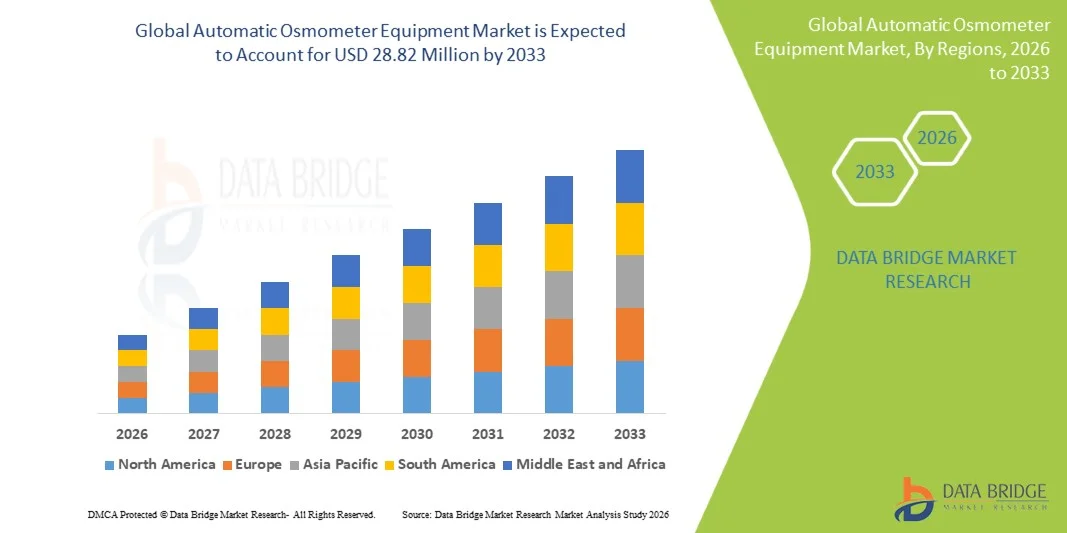
The Automatic Osmometer Equipment Market was valued at USD 20.27 Million in 2025 and is projected to reach USD 28.82 Million by 2033, growing at a CAGR of 4.50% from 2026 to 2033. The Automatic Osmometer Equipment Market is experiencing consistent growth driven by rising demand for accurate osmolality measurement solutions, increasing adoption of automated laboratory instruments, and expanding applications across pharmaceutical, biotechnology, clinical diagnostics, and research laboratories.
The growing need for precise quality control testing in drug development, biologics manufacturing, and medical diagnostics, combined with stringent regulatory requirements for pharmaceutical production and laboratory accuracy, is compelling healthcare providers, pharmaceutical companies, and research institutions to adopt advanced automatic osmometer systems. Automated freezing point and vapor pressure osmometry technologies are increasingly replacing manual testing methods by offering faster analysis, improved accuracy, reduced operator dependency, and higher testing efficiency across clinical and industrial environments.
Key Market Trends & Insights
- North America dominated the Automatic Osmometer Equipment Market with the largest revenue share of 35.2% in 2025, supported by the strong presence of advanced healthcare infrastructure, pharmaceutical and biotechnology research facilities, and high adoption of automated laboratory technologies. The region benefits from increasing demand for precise osmolality testing in clinical diagnostics, drug development, quality control, and research applications. Growing investments in laboratory automation, increasing pharmaceutical R&D activities, and the presence of major diagnostic and life science companies are further strengthening North America’s leading position in the market.
- The freezing point osmometers segment dominated the market with a 68.4% share in 2025, owing to its widespread adoption in clinical laboratories, pharmaceutical manufacturing, biotechnology research, and quality control applications.
- Asia-Pacific is expected to be the fastest-growing region at a CAGR of 7.6% from 2026 to 2033, fueled by expanding pharmaceutical manufacturing, rising healthcare expenditure, increasing diagnostic laboratory networks, and growing adoption of advanced analytical instruments in countries such as China, India, Japan, and South Korea. The region is witnessing rapid growth in biotechnology research, contract manufacturing organizations (CMOs), and clinical testing facilities, which is increasing demand for automated osmolality measurement solutions. Government initiatives supporting healthcare modernization and laboratory infrastructure development are further accelerating market expansion.
- The multiple sample segment is expected to witness significant growth, registering a CAGR of 7.1% from 2026 to 2033, driven by increasing demand for high-throughput laboratory testing and automation in pharmaceutical, biotechnology, and diagnostic environments. Multiple sample osmometer systems enable laboratories to improve workflow efficiency, reduce manual handling, and process larger sample volumes with consistent accuracy. Growing adoption in quality control laboratories, research institutions, and contract testing facilities is accelerating the shift toward multi-sample analytical platforms.
- The pharmaceuticals and biotechnology application segment dominated the market with a 38.7% revenue share in 2025, supported by increasing demand for osmolality testing during drug formulation, biologics development, injectable product manufacturing, and regulatory quality assessment. Pharmaceutical and biotechnology companies rely on automated osmometers to ensure product stability, optimize formulations, and maintain compliance with global quality standards. Rising investments in biologics, personalized medicine, and advanced therapies are further increasing the adoption of osmometer equipment in this segment.
Market Size & Forecast
- Global Market Value (2025): USD 20.27 Million
- Expected Market Value (2033): USD 28.82 Million
- Forecast CAGR (2026–2033): 4.50%
- Leading Region in 2025: North America
- Fastest Growing Region: Asia-Pacific
Report Scope and Automatic Osmometer Equipment Market Segmentation
|
Attributes |
Automatic Osmometer Equipment Key Market Insights |
|
Segments Covered |
· By Product: Freezing Point Osmometers, Vapor Pressure Osmometers, Membrane Osmometers, and Others · By Sample: Single Sample, Multiple Sample · By Application: Clinical, Dairy Analysis, Pharmaceuticals and Biotech, and Others · By End User: Hospitals, Laboratory and Diagnostic Centers, Healthcare Companies, Contract Research Organizations, Contract Manufacturing Organizations, Food and Feed Industries, and Others |
|
Countries Covered |
North America · U.S. · Canada · Mexico Europe · Germany · France · U.K. · Netherlands · Switzerland · Belgium · Russia · Italy · Spain · Turkey · Rest of Europe Asia-Pacific · China · Japan · India · South Korea · Singapore · Malaysia · Australia · Thailand · Indonesia · Philippines · Rest of Asia-Pacific Middle East and Africa · Saudi Arabia · U.A.E. · South Africa · Egypt · Israel · Rest of Middle East and Africa South America · Brazil · Argentina · Rest of South America |
|
Key Market Players |
• Advanced Instruments Inc. (U.S.) |
|
Market Opportunities |
· Increasing Adoption in Pharmaceutical and Biotechnology Research · Rising Demand for Automated Laboratory and Diagnostic Technologies · Expansion of Food, Dairy, and Industrial Quality Testing Applications |
|
Value Added Data Infosets |
In addition to the insights on market scenarios such as market value, growth rate, segmentation, geographical coverage, and major players, the market reports curated by the Data Bridge Market Research also include in-depth expert analysis, geographically represented company-wise production and capacity, network layouts of distributors and partners, detailed and updated price trend analysis and deficit analysis of supply chain and demand. |
Automatic Osmometer Equipment Market Trends
Trend: Rising Adoption of Automated Laboratory Testing and Advanced Analytical Instruments
Healthcare laboratories, pharmaceutical companies, and biotechnology organizations are increasingly adopting advanced automatic osmometer equipment to improve accuracy, efficiency, and reliability in osmolality measurement. Automated osmometers are replacing conventional manual testing methods by offering faster analysis, improved reproducibility, reduced operator dependency, and enhanced workflow efficiency. These systems are widely used in clinical diagnostics, pharmaceutical formulation testing, biologics development, and quality control applications where precise measurement of osmotic concentration is critical.
Automatic Osmometer Equipment Market Dynamics
Key Market Driver: Increasing Demand for Pharmaceutical Quality Control and Clinical Diagnostics
The rising demand for accurate analytical testing in pharmaceutical manufacturing, biotechnology research, and clinical diagnostics is a major factor driving growth of the Automatic Osmometer Equipment Market. Osmometers play a critical role in measuring osmolality of biological samples, intravenous solutions, injectable drugs, and formulations, helping manufacturers ensure product safety, stability, and compliance with regulatory standards. The rapid expansion of biologics, vaccines, cell and gene therapies, and injectable medications is increasing the need for reliable osmolality testing technologies. Pharmaceutical and biotechnology companies are investing in automated analytical platforms to improve quality control processes and reduce testing time. According to global pharmaceutical industry trends, increasing regulatory emphasis on product consistency and manufacturing quality is encouraging adoption of advanced laboratory instruments. In addition, the expansion of diagnostic laboratories and increasing healthcare testing volumes are supporting demand for automated osmometer systems in hospitals and clinical laboratories
Key Restraint/Challenge: High Cost of Advanced Automated Osmometer Systems and Limited Adoption in Emerging Markets
A significant challenge in the Automatic Osmometer Equipment Market is the high acquisition and maintenance cost associated with advanced automated systems. Modern osmometer equipment requires substantial investment in procurement, calibration, servicing, software integration, and laboratory infrastructure upgrades. Small hospitals, diagnostic centers, and research laboratories in cost-sensitive regions often face budget limitations that restrict adoption of premium automated solutions.
In addition, the requirement for trained laboratory professionals and regular instrument maintenance can increase operational expenses. In emerging economies, limited awareness regarding advanced osmolality testing technologies and uneven availability of sophisticated laboratory infrastructure continue to affect market penetration. Although automation improves efficiency and accuracy, affordability remains a key factor influencing adoption among smaller healthcare facilities.
Key Market Opportunity: Integration of Automation, Digital Healthcare, and Advanced Laboratory Connectivity
The integration of automation, artificial intelligence, and connected laboratory technologies presents significant growth opportunities for the automatic osmometer equipment market. Advanced osmometer systems equipped with digital interfaces, automated sample handling, and connectivity features enable real-time monitoring, improved data accuracy, and seamless integration with laboratory workflows. The increasing adoption of smart laboratories and Industry 4.0-based healthcare infrastructure is creating demand for connected analytical instruments capable of supporting data-driven decision-making. Pharmaceutical companies and contract research organizations (CROs) are increasingly investing in automated testing platforms to improve research efficiency and accelerate drug development processes. Furthermore, expanding pharmaceutical manufacturing capabilities in Asia-Pacific, rising biotechnology investments, and growing adoption of laboratory automation solutions are expected to create new opportunities for osmometer equipment providers globally.
Automatic Osmometer Equipment Market Scope
The automatic osmometer equipment market is segmented on the basis of product, sample type, application, and end user.
By Product
On the basis of product, the Automatic Osmometer Equipment Market is segmented into freezing point osmometers, vapor pressure osmometers, membrane osmometers, and others. The freezing point osmometers segment dominated the market with a 68.4% share in 2025, owing to its widespread adoption in clinical laboratories, pharmaceutical manufacturing, biotechnology research, and quality control applications. Freezing point osmometry is considered a highly accurate and reliable technique for measuring osmolality in biological fluids, injectable formulations, and drug products. These systems are extensively used due to their ability to analyze diverse sample types with high precision and repeatability. Increasing demand for automated laboratory workflows, regulatory requirements for pharmaceutical testing, and growing adoption of advanced diagnostic technologies are further strengthening the dominance of this segment across healthcare and research environments.
The vapor pressure osmometers segment is projected to register the fastest growth at a CAGR of 7.3% from 2026 to 2033, driven by increasing adoption in specialized research applications, pharmaceutical formulation analysis, and laboratories requiring rapid osmolality measurement with minimal sample volume. Advancements in micro-sample analysis technologies, improved automation capabilities, and increasing demand for efficient analytical methods are supporting segment expansion. Growing investments in biotechnology research and development of complex biologics are further contributing to the increasing adoption of vapor pressure-based osmometry solutions.
By Sample
On the basis of sample type, the Automatic Osmometer Equipment Market is segmented into single sample and multiple sample. The single sample segment dominated the market with a 57.6% share in 2025, supported by extensive utilization in hospitals, diagnostic laboratories, and research facilities requiring accurate and routine osmolality testing. Single sample osmometers are preferred due to their lower operational complexity, cost efficiency, and suitability for laboratories with moderate testing volumes. These systems are widely used in clinical diagnostics, electrolyte imbalance assessment, and pharmaceutical quality testing. Increasing demand for compact and user-friendly laboratory instruments is further supporting the adoption of single sample osmometer systems.
The multiple sample segment is expected to witness the fastest growth at a CAGR of 7.1% from 2026 to 2033, driven by increasing demand for high-throughput testing capabilities in pharmaceutical companies, contract research organizations, and large diagnostic laboratories. Multiple sample systems allow simultaneous analysis of several samples, improving laboratory productivity, reducing turnaround time, and minimizing manual intervention. The rising adoption of automation in quality control laboratories and increasing pharmaceutical manufacturing activities are accelerating the demand for multi-sample osmometer platforms.
By Application
On the basis of application, the Automatic Osmometer Equipment Market is segmented into clinical, dairy analysis, pharmaceuticals and biotech, and others. The pharmaceuticals and biotech segment dominated the market with a 39.2% share in 2025, driven by increasing use of osmometers in drug formulation development, biologics manufacturing, injectable product testing, and quality assurance processes. Pharmaceutical and biotechnology companies rely on automated osmometry systems to ensure product stability, maintain regulatory compliance, and optimize formulation characteristics. The expansion of biologics, vaccines, cell therapies, and advanced drug delivery systems is further increasing demand for precise osmolality measurement solutions.
The clinical segment is anticipated to witness the fastest CAGR of 7.5% from 2026 to 2033, supported by rising demand for accurate diagnostic testing, increasing hospital admissions, and growing prevalence of chronic diseases requiring laboratory monitoring. Clinical laboratories are increasingly adopting automated osmometers for analysis of serum, urine, and other biological samples to support diagnosis and patient management. Expansion of healthcare infrastructure, increasing diagnostic testing volumes, and adoption of automated laboratory systems are expected to drive segment growth.
By End User
On the basis of end user, the Automatic Osmometer Equipment Market is segmented into hospitals, laboratory and diagnostic centers, healthcare companies, contract research organizations, contract manufacturing organizations, food and feed industries, and others. The laboratory and diagnostic centers segment dominated the market with a 31.8% share in 2025, owing to increasing adoption of automated analytical instruments for clinical testing, research applications, and routine sample analysis. Diagnostic laboratories require accurate and efficient osmolality measurement solutions to improve testing reliability and operational performance. Growing healthcare testing demand, expansion of diagnostic networks, and increasing adoption of laboratory automation technologies are supporting segment growth.
The contract research organizations (CROs) and contract manufacturing organizations (CMOs) segment is expected to witness the fastest CAGR of 7.6% from 2026 to 2033, driven by increasing outsourcing of pharmaceutical research, analytical testing, and manufacturing activities. CROs and CMOs are investing in advanced laboratory equipment to support pharmaceutical companies with drug development, quality control, and regulatory compliance requirements. The growth of outsourced pharmaceutical services, increasing biotechnology investments, and expansion of manufacturing capabilities in emerging economies are expected to create significant opportunities for automatic osmometer equipment adoption.
Automatic Osmometer Equipment Market Regional Analysis
North America dominated the Automatic Osmometer Equipment Market and accounted for the largest revenue share of 35.2% in 2025, supported by the strong presence of advanced healthcare infrastructure, pharmaceutical and biotechnology research facilities, and increasing adoption of automated laboratory technologies. The region benefits from high demand for precise osmolality testing across clinical diagnostics, pharmaceutical quality control, drug formulation development, and life science research applications. The presence of leading diagnostic companies, advanced laboratory networks, and strong investments in pharmaceutical R&D are accelerating the adoption of automated osmometer systems. In addition, stringent regulatory standards for pharmaceutical manufacturing and increasing focus on laboratory accuracy and efficiency are driving demand for advanced osmolality measurement solutions across hospitals, research institutes, and contract testing organizations.
U.S. Automatic Osmometer Equipment Market Insight
The U.S. automatic osmometer equipment market is witnessing significant growth due to increasing investments in pharmaceutical research, biotechnology development, and advanced diagnostic laboratory infrastructure. The country’s strong presence of pharmaceutical manufacturers, contract research organizations, and life science companies is driving demand for automated osmometer systems used in drug development, injectable formulation testing, and clinical analysis. Increasing adoption of laboratory automation, digital data management, and high-precision analytical technologies is further supporting market expansion. Additionally, growing regulatory emphasis on product quality, sterility testing, and accurate osmolality measurement in pharmaceutical production is accelerating adoption across healthcare and research facilities.
Europe Automatic Osmometer Equipment Market Insight
The Europe automatic osmometer equipment market remains a major contributor to global revenue, driven by advanced healthcare systems, strong pharmaceutical manufacturing capabilities, and increasing demand for reliable analytical testing solutions. Countries across the region are adopting automated osmometry technologies for clinical diagnostics, biotechnology research, and pharmaceutical quality assurance. The presence of established life science companies, strong regulatory frameworks, and increasing investments in laboratory modernization are supporting market growth. Furthermore, rising demand for biologics, injectable therapies, and personalized medicine development is increasing the requirement for accurate osmolality testing solutions throughout Europe.
U.K. Automatic Osmometer Equipment Market Insight
The U.K. automatic osmometer equipment market is experiencing steady growth, supported by expanding pharmaceutical research activities, increasing adoption of laboratory automation, and rising demand for advanced diagnostic technologies. Universities, research institutes, pharmaceutical companies, and clinical laboratories are increasingly utilizing automated osmometer systems for biological sample testing, formulation analysis, and quality control applications. Growing investments in biotechnology innovation and healthcare infrastructure modernization are contributing to market expansion. Additionally, the adoption of advanced analytical instruments with improved accuracy, automation, and data connectivity is strengthening the role of the U.K. in the European osmometer equipment market.
Germany Automatic Osmometer Equipment Market Insight
The Germany automatic osmometer equipment market is expanding steadily due to the country’s strong pharmaceutical industry, advanced laboratory ecosystem, and high focus on precision analytical technologies. Pharmaceutical manufacturers, biotechnology companies, and research organizations are increasingly adopting automatic osmometer equipment for drug development, quality control, and clinical testing applications. Continuous advancements in laboratory automation, increasing demand for biologics manufacturing, and strict quality standards are driving market growth. Moreover, Germany’s strong research capabilities and emphasis on innovation in healthcare technologies are supporting wider adoption of automated osmolality measurement systems.
Asia-Pacific Automatic Osmometer Equipment Market Insight
The Asia-Pacific automatic osmometer equipment market is expected to witness rapid growth, driven by expanding pharmaceutical manufacturing, rising healthcare expenditure, increasing diagnostic laboratory networks, and growing adoption of advanced analytical instruments across countries such as China, India, Japan, and South Korea. The region is experiencing strong growth in biotechnology research, contract manufacturing organizations (CMOs), and clinical testing facilities, increasing demand for automated osmometry solutions. Government initiatives focused on healthcare modernization, laboratory infrastructure development, and pharmaceutical production expansion are further supporting market growth. Increasing awareness regarding quality control and precision testing is also accelerating adoption across hospitals, research centers, and industrial laboratories.
Japan Automatic Osmometer Equipment Market Insight
The Japan automatic osmometer equipment market is witnessing consistent growth due to increasing investments in pharmaceutical innovation, advanced healthcare technologies, and laboratory automation. Pharmaceutical companies, research institutes, and diagnostic laboratories are adopting automated osmometer systems for drug formulation analysis, clinical testing, and biotechnology research. Japan’s focus on high-quality healthcare services, precision medicine, and advanced analytical solutions is supporting market expansion. Furthermore, rising demand for biologics, injectable medications, and advanced therapeutic products is increasing the need for accurate osmolality measurement technologies.
China Automatic Osmometer Equipment Market Insight
The China automatic osmometer equipment market is growing rapidly, driven by expanding pharmaceutical production, increasing healthcare infrastructure development, and rising investments in biotechnology and laboratory research. The country’s growing pharmaceutical manufacturing sector and increasing number of diagnostic laboratories are creating strong demand for automated osmolality testing equipment. Adoption is further supported by increasing focus on pharmaceutical quality standards, regulatory compliance, and modernization of laboratory facilities. In addition, growth in contract manufacturing organizations, clinical research activities, and advanced drug development programs is positioning China as one of the fastest-growing markets for Automatic Osmometer Equipment globally.
Automatic Osmometer Equipment Market Share
The automatic osmometer equipment industry is primarily led by well-established companies, including:
- Advanced Instruments Inc. (U.S.)
- Arkray Inc. (Japan)
- Roche Diagnostics International Ltd. (Switzerland)
- Thermo Fisher Scientific Inc. (U.S.)
- ELITechGroup (France)
- Precision Systems Inc. (U.S.)
- KNAUER Wissenschaftliche Geräte GmbH (Germany)
- Loser & Co. GmbH (Germany)
- Shanghai Medical Instruments Co., Ltd. (China)
- ARKRAY Healthcare Pvt. Ltd. (Japan)
- Anton Paar GmbH (Austria)
- Memmert GmbH + Co. KG (Germany)
- Knauer Engineering GmbH (Germany)
- OSMOMAT (Germany)
- 2M Medical Solutions (U.S.)
- SI Analytics GmbH (Germany)
- Lawson Labs Inc. (U.S.)
- Merck KGaA (Germany)
- Sartorius AG (Germany)
- Agilent Technologies Inc. (U.S.)
- Shimadzu Corporation (Japan)
- Horiba Ltd. (Japan)
- Beckman Coulter Life Sciences (U.S.)
- Bio-Rad Laboratories Inc. (U.S.)
- Waters Corporation (U.S.)
- Bruker Corporation (U.S.)
- Mettler Toledo International Inc. (Switzerland)
- Siemens Healthineers AG (Germany)
- Erba Mannheim (Germany)
- Trinity Biotech plc (Ireland)
- Medica Corporation (U.S.)
- Dirui Industrial Co., Ltd. (China)
- URIT Medical Electronic Co., Ltd. (China)
Latest Developments in Automatic Osmometer Equipment Market
- In July 2021, ELITechGroup, a global provider of in vitro diagnostic solutions, announced the acquisition of GONOTEC, a leading company specializing in freezing point osmometry technology. The acquisition combined ELITechGroup’s expertise in vapor pressure osmometry with GONOTEC’s established freezing point osmometer portfolio, strengthening its presence across clinical diagnostics, biotechnology, pharmaceutical, food & beverage, environmental, and research applications. The strategic move expanded ELITechGroup’s global osmometry capabilities and enhanced its ability to provide comprehensive osmolality testing solutions to laboratories worldwide
- In January 2023, ELITechGroup expanded its osmometry market position through the integration of GONOTEC technologies into its global product portfolio, strengthening its freezing point osmometry offerings. The development supported broader adoption of automated osmometry solutions in hospitals, diagnostic laboratories, pharmaceutical research facilities, and industrial testing environments by improving product accessibility, service capabilities, and application coverage across multiple end-use sectors
- In January 2025, Advanced Instruments announced the launch of the OsmoPRO MAX Automated Osmometer, designed to improve efficiency and workflow automation in clinical laboratories. The system introduced enhanced automation capabilities, including direct sampling from primary tubes, automated barcode scanning, reduced manual handling, and improved data management integration. The OsmoPRO MAX uses freezing point depression technology to deliver rapid and reliable osmolality measurements, supporting high-throughput clinical laboratories seeking improved productivity and reduced operational complexity

- Interactive Data Analysis Dashboard
- Company Analysis Dashboard for high growth potential opportunities
- Research Analyst Access for customization & queries
- Competitor Analysis with Interactive dashboard
- Latest News, Updates & Trend analysis
- Harness the Power of Benchmark Analysis for Comprehensive Competitor Tracking
Data collection and base year analysis are done using data collection modules with large sample sizes. The stage includes obtaining market information or related data through various sources and strategies. It includes examining and planning all the data acquired from the past in advance. It likewise envelops the examination of information inconsistencies seen across different information sources. The market data is analysed and estimated using market statistical and coherent models. Also, market share analysis and key trend analysis are the major success factors in the market report. To know more, please request an analyst call or drop down your inquiry.
The key research methodology used by DBMR research team is data triangulation which involves data mining, analysis of the impact of data variables on the market and primary (industry expert) validation. Data models include Vendor Positioning Grid, Market Time Line Analysis, Market Overview and Guide, Company Positioning Grid, Patent Analysis, Pricing Analysis, Company Market Share Analysis, Standards of Measurement, Global versus Regional and Vendor Share Analysis. To know more about the research methodology, drop in an inquiry to speak to our industry experts.
Data Bridge Market Research is a leader in advanced formative research. We take pride in servicing our existing and new customers with data and analysis that match and suits their goal. The report can be customized to include price trend analysis of target brands understanding the market for additional countries (ask for the list of countries), clinical trial results data, literature review, refurbished market and product base analysis. Market analysis of target competitors can be analyzed from technology-based analysis to market portfolio strategies. We can add as many competitors that you require data about in the format and data style you are looking for. Our team of analysts can also provide you data in crude raw excel files pivot tables (Fact book) or can assist you in creating presentations from the data sets available in the report.













