


What is the Automatic Pill Dispenser Market Size and Growth Rate?
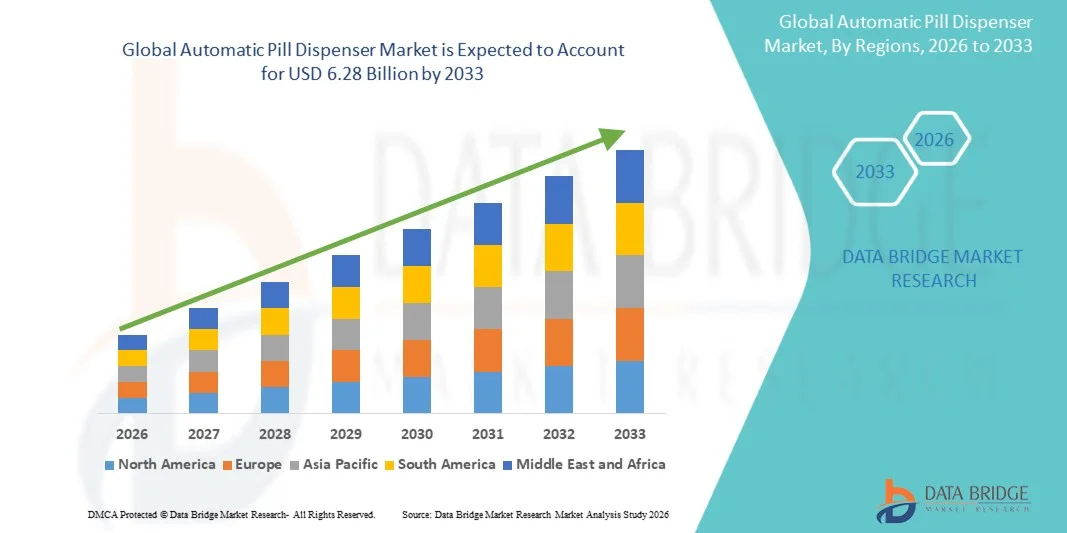
- As per Data Bridge Market Research analysis, the automatic pill dispenser market was valued at USD 3.51 billion in 2025 and is projected to reach USD 6.28 billion by 2033, growing at a CAGR of 7.55% from 2026 to 2033.
- The market is experiencing consistent growth driven by rising demand for medication adherence solutions, increasing prevalence of chronic diseases, growing geriatric populations, and rapid advancements in automated dispensing and connected healthcare technologies.
- The increasing need to reduce medication errors and improve adherence, combined with the rising adoption of home healthcare and remote patient monitoring, is compelling hospitals, pharmacies, caregivers, and patients to adopt automatic pill dispensing solutions. Smart and connected dispensers are increasingly replacing conventional medication management methods, offering scheduled dispensing, reminders, remote monitoring, and improved medication safety.
Market Size & Forecast
- Global Market Value (2025): USD 3.51 Billion
- Expected Market Value (2033): USD 6.28 Billion
- Forecast CAGR (2026–2033): 7.55%
- Leading Region in 2025: North America
- Fastest Growing Region: Asia Pacific
What are the Major Takeaways of the Automatic Pill Dispenser Market?
- North America dominated the automatic pill dispenser market with the largest revenue share of 39.4% in 2025, supported by advanced healthcare infrastructure, high adoption of medication-management technologies, and growing demand for home healthcare
- Asia-Pacific is expected to be the fastest-growing region at a CAGR of 9.6% from 2026 to 2033, fueled by rising chronic disease prevalence, expanding geriatric populations, increasing healthcare expenditure, and growing adoption of home healthcare solutions in China, Japan, and India.
- The centralized automatic dispensers segment led the market with a 64.73% share in 2025, driven by their extensive deployment in hospitals, institutional pharmacies, and large healthcare facilities.
- Decentralized automatic dispensers are the fastest-growing type, projected to register a CAGR of 9.0%, reflecting the surge in demand for medication management closer to patients.
- The electronic segment dominated the technology category with a 42.24% revenue share in 2025, led by its widespread use in automated dosing mechanisms, programmable medication schedules, alarms, and controlled dispensing functions.
- 20–30 pills accounted for 44.13% of the market share in 2025, preferred by patients managing multiple daily medications, elderly individuals, and homecare users seeking a balance between adequate pill capacity, compact device size, and convenient medication scheduling.
- The physical disability segment is the fastest-growing indication category, with a CAGR of 9.8%, driven by increasing demand for accessible medication-management solutions among individuals with limited dexterity, mobility, or vision.
Report Scope and Automatic Pill Dispenser Market Segmentation
|
Attributes |
Automatic Pill Dispenser Key Market Insights |
|
Segments Covered |
|
|
Countries Covered |
North America
Europe
Asia-Pacific
Middle East and Africa
South America
|
|
Key Market Players |
|
|
Market Opportunities |
|
|
Value Added Data Infosets |
In addition to the insights on market scenarios such as market value, growth rate, segmentation, geographical coverage, and major players, the market reports curated by the Data Bridge Market Research also include in-depth expert analysis, patient epidemiology, pipeline analysis, pricing analysis, and regulatory framework. |
What is the Key Trend in the Automatic Pill Dispenser Market?
- Smart and connected medication dispensers are increasingly integrating real-time adherence monitoring, cellular connectivity, automated reminders, and caregiver alerts, transforming automatic pill dispensers from basic dosing devices into connected medication-management platforms.
- For instance, in April 2025, Centor launched a smart weekly pill organizer with real-time medication-intake monitoring and LTE data transmission, enabling pharmacies and clinical partners to remotely track adherence without requiring patients to use an app.
- Cloud connectivity enables medication-use data to be transmitted to pharmacies, caregivers, and healthcare providers, supporting earlier intervention when doses are missed and improving visibility into patient adherence.
- Remote medication monitoring is becoming particularly important for chronic-care patients and older adults, as healthcare providers increasingly seek connected solutions that support medication management outside traditional clinical settings.
- For instance, in March 2024, Spencer Health Solutions released an updated spencerAssist mobile application supporting its spencer SmartHub intelligent medication dispenser, which collects longitudinal medication-use data and supports patients and caregivers remotely.
- As pharmacies, caregivers, and healthcare providers increasingly prioritize measurable medication adherence and remote patient support, connected automatic pill dispensers are expected to become an increasingly important component of digital medication-management and home-healthcare ecosystems.
What are the Key Drivers of the Automatic Pill Dispenser Market?
- The rising need to improve medication adherence and reduce medication errors is significantly increasing demand for automatic pill dispensers capable of providing scheduled dosing, reminders, controlled access, and automated medication tracking for patients managing multiple prescriptions.
- For instance, in April 2025, PR Newswire reported that Centor launched a connected smart weekly pill organizer that uses LTE and cloud technology to monitor medication intake in real time, enabling pharmacies and clinical partners to identify adherence issues and provide timely intervention
- The growing elderly population, increasing prevalence of chronic diseases, and expansion of home healthcare are encouraging patients and caregivers to adopt automated medication-management technologies that simplify complex medication schedules and reduce dependence on manual pill organization.
- For instance, in November 2024, PLOS ONE published a study protocol evaluating an automated medication dispensing device and adherence dashboard for older adults, with the system designed to monitor medication adherence and help clinicians identify medication-management challenges.
- With healthcare increasingly shifting toward patient-centric and remote care models, automatic pill dispensers will remain important for improving adherence, supporting caregivers, and enabling healthcare providers to monitor medication-taking behavior beyond traditional clinical environments.
Which Factors are Challenging the Growth of the Automatic Pill Dispenser Market?
- Advanced automatic pill dispensers require significant upfront investment because they incorporate electronic dispensing mechanisms, sensors, connectivity modules, software, security features, and medication-monitoring technologies.
- These higher costs can limit adoption among price-sensitive patients, smaller healthcare providers, and households that rely on conventional pill organizers or manual medication-management methods.
- For instance, in December 2025, Omnicell launched Titan XT, an enterprise automated dispensing system incorporating cloud-based medication management, AI-enabled intelligence, centralized inventory control, and medication-safety safeguards, illustrating the technological complexity of advanced automated dispensing infrastructure.
- The financial burden is further increased by recurring software, connectivity, maintenance, device-management, and integration costs, particularly for healthcare organizations deploying connected dispensers across multiple patients or care locations.
- For instance, in September 2024, Spencer Health Solutions achieved ISO 27001 certification for its smart medication-management platform, highlighting the importance of data-security infrastructure for connected medication devices and the associated compliance requirements.
- The combination of device costs, connectivity expenses, software requirements, maintenance, and data-security obligations continues to restrict adoption among smaller organizations and cost-sensitive users, slowing penetration of advanced automatic pill dispensers despite rising demand for medication adherence solutions.
How is the Automatic Pill Dispenser Market Segmented?
The automatic pill dispenser market is segmented on the basis of type, technology, capacity, indication, and end user.
- By Type
On the basis of type, the automatic pill dispenser market is segmented into centralized automatic dispensers, decentralized automatic dispensers, and others. The centralized automatic dispensers segment dominated the market with a 64.73% share in 2025, owing to their extensive deployment in hospitals, institutional pharmacies, and large healthcare facilities. These systems automate high-volume medication dispensing and help improve accuracy, inventory control, and pharmacy workflow efficiency. Centralized systems can manage multiple medications and prescriptions from a single location, reducing repetitive manual dispensing activities. Their integration with pharmacy-management and electronic medication systems further supports operational efficiency. Increasing emphasis on reducing medication errors and improving patient safety is strengthening demand for centralized dispensing infrastructure.
The decentralized automatic dispensers segment is projected to register the fastest growth at a CAGR of 9.0% from 2026 to 2033, driven by increasing demand for medication management closer to patients. These systems allow medications to be dispensed at nursing stations, patient-care areas, long-term-care facilities, and homecare environments. Decentralized dispensing can reduce medication retrieval time and improve accessibility for patients and caregivers. Growing adoption of home healthcare and remote patient monitoring is creating additional opportunities for compact automated dispensers. Increasing demand for personalized medication schedules among elderly and chronically ill patients is further supporting the segment. Integration with connected healthcare platforms can provide reminders, adherence monitoring, and caregiver notifications.
- By Technology
On the basis of technology, the automatic pill dispenser market is segmented into mechanical, electronic, software-integrated, RFID, barcode, and sensor-based technologies. The electronic technology segment dominated the market with 42.24% share in 2025, supported by its widespread use in automated dosing mechanisms, programmable medication schedules, alarms, and controlled dispensing functions. Electronic dispensers provide greater accuracy and flexibility than purely mechanical dispensers. They can be programmed according to individual medication schedules and dosage requirements. Their established technology and broad availability support adoption across homecare, pharmacies, and healthcare facilities. Increasing demand for automated reminders and electronic medication tracking is further supporting the segment.
The software-integrated technology segment is expected to register the fastest growth at an CAGR of 10% during the forecast period, driven by increasing demand for intelligent medication management and digital healthcare integration. Software-integrated dispensers can connect medication schedules with mobile applications, pharmacy systems, electronic health records, and caregiver platforms. These capabilities enable real-time adherence monitoring and automated notifications when scheduled doses are missed. Cloud-based platforms can also allow healthcare providers and caregivers to remotely review medication-use information. Growing adoption of telehealth and remote patient monitoring is creating additional demand for software-enabled dispensing systems. Artificial intelligence and data analytics can further support personalized medication schedules and adherence interventions.
- By Capacity
On the basis of capacity, the automatic pill dispenser market is segmented into less than 20 pills, 20–30 pills, and more than 30 pills. The 20–30 pills segment dominated the market with 44.13% share in 2025, primarily because this capacity provides a balance between medication storage, device size, and ease of use. It is suitable for patients taking multiple medications across different dosing schedules. Mid-capacity dispensers can accommodate several daily doses while remaining relatively compact for homecare use. They are particularly suitable for elderly patients and individuals managing chronic conditions. Increasing prevalence of polypharmacy is supporting demand for dispensers capable of organizing multiple medications.
The more than 30 pills segment is projected to register the fastest growth at a CAGR of 10.33% during the forecast period, driven by increasing demand among patients managing multiple prescriptions and complex dosing schedules. Higher-capacity dispensers can accommodate larger medication inventories and reduce the frequency of refilling. They are particularly suitable for nursing homes, institutional care, and patients experiencing polypharmacy. Increasing numbers of elderly patients requiring multiple medications are supporting demand for larger-capacity devices. Advanced high-capacity dispensers can also incorporate automated reminders, controlled dispensing, and adherence-monitoring features. These capabilities can reduce caregiver workload and improve medication-management efficiency.
- By Indication
On the basis of indication, the automatic pill dispenser market is segmented into physical disability, neurodegenerative disorders and dementia, and others. The neurodegenerative disorders and dementia segment dominated the market with 40% in 2025, owing to the increasing need for medication-management assistance among patients experiencing memory loss, cognitive impairment, and difficulties following complex dosing schedules. Automatic dispensers can provide audible and visual reminders when medication is due. Controlled dispensing can also reduce the possibility of accidental double dosing or missed doses. Caregivers can benefit from alerts and monitoring functions that provide information about medication-taking behavior. The growing elderly population and increasing prevalence of dementia-related conditions are supporting demand for automated medication-management solutions.
The physical disability segment is expected to witness the fastest growth at an CAGR of 9.8% during the forecast period, as individuals with limited mobility or dexterity increasingly require accessible medication-management solutions. Automatic dispensers can reduce the physical effort required to open medication containers, sort pills, and organize daily doses. Programmable dispensing mechanisms can provide medications at predetermined times without extensive manual handling. Increasing availability of user-friendly interfaces and voice or mobile-based controls is improving accessibility for people with physical limitations. Expansion of home healthcare is also increasing demand for technologies that allow patients to manage medication independently. Caregivers can remotely monitor dispensing activity through connected systems where available.
- By End User
On the basis of end user, the automatic pill dispenser market is segmented into hospitals, pharmacies, homecare, nursing homes, clinics, and rehabilitation centers. The hospitals segment dominated the market with a 44.1% share in 2025, supported by high medication volumes, complex dispensing requirements, and increasing emphasis on medication safety. Hospitals use automated dispensing technologies to improve medication availability, reduce dispensing errors, and streamline pharmacy operations. Automated systems can also support inventory management and provide greater control over medication distribution. Integration with hospital information systems and electronic medication records further strengthens adoption. Growing healthcare expenditure and modernization of hospital pharmacy infrastructure are supporting demand.
The homecare segment is expected to register the fastest growth at a CAGR of 11.57% during the forecast period, driven by the increasing shift toward home-based healthcare and growing demand for independent medication management. Automatic dispensers can help patients follow complex medication schedules without requiring constant caregiver supervision. Reminder functions can notify users when medication is due, while connected systems can alert caregivers when doses are missed. The aging population and increasing prevalence of chronic diseases are expanding the number of patients requiring long-term medication management at home. Rising adoption of telehealth and remote patient monitoring is further increasing the value of connected home medication devices. Manufacturers are increasingly developing compact, easy-to-use, and remotely monitored dispensers for residential settings.
Which Region Holds the Largest Share of the Automatic Pill Dispenser Market?
- North America dominated the automatic pill dispenser market with the largest revenue share of 39.4% in 2025, supported by advanced healthcare infrastructure, high adoption of medication-management technologies, and growing demand for home healthcare
- The region also benefits from a large aging population, high prevalence of chronic diseases, established pharmacy and hospital automation infrastructure, and early adoption of connected medication-management technologies. Increasing preference for aging in place, remote patient monitoring, and smart medication adherence solutions continues to strengthen North America’s leadership position in the global market.
U.S. Automatic Pill Dispenser Market Insight
The U.S. automatic pill dispenser market is witnessing strong growth due to rising demand for medication adherence solutions, expanding home healthcare services, and increasing adoption of automated medication-management technologies. The country’s advanced healthcare infrastructure, large elderly population, and high prevalence of chronic diseases are driving demand across hospitals, pharmacies, nursing homes, and homecare settings. In addition, growing emphasis on reducing medication errors and improving patient independence is accelerating adoption of smart and connected pill dispensing systems across healthcare providers and households.
Asia-Pacific Automatic Pill Dispenser Market Insight
The Asia-Pacific automatic pill dispenser market is expected to witness rapid growth, driven by increasing healthcare expenditure, expanding elderly populations, and rising prevalence of chronic diseases across countries such as China, Japan, and India. Growing awareness regarding medication adherence, increasing adoption of home healthcare, and rising demand for automated medication-management solutions are supporting regional market expansion. In addition, improving healthcare infrastructure and growing adoption of connected healthcare technologies are accelerating automatic pill dispenser adoption across hospitals, pharmacies, and residential care settings.
Japan Automatic Pill Dispenser Market Insight
The Japan automatic pill dispenser market is witnessing consistent growth due to the country’s rapidly aging population, increasing healthcare needs, and strong focus on elderly care and medication adherence. Hospitals, pharmacies, nursing homes, and homecare providers are increasingly adopting automated dispensing technologies to support patients managing multiple medications. Moreover, increasing integration of smart monitoring, electronic medication management, and remote-care technologies, along with Japan’s advanced healthcare infrastructure, is further contributing to market growth.
China Automatic Pill Dispenser Market Insight
The China automatic pill dispenser market is growing rapidly, driven by an expanding elderly population, increasing chronic disease burden, and rising healthcare expenditure. Growing adoption of automated medication-management technologies across hospitals, pharmacies, nursing facilities, and homecare settings is significantly boosting market demand. In addition, increasing investments in digital healthcare, rising awareness regarding medication adherence, and rapid development of connected medical devices are positioning China as one of the fastest-growing markets for automatic pill dispensers globally.
U.K. Automatic Pill Dispenser Market Insight
The U.K. automatic pill dispenser market is experiencing steady growth, supported by rising demand for medication adherence technologies, expanding home-based care, and increasing adoption of pharmacy automation. Increasing use of automated dispensing solutions in hospitals, community pharmacies, care homes, and residential settings is contributing to market growth. Furthermore, integration of smart reminders, remote monitoring, and digital medication-management technologies is improving dispensing efficiency and patient support, positioning the U.K. as a key European market for automatic pill dispensers.
Germany Automatic Pill Dispenser Market Insight
The Germany automatic pill dispenser market is expanding steadily due to the country’s aging population, established healthcare infrastructure, and increasing emphasis on medication safety and healthcare automation. Hospitals, pharmacies, nursing homes, and homecare providers are increasingly utilizing automated dispensers for medication management, adherence support, and dispensing accuracy. Continuous advancements in connected healthcare, electronic medication management, and smart dispensing technologies, along with strong focus on improving elderly care and healthcare efficiency, are further driving market growth in Germany.
Which are the Top Companies in Automatic Pill Dispenser Market?
The automatic pill dispenser industry is primarily led by well-established companies, including:
- Accu-Chart (U.S.)
- ARxIUM (Canada)
- BD (U.S.)
- Capsa Healthcare (U.S.)
- Hero Health, Inc. (U.S.)
- JVM Co., Ltd. (Japan)
- MedMinder Systems, Inc. (U.S.)
- MedReady, Inc. (U.S.)
- Omnicell, Inc. (U.S.)
- PharmAdva, LLC (U.S.)
- ScriptPro LLC (U.S.)
- YUYAMA Co., Ltd. (Japan)
- e-pill, LLC (U.S.)
- Pivotell Ltd (U.K.)
- Wisepill Technologies CC (South Africa)
- Vaica Medical (Israel)
- Addinex Technologies, Inc. (U.S.)
- Dose Health, LLC (U.S.)
- Medido (Netherlands)
What are Latest Developments in Automatic Pill Dispenser Market?
- In April 2025, PR Newswire reported that Centor launched a smart weekly pill organizer developed with RxCap, combining automated medication management with LTE connectivity and real-time medication-intake monitoring. The product enables pharmacies and clinical partners to receive adherence information remotely, supporting intervention when patients miss scheduled medications. This launch highlights the growing integration of connected technology into automatic medication dispensing and adherence management.
- In January 2025, Particle published an article demonstrating the development of a smart pill dispenser using its IoT technology, designed to automate medication management and provide reliable, scheduled dispensing. The system illustrates the integration of connected hardware, sensors, and cloud-based technology into automatic medication dispensing solutions, supporting the broader shift toward smart and remotely monitored medication management.
- In June 2024, PHC Corporation announced the launch of its Smart Picker ampoule dispensing system, expanding its pharmacy-automation portfolio for pharmacists. The system was designed to automate the picking and handling of ampoules, supporting more efficient and accurate medication dispensing workflows in pharmacies. The launch demonstrates continued development of automated dispensing equipment for pharmaceutical operations.
- In February 2022, PR Newswire reported that Hero partnered with Henry Ford Health System to deploy its smart medication dispenser and medication-management service for patients receiving home healthcare. Hero's dispenser automatically organizes and dispenses medications while its connected platform supports adherence monitoring and medication-management assistance. The deployment demonstrates the growing use of smart dispensing technology in home-based care.
- In March 2021, Business Wire reported that MedMinder received a USD 40 million investment led by Accelmed Partners to support the expansion of its medication-management platform. MedMinder's automated dispenser provides scheduled medication dispensing and adherence support for elderly and chronically ill patients, while its connected platform enables medication-management oversight. The investment supported the continued commercialization and expansion of smart dispensing technology.

- Interactive Data Analysis Dashboard
- Company Analysis Dashboard for high growth potential opportunities
- Research Analyst Access for customization & queries
- Competitor Analysis with Interactive dashboard
- Latest News, Updates & Trend analysis
- Harness the Power of Benchmark Analysis for Comprehensive Competitor Tracking
Data collection and base year analysis are done using data collection modules with large sample sizes. The stage includes obtaining market information or related data through various sources and strategies. It includes examining and planning all the data acquired from the past in advance. It likewise envelops the examination of information inconsistencies seen across different information sources. The market data is analysed and estimated using market statistical and coherent models. Also, market share analysis and key trend analysis are the major success factors in the market report. To know more, please request an analyst call or drop down your inquiry.
The key research methodology used by DBMR research team is data triangulation which involves data mining, analysis of the impact of data variables on the market and primary (industry expert) validation. Data models include Vendor Positioning Grid, Market Time Line Analysis, Market Overview and Guide, Company Positioning Grid, Patent Analysis, Pricing Analysis, Company Market Share Analysis, Standards of Measurement, Global versus Regional and Vendor Share Analysis. To know more about the research methodology, drop in an inquiry to speak to our industry experts.
Data Bridge Market Research is a leader in advanced formative research. We take pride in servicing our existing and new customers with data and analysis that match and suits their goal. The report can be customized to include price trend analysis of target brands understanding the market for additional countries (ask for the list of countries), clinical trial results data, literature review, refurbished market and product base analysis. Market analysis of target competitors can be analyzed from technology-based analysis to market portfolio strategies. We can add as many competitors that you require data about in the format and data style you are looking for. Our team of analysts can also provide you data in crude raw excel files pivot tables (Fact book) or can assist you in creating presentations from the data sets available in the report.













