What is the Automotive Air Suspension Market Size and Growth Rate?
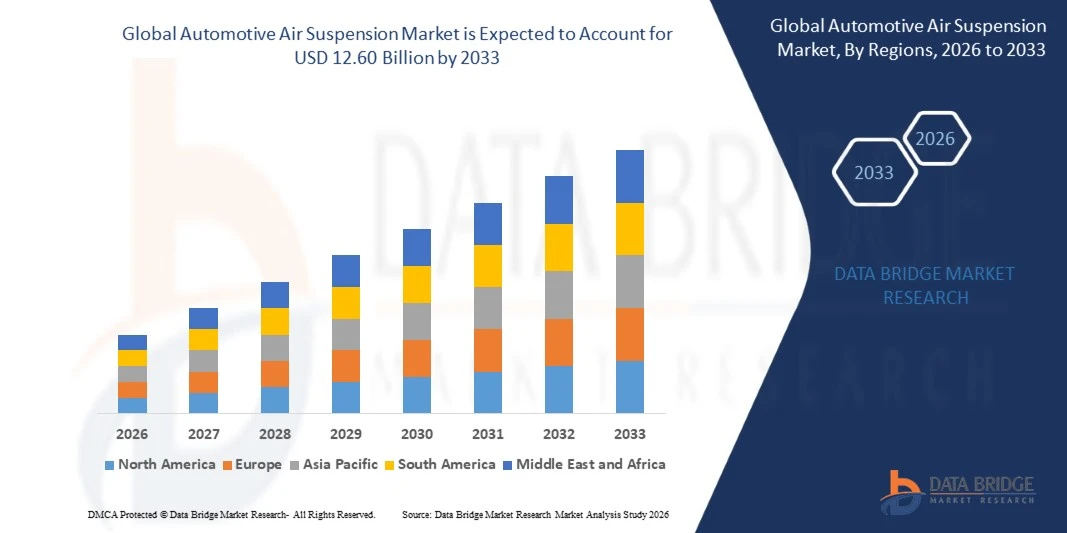
- As per Data Bridge Market Research analysis, the automotive air suspension market was valued at USD 7.85 billion in 2025 and is projected to reach USD 12.60 billion by 2033, growing at a CAGR of 6.10% from 2026 to 2033.
- The market is experiencing consistent growth driven by rising demand for enhanced ride comfort and vehicle stability, increasing adoption of luxury and commercial vehicles, and advancements in electronically controlled suspension technologies.
- The growing production of heavy-duty trucks, buses, premium passenger vehicles, and electric vehicles, combined with rising consumer preference for smoother driving experiences and improved vehicle handling, is compelling automotive manufacturers to adopt advanced air suspension systems. Electronically controlled and adaptive air suspension technologies are increasingly replacing conventional suspension systems in premium and commercial vehicles, offering improved load management, vibration reduction, adjustable ride height, and enhanced driving performance. Integration with smart sensors and advanced vehicle control technologies is further supporting market expansion.
Market Size & Forecast
- Global Market Value (2025): USD 7.85 Billion
- Expected Market Value (2033): USD 12.60 Billion
- Forecast CAGR (2026–2033): 6.10%
- Leading Region in 2025: North America
- Fastest Growing Region: Asia Pacific
What are the Major Takeaways of the Automotive Air Suspension Market?
- North America dominated the automotive air suspension market with the largest revenue share of 38.42% in 2025, supported by strong demand for premium passenger vehicles, heavy commercial trucks, and advanced vehicle comfort technologies.
- Asia-Pacific is expected to be the fastest-growing region at a CAGR of 7.0% from 2026 to 2033, fueled by expanding automotive manufacturing, rising electric vehicle adoption, and increasing demand for luxury vehicles in China, India, and Japan.
- The non-electronically controlled air suspension segment led the market with a 54.90% share in 2025, driven by its cost-effectiveness and established use across various passenger and commercial vehicle applications
- Electronically controlled air suspension are the fastest-growing control type, projected to register a CAGR of 9.03%, reflecting the surge in demand for intelligent suspension management and enhanced driving comfort.
- The passenger vehicle segment dominated the vehicle type category with a 65.10% revenue share in 2025, led by increasing adoption of air suspension systems in luxury cars, premium SUVs, and high-end electric vehicles.
- Air spring accounted for 33.95% of the market share in 2025, preferred by its essential role in supporting vehicle weight and absorbing road shock
- The electronic control module segment is the fastest-growing component type category, with a CAGR of 9.96%, driven by increasing adoption of intelligent suspension systems and electronically controlled chassis technologies
Report Scope and Automotive Air Suspension Market Segmentation
|
Attributes |
Automotive Air Suspension Key Market Insights |
|
Segments Covered |
|
|
Countries Covered |
North America
Europe
Asia-Pacific
Middle East and Africa
South America
|
|
Key Market Players |
|
|
Market Opportunities |
|
|
Value Added Data Infosets |
In addition to the market insights such as market value, growth rate, market segments, geographical coverage, market players, and market scenario, the market report curated by the Data Bridge Market Research team includes in-depth expert analysis, import/export analysis, pricing analysis, production consumption analysis, and pestle analysis. |
What is the Key Trend in the Automotive Air Suspension Market?
- Automotive manufacturers are increasingly integrating electronically controlled air suspension systems to improve ride comfort, vehicle stability, adjustable ride height, and load management across premium passenger cars and commercial vehicles.
- For instance, in June 2025, ZF announced series production of its fifth-generation OptiRide electronically controlled air suspension system for Hyundai Motor Company, integrating pressure sensors and a solenoid valve into a compact Smart Pneumatic Actuator to simplify system architecture.
- Real-time sensor feedback enables suspension systems to adjust vehicle height and stability according to road conditions, vehicle load, and driving requirements.
- Electric vehicle manufacturers are increasingly exploring advanced suspension technologies to accommodate battery weight, optimize ride dynamics, and enhance passenger comfort.
- For instance, in March 2025, Mahindra introduced its BE 6 and XEV 9e electric SUVs with Monroe Intelligent Suspension CVSAe technology, which continuously adapts damping to changing road conditions to improve handling and ride comfort.
- As vehicle manufacturers prioritize intelligent chassis technologies, ride quality, and adaptive vehicle performance, the adoption of advanced air suspension systems is expected to increase, strengthening their role in next-generation passenger and commercial vehicles
What are the Key Drivers of the Automotive Air Suspension Market?
- The growing demand for premium vehicles and improved passenger comfort has significantly increased the adoption of air suspension systems capable of delivering smoother rides, adjustable ground clearance, and enhanced vehicle stability.
- For instance, in November 2025, Nissan introduced adaptive air suspension with Intelligent Dynamic Damping technology on selected versions of its all-new Patrol in the Middle East, highlighting growing demand for advanced comfort and off-road performance
- The expansion of commercial transportation, including heavy-duty trucks, buses, and logistics fleets, is encouraging manufacturers to adopt air suspension systems for better load distribution, reduced vibration, and improved driving stability.
- For instance, in June 2025, ZF confirmed series production of its fifth-generation OptiRide electronically controlled air suspension for Hyundai Motor Company, supporting chassis-height adjustment and load-dependent stability control in commercial vehicles.
- With automotive manufacturers increasingly prioritizing ride comfort, vehicle handling, and load-management efficiency, air suspension systems are expected to remain important for premium mobility and next-generation commercial transportation.
What Factors are Challenging the Growth of the Automotive Air Suspension Market?
- Advanced automotive air suspension systems require higher initial investment than conventional suspension systems because they incorporate air springs, compressors, electronic controls, pressure sensors, and specialized components.
- For instance, in March 2025, Autocar India reported that air suspension systems in high-end used cars can require technically complex and expensive maintenance, with component wear contributing to declining resale values.
- These high costs limit adoption among budget-conscious vehicle buyers and manufacturers targeting entry-level passenger cars and price-sensitive commercial vehicle segments.
- The complexity of diagnosing air leaks, compressor failures, and electronic control malfunctions can increase maintenance expenses and require trained technicians and specialized diagnostic equipment.
- For instance, in December 2025, Professional Motor Mechanic published a technical article explaining how air-spring deterioration, road debris, and damaged rubber bellows can cause air leaks and lead to more extensive system damage.
- The combination of high installation costs, specialized repair requirements, and replacement expenses continues to restrict adoption in price-sensitive markets, making affordability, component durability, and wider service availability important factors for future market expansion.
How is the Automotive Air Suspension Market Segmented?
The automotive air suspension market is segmented on the basis of control type, vehicle type, component type, and sales channel
- By Control Type
On the basis of control type, the automotive air suspension market is segmented into electronically controlled air suspension and non-electronically controlled air suspension. The non-electronically controlled air suspension segment dominated the market with 54.90% share in 2025, supported by its cost-effectiveness and established use across various passenger and commercial vehicle applications. These systems provide pneumatic cushioning and load support without relying on sophisticated electronic control architectures. Their relatively simple design can reduce initial installation costs and maintenance complexity. They are suitable for applications where reliable ride comfort and load distribution are more important than automated suspension adjustments. Demand is supported by commercial vehicle operators seeking practical and economical suspension solutions.
The electronically controlled air suspension segment is projected to register the fastest growth at CAGR of 9.03% during forecast period, driven by increasing demand for intelligent suspension management and enhanced driving comfort. These systems use electronic control units and sensors to adjust suspension height and air pressure according to road conditions and vehicle load. They enable improved vehicle stability, handling, and passenger comfort. Growing adoption of premium SUVs and luxury passenger cars is supporting market expansion. Integration with advanced driver assistance systems and intelligent chassis technologies is further increasing their relevance. Electric vehicle manufacturers are also adopting advanced suspension technologies to accommodate vehicle weight and improve ride quality.
- By Vehicle Type
On the basis of vehicle type, the automotive air suspension market is segmented into passenger vehicles, light commercial vehicles, heavy commercial vehicles, and buses and coaches. The passenger vehicle segment dominated the market with 65.10% share in 2025, driven by increasing adoption of air suspension systems in luxury cars, premium SUVs, and high-end electric vehicles. These systems provide enhanced ride comfort and help maintain vehicle stability across varying road conditions. Premium automotive manufacturers use air suspension to differentiate their vehicles through improved driving dynamics and adjustable ride height. Rising consumer demand for comfortable and technologically advanced vehicles is further supporting adoption. The expansion of luxury SUV offerings is creating additional demand for advanced suspension solutions.
The heavy commercial vehicle segment is expected to witness the fastest growth at CAGR of 7.94% during forecast period, driven by increasing demand for efficient freight transportation and improved vehicle load management. Air suspension systems help distribute heavy loads while reducing road vibrations transmitted to the vehicle chassis. These capabilities can improve driver comfort and help protect sensitive cargo during long-distance transportation. Growing logistics activity and commercial fleet expansion are supporting demand for advanced suspension technologies. Fleet operators are increasingly focusing on vehicle reliability, reduced cargo damage, and improved operating efficiency. The expansion of modern trucking infrastructure is further encouraging adoption.
- By Component Type
On the basis of component type, the automotive air suspension market is segmented into air spring, shock absorber, compressor, electronic control module, air reservoir, height sensors, and others. The air spring segment dominated the component category with 33.95% share in 2025, supported by its essential role in supporting vehicle weight and absorbing road shocks. Air springs use compressed air to provide cushioning and maintain appropriate suspension height under varying loads. They are widely used in passenger vehicles, heavy-duty trucks, buses, and coaches. Their ability to improve ride comfort and reduce vibration makes them a critical part of air suspension systems. Increasing demand for premium vehicles and commercial transportation is supporting their continued use.
The electronic control module segment is expected to register the fastest growth at CAGR of 9.96% during forecast period, driven by increasing adoption of intelligent suspension systems and electronically controlled chassis technologies. These modules process information from sensors and coordinate suspension adjustments according to vehicle speed, road conditions, and load distribution. They support automatic ride-height adjustment and improve the precision of suspension control. Growing adoption of premium vehicles and electric SUVs is strengthening demand for advanced electronic components. Integration with vehicle stability systems and advanced driver assistance technologies is creating further growth potential. Automakers are increasingly emphasizing software-based vehicle control to improve driving performance and passenger comfort.
- By Sales Channel
On the basis of sales channel, the automotive air suspension market is segmented into OEMs and aftermarket. The OEM segment dominated the market with 73.60% share in 2025, supported by the increasing integration of factory-fitted air suspension systems in premium passenger vehicles and commercial vehicles. Original equipment manufacturers incorporate these systems during vehicle production to ensure compatibility with the chassis and electronic control architecture. Factory integration enables suspension performance to be calibrated according to vehicle design and operating requirements. Luxury vehicle manufacturers use air suspension to improve ride comfort, handling, and product differentiation. Commercial vehicle manufacturers also integrate these systems to support load management and passenger comfort.
The aftermarket segment is projected to register the fastest growth at CAGR of 7.38% during forecast period, driven by rising replacement demand and maintenance requirements for vehicles equipped with air suspension systems. Air springs, compressors, valves, and related components can deteriorate over time and require replacement. The growing population of air suspension-equipped vehicles is supporting recurring demand for spare parts and repair services. Vehicle owners are increasingly turning to specialist workshops to maintain suspension performance after warranty coverage expires. Commercial fleet operators also require replacement components to reduce vehicle downtime and maintain operational reliability. Greater availability of compatible aftermarket components is supporting maintenance and repair activities.
Which Region Holds the Largest Share of the Automotive Air Suspension Market?
- North America dominated the automotive air suspension market with the largest revenue share of 38.42% in 2025, supported by strong demand for premium passenger vehicles, heavy commercial trucks, and advanced vehicle comfort technologies.
- The region also benefits from established automotive manufacturing capabilities, high consumer preference for luxury SUVs and pickup trucks, and increasing adoption of air suspension technologies in heavy-duty transportation. Growing emphasis on ride comfort, vehicle stability, load management, and advanced chassis technologies continues to strengthen North America's position in the global market.
U.S. Automotive Air Suspension Market Insight
The U.S. automotive air suspension market is witnessing steady growth due to rising demand for luxury vehicles, pickup trucks, and heavy-duty commercial vehicles equipped with advanced suspension technologies. The country’s established automotive industry, along with increasing adoption of electronically controlled suspension systems, is driving demand across passenger and commercial vehicle applications. In addition, growing emphasis on ride comfort, vehicle stability, load management, and improved driving performance is accelerating the adoption of air suspension systems among automotive manufacturers and fleet operators.
Asia-Pacific Automotive Air Suspension Market Insight
The Asia-Pacific automotive air suspension market is expected to witness rapid growth, driven by expanding automotive production, rising disposable incomes, and increasing demand for premium passenger vehicles across China, India, and Japan. Growing electric vehicle production, rising consumer preference for enhanced ride comfort, and increasing investments in advanced automotive technologies are supporting regional market expansion. In addition, the growing commercial transportation sector and increasing integration of electronically controlled suspension systems are accelerating adoption across passenger vehicles, heavy-duty trucks, and buses.
Japan Automotive Air Suspension Market Insight
The Japan automotive air suspension market is witnessing consistent growth due to rising investments in automotive innovation, advanced chassis technologies, and premium vehicle development. Automotive manufacturers are increasingly incorporating sophisticated suspension systems to improve ride comfort, vehicle stability, and driving performance. Moreover, the growing focus on electric mobility, vehicle safety, and intelligent suspension controls is supporting the adoption of advanced air suspension technologies across passenger vehicles and selected commercial vehicle applications.
China Automotive Air Suspension Market Insight
The China automotive air suspension market is growing rapidly, driven by expanding vehicle production, rising demand for luxury SUVs, and increasing adoption of electric vehicles. Growing investments in intelligent automotive technologies and electronically controlled chassis systems are significantly boosting market demand. In addition, increasing consumer expectations for enhanced ride comfort, improved handling, and adjustable ride height are encouraging manufacturers to integrate advanced suspension systems. China's expanding electric vehicle ecosystem and strong domestic automotive manufacturing capabilities are further supporting market development.
U.K. Automotive Air Suspension Market Insight
The U.K. automotive air suspension market is experiencing steady growth, supported by demand for premium passenger vehicles, luxury SUVs, and advanced commercial transportation solutions. Increasing adoption of electronically controlled suspension technologies and growing consumer preference for improved ride quality are contributing to market expansion. Furthermore, the presence of luxury automotive manufacturers, increasing interest in electric vehicles, and demand for enhanced vehicle handling are supporting the integration of air suspension systems across premium automotive applications.
Germany Automotive Air Suspension Market Insight
The Germany automotive air suspension market is expanding steadily due to the country's strong automotive manufacturing base, established luxury vehicle industry, and continued investment in advanced vehicle engineering. Automotive manufacturers are increasingly incorporating air suspension systems to improve ride comfort, driving dynamics, and vehicle stability across premium cars and SUVs. Continuous advancements in electronically controlled chassis technologies, electric vehicle development, and intelligent suspension management are further driving market growth in Germany.
Which are the Top Companies in Automotive Air Suspension Market?
The automotive air suspension industry is primarily led by well-established companies, including:
- ZF Friedrichshafen AG (Germany)
- Continental AG (Germany)
- Hendrickson USA, L.L.C. (U.S.)
- Arnott Inc. (U.S.)
- Air Lift Company (U.S.)
- VIAIR Corporation (U.S.)
- KYB Corporation (Japan)
- HL Mando Corporation (South Korea)
- BWI Group (China)
- SAF-HOLLAND SE (Germany)
- BPW Bergische Achsen Kommanditgesellschaft (Germany)
- Knorr-Bremse AG (Germany)
- Parker-Hannifin Corporation (U.S.)
- Dunlop Systems and Components (U.K.)
- Vibracoustic SE (Germany)
- Nidec Corporation (Japan)
- Trelleborg AB (Sweden)
- Sampa Otomotiv San. ve Tic. A.Ş. (Turkey)
- thyssenkrupp Bilstein GmbH (Germany)
- Firestone Industrial Products Company, LLC (U.S.)
What are Latest Developments in Automotive Air Suspension Market?
- In June 2025, ZF announced series production of its fifth-generation OptiRide electronically controlled air suspension system for Hyundai Motor Company. The system integrates pressure sensors and a solenoid valve into a compact Smart Pneumatic Actuator, simplifying system architecture while supporting chassis-height adjustment, efficient loading and unloading, and load-dependent stability control. This development highlights the growing adoption of intelligent air suspension technologies in commercial vehicles.
- In April 2025, thyssenkrupp Bilstein and Baolong Automotive entered a strategic cooperation to offer integrated suspension solutions combining Bilstein shock absorbers and Baolong air springs. The collaboration aims to provide global automotive manufacturers with coordinated product solutions, reduce component interfaces, improve product quality, and shorten development timelines. This partnership reflects the industry's growing emphasis on integrated suspension systems and cost-effective engineering for next-generation vehicles.
- In June 2024, Nidec announced the development of a new automotive air suspension motor by its subsidiary Nidec Motor (Dalian). Designed to drive the air compressor that supplies compressed air to the suspension system, the motor focuses on compact construction, durability, and responsive startup performance. The development supports ongoing component innovation aimed at improving the functionality and performance of automotive air suspension systems.
- In September 2022, ZF Aftermarket introduced its own Sachs air springs in original-equipment quality for the independent automotive aftermarket. The launch expanded access to replacement components for vehicles from manufacturers including Audi, BMW, Mercedes-Benz, and Citroën. The company also highlighted installation guidance and technician training to help workshops service air suspension systems correctly, strengthening aftermarket support for suspension maintenance and repair.
- In October 2021, Continental expanded its aftermarket portfolio by offering original air suspension vibration dampers and compressors to independent workshops. Initially available for selected Audi and Volkswagen models, these components allowed workshops to use parts matching those supplied for factory installation. The development improved access to replacement components and supported the repair and maintenance of air suspension systems outside authorized dealer networks.
- Interactive Data Analysis Dashboard
- Company Analysis Dashboard for high growth potential opportunities
- Research Analyst Access for customization & queries
- Competitor Analysis with Interactive dashboard
- Latest News, Updates & Trend analysis
- Harness the Power of Benchmark Analysis for Comprehensive Competitor Tracking
Data collection and base year analysis are done using data collection modules with large sample sizes. The stage includes obtaining market information or related data through various sources and strategies. It includes examining and planning all the data acquired from the past in advance. It likewise envelops the examination of information inconsistencies seen across different information sources. The market data is analysed and estimated using market statistical and coherent models. Also, market share analysis and key trend analysis are the major success factors in the market report. To know more, please request an analyst call or drop down your inquiry.
The key research methodology used by DBMR research team is data triangulation which involves data mining, analysis of the impact of data variables on the market and primary (industry expert) validation. Data models include Vendor Positioning Grid, Market Time Line Analysis, Market Overview and Guide, Company Positioning Grid, Patent Analysis, Pricing Analysis, Company Market Share Analysis, Standards of Measurement, Global versus Regional and Vendor Share Analysis. To know more about the research methodology, drop in an inquiry to speak to our industry experts.
Data Bridge Market Research is a leader in advanced formative research. We take pride in servicing our existing and new customers with data and analysis that match and suits their goal. The report can be customized to include price trend analysis of target brands understanding the market for additional countries (ask for the list of countries), clinical trial results data, literature review, refurbished market and product base analysis. Market analysis of target competitors can be analyzed from technology-based analysis to market portfolio strategies. We can add as many competitors that you require data about in the format and data style you are looking for. Our team of analysts can also provide you data in crude raw excel files pivot tables (Fact book) or can assist you in creating presentations from the data sets available in the report.