


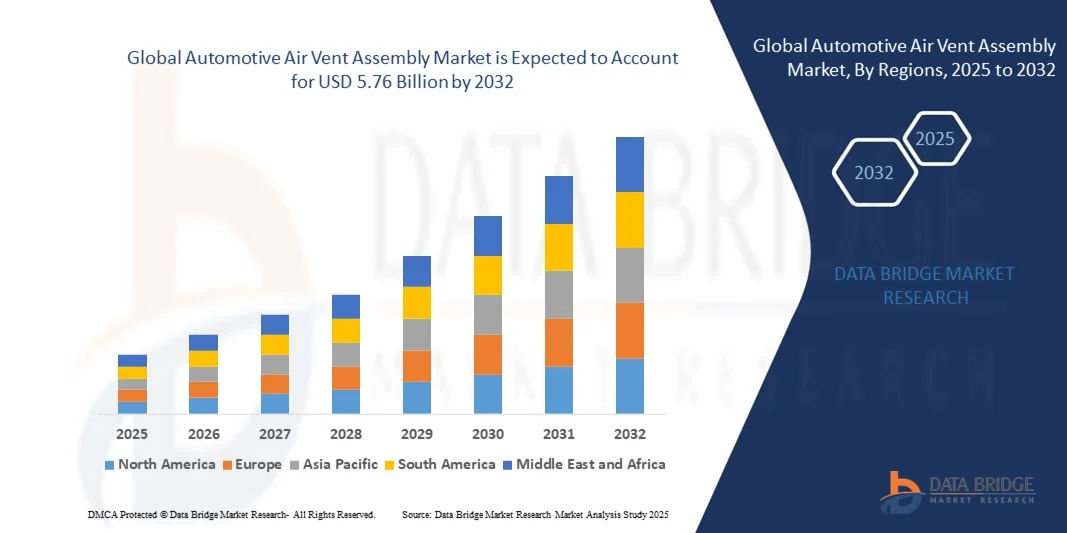
Global Automotive Air Vent Assembly Market Size
- The global Automotive Air Vent Assembly Market size was valued at USD 3.69 billion in 2024 and is projected to reach USD 5.76 billion by 2032, growing at a CAGR of 5.70% during the forecast period
- Market expansion is primarily driven by rising vehicle production, increasing consumer preference for enhanced in-vehicle comfort, and the integration of advanced HVAC systems across passenger and commercial vehicles
- Additionally, innovations in lightweight materials, aesthetic customization, and ergonomic designs are driving OEM demand, while aftermarket upgrades and growing EV adoption further accelerate the market’s upward trajectory
Global Automotive Air Vent Assembly Market Analysis
- Automotive air vent assemblies, essential for directing airflow within a vehicle’s cabin, are becoming increasingly sophisticated components in modern vehicles due to growing consumer demand for enhanced comfort, climate control, and aesthetic appeal in both passenger and commercial segments
- The rising demand for automotive air vent assemblies is largely driven by advancements in vehicle HVAC systems, increasing vehicle production worldwide, and a shift toward premium interiors with customizable air distribution features
- Asia-Pacific dominated the automotive air vent assembly market with the largest revenue share of 39.6% in 2024, supported by high vehicle production, expanding middle-class population, and the presence of major automotive manufacturers, especially in China, Japan, and India
- Europe is expected to be the fastest growing region in the automotive air vent assembly market during the forecast period, driven by stringent environmental regulations, rapid adoption of electric vehicles, and a strong focus on comfort and design innovation
- The dashboard air vents segment dominated the market with the largest revenue share of 47.6% in 2024, owing to their central role in delivering directed airflow to both drivers and front-seat passengers
Report Scope and Global Automotive Air Vent Assembly Market Segmentation
|
Attributes |
Automotive Air Vent Assembly Key Market Insights |
|
Segments Covered |
|
|
Countries Covered |
North America
Europe
Asia-Pacific
Middle East and Africa
South America
|
|
Key Market Players |
|
|
Market Opportunities |
|
|
Value Added Data Infosets |
In addition to the market insights such as market value, growth rate, market segments, geographical coverage, market players, and market scenario, the market report curated by the Data Bridge Market Research team includes in-depth expert analysis, import/export analysis, pricing analysis, production consumption analysis, and pestle analysis. |
Global Automotive Air Vent Assembly Market Trends
Enhanced Comfort Through AI and Climate Personalization
- A significant and accelerating trend in the global Automotive Air Vent Assembly Market is the integration of artificial intelligence (AI) and smart climate control technologies, enabling more personalized and responsive in-cabin airflow experiences. This technological evolution is redefining how users interact with vehicle climate systems, enhancing both comfort and efficiency.
- For instance, premium vehicles from brands like Mercedes-Benz and BMW feature AI-driven climate control systems that automatically adjust air vent direction, intensity, and temperature based on passenger preferences, seat occupancy, and even external weather conditions. These systems utilize data from multiple sensors to deliver an optimal and adaptive environment.
- AI integration allows automotive HVAC systems to learn from user behavior over time—automatically adjusting vent flow patterns based on past preferences, time of day, and even biometric feedback from seat or steering sensors. Some models can also predict and proactively regulate cabin conditions before a user enters the vehicle, improving the overall driving experience.
- In addition, voice control functionality is becoming increasingly prevalent, allowing drivers and passengers to adjust airflow direction or temperature through verbal commands. Integrated systems like BMW’s Intelligent Personal Assistant and Mercedes MBUX offer natural language processing for seamless in-vehicle climate adjustments, enhancing safety and convenience by reducing driver distraction.
- Automakers are also linking air vent operations with smart infotainment systems, allowing users to control and visualize air distribution through touchscreens or mobile apps. This convergence enables centralized command over various cabin functions, including ambient lighting, seat heating, and airflow—creating a harmonized and tech-forward interior experience.
- As consumer expectations rise for comfort, convenience, and customization, the demand for intelligent air vent assemblies integrated with AI and voice control is growing rapidly, particularly in the luxury and electric vehicle segments. Leading OEMs and suppliers are responding by investing in adaptive climate technologies that offer a more refined and intuitive user experience.
Global Automotive Air Vent Assembly Market Dynamics
Driver
Growing Need Due to Increasing Vehicle Production and Comfort Expectations
-
The steady rise in global vehicle production, coupled with growing consumer expectations for enhanced in-cabin comfort, is a major driver fueling the demand for advanced automotive air vent assemblies. As automakers prioritize passenger experience, air vent systems are evolving from basic airflow outlets to intelligent, integrated components within the overall HVAC and interior design systems.
- For instance, luxury brands such as Mercedes-Benz and Audi are incorporating multi-zone climate control systems with customizable air vent designs that offer targeted airflow for each passenger. These innovations not only enhance comfort but also align with growing demand for premium interior features across both luxury and mid-range vehicles.
- Consumer demand for more personalized climate experiences, noise-reducing vent technologies, and aesthetically appealing interior elements is prompting OEMs to invest in advanced air vent designs. This includes features like active air flaps, motorized directional control, and soft-close mechanisms for reduced noise and smoother airflow.
- The rising popularity of electric vehicles (EVs) is also playing a pivotal role, as EV manufacturers seek innovative, lightweight, and energy-efficient ventilation solutions to optimize cabin climate control without compromising vehicle range. Tesla, for example, utilizes concealed, streamlined air vents with AI-driven airflow control in its Model 3 and Model Y models, setting new standards in the segment.
- Furthermore, with the integration of infotainment systems and smart assistants in modern vehicles, air vent assemblies are increasingly being designed to work in tandem with voice commands and digital interfaces. This trend supports the broader move toward intelligent, connected interiors and further boosts market demand for tech-enhanced air vent solutions.
Restraint/Challenge
“Design Complexity, Customization Demands, and Cost Constraints”
- Increasing consumer demand for premium interior aesthetics and personalized climate control has led to greater design complexity in automotive air vent assemblies, posing a significant challenge for manufacturers. As automakers aim to differentiate cabin interiors with sleek, integrated vent designs and electronic airflow control, the engineering and production of such components have become more resource-intensive.
- For instance, high-end vehicles often feature multi-zone climate systems with motorized or hidden vents, requiring precise mechanical and electronic integration. This level of customization significantly raises R&D and tooling costs, making it difficult to scale such features across mass-market models without impacting profit margins.
- Additionally, balancing functionality, durability, and aesthetics is a constant challenge—particularly when integrating air vents with touchscreens, ambient lighting, and voice-controlled systems. These integration requirements increase development time and introduce compatibility issues, especially in modular vehicle platforms with varying trim levels.
- The need for lightweight, compact components to support fuel efficiency and EV performance adds further pressure, as traditional materials and mechanical vent designs may no longer meet evolving efficiency standards. New materials such as advanced plastics and composites come with higher costs and require specialized manufacturing techniques.
- While OEMs are increasingly turning to suppliers for innovative, cost-effective solutions, price-sensitive markets—especially in developing regions—may be slower to adopt such advanced air vent assemblies due to budget constraints and lower consumer emphasis on interior features.
- Overcoming these challenges will require manufacturers to invest in modular, scalable vent designs, increase collaboration with HVAC and infotainment system developers, and find a balance between innovation, durability, and cost-efficiency to ensure widespread adoption across vehicle segments.
Global Automotive Air Vent Assembly Market Scope
The market is segmented on the basis of Product type, vehicle type, material, sales channel.
- By Product Type
On the basis of product type, The automotive air vent assembly market is segmented into dashboard air vents, roof air vents, floor air vents, and others. The dashboard air vents segment dominated the market with the largest revenue share of 47.6% in 2024, owing to their central role in delivering directed airflow to both drivers and front-seat passengers. These vents are a critical part of the vehicle’s HVAC system and are often integrated with infotainment and control panels, increasing their importance in both functionality and design. The rising demand for personalized airflow, improved aesthetics, and touch-enabled climate controls is also boosting dashboard vent installations across all vehicle types.
The roof air vents segment is expected to witness the fastest CAGR from 2025 to 2032, driven by increasing adoption in SUVs, MPVs, and premium vehicles to enhance rear passenger comfort. Their role in multi-zone climate control systems is expanding, especially in electric and autonomous vehicles focused on passenger experience.
- By Vehicle Type
Based on vehicle type, the market is segmented into passenger cars, light commercial vehicles (LCVs), and heavy commercial vehicles (HCVs). The passenger cars segment held the largest revenue share of 58.4% in 2024, owing to high global production volumes, rising consumer demand for interior comfort, and integration of advanced HVAC systems in even mid-range models. Growing consumer expectations for personalized climate control, noise-reduced vent operation, and seamless interior design aesthetics are key drivers in this segment.
The light commercial vehicles (LCVs) segment is expected to register the fastest CAGR from 2025 to 2032, supported by the booming logistics and last-mile delivery industries. As comfort and driver ergonomics become a priority in fleet vehicles, OEMs are upgrading HVAC and air vent systems in commercial vans and pickups to ensure a better driving experience and reduced fatigue during extended use.
- By Material
By material, the market is segmented into plastic, metal, and others. The plastic segment dominated the market with a 66.1% revenue share in 2024, primarily due to the material's lightweight, cost-effective, and moldable nature, making it ideal for both functional and decorative air vent components. High design flexibility, corrosion resistance, and compatibility with modern manufacturing techniques such as injection molding contribute to the widespread use of plastic in dashboard and roof vent assemblies.
The metal segment is projected to grow at the fastest CAGR from 2025 to 2032, driven by increased use in luxury vehicles and high-performance models where durability, thermal resistance, and premium finish are crucial. Metal air vents, often aluminum or stainless steel, are being used in high-end interiors for their tactile quality, aesthetic appeal, and long-term resilience in extreme temperature variations.
- By Sales Channel
On the basis of sales channel, the market is segmented into OEM (Original Equipment Manufacturer) and Aftermarket. The OEM segment accounted for the largest market revenue share of 72.5% in 2024, as air vent assemblies are standard components integrated during vehicle production. OEMs are increasingly focused on delivering enhanced in-cabin experiences, which has led to strong collaboration with interior system suppliers for custom-designed, brand-aligned air vent solutions. The growing demand for EVs and connected vehicles is further fueling innovation in OEM-installed air vents with intelligent features.
The Aftermarket segment is anticipated to witness the fastest growth rate from 2025 to 2032. Rising consumer interest in upgrading vehicle interiors, especially in older vehicles and entry-level models, is driving demand for aftermarket air vent kits. DIY replacements, customization options, and availability of stylish or tech-enhanced vent covers are making the aftermarket channel more attractive to both individual car owners and service garages.
Global Automotive Air Vent Assembly Market Regional Analysis
- Asia-Pacific dominated the automotive air vent assembly market with the largest revenue share of 39.6% in 2024, driven by high vehicle production volumes, rising automotive exports, and growing consumer demand for improved in-cabin comfort features
- Consumers in the region increasingly prioritize climate control and ergonomic interior design, especially in markets like China, India, and Japan, where urbanization and rising disposable incomes are fueling demand for both mid-range and premium vehicles
- This strong market position is further supported by the presence of major automotive manufacturers and HVAC system suppliers, robust supply chain networks, and government initiatives promoting electric and fuel-efficient vehicles, all of which are boosting the integration of advanced air vent assemblies across both passenger and commercial vehicle segments
U.S. Automotive Air Vent Assembly Market Insight
The U.S. automotive air vent assembly market captured the largest revenue share of 38% in 2024 within North America, driven by the country’s mature automotive industry and rising demand for enhanced in-cabin comfort features. Increasing consumer preference for advanced HVAC systems with customizable airflow and integration with vehicle infotainment is propelling market growth. Moreover, the expanding adoption of electric vehicles (EVs) and smart cabin technologies is encouraging OEMs to innovate with intelligent air vent designs that optimize climate control and energy efficiency. The aftermarket segment is also growing as vehicle owners seek upgrades for better air quality and ventilation performance.
Europe Automotive Air Vent Assembly Market Insight
The Europe automotive air vent assembly market is projected to grow steadily at a notable CAGR throughout the forecast period, primarily driven by stringent vehicle emission regulations and rising demand for fuel-efficient HVAC systems. The region’s focus on electric and hybrid vehicles is boosting demand for lightweight, aerodynamically optimized vent assemblies. Additionally, European consumers’ increasing emphasis on premium interiors and multi-zone climate control systems in luxury and mid-range vehicles is fostering adoption. Countries like Germany, France, and Italy lead the market, supported by strong automotive manufacturing hubs and advanced research in cabin comfort technologies.
U.K. Automotive Air Vent Assembly Market Insight
The U.K. automotive air vent assembly market is anticipated to grow at a significant CAGR during the forecast period, driven by the rapid electrification of the automotive fleet and government incentives encouraging low-emission vehicles. The increasing preference for compact yet efficient HVAC components in electric and hybrid vehicles is stimulating demand for innovative air vent solutions. Moreover, the rising adoption of connected car technologies and voice-activated climate controls is driving upgrades to more sophisticated air vent assemblies. The aftermarket segment is also growing due to vehicle customization trends.
Germany Automotive Air Vent Assembly Market Insight
The Germany automotive air vent assembly market is expected to expand considerably during the forecast period, fueled by the country’s leadership in automotive engineering and innovation. Germany’s strong focus on premium and luxury vehicle production supports demand for advanced air vent assemblies featuring electronic airflow control, integrated lighting, and noise reduction technologies. The growing push towards electric vehicles and autonomous driving systems further promotes the development of smart, efficient HVAC components. Local OEMs and suppliers continue investing heavily in R&D to meet evolving consumer expectations for comfort and sustainability.
Asia-Pacific Automotive Air Vent Assembly Market Insight
The Asia-Pacific automotive air vent assembly market is poised to grow at the fastest CAGR of 22% during 2025–2032, driven by rapid urbanization, rising vehicle production, and expanding middle-class income in countries like China, India, Japan, and South Korea. The region’s automotive sector benefits from increasing investments in EVs and smart vehicle technologies, which demand innovative, lightweight, and multifunctional air vent assemblies. Government policies promoting green vehicles and improving air quality standards also boost the market. Additionally, growing exports from APAC to global markets position the region as a vital hub for automotive air vent manufacturing.
Japan Automotive Air Vent Assembly Market Insight
The Japan automotive air vent assembly market is gaining momentum due to the country’s advanced automotive technology ecosystem and consumer demand for high comfort standards. Japan’s strong emphasis on electric and hybrid vehicle production drives demand for efficient HVAC components that maximize energy use and passenger comfort. Integration of air vents with vehicle infotainment and voice-activated climate controls is increasing, fueled by the country’s tech-savvy population. Furthermore, Japan’s aging demographic supports demand for user-friendly cabin features, including adjustable and automated air vent systems.
China Automotive Air Vent Assembly Market Insight
The China automotive air vent assembly market accounted for the largest revenue share in Asia-Pacific in 2024, attributed to the country’s dominant vehicle manufacturing industry and rapidly growing EV segment. Increasing consumer preference for vehicles equipped with multi-zone climate control and advanced air filtration systems is driving market expansion. The Chinese government’s strong push towards smart cities and green mobility further accelerates adoption of innovative air vent technologies. Domestic manufacturers are continuously innovating to offer competitive, feature-rich air vent assemblies, contributing to the country’s leadership in both production and consumption.
Global Automotive Air Vent Assembly Market Share
The Automotive Air Vent Assembly industry is primarily led by well-established companies, including:
- Denso Corporation (Japan)
- Valeo SA (France)
- MAHLE GmbH (Germany)
- Toyota Boshoku Corporation (Japan)
- Nissan Motor Co., Ltd. (Japan)
- Ford Motor Company (U.S.)
- General Motors Company (U.S.)
- Hyundai Mobis Co., Ltd. (South Korea)
- Magna International Inc. (Canada)
- Faurecia S.A. (France)
- Continental AG (Germany)
- Lear Corporation (U.S.)
- Calsonic Kansei Corporation (Japan)
- Delphi Technologies PLC (U.K.)
- Gentherm Incorporated (U.S.)
- Hanon Systems (South Korea)
- Marelli Corporation (Japan)
- Nippon Seiki Co., Ltd. (Japan)
- Visteon Corporation (U.S.)
- Yanfeng Automotive Interiors (China)
What are the Recent Developments in Global Automotive Air Vent Assembly Market?
- In April 2023, Denso Corporation, a global leader in automotive components, launched a strategic initiative in South Africa to expand its advanced air vent assembly solutions tailored for passenger and commercial vehicles. This move emphasizes Denso’s commitment to enhancing in-cabin climate comfort and air quality by delivering innovative, energy-efficient ventilation systems that meet the specific demands of emerging markets. Leveraging its global expertise, Denso aims to strengthen its presence in the rapidly growing automotive air vent assembly market in the region.
- In March 2023, Magna International Inc., a renowned automotive supplier headquartered in Canada, introduced a next-generation roof air vent system designed specifically for electric and autonomous vehicles. The new system offers enhanced airflow management with reduced energy consumption, improving overall cabin comfort while supporting EV efficiency goals. This innovation highlights Magna’s focus on integrating advanced ventilation technologies that cater to evolving automotive design trends and consumer expectations.
- In March 2023, Valeo SA, a global automotive technology company, successfully completed the deployment of its smart HVAC air vent modules for a major automotive manufacturer in India. This project aimed at improving air circulation and passenger comfort in compact and mid-size vehicles, reinforcing Valeo’s dedication to delivering tailored climate control solutions that address regional needs and support the growth of the automotive sector in fast-developing markets.
- In February 2023, Toyota Boshoku Corporation, a leader in automotive interior systems, announced a strategic partnership with a leading European automaker to develop innovative floor air vent assemblies integrated with air purification technology. This collaboration is set to enhance in-cabin air quality and passenger comfort, demonstrating Toyota Boshoku’s commitment to pioneering advanced interior components that align with increasing consumer demand for healthier and more comfortable vehicle environments.
- In January 2023, Continental AG, a major player in automotive parts manufacturing, unveiled its new dashboard air vent assembly featuring intelligent airflow control and noise reduction technology at the CES 2023 event. Designed to enhance user comfort and cabin ambiance, the system supports seamless integration with vehicle smart HVAC controls. Continental’s latest offering underscores its focus on advancing automotive interior technologies to meet the evolving expectations of both OEMs and end-users.

- Interactive Data Analysis Dashboard
- Company Analysis Dashboard for high growth potential opportunities
- Research Analyst Access for customization & queries
- Competitor Analysis with Interactive dashboard
- Latest News, Updates & Trend analysis
- Harness the Power of Benchmark Analysis for Comprehensive Competitor Tracking
Data collection and base year analysis are done using data collection modules with large sample sizes. The stage includes obtaining market information or related data through various sources and strategies. It includes examining and planning all the data acquired from the past in advance. It likewise envelops the examination of information inconsistencies seen across different information sources. The market data is analysed and estimated using market statistical and coherent models. Also, market share analysis and key trend analysis are the major success factors in the market report. To know more, please request an analyst call or drop down your inquiry.
The key research methodology used by DBMR research team is data triangulation which involves data mining, analysis of the impact of data variables on the market and primary (industry expert) validation. Data models include Vendor Positioning Grid, Market Time Line Analysis, Market Overview and Guide, Company Positioning Grid, Patent Analysis, Pricing Analysis, Company Market Share Analysis, Standards of Measurement, Global versus Regional and Vendor Share Analysis. To know more about the research methodology, drop in an inquiry to speak to our industry experts.
Data Bridge Market Research is a leader in advanced formative research. We take pride in servicing our existing and new customers with data and analysis that match and suits their goal. The report can be customized to include price trend analysis of target brands understanding the market for additional countries (ask for the list of countries), clinical trial results data, literature review, refurbished market and product base analysis. Market analysis of target competitors can be analyzed from technology-based analysis to market portfolio strategies. We can add as many competitors that you require data about in the format and data style you are looking for. Our team of analysts can also provide you data in crude raw excel files pivot tables (Fact book) or can assist you in creating presentations from the data sets available in the report.













