


What is the Automotive Axle Market Size and Growth Rate?
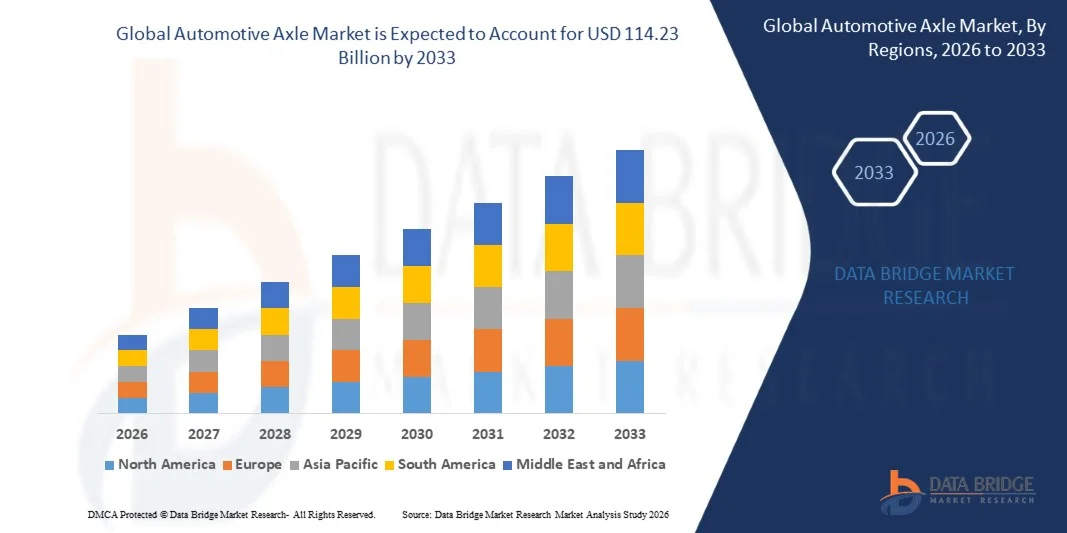
- As per Data Bridge Market Research analysis, the automotive axle market was valued at USD 75.34 billion in 2025 and is projected to reach USD 114.23 billion by 2033, growing at a CAGR of 5.34% from 2026 to 2033.
- The market is experiencing steady growth driven by increasing global vehicle production, rising demand for fuel-efficient and high-performance vehicles, and the rapid shift towards electric and hybrid vehicles. Axles, as a foundational mechanical subsystem connecting propulsion, load distribution, and vehicle handling, are evolving beyond simple rotating shafts into integrated platforms that require cross-functional engineering and supplier orchestration.
- Key growth drivers include the electrification of powertrains, demand for lightweight materials to meet fuel-efficiency norms, and stringent safety and load regulations mandating robust axle designs. The increasing popularity of SUVs and all-wheel-drive (AWD) vehicles is also significantly boosting demand for multi-axle configurations.
Market Size & Forecast
- Market Value (2025): USD 75.34 Billion
- Expected Market Value (2033): USD 114.23 Billion
- Forecast CAGR (2026–2033): 5.34%
- Leading Region in 2025: Asia-Pacific
- Fastest Growing Region: North America
What are the Major Takeaways of the Automotive Axle Market?
- Asia-Pacific dominated the automotive axle market and accounted for the largest revenue share of 50.7% in 2025, supported by its status as the world's largest automotive manufacturing hub, with major production bases in China, Japan, and India.
- North America is expected to witness the fastest growth rate from 2026 to 2033, supported by strong vehicle production, high demand for pickup trucks and SUVs, and the presence of leading automotive OEMs and component manufacturers. The region is witnessing increasing adoption of lightweight axle systems and e-axles to improve vehicle efficiency and support electrification.
- The drive axle segment dominated the market share of 65.5% in 2025 driven by the increasing adoption of front-wheel drive and all-wheel drive configurations across passenger and commercial vehicles. These axle systems provide improved traction, enhanced vehicle stability, and better performance across diverse road conditions, making them the preferred choice for modern vehicle manufacturers. Growing vehicle production and rising demand for passenger and commercial vehicles across Asia Pacific, Europe, and North America continue to support the dominance of the drive axle segment.
- The lift axle segment is projected to register the fastest growth during the forecast period from 2026 to 2033. Growth is attributed to the increasing adoption of lift axles in long-haul trucks and heavy-duty commercial vehicles, where they help distribute cargo weight more evenly, improve fuel efficiency by reducing rolling resistance, and extend the service life of tires and braking systems. In addition, regulations established by the European Economic Community (EEC) regarding permissible axle loads are encouraging the use of liftable axles to ensure proper load distribution and compliance, further driving segment growth.
- The passenger car segment dominated the market and accounted for the largest revenue share in 2025. Factors such as increasing urbanization, growing population, and increasing disposable income worldwide are driving the demand for passenger vehicles. The surge in passenger car production in economies such as Indonesia, India, China, and South Africa is influencing market growth. Furthermore, the application of front-wheel-drive, rear-wheel-drive, and all-wheel drive in many segments of luxury and hybrid passenger cars is expected to provide rapid growth to the segment.
- The heavy commercial vehicle segment is projected witness the highest CAGR of 2.5% during the forecast period from 2026 to 2033. The growth of the HCV segment is attributed to the growing logistics industry, especially in the North American and European regions. Moreover, heavy commercial vehicles generally use lift axles, which is another factor favoring the market growth. Many heavy commercial vehicles use six or eight wheel-drive or a larger wheel drive creating prospects for market growth.
Report Scope and Automotive Axle Market Segmentation
|
Attributes |
Automotive Axle Key Market Insights |
|
Segments Covered |
|
|
Countries Covered |
North America
Europe
Asia-Pacific
Middle East and Africa
South America
|
|
Key Market Players |
|
|
Market Opportunities |
|
|
Value Added Data Infosets |
In addition to the market insights such as market value, growth rate, market segments, geographical coverage, market players, and market scenario, the market report curated by the Data Bridge Market Research team includes in-depth expert analysis, import/export analysis, pricing analysis, production consumption analysis, and pestle analysis. |
What is the Key Trend in the Automotive Axle Market?
- The rapid shift toward vehicle electrification is accelerating the adoption of integrated e-Axle systems, as automotive manufacturers seek compact, lightweight, and energy-efficient driveline solutions for battery electric and hybrid vehicles. Integrated e-Axles combine the electric motor, transmission, and power electronics into a single unit, improving vehicle efficiency, reducing weight, and simplifying assembly.
- For instance, in September 2024, ZF showcased its latest electrified driveline technologies at IAA Transportation 2024, including its modular e-mobility platform and the AxTrax 2 electric drive axle for commercial vehicles. These solutions are designed to improve drivetrain efficiency, support vehicle electrification, and reduce carbon emissions.
- Automotive manufacturers are also increasingly focusing on lightweight axle designs and integrated electric drivetrain architectures to improve vehicle range, payload capacity, and overall performance while complying with stringent global emission regulations. The use of advanced materials and highly integrated axle systems is becoming a key differentiator in next-generation electric vehicles.
- For instance, in September 2024, ZF introduced its TrailTrax electrified trailer system featuring the AxTrax 2 e-Axle, enabling trailer manufacturers to reduce CO₂ emissions by up to 40% (with plug-in charging) while improving transport efficiency for commercial vehicles.
- global vehicle electrification continues to accelerate, automotive OEMs and drivetrain suppliers are expected to increase investments in integrated e-Axles, lightweight axle technologies, and high-efficiency driveline systems, reinforcing electrified axles as a defining trend in the global automotive axle market.
What are the Key Drivers of the Automotive Axle Market?
- The rapid growth of electric vehicle (EV) production and the transition toward electrified powertrains are significantly driving demand for advanced automotive axle systems. Automakers are increasingly adopting integrated e-Axles that combine the electric motor, transmission, and power electronics into a compact unit, improving drivetrain efficiency, reducing vehicle weight, and extending driving range.
- For instance, in December 2024, Dana Incorporated launched the Spicer AdvanTEK 40 Pro axle system, designed to improve durability, increase fuel efficiency through extreme downspeeding, and optimize fleet performance for heavy-duty commercial vehicles. The launch reflects the growing demand for next-generation axle technologies in commercial transportation.
- Growing investments in commercial vehicle modernization and demand for high-efficiency drivetrain technologies are further accelerating the automotive axle market. Fleet operators and OEMs are increasingly deploying advanced axle technologies to improve payload capacity, fuel economy, vehicle performance, and compliance with tightening emission regulation
- As global vehicle electrification, commercial vehicle production, and demand for energy-efficient drivetrains continue to increase, manufacturers are expected to expand investments in lightweight, integrated, and electrified axle technologies, reinforcing automotive axles as a critical component of next-generation mobility.
Which Factors are Challenging the Growth of the Automotive Axle Market?
- Volatility in steel, aluminum, and other raw material prices is one of the primary challenges affecting the automotive axle market. Automotive axle manufacturers rely heavily on these materials for producing lightweight and high-strength components. Fluctuating raw material costs, combined with supply chain disruptions and increasing energy prices, continue to pressure profit margins and increase manufacturing costs for OEMs and Tier-1 suppliers.
- For instance, in October 2024, American Axle & Manufacturing (AAM) announced the sale of its commercial vehicle axle business in India to Bharat Forge as part of a strategic portfolio optimization initiative. The move reflects the increasing need for axle manufacturers to streamline operations, improve financial flexibility, and manage rising production costs in a highly competitive market.
- The transition toward lightweight and electrified axle systems also requires significant investments in advanced manufacturing technologies, production capacity, and research & development. These high capital requirements create barriers for smaller manufacturers and increase the cost of developing next-generation axle solutions for electric and commercial vehicles.
- The combination of volatile raw material prices, high capital investment requirements, and continuous R&D spending for lightweight and electrified axle technologies continues to challenge market growth, particularly for small and mid-sized suppliers operating in cost-sensitive automotive markets.
How is the Automotive Axle Market Segmented?
The automotive axle market is segmented on the basis of axle type, vehicle type, propulsion, material, and sales channel.
- By Axle Type
On the basis of axle type, the automotive axle market is segmented into drive axle, dead axle, and lift axle. The drive axle segment dominated the market share of 65.5% in 2025 driven by the increasing adoption of front-wheel drive and all-wheel drive configurations across passenger and commercial vehicles. These axle systems provide improved traction, enhanced vehicle stability, and better performance across diverse road conditions, making them the preferred choice for modern vehicle manufacturers. Growing vehicle production and rising demand for passenger and commercial vehicles across Asia Pacific, Europe, and North America continue to support the dominance of the drive axle segment.
The lift axle segment is projected to register the fastest growth during the forecast period from 2026 to 2033. Growth is attributed to the increasing adoption of lift axles in long-haul trucks and heavy-duty commercial vehicles, where they help distribute cargo weight more evenly, improve fuel efficiency by reducing rolling resistance, and extend the service life of tires and braking systems. In addition, regulations established by the European Economic Community (EEC) regarding permissible axle loads are encouraging the use of liftable axles to ensure proper load distribution and compliance, further driving segment growth.
- By Vehicle Type
On the basis of vehicle type, automotive axle market is segmented into passenger cars, light commercial vehicles (LCVs), and heavy commercial vehicles (HCVs). The passenger car segment dominated the market and accounted for the largest revenue share in 2025. Factors such as increasing urbanization, growing population, and increasing disposable income worldwide are driving the demand for passenger vehicles. The surge in passenger car production in economies such as Indonesia, India, China, and South Africa is influencing market growth. Furthermore, the application of front-wheel-drive, rear-wheel-drive, and all-wheel drive in many segments of luxury and hybrid passenger cars is expected to provide rapid growth to the segment.
The heavy commercial vehicle segment is projected witness the highest CAGR of 2.5% during the forecast period from 2026 to 2033. The growth of the HCV segment is attributed to the growing logistics industry, especially in the North American and European regions. Moreover, heavy commercial vehicles generally use lift axles, which is another factor favoring the market growth. Many heavy commercial vehicles use six or eight wheel-drive or a larger wheel drive creating prospects for market growth.
- By Propulsion
On the basis of propulsion, the automotive axle market is segmented into internal combustion engine (ICE), battery electric vehicle (BEV), and hybrid electric vehicle (HEV). The internal combustion engine (ICE) segment dominated the market with the largest revenue share in 2025 due to its extensive global vehicle fleet, established manufacturing infrastructure, and continued production of conventional passenger and commercial vehicles. The widespread availability of ICE vehicles across both developed and emerging economies continues to support strong demand for automotive axles.
The battery electric vehicle (BEV) segment is anticipated to witness the fastest growth from 2026 to 2033, driven by accelerating electric vehicle adoption, supportive government incentives, and increasing investments by automotive manufacturers in dedicated EV platforms. The growing demand for lightweight e-axles and integrated electric drive systems is further propelling segment growth.
- By Material
On the basis of material, automotive axle market is segmented into steel and aluminum. The steel segment dominated the market in 2025, owing to its superior tensile strength, high load-bearing capacity, and excellent durability, making it the preferred material for passenger vehicles, commercial vehicles, and heavy-duty applications. Steel axles provide enhanced structural stability and reliability under demanding operating conditions, contributing to their widespread adoption across the automotive industry.
The Aluminum segment is projected to witness the fastest growth during the forecast period from 2026 to 2033, driven by the automotive industry's increasing focus on lightweight vehicle components to improve fuel efficiency and reduce emissions. Aluminum axles offer significant weight savings while maintaining adequate strength, making them particularly suitable for electric and hybrid vehicles. Growing regulatory emphasis on vehicle electrification and carbon emission reduction, coupled with advancements in aluminum alloy technologies, is expected to further accelerate the adoption of aluminum axles.
Which Region Holds the Largest Share of the Automotive Axle Market?
- Asia-Pacific dominated the automotive axle market and accounted for the largest revenue share of 50.7% in 2025, supported by its status as the world's largest automotive manufacturing hub, with major production bases in China, Japan, and India
- The region benefits from immense vehicle production volumes, rapid economic development, increasing disposable incomes, and expanding infrastructure. China leads the region with a robust automotive industry, while India is experiencing significant growth in vehicle sales.
Japan Automotive Axle Market Insight
The Japan automotive axle market is expected to witness steady growth from 2026 to 2033 due to the country's advanced automotive industry and continuous technological innovation. Increasing production of hybrid and electric vehicles, growing adoption of lightweight axle components, and rising investments in next-generation mobility solutions are supporting market expansion. The strong presence of globally recognized automotive OEMs and component suppliers further contributes to sustained market growth.
China Automotive Axle Market Insight
The China automotive axle market accounted for the largest market revenue share in Asia-Pacific in 2025, attributed to its position as the world's largest automobile producer and consumer. Rapid expansion of passenger and commercial vehicle manufacturing, increasing adoption of electric vehicles, and significant investments in advanced automotive component production are key factors driving market growth. Government support for new energy vehicles, combined with a robust domestic supply chain and large-scale manufacturing capabilities, continues to reinforce China's leadership in the global automotive axle market.
North America Automotive Axle Market Insight
North America is expected to witness the fastest growth rate from 2026 to 2033, supported by strong vehicle production, high demand for pickup trucks and SUVs, and the presence of leading automotive OEMs and component manufacturers. The region is witnessing increasing adoption of lightweight axle systems and e-axles to improve vehicle efficiency and support electrification. Growing investments in electric vehicle production and advanced drivetrain technologies continue to strengthen the regional market.
U.S. Automotive Axle Market Insight
The U.S. automotive axle market is expected to witness the fastest growth rate from 2026 to 2033, fueled by robust production of passenger vehicles, pickup trucks, and commercial vehicles. Rising consumer demand for high-performance vehicles, expanding electric vehicle manufacturing, and increasing investments in advanced axle technologies are driving market growth. Moreover, the presence of major automotive manufacturers and a well-established automotive supply chain continues to support the expansion of the market.
Europe Automotive Axle Market Insight
The Europe automotive axle market is expected to witness the fastest growth rate from 2026 to 2033, primarily driven by the rapid transition toward electric mobility and stringent vehicle emission regulations. Increasing production of battery electric vehicles (BEVs), growing demand for lightweight automotive components, and continuous innovation in integrated e-axle systems are supporting market expansion. The region is also benefiting from strong investments in automotive R&D and advanced manufacturing technologies.
U.K. Automotive Axle Market Insight
The U.K. automotive axle market is expected to witness notable growth from 2026 to 2033, driven by increasing electric vehicle adoption and continued investments in advanced automotive manufacturing. Growing demand for lightweight drivetrain components, supportive government policies for zero-emission vehicles, and expansion of domestic EV production are expected to stimulate market growth. Rising investments in next-generation mobility technologies further contribute to market development.
Germany Automotive Axle Market Insight
The Germany automotive axle market is expected to witness significant growth from 2026 to 2033, fueled by the country's strong automotive manufacturing base and leadership in vehicle engineering. Increasing production of premium passenger vehicles and electric vehicles, combined with growing investments in lightweight axle technologies and integrated electric drive systems, is supporting market expansion. Germany's emphasis on innovation, automation, and sustainable mobility continues to strengthen its position in the regional market.
Which are the Top Companies in Automotive Axle Market?
The driving simulators industry is primarily led by well-established companies, including:
- American Axle & Manufacturing Holdings, Inc. (U.S.)
- Dana Incorporated (U.S.)
- Meritor, Inc. (U.S.)
- Cummins Inc. (U.S.)
- ZF Friedrichshafen AG (Germany)
- GKN Automotive Limited (U.K.)
- Hyundai WIA Corporation (South Korea)
- JTEKT Corporation (Japan)
- RABA Automotive Holding Plc. (Hungary)
- Sampa Otomotiv Sanayi ve Ticaret A.Ş. (Turkey)
- IFA Group (India)
- Talbros Automotive Components Limited (India)
- Bharat Forge Limited (India)
- Dongfeng Dana Axle Co., Ltd. (China)
- Sinotruk Axle Co., Ltd. (China)
What are Latest Developments in Automotive Axle Market?
- In December 2024, Dana Incorporated launched the Spicer AdvanTEK 40 Pro axle system, designed to improve durability, increase fuel efficiency through extreme downspeeding, and optimize fleet performance for heavy-duty commercial vehicles. The launch reflects the growing demand for next-generation axle technologies in commercial transportation.
- For instance, in October 2024, American Axle & Manufacturing (AAM) announced the sale of its commercial vehicle axle business in India to Bharat Forge as part of a strategic portfolio optimization initiative. The move reflects the increasing need for axle manufacturers to streamline operations, improve financial flexibility, and manage rising production costs in a highly competitive market.

- Interactive Data Analysis Dashboard
- Company Analysis Dashboard for high growth potential opportunities
- Research Analyst Access for customization & queries
- Competitor Analysis with Interactive dashboard
- Latest News, Updates & Trend analysis
- Harness the Power of Benchmark Analysis for Comprehensive Competitor Tracking
Data collection and base year analysis are done using data collection modules with large sample sizes. The stage includes obtaining market information or related data through various sources and strategies. It includes examining and planning all the data acquired from the past in advance. It likewise envelops the examination of information inconsistencies seen across different information sources. The market data is analysed and estimated using market statistical and coherent models. Also, market share analysis and key trend analysis are the major success factors in the market report. To know more, please request an analyst call or drop down your inquiry.
The key research methodology used by DBMR research team is data triangulation which involves data mining, analysis of the impact of data variables on the market and primary (industry expert) validation. Data models include Vendor Positioning Grid, Market Time Line Analysis, Market Overview and Guide, Company Positioning Grid, Patent Analysis, Pricing Analysis, Company Market Share Analysis, Standards of Measurement, Global versus Regional and Vendor Share Analysis. To know more about the research methodology, drop in an inquiry to speak to our industry experts.
Data Bridge Market Research is a leader in advanced formative research. We take pride in servicing our existing and new customers with data and analysis that match and suits their goal. The report can be customized to include price trend analysis of target brands understanding the market for additional countries (ask for the list of countries), clinical trial results data, literature review, refurbished market and product base analysis. Market analysis of target competitors can be analyzed from technology-based analysis to market portfolio strategies. We can add as many competitors that you require data about in the format and data style you are looking for. Our team of analysts can also provide you data in crude raw excel files pivot tables (Fact book) or can assist you in creating presentations from the data sets available in the report.













