


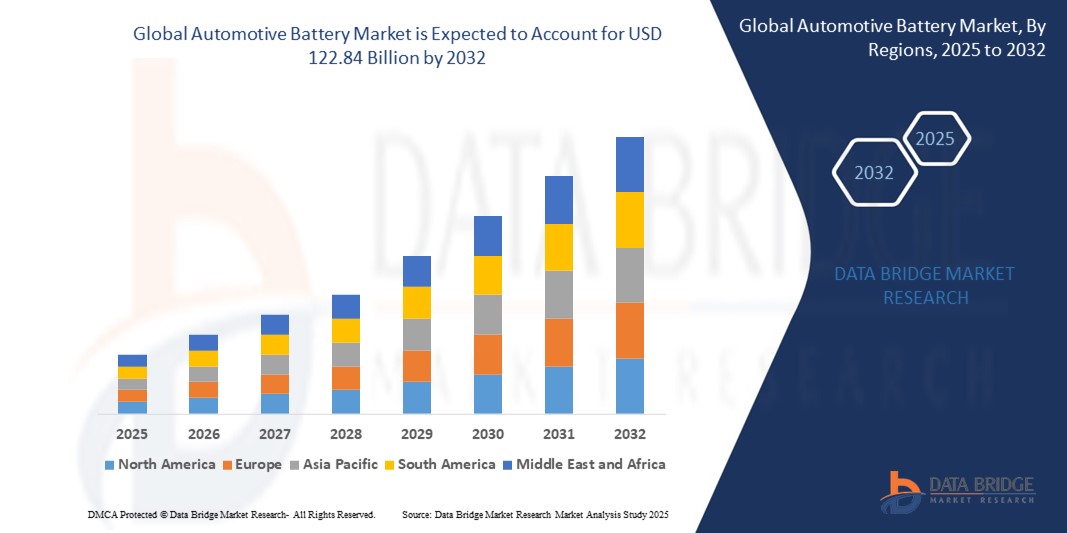
Automotive Battery Market Analysis
- Automotive batteries refer to batteries which supply electric current to motor vehicle that are usually rechargeable in nature. Some of the automotive battery’s types are Lithium- ion, lead- acid, nickel and sodium- ion. These are generally 12-volt battery of six cells and are the heart of the car's electrical system. The main aim of the component is to start the engine and then the power for electrical system is supplied by alternator.
- The use of the rankings used to measure battery performance include cold cranking amperes (CCA), amp-hours (AH), power (watts) and reserve capacity (RC), new hybrid and electric automotive models from OEMs and the implementation of supportive policies by federal, state and area administrative bodies to sustain long-term benefits for successful manufacturing of an EV accelerate the automotive battery market growth.
- North America dominates the automotive battery market with the largest revenue share of 46.01% in 2025, due to the strong presence of lead-acid battery manufacturer, increasing demand for electric vehicles and rising government efforts to reduce carbon emission by developing eco-friendly products.
- Asia-Pacific is expected to be the fastest growing region in the Automotive Battery market during the forecast period due the growing product demand in automotive applications in various countries, high sales of commercial cars, passenger cars and motorcycles, product developments by various companies to manufacture cost-efficient and high-performance vehicles and government initiatives to provide subsidies based on the price difference between EVs and internal combustion engine (ICE) enabled vehicles.
- The lithium- ion segment is anticipated to hold the largest market share of 25.9% in the Automotive Battery Market during the forecast period. The segment is driven by rising electric vehicle (EV) demand, government regulations promoting clean energy, and advancements in battery technology. Key factors include higher energy density, longer lifespan, and faster charging capabilities compared to traditional batteries, making lithium-ion the preferred choice for modern EVs and hybrid vehicles.
Report Scope and Automotive Battery Market Segmentation
|
Attributes |
Automotive Battery Key Market Insights |
|
Segments Covered |
|
|
Countries Covered |
North America
Europe
Asia-Pacific
Middle East and Africa
South America
|
|
Key Market Players |
|
|
Market Opportunities |
|
|
Value Added Data Infosets |
In addition to the insights on market scenarios such as market value, growth rate, segmentation, geographical coverage, and major players, the market reports curated by the Data Bridge Market Research also include import export analysis, production capacity overview, production consumption analysis, price trend analysis, climate change scenario, supply chain analysis, value chain analysis, raw material/consumables overview, vendor selection criteria, PESTLE Analysis, Porter Analysis, and regulatory framework. |
Automotive Battery Market Trends
“Powering the Future of Mobility”
- One of the most significant trends in the Automotive Battery market is the rapid shift toward high-energy-density battery chemistrie , such as solid-state and lithium-sulfur batteries. These technologies offer improved range, faster charging times, and enhanced safety, addressing key consumer concerns around electric vehicles (EVs).
- The integration of vehicle-to-grid (V2G) technology is gaining traction, allowing EVs to not only draw power from the grid but also feed it back. This bi-directional energy flow enhances grid stability and opens new revenue streams for EV owners, boosting demand for advanced automotive batteries.
- There is a growing emphasis on battery recycling and sustainability initiatives, with automakers and battery manufacturers investing in closed-loop systems to recover valuable materials like lithium, cobalt, and nickel. This trend aligns with global environmental regulations and corporate ESG goals.
- The rise of modular battery platforms enables scalable designs across multiple vehicle models, reducing development costs and accelerating time-to-market for automakers while improving efficiency in battery production.
Automotive Battery Market Dynamics
Driver
“Surge in Electric Vehicle Production and Government Support”
- The increasing global production of electric and hybrid vehicles is a major growth driver for the Automotive Battery market. Governments worldwide are enforcing stringent emission norms and offering subsidies, tax benefits, and infrastructure support to promote EV adoption.
- Battery cost reduction due to economies of scale, improvements in manufacturing processes, and raw material sourcing is making EVs more affordable, further fueling demand for automotive batteries.
- Consumer preference for zero-emission mobility solutions is pushing OEMs to electrify their vehicle lineups, directly translating into increased demand for high-performance automotive batteries across passenger cars, commercial vehicles, and two-wheelers.
Restraint/Challenge
“Raw Material Supply Constraints and Regulatory Hurdles”
- The Automotive Battery market faces challenges related to availability and price volatility of critical raw materials such as lithium, cobalt, and nickel. Geopolitical tensions and supply chain disruptions can hinder consistent battery production.
- Stringent regulatory compliance requirements across different regions regarding battery performance, safety standards, and recyclability add complexity to product development and increase compliance costs for manufacturers.
- Limited charging infrastructure penetration, especially in emerging markets, hampers widespread EV adoption, indirectly affecting automotive battery demand. Additionally, concerns over battery lifespan and second-life applications remain unresolved issues for the industry.
Automotive Battery Market Scope
The market is segmented on the battery type, vehicle type, engine type, functions and sales channel.
|
Segmentation |
Sub-Segmentation |
|
By Battery Type |
|
|
By Vehicle Type |
|
|
By Engine Type |
|
|
By Functions |
|
Automotive Battery Market Scope
The market is segmented on the basis battery type, vehicle type, engine type, functions and sales channel.
- By Battery Type
On the basis of battery type, the automotive battery market is segmented into lithium- ion, lead- acid, nickel and sodium- ion. The lithium-ion segment dominates the largest market revenue share of 25.9% in 2025, the lithium-ion segment is driven by rising electric vehicle (EV) adoption, government emission regulations, and advancements in battery technology. Its high energy density, longer lifespan, and fast-charging capabilities make it ideal for modern EVs and hybrid vehicles, boosting its dominance in the automotive battery market.
The lead- acid segment is anticipated to witness the fastest growth rate of 18.7% from 2025 to 2032, The lead-acid battery segment is driven by its widespread use in conventional internal combustion engine (ICE) vehicles for starter, lighting, and ignition functions. Low cost, established recycling infrastructure, and reliability ensure continued demand, especially in emerging markets and entry-level vehicle segments.
- By Vehicle Type
On the basis of vehicle type the automotive battery market is segmented into passenger vehicle, commercial vehicle and electric vehicle. The passenger vehicle held the largest market revenue share in 2025 of, the passenger vehicle segment is driven by the rising adoption of electric and hybrid vehicles, growing environmental awareness, and government incentives promoting EVs. Increasing consumer demand for fuel-efficient, low-emission vehicles is boosting automotive battery demand in this segment.
The commercial vehicle segment is expected to witness the fastest CAGR from 2025 to 2032, the commercial vehicle segment is driven by the electrification of logistics and transport fleets, along with stricter emission regulations. Growth in e-commerce and urban delivery services is accelerating demand for electric trucks and vans, thereby increasing automotive battery adoption in commercial vehicles.
- By Engine Type
On the basis of engine type, the automotive battery market is segmented into internal combustion engine and electric vehicles. The internal combustion engine held the largest market revenue share in 2025, and it is expected to witness the fastest CAGR from 2025 to 2032. The automotive battery market is primarily driven by the continued demand for internal combustion engine (ICE) vehicles, which rely on lead-acid batteries for ignition and electrical systems. As ICE vehicles still dominate global sales, especially in emerging economies, the need for reliable and cost-effective batteries remains high, supporting steady growth in this segment despite rising competition from electric vehicles.
- By Functions
On the basis of functions, the automotive battery market is segmented into electric propulsion, start, lighting and ignition. The electric propulsion segment accounted for the largest market revenue share in 2024 and it is expected to witness the fastest CAGR from 2025 to 2032. The automotive battery market is driven by the rapid growth of the electric propulsion segment, as batteries are essential for powering electric vehicles (EVs). Increasing environmental concerns, government regulations promoting clean energy, and advancements in battery technology are boosting EV adoption, thereby fueling demand for high-performance automotive batteries in the electric propulsion segment.
- By Sales Channel
On the basis of sales channel, the automotive battery market is segmented into OEM and aftermarket. The OEM segment accounted for the largest market revenue share in 2024 and it is expected to witness the fastest CAGR from 2025 to 2032. The automotive battery market is driven by the strong demand from the OEM segment, as vehicle manufacturers integrate advanced battery systems into new vehicles to meet evolving performance and emission standards. With the rise in electric and hybrid vehicle production, OEMs are prioritizing reliable, high-capacity batteries, boosting sales through this channel and supporting sustained market growth.
Automotive Battery Market Regional Analysis
- North America dominates the Automotive Battery market with the largest revenue share of 45.01% in 2024, The North American automotive battery market is significantly driven by the accelerating adoption of electric vehicles (EVs), spurred by federal and state incentives and increasing environmental concerns.
- Additionally, substantial investments in local battery manufacturing, including the establishment of gigafactories, are boosting regional supply capabilities. The ongoing demand for traditional internal combustion engine (ICE) vehicles and the cost-effectiveness of lead-acid batteries also contribute to market growth.
U.S. Automotive Battery Market Insight
The U.S. Automotive Battery market captured the largest revenue share of 71.2% within North America in 2025, driven by the escalating adoption of electric vehicles (EVs), fueled by government incentives and a growing consumer preference for sustainable transportation. Significant investments in domestic battery manufacturing, including giga factories, are bolstering supply.
Europe Automotive Battery Market Insight
The Europe Automotive Battery market is projected to expand at a substantial CAGR throughout the forecast period, The European automotive battery market is propelled by stringent EU emission regulations, aiming for a de facto ban on new ICE vehicle sales by 2035, significantly accelerating EV adoption. Substantial public and private investments and cross the continent are boosting local battery manufacturing capacity and reducing reliance on imports. Additionally, growing consumer demand for fuel-efficient and sustainable vehicles, coupled with advancements in battery technology, further fuels market expansion.
Germany Automotive Battery Market Insight
The Germany automotive battery market is anticipated to grow at a noteworthy CAGR during the forecast period, Germany automotive battery market is significantly driven by its robust domestic automotive industry, with leading manufacturers heavily investing in EV production. Strong government policies supporting e-mobility and sustainability, coupled with a focus on local battery cell manufacturing, are accelerating market growth. Technological advancements in battery performance and increasing consumer adoption of electric and hybrid vehicles further fuel demand.
France Automotive Battery Market Insight
The France automotive battery market is expected to expand at a considerable CAGR during the forecast period, France automotive battery market is propelled by strong government incentives and regulations promoting EV adoption and a shift towards sustainable transportation. The expanding hybrid vehicle fleet and ongoing technological advancements in battery efficiency also contribute to market growth.
Asia-Pacific Intelligence Systems Market Insight
The Asia-Pacific Automotive Battery market is poised to grow at the fastest CAGR of over 25.1% in 2025, The Asia-Pacific automotive battery market is experiencing rapid growth, driven by increasing vehicle production and rising demand for EVs. Government initiatives promoting electrification, coupled with investments in charging infrastructure, are key drivers. Technological advancements, such as improved battery energy density and faster charging capabilities, are also fueling market expansion.
Japan Automotive Battery Market Insight
The Japan Automotive Battery market is fueled by strong focus on technological innovation and high-quality production. Key trends include the development of advanced lithium-ion batteries and solid-state battery technology. Driving factors include stringent environmental regulations, government support for EV adoption, and the presence of leading automotive manufacturers.
China Automotive Battery Market Insight
The China Automotive Battery market accounted for the largest market revenue share in Asia Pacific in 2025, China automotive battery market is the world's largest, driven by the country's dominance in EV production and sales. Government policies, including subsidies and emission standards, have fueled this growth. The market is characterized by large-scale manufacturing, increasing battery production capacity, and a focus on cost-effective solutions.
Automotive Battery Market Share
The Automotive Battery industry is primarily led by well-established companies, including:
- Johnson Controls
- GS Yuasa International Ltd.
- Exide Technologies
- East Penn Manufacturing Company
- Camel Group Co
- Fengfan Co.,Ltd.
- FIAMM
- ENERSYS
- Robert Bosch GmbH
- MK Battery
- Amara Raja Group
- Hitachi, Ltd.
- SANYO Electric Co.,Ltd
- Okaya Power Pvt. Ltd.
- Luminous India
- Huawei Technologies Co., Ltd.
- Chaowel Power Holdings Limited
Latest Developments in Global Automotive Battery Market
- In May 2023, Orano and XTC New Energy agreed to form two joint ventures focused on producing critical materials essential for electric vehicle batteries, supporting European supply chain independence and the growing e-mobility sector.
- In June 2023, Mazda Motor and Panasonic Corporation initiated talks to establish a long-term partnership focused on electric vehicles and automotive batteries, aiming to strengthen battery supply chains and support growing global demand for electrification in the automotive industry.
- In March 2023, Li-Cycle partnered with KION Group to become its preferred global lithium-ion battery recycling provider. As part of the agreement, Li-Cycle announced plans to establish a recycling facility in France with an initial capacity of 10,000 tons, scalable to 25,000 tons, supporting Europe’s sustainable battery waste management.
- In March 2023, Morrow Batteries invested EUR 20 million to launch lithium iron phosphate (LFP) battery cell production at its Customer Qualification Line in South Korea. The facility focuses on prototype manufacturing and will be relocated to Norway in 2024, serving as a foundation for Morrow’s planned gigafactory development.

- Interactive Data Analysis Dashboard
- Company Analysis Dashboard for high growth potential opportunities
- Research Analyst Access for customization & queries
- Competitor Analysis with Interactive dashboard
- Latest News, Updates & Trend analysis
- Harness the Power of Benchmark Analysis for Comprehensive Competitor Tracking
Data collection and base year analysis are done using data collection modules with large sample sizes. The stage includes obtaining market information or related data through various sources and strategies. It includes examining and planning all the data acquired from the past in advance. It likewise envelops the examination of information inconsistencies seen across different information sources. The market data is analysed and estimated using market statistical and coherent models. Also, market share analysis and key trend analysis are the major success factors in the market report. To know more, please request an analyst call or drop down your inquiry.
The key research methodology used by DBMR research team is data triangulation which involves data mining, analysis of the impact of data variables on the market and primary (industry expert) validation. Data models include Vendor Positioning Grid, Market Time Line Analysis, Market Overview and Guide, Company Positioning Grid, Patent Analysis, Pricing Analysis, Company Market Share Analysis, Standards of Measurement, Global versus Regional and Vendor Share Analysis. To know more about the research methodology, drop in an inquiry to speak to our industry experts.
Data Bridge Market Research is a leader in advanced formative research. We take pride in servicing our existing and new customers with data and analysis that match and suits their goal. The report can be customized to include price trend analysis of target brands understanding the market for additional countries (ask for the list of countries), clinical trial results data, literature review, refurbished market and product base analysis. Market analysis of target competitors can be analyzed from technology-based analysis to market portfolio strategies. We can add as many competitors that you require data about in the format and data style you are looking for. Our team of analysts can also provide you data in crude raw excel files pivot tables (Fact book) or can assist you in creating presentations from the data sets available in the report.













