


What is Automotive Bearings Market Size and Overview ?
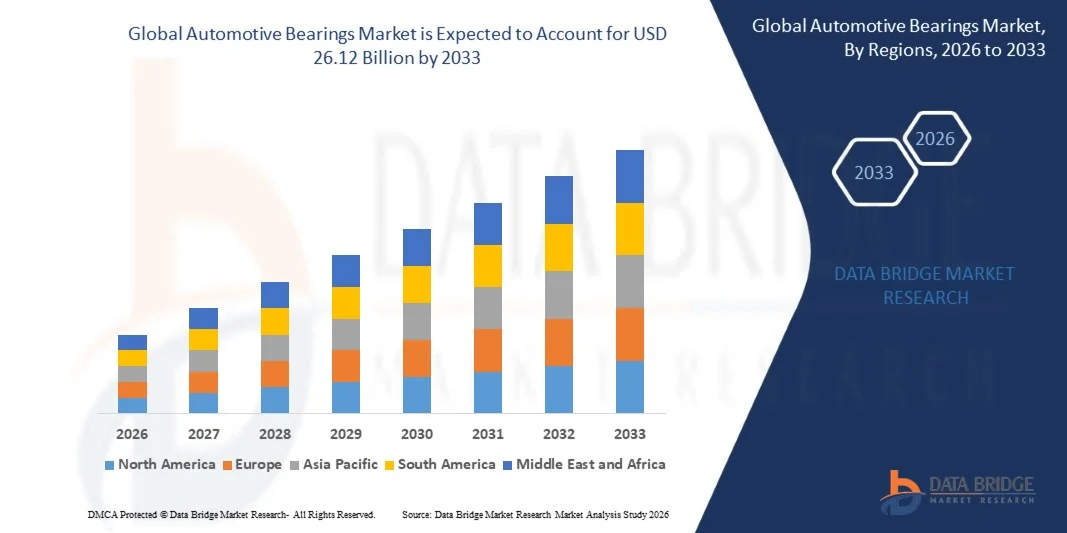
- As per Data Bridge Market Research Analysis, the automotive bearings market was valued at USD 21.52 billion in 2025 and is projected to reach USD 26.12 billion by 2033, growing at a CAGR of 2.45% from 2026 to 2033. The market is experiencing steady growth driven by stabilizing internal combustion engine (ICE) vehicle production and accelerating electrification, reshaping bearing specifications. Rolling-element designs continue to dominate core wheel-end, transmission, and e-powertrain positions, while ceramic hybrids, sensor-integrated units, and additive-manufactured cages are gaining a premium market share as OEMs pursue energy savings and compact modular layouts.
- The automotive bearings market for electric vehicles (EVs) is projected to grow from USD 5.81 billion in 2025 to USD 12.82 billion by 2032 at a CAGR of 11.97%, reflecting rising electrification. Although EVs generally require fewer bearings than conventional internal combustion vehicles, they require higher-value, high-performance bearings, supporting premium market growth. The rising average vehicle age drives strong aftermarket demand for replacement bearings, while the growing adoption of panoramic sunroofs and other comfort-oriented features is boosting the need for compact, precision bearings in interior and roof systems.
Market Size & Forecast
- Global Market Value (2025): USD 21.52 Billion
- Expected Market Value (2033): USD 26.12 Billion
- Forecast CAGR (2026–2033): 2.45%
- Leading Region in 2025: Asia-Pacific
- Fastest Growing Region: Asia-Pacific
Key Market Trends & Insights
- Asia-Pacific anchors global growth on rising light-vehicle builds and local EV adoption, accounting for the largest share of the global market, supported by the world's largest vehicle fleet, strong automotive manufacturing ecosystems, and rapidly expanding repair networks.
- North America and Europe focus on aftermarket upgrades and predictive maintenance enabled by intelligent bearings.
- The ball bearing segment led the market in 2025, driven by widespread use in wheel hubs, transmissions, and electric motors.
- Electric vehicles require bearings with ultra-low friction and high electrical insulation, pushing suppliers toward ceramic balls, specialized coatings, and new cage geometries that curb energy loss and avert electrical discharge.
- The aftermarket segment is witnessing significant growth due to the aging vehicle fleet and increasing vehicle service life.
- Counterfeit bearings remain a major challenge, eroding OEM and aftermarket revenue and posing safety risks.
- Integration of sensor capabilities and AI-driven predictive maintenance is emerging as a key trend in bearing technology.
Report Scope and Automotive Bearings Market Segmentation
|
Attributes |
Automotive Bearings Key Market Insights |
|
Segments Covered |
|
|
Countries Covered |
North America
Europe
Asia-Pacific
Middle East and Africa
South America
|
|
Key Market Players |
|
|
Market Opportunities |
|
|
Value Added Data Infosets |
In addition to the market insights such as market value, growth rate, market segments, geographical coverage, market players, and market scenario, the market report curated by the Data Bridge Market Research team includes in-depth expert analysis, import/export analysis, pricing analysis, production consumption analysis, and pestle analysis. |
Automotive Bearings Market Trends
Trend: Aftermarket Expansion and Longer Vehicle Service Life
The aging vehicle fleet in mature markets such as the United States prompts longer intervals between component replacements, particularly for hub and drivetrain bearings. Advances in surface treatment technologies are helping extend the lifespan of these parts, allowing owners to maintain safety while reducing service frequency. Fleet operators increasingly use data analytics to anticipate mechanical issues, shifting the aftermarket landscape from reactive repairs to proactive, condition-based purchasing. Streamlined distribution channels and independent aftermarket distributors enable high-performance bearing products to retain value beyond their initial installation. This evolving structure is helping stabilize demand across the automotive bearings sector, even as new vehicle sales fluctuate.
Automotive Bearings Market Dynamics
Key Market Driver: Rising Vehicle Production and Electrification
One of the key factors propelling the global automotive bearing market is the growing momentum towards electric vehicles (EVs). The worldwide transition to EVs is primarily fueled by stringent emission standards and the increasing emphasis on sustainable transportation options. This shift is driving a heightened demand for specialized bearings designed to optimize the performance of electric vehicles. These advanced bearings must be efficient, lightweight, and durable to accommodate the specific requirements of battery-electric powertrains while enhancing overall vehicle efficiency. Additionally, the rising popularity of hybrid vehicles, which merge traditional engines with electric systems, also drives demand for specialized bearing solutions.
Key Restraint/Challenge: Counterfeit Bearings Eroding OEM and Aftermarket Revenue
A significant challenge facing the automotive bearings market is the presence of counterfeit bearings. JTEKT testing shows counterfeit hub units failing fatigue tests in one-tenth the life of genuine parts. SKF destroyed 15 tons of seized knock-offs, yet improved holographic labels and blockchain traceability only partially stem the tide. In emerging markets, weak legal penalties allow repeat offenders, forcing legitimate suppliers to finance education campaigns and forensic audits. The reputational and warranty costs weigh on the automotive bearings market's OEM and aftermarket segments.
Key Market Opportunity:Rising Demand for Specialized EV Bearings
The accelerating shift toward electric vehicles presents a significant growth opportunity for the automotive bearings market. The automotive bearings market for electric vehicles (EVs) is projected to rise from USD 5.81 billion in 2025 to USD 12.82 billion by 2032, at a CAGR of 11.97%. EVs require specialized bearings designed to optimize electric powertrain performance, including motors, transmissions, and e-axles. These advanced bearings must be efficient, lightweight, and durable to meet the specific requirements of battery-electric powertrains. Manufacturers that invest in developing innovative bearing solutions for EVs are well-positioned to capitalize on this growing demand.
Automotive Bearings Market Scope
The automotive bearings market is segmented on the basis of bearing type, material, vehicle type, and distribution channel.
- By Bearing Type
On the basis of bearing type, the Automotive Bearings Market is segmented into ball bearing, roller bearing, thrust bearing, plain bearing and others. The Ball Bearing segment dominated the market in 2025, driven by widespread use in wheel hubs, transmissions, and electric motors. Ball bearings are preferred for their ability to handle both radial and axial loads with minimal friction, making them ideal for high-speed applications. Roller bearings are gaining traction in heavy-duty applications such as trucks, buses, and off-highway commercial vehicles due to their higher load-carrying capacity and durability under extreme conditions. Thrust bearings are specifically designed to handle axial loads and are commonly used in automotive transmissions and steering systems. Plain bearings, also known as bushings, are increasingly used in engine components and suspension systems due to their simplicity and cost-effectiveness. The shift toward electric vehicles is driving demand for specialized bearing types that can withstand higher speeds, reduce friction, and provide electrical insulation to prevent pitting and corrosion. Manufacturers are investing in advanced materials and coatings to enhance bearing performance and longevity in EV applications.
- By Material
On the basis of material, the Automotive Bearings Market is segmented into steel, ceramic, polymer and composite. Steel bearings dominate the market due to their high strength, durability, and cost-effectiveness, making them the preferred choice for most automotive applications. Steel bearings are manufactured using high-quality bearing steel that offers excellent wear resistance and fatigue strength under heavy loads. However, ceramic bearings are gaining popularity in high-performance and EV applications due to their lightweight properties, corrosion resistance, and ability to operate at higher temperatures without degradation. Ceramic bearings reduce friction significantly, contributing to improved fuel efficiency and extended component life. Polymer and composite bearings are also emerging as viable alternatives, offering advantages such as self-lubrication, reduced weight, and resistance to corrosion and chemicals. These materials are particularly suitable for applications where traditional steel bearings may face challenges such as limited lubrication or harsh operating environments. The growing focus on lightweighting and fuel efficiency in the automotive industry is driving innovation in bearing materials, with manufacturers exploring new composite formulations and hybrid designs.
- By Vehicle Type
On the basis of vehicle type, the Automotive Bearings Market is segmented into passenger vehicles, commercial vehicles and two-wheelers. The Passenger Vehicles segment led the market in 2025, driven by high global production volumes and increasing demand for comfort and safety features. Passenger vehicles utilize bearings across multiple applications including wheel hubs, transmissions, engines, and electric power steering systems. The Commercial Vehicles segment represents a significant market opportunity, with bearings used in heavy-duty applications such as trucks, buses, and trailers that require robust and durable components capable of withstanding extreme loads and operating conditions. The growing demand for commercial vehicles in logistics and transportation sectors is further driving the adoption of high-performance bearings. The Two-Wheelers segment is experiencing steady growth, particularly in Asia-Pacific markets where two-wheelers are a primary mode of transportation, driven by increasing urbanization and rising disposable incomes. Each vehicle type presents unique bearing requirements, with passenger vehicles emphasizing efficiency and comfort, commercial vehicles focusing on durability and load capacity, and two-wheelers prioritizing compact and lightweight designs.
- By Distribution Channel
On the basis of distribution channel, the Automotive Bearings Market is segmented into OEM and aftermarket. The OEM segment dominates the market, as bearings are critical components supplied directly to automotive manufacturers for new vehicle assembly. OEMs require bearings that meet stringent quality standards and are specifically engineered for each vehicle model to ensure optimal performance and reliability. The aftermarket segment is witnessing significant growth due to the aging vehicle fleet and increasing vehicle service life, which drives demand for replacement bearings as original components wear out over time. The rising average vehicle age in mature markets such as North America and Europe has created a robust aftermarket for replacement bearings. Fleet operators increasingly use data analytics to anticipate mechanical issues, shifting the aftermarket landscape from reactive repairs to proactive, condition-based purchasing. Technological advancements in bearing diagnostics and monitoring systems are enabling predictive maintenance, reducing downtime, and optimizing replacement schedules. The expansion of online retail channels and independent aftermarket distributors is also improving accessibility and driving competition in the aftermarket segment.
Automotive Bearings Market Regional Analysis
Asia-Pacific Automotive Bearings Market Insight
Asia-Pacific dominated the automotive bearings market with the largest revenue share in 2025, driven by the presence of major automotive manufacturing hubs in countries like China, India, and Japan. Asia-Pacific leads global demand, supported by the world's largest vehicle fleet, strong automotive manufacturing ecosystems, and rapidly expanding repair networks. China remains the world's largest automotive producer, driving substantial demand for bearings across all vehicle types. India is emerging as a key growth market, fueled by increasing vehicle production and rising demand for passenger cars and two-wheelers. The region's dominance is attributed to rapid industrialization, rising disposable incomes, and growing population.
North America Automotive Bearings Market Insight
North America holds a significant share of the Automotive Bearings Market, driven by a mature automotive industry, high vehicle ownership rates, and a strong aftermarket for replacement bearings. North America maintains a significant position in the automotive bearings market due to its established automotive manufacturing base, high vehicle ownership, and robust aftermarket demand. The region continues to benefit from increasing adoption of electric vehicles and predictive maintenance technologies. The aging vehicle fleet in the United States prompts longer intervals between component replacements, particularly for hub and drivetrain bearings, driving steady aftermarket demand.
Europe Automotive Bearings Market Insight
Europe maintains a substantial share of the Automotive Bearings Market, supported by a strong automotive manufacturing base, stringent emission regulations, and high consumer awareness of vehicle safety and performance. Germany dominates the European market with its premium vehicle production. The region's focus on technological advancements, regulatory compliance, and sustainability continues to drive market growth. The growing trend toward electric vehicles and the development of advanced bearing technologies are shaping the European automotive bearings landscape. Regulatory frameworks governing vehicle emissions and safety standards continue to influence product development and market dynamics in the region.
Automotive Bearings Market Share
The Automotive Bearings industry is primarily led by well-established companies, including:
- SKF AB (Sweden)
- NSK Ltd. (Japan)
- NTN Corporation (Japan)
- Schaeffler AG (Germany)
- JTEKT Corporation (Japan)
- The Timken Company (U.S.)
- NACHI-FUJIKOSHI CORP. (Japan)
- ILJIN Bearing Co. Ltd. (South Korea)
- MinebeaMitsumi Inc. (Japan)
- RBC Bearings Incorporated (U.S.)
- GMB Corporation (Japan)
- NRB Bearings Ltd. (India)
- NBC Bearings (India)
- Wanxiang Group (China)
- CW Bearing GmbH (Germany)
- Harbin Bearing Manufacturing Co., Ltd. (China)
- ZWZ Bearing Group Co., Ltd. (China)
- C&U Group Co., Ltd. (China)
- Fersa Bearings (Spain)
Latest Developments in Automotive Bearings Market
- In May 2026, NTN began setting up local manufacturing capability in China for its Resin Mold Insulated Bearings, used in e-Axles for electric and hybrid vehicles. The bearings suppress electrical pitting by injection-moulding an insulating resin layer onto the bearing's outer ring. NTN began mass production in Japan in 2025 and has been expanding its electrical pitting-resistant product line for electrified vehicles. The China move adds a second manufacturing base in what NTN describes as the region where electrification is advancing ahead of other markets.
- In May 2026, NTN showcased three EV-focused products at Automotive Engineering Exposition 2026 in Yokohama, including a redesigned hub bearing claimed to lower rotational friction by around 66% versus its predecessor. The improved Low Friction Hub Bearing series achieves this reduction through a newly developed seal design. When applied to battery electric vehicles, this improvement is expected to enhance energy efficiency by 0.76% and extend cruising distance by approximately 2.2 km per charge.
- In April 2025, JTEKT Corporation developed the JIGB (JTEKT Integrated Gear Bearing), which integrates gear and bearing functions into a single unit for automotive applications. The inner raceway type integrates the bearing raceway onto the gear shaft to reduce outer diameter and torque loss, while the outer raceway type uses the bearing's outer ring as the gear's inner diameter, minimizing misalignment and component count. By eliminating the bearing's inner ring and the press-fitting process, the integrated design enables downsizing of the unit and reduction in torque loss.
- In 2025, Schaeffler AG introduced its high-performance ball bearing with an integrated centrifugal disc, which lowers friction by approximately 80% compared to conventional sealed bearings. The centrifugal disc rotates freely and acts as a contactless seal, deflecting contaminants while eliminating the friction of traditional sealing methods. This innovation is particularly beneficial for electromobility applications, where reduced friction translates directly to improved efficiency and extended range. The bearing is expected to contribute to a CO₂ reduction of up to 0.3 grams per kilometer per vehicle.
- In March 2025, NTN Corporation announced organizational changes to accelerate consolidating its bearing business by integrating OEM and aftermarket operations. The restructuring aims to strengthen supply capabilities and expand sales of the aftermarket business as part of the company's Medium-term Management Plan "DRIVE NTN 100" Final. A new Finished Products Procurement Department was established within the SCM Strategy HQ to manage contract manufacturers and improve supply chain efficiency. Additionally, NTN consolidated its bearing sales bases in Japan's Chugoku and Kyusyu regions to improve customer satisfaction and optimize human resource utilization.

- Interactive Data Analysis Dashboard
- Company Analysis Dashboard for high growth potential opportunities
- Research Analyst Access for customization & queries
- Competitor Analysis with Interactive dashboard
- Latest News, Updates & Trend analysis
- Harness the Power of Benchmark Analysis for Comprehensive Competitor Tracking
Data collection and base year analysis are done using data collection modules with large sample sizes. The stage includes obtaining market information or related data through various sources and strategies. It includes examining and planning all the data acquired from the past in advance. It likewise envelops the examination of information inconsistencies seen across different information sources. The market data is analysed and estimated using market statistical and coherent models. Also, market share analysis and key trend analysis are the major success factors in the market report. To know more, please request an analyst call or drop down your inquiry.
The key research methodology used by DBMR research team is data triangulation which involves data mining, analysis of the impact of data variables on the market and primary (industry expert) validation. Data models include Vendor Positioning Grid, Market Time Line Analysis, Market Overview and Guide, Company Positioning Grid, Patent Analysis, Pricing Analysis, Company Market Share Analysis, Standards of Measurement, Global versus Regional and Vendor Share Analysis. To know more about the research methodology, drop in an inquiry to speak to our industry experts.
Data Bridge Market Research is a leader in advanced formative research. We take pride in servicing our existing and new customers with data and analysis that match and suits their goal. The report can be customized to include price trend analysis of target brands understanding the market for additional countries (ask for the list of countries), clinical trial results data, literature review, refurbished market and product base analysis. Market analysis of target competitors can be analyzed from technology-based analysis to market portfolio strategies. We can add as many competitors that you require data about in the format and data style you are looking for. Our team of analysts can also provide you data in crude raw excel files pivot tables (Fact book) or can assist you in creating presentations from the data sets available in the report.













