


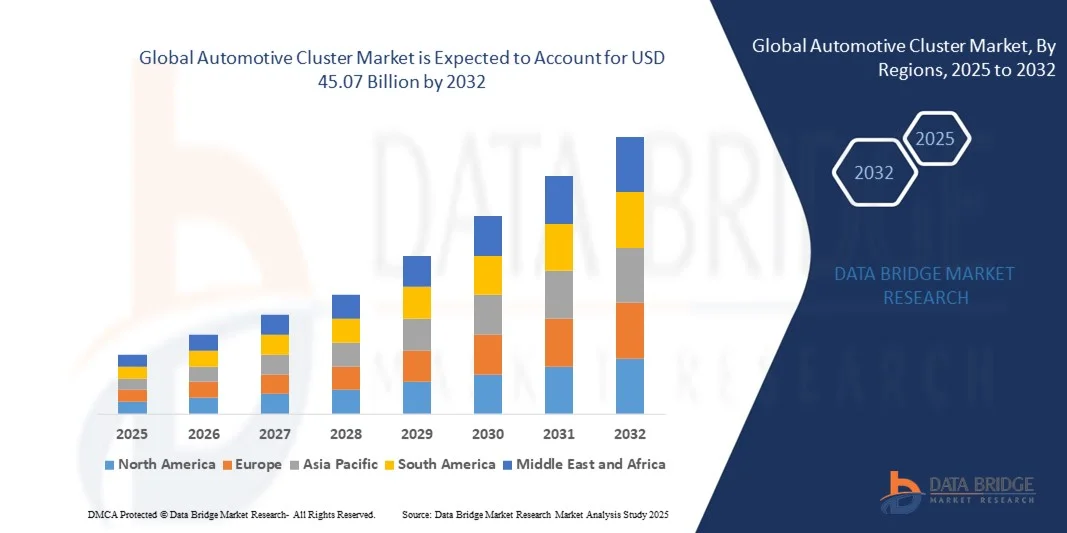
What is the Global Automotive Cluster Market Size and Growth Rate?
- The global automotive cluster market size was valued at USD 34.50 billion in 2024 and is expected to reach USD 45.07 billion by 2032, at a CAGR of3.40% during the forecast period
- The increasing demand of the advanced technology-based cluster in the automotive industry, growing concern regarding the comfortable and safe driving by offering accurate information given by cluster, rising demand of automotive cluster in luxury vehicles, rising trends of digitalized and hybrid cluster are some of the most important and vital factors which will such as to augment the growth of the automotive cluster market
What are the Major Takeaways of Automotive Cluster Market?
- Increasing number of research and development activities for advanced product development along with changing consumer lifestyle which will further contribute by generating immense opportunities that will led to the growth of the automotive cluster market in the above mentioned projected timeframe
- North America dominated the automotive cluster market with the largest revenue share of 38.9% in 2024, driven by the rapid adoption of digital cockpits, advanced infotainment systems, and connected vehicle technologies
- The Asia-Pacific automotive cluster market is poised to grow at the fastest CAGR of 13.7% during the forecast period (2025–2032), driven by rapid urbanization, rising vehicle production, and the growing shift toward connected and electric vehicles
- The Digital segment dominated the market with the largest revenue share of 56.4% in 2024, owing to the growing preference for digital interfaces that offer enhanced visibility, real-time data display, and integration with advanced driver assistance systems (ADAS)
Report Scope and Automotive Cluster Market Segmentation
|
Attributes |
Automotive Cluster Key Market Insights |
|
Segments Covered |
|
|
Countries Covered |
North America
Europe
Asia-Pacific
Middle East and Africa
South America
|
|
Key Market Players |
|
|
Market Opportunities |
|
|
Value Added Data Infosets |
In addition to the insights on market scenarios such as market value, growth rate, segmentation, geographical coverage, and major players, the market reports curated by the Data Bridge Market Research also include in-depth expert analysis, pricing analysis, brand share analysis, consumer survey, demography analysis, supply chain analysis, value chain analysis, raw material/consumables overview, vendor selection criteria, PESTLE Analysis, Porter Analysis, and regulatory framework. |
What is the Key Trend in the Automotive Cluster Market?
Enhanced Convenience Through AI and Voice Integration
- A prominent trend in the automotive cluster market is the integration of artificial intelligence (AI) and voice-controlled systems such as Amazon Alexa, Google Assistant, and Apple Siri, enhancing real-time interaction and driving experience
- Automotive Clusters now leverage AI to analyze driver behavior, predict vehicle maintenance needs, and personalize dashboard displays based on user preferences. For instance, Bosch and NVIDIA have collaborated to develop AI-powered digital clusters capable of adaptive visualization and context-aware alerts
- Voice integration enables hands-free control of navigation, calls, and infotainment systems, significantly improving driver safety and convenience
- The convergence of AI and voice technologies in cluster systems supports seamless communication between vehicle subsystems, ensuring a more connected and intelligent driving environment
- Companies such as Continental AG and Visteon Corporation are investing in AI-enabled cockpit domain controllers, enabling centralized management of digital displays and interactive features
- This trend reflects the industry's shift toward intuitive, intelligent, and connected automotive interfaces, transforming the driving experience and setting new benchmarks for in-vehicle technology
What are the Key Drivers of Automotive Cluster Market?
- The rising demand for advanced driver assistance systems (ADAS) and growing adoption of digital dashboards are major drivers propelling the automotive cluster market forward
- In February 2024, DENSO Corporation unveiled its latest digital cockpit platform, offering enhanced visualization and integrated safety alerts, aimed at improving driving precision and comfort
- The increasing penetration of electric and connected vehicles is creating strong demand for high-resolution, multifunctional clusters capable of real-time data display and energy monitoring
- Consumers’ preference for customizable and interactive vehicle interiors is encouraging automakers to incorporate hybrid and reconfigurable cluster systems
- In addition, the shift toward vehicle electrification and connectivity is motivating OEMs to integrate cluster systems with cloud-based platforms for over-the-air updates and performance analytics
- The expansion of autonomous and semi-autonomous vehicles further accelerates the need for dynamic visualization systems that support situational awareness and predictive analytics
Which Factor is Challenging the Growth of the Automotive Cluster Market?
- The high cost of advanced digital clusters and complex integration requirements remain significant challenges for widespread adoption
- Many mid-range and entry-level vehicles still rely on analog or semi-digital systems due to cost constraints and limited compatibility with existing vehicle architectures
- For instance, several automakers in developing regions have delayed the adoption of fully digital clusters because of supply chain limitations and high production costs associated with OLED and TFT-LCD displays
- Moreover, ensuring system reliability and driver safety while managing the growing volume of data from ADAS and infotainment systems is a persistent technical hurdle
- Another challenge is the need for standardized software interfaces to facilitate seamless communication between electronic control units (ECUs) and instrument clusters
- To overcome these challenges, manufacturers are focusing on cost-efficient display technologies, modular design frameworks, and software-defined architectures to enhance scalability and affordability in the long term
How is the Automotive Cluster Market Segmented?
The automotive cluster market is segmented on the basis of product type, vehicle type, sales channel, display type, instrument cluster, and application.
- By Product Type
On the basis of product type, the automotive cluster market is segmented into Analog, Digital, and Hybrid. The Digital segment dominated the market with the largest revenue share of 56.4% in 2024, owing to the growing preference for digital interfaces that offer enhanced visibility, real-time data display, and integration with advanced driver assistance systems (ADAS). The transition from analog to digital systems is supported by the increasing electrification of vehicles and the demand for smart cockpit designs. Digital clusters provide customizable layouts, connectivity options, and improved aesthetics, making them highly desirable in modern vehicles.
The Hybrid segment is expected to witness the fastest CAGR from 2025 to 2032, driven by its ability to combine traditional analog readability with digital flexibility. Hybrid clusters are gaining traction among mid-range vehicle manufacturers seeking cost-effective yet feature-rich display solutions.
- By Vehicle Type
Based on vehicle type, the automotive cluster market is segmented into Passenger Cars, Light Commercial Vehicles (LCVs), Heavy Commercial Vehicles (HCVs), and Special Purpose Vehicles. The Passenger Cars segment dominated the market with a revenue share of 61.7% in 2024, attributed to rising consumer demand for technologically advanced interiors and the growing penetration of digital displays in compact and luxury cars. Increasing adoption of smart dashboards and enhanced infotainment systems further fuels this dominance.
The Light Commercial Vehicles (LCVs) segment is projected to register the fastest CAGR from 2025 to 2032, driven by growing fleet digitalization and real-time data monitoring needs. The integration of clusters with telematics systems enhances fleet efficiency, route optimization, and safety monitoring, boosting adoption in the logistics and last-mile delivery sectors.
- By Sales Channel
On the basis of sales channel, the automotive cluster market is bifurcated into Original Equipment Manufacturers (OEM) and Aftermarket. The OEM segment held the largest market revenue share of 78.9% in 2024, primarily due to the integration of advanced digital clusters during the vehicle manufacturing stage. Automakers increasingly collaborate with cluster manufacturers to enhance vehicle intelligence and connectivity from production. OEMs benefit from economies of scale and the ability to incorporate display technologies that align with the vehicle’s electronic architecture.
The Aftermarket segment is expected to witness the fastest CAGR from 2025 to 2032, fueled by rising consumer interest in upgrading analog clusters to digital and hybrid systems. The availability of plug-and-play retrofit options and improved compatibility across vehicle models further supports aftermarket growth.
- By Display Type
Based on display type, the market is segmented into LCD, TFT-LCD, and OLED. The TFT-LCD segment dominated the market with the largest revenue share of 49.8% in 2024, owing to its high image clarity, energy efficiency, and cost-effectiveness compared to OLEDs. TFT-LCD displays are widely adopted in both passenger and commercial vehicles for their reliability and improved contrast performance under diverse lighting conditions.
The OLED segment is anticipated to grow at the fastest CAGR from 2025 to 2032, driven by its superior brightness, flexibility, and lightweight design. OLED technology supports curved and transparent display configurations, making it a preferred choice for next-generation digital cockpits and premium vehicles emphasizing futuristic aesthetics.
- By Instrument Cluster
On the basis of instrument cluster type, the market is divided into Fully Reconfigurable Instrument Cluster and Partially Reconfigurable Instrument Cluster. The Partially Reconfigurable Instrument Cluster segment dominated the market with a revenue share of 57.3% in 2024, as it offers a balanced combination of analog-style gauges with digital customization. These clusters are favored in mid-range vehicles for their cost efficiency and ease of integration with vehicle electronics.
The Fully Reconfigurable Instrument Cluster segment is projected to record the fastest CAGR from 2025 to 2032, driven by increasing adoption in luxury and electric vehicles. These clusters offer dynamic interface customization, real-time vehicle data visualization, and seamless integration with driver assistance features, enhancing overall driving intelligence.
- By Application
Based on application, the automotive cluster market is segmented into Speedometer, Odometer, Tachometer, and Others. The Speedometer segment held the largest market share of 44.1% in 2024, owing to its critical role in displaying real-time vehicle speed and integrating with advanced safety systems. The digitalization of speedometers enhances driver visibility, reduces distractions, and enables seamless synchronization with ADAS and navigation systems.
The Tachometer segment is expected to grow at the fastest CAGR from 2025 to 2032, driven by its expanding use in performance-oriented vehicles and the increasing demand for real-time engine monitoring. The combination of precision analytics and digital interface advancements is making tachometers a core element in both passenger and commercial vehicle dashboards.
Which Region Holds the Largest Share of the Automotive Cluster Market?
- North America dominated the automotive cluster market with the largest revenue share of 38.9% in 2024, driven by the rapid adoption of digital cockpits, advanced infotainment systems, and connected vehicle technologies. Automakers in the region are increasingly equipping vehicles with reconfigurable digital clusters to enhance driver experience, safety, and connectivity
- Consumers in North America value the integration of AI-based visualization, intuitive user interfaces, and real-time performance monitoring, which has accelerated the shift from analog to digital instrument panels
- The strong presence of major automotive technology providers, such as Continental AG, Visteon Corporation, and NVIDIA Corporation, coupled with rising demand for luxury and electric vehicles, continues to reinforce the region’s leadership in this market
U.S. Automotive Cluster Market Insight
The U.S. automotive cluster market captured the largest revenue share of 63% in 2024 within North America, fueled by high consumer preference for connected vehicles and the increasing penetration of electric and hybrid models. Automakers are adopting digital clusters that combine driver information, ADAS alerts, and infotainment functions into a single unified display. The ongoing expansion of EV manufacturing by brands such as Tesla and General Motors, along with the presence of advanced semiconductor and software firms, drives continuous technological innovation. In addition, the trend toward personalized cockpit experiences and AI-enabled visualization systems is propelling sustained growth across premium and mid-range vehicles.
Europe Automotive Cluster Market Insight
The Europe automotive cluster market is projected to expand at a steady CAGR throughout the forecast period, supported by stringent safety regulations, digital transformation in vehicles, and the growing adoption of sustainable mobility solutions. The region’s focus on eco-friendly, data-driven automotive technologies encourages widespread use of digital and hybrid instrument clusters. European automakers such as BMW, Mercedes-Benz, and Volkswagen are pioneering fully reconfigurable digital displays that integrate navigation, vehicle diagnostics, and connectivity features. The growing consumer demand for enhanced aesthetics, customization, and energy efficiency across passenger and commercial vehicles further supports regional growth.
U.K. Automotive Cluster Market Insight
The U.K. automotive cluster market is expected to grow at a notable CAGR during the forecast period, driven by rising consumer preference for advanced in-vehicle information systems and the expanding electric vehicle ecosystem. Increasing adoption of hybrid and digital clusters by automakers such as Jaguar Land Rover reflects the nation’s move toward modern, connected cockpits. Furthermore, ongoing investments in smart mobility infrastructure and digital vehicle dashboards are reinforcing the country’s position in the European automotive landscape. The U.K.’s strong focus on driver safety and connectivity is expected to drive continuous adoption in both passenger and commercial fleets.
Germany Automotive Cluster Market Insight
The Germany automotive cluster market is anticipated to expand at a significant CAGR through 2032, led by technological innovation, premium vehicle production, and strong automotive R&D infrastructure. Germany’s automotive giants—Volkswagen, BMW, and Audi—are actively developing AI-integrated, fully reconfigurable instrument clusters to enhance user experience and safety. The nation’s strong supply chain for display components and embedded systems supports cluster production efficiency. In addition, the country’s push toward electromobility and digital transformation in vehicles continues to fuel demand for cutting-edge cockpit display solutions, positioning Germany as a key growth hub in Europe.
Which Region is the Fastest Growing Region in the Automotive Cluster Market?
The Asia-Pacific automotive cluster market is poised to grow at the fastest CAGR of 13.7% during the forecast period (2025–2032), driven by rapid urbanization, rising vehicle production, and the growing shift toward connected and electric vehicles. Governments across China, Japan, South Korea, and India are promoting digital automotive technologies, accelerating the adoption of next-generation clusters. Expanding local manufacturing capabilities, coupled with the availability of cost-effective digital display components, is enabling broad market accessibility and affordability.
Japan Automotive Cluster Market Insight
The Japan automotive cluster market is witnessing strong momentum due to the nation’s technological expertise, innovation culture, and growing penetration of smart and electric vehicles. Domestic automakers such as Toyota, Honda, and Nissan are increasingly adopting AI-driven, fully digital instrument clusters to improve driver engagement and vehicle intelligence. The integration of voice and gesture recognition, coupled with compact, high-resolution displays, is becoming a major trend. In addition, Japan’s aging population and focus on user-friendly interfaces continue to support the adoption of safe, intuitive digital cluster systems in both personal and commercial vehicles.
China Automotive Cluster Market Insight
The China automotive cluster market held the largest revenue share within Asia-Pacific in 2024, supported by the country’s vast automotive manufacturing ecosystem and growing preference for premium in-car experiences. The government’s strong emphasis on smart mobility and electric vehicle production is accelerating the demand for digital and hybrid clusters. Local automakers such as BYD and Geely, alongside technology leaders such as Huawei, are driving innovation in AI-integrated cockpit systems. The country’s expanding middle class and increasing vehicle ownership are further boosting adoption, making China one of the world’s most dynamic and influential markets for automotive display technologies.
Which are the Top Companies in Automotive Cluster Market?
The automotive cluster industry is primarily led by well-established companies, including:
- Continental AG (Germany)
- YNA (South Korea)
- Marelli Corporation (Japan)
- IAC Group (Luxembourg)
- NVIDIA Corporation (U.S.)
- Robert Bosch GmbH (Germany)
- DENSO CORPORATION (Japan)
- BorgWarner Inc. (U.S.)
- Visteon Corporation (U.S.)
- HARMAN International (U.S.)
- KYOCERA Corporation (Japan)
- MTA S.p.A. (Italy)
- Nippon Seiki Co., Ltd. (Japan)
- Stoneridge, Inc. (U.S.)
- Pricol Limited (India)
- Simco Ltd. (Canada)
- Qualcomm Technologies, Inc. (U.S.)
- ALPS ALPINE CO., LTD. (Japan)
- Japan Display Inc. (Japan)
- Innolux Corporation (Taiwan)
What are the Recent Developments in Global Automotive Cluster Market?
- In November 2023, at EVangelise '23 hosted by iCreate in Ahmedabad, Bengaluru-based startup Auklr Technologies introduced an advanced intelligent instrument cluster aimed at enhancing the driving experience for electric vehicles (EVs). This innovation marks a significant step toward the integration of smart digital interfaces in EVs, promoting greater connectivity and efficiency in vehicle performance
- In August 2023, TVS Motor Company, a renowned Indian automotive manufacturer, launched the TVS X, an electric two-wheeler built on an entirely new platform and featuring a 10.25-inch instrument cluster integrated with the in-house NavPro navigation system. This launch reflects TVS’s commitment to redefining electric mobility through advanced technology and superior rider experience
- In May 2020, Continental AG, a leading technology and service provider, entered into a strategic partnership with Pioneer Corporation to develop a next-generation integrated instrument cluster and infotainment system for enhanced user experience. This collaboration signifies a major advancement in creating unified digital cockpit solutions for the automotive industry

- Interactive Data Analysis Dashboard
- Company Analysis Dashboard for high growth potential opportunities
- Research Analyst Access for customization & queries
- Competitor Analysis with Interactive dashboard
- Latest News, Updates & Trend analysis
- Harness the Power of Benchmark Analysis for Comprehensive Competitor Tracking
Data collection and base year analysis are done using data collection modules with large sample sizes. The stage includes obtaining market information or related data through various sources and strategies. It includes examining and planning all the data acquired from the past in advance. It likewise envelops the examination of information inconsistencies seen across different information sources. The market data is analysed and estimated using market statistical and coherent models. Also, market share analysis and key trend analysis are the major success factors in the market report. To know more, please request an analyst call or drop down your inquiry.
The key research methodology used by DBMR research team is data triangulation which involves data mining, analysis of the impact of data variables on the market and primary (industry expert) validation. Data models include Vendor Positioning Grid, Market Time Line Analysis, Market Overview and Guide, Company Positioning Grid, Patent Analysis, Pricing Analysis, Company Market Share Analysis, Standards of Measurement, Global versus Regional and Vendor Share Analysis. To know more about the research methodology, drop in an inquiry to speak to our industry experts.
Data Bridge Market Research is a leader in advanced formative research. We take pride in servicing our existing and new customers with data and analysis that match and suits their goal. The report can be customized to include price trend analysis of target brands understanding the market for additional countries (ask for the list of countries), clinical trial results data, literature review, refurbished market and product base analysis. Market analysis of target competitors can be analyzed from technology-based analysis to market portfolio strategies. We can add as many competitors that you require data about in the format and data style you are looking for. Our team of analysts can also provide you data in crude raw excel files pivot tables (Fact book) or can assist you in creating presentations from the data sets available in the report.













