


What is the Global Automotive Conformal Coatings Market Size and Growth Rate?
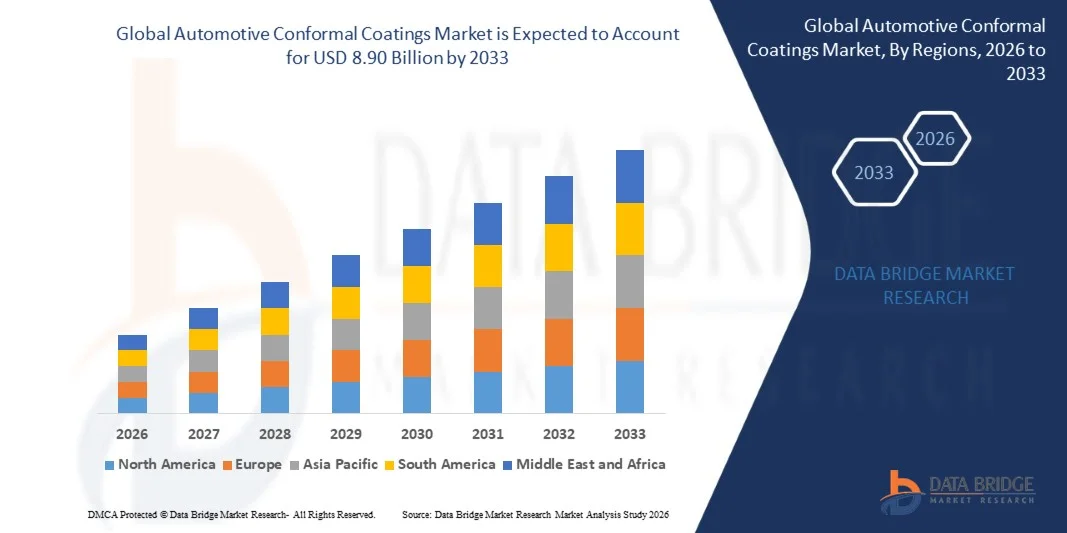
- The global automotive conformal coatings market size was valued at USD 4.42 billion in 2025 and is expected to reach USD 8.90 billion by 2033, at a CAGR of 9.15% during the forecast period
- Rise in the large-scale demand for conformal coating from the automotive industry is the major driver escalating the market growth, also rise in the adoption by the telecommunication industry and increase in the usage in substrate-such as PCB (SLP) are the major factors among others driving the automotive conformal coatings market growth
What are the Major Takeaways of Automotive Conformal Coatings Market?
- Rise in the technological advancements in end-use industries and increase in the demand for medical equipment due to COVID-19 outbreak will further create new opportunities for the automotive conformal coatings market manufacturers
- However, rise in the miniaturization of PCBs affecting the usage of conformal coatings and impact of COVID on end-use industries of PCBs acts as the major factor acting as restraints, and will further challenge the growth of automotive conformal coatings market in the forecast period
- Asia-Pacific dominated the Automotive Conformal Coatings market with a 44.12% revenue share in 2025, driven by strong growth in automotive manufacturing, electronics production, and rapid expansion of electric vehicle (EV) ecosystems across China, Japan, South Korea, and India
- North America is projected to register the fastest CAGR of 9.84% from 2026 to 2033, driven by rising adoption of electric vehicles, advanced driver assistance systems (ADAS), connected vehicle technologies, and autonomous driving platforms
- The Acrylic segment dominated the market with a 34.6% share in 2025, as acrylic coatings are widely preferred for automotive electronics due to their cost-effectiveness, ease of application, and strong moisture resistance
Report Scope and Automotive Conformal Coatings Market Segmentation
|
Attributes |
Automotive Conformal Coatings Key Market Insights |
|
Segments Covered |
|
|
Countries Covered |
North America
Europe
Asia-Pacific
Middle East and Africa
South America
|
|
Key Market Players |
|
|
Market Opportunities |
|
|
Value Added Data Infosets |
In addition to the insights on market scenarios such as market value, growth rate, segmentation, geographical coverage, and major players, the market reports curated by the Data Bridge Market Research also include in-depth expert analysis, pricing analysis, brand share analysis, consumer survey, demography analysis, supply chain analysis, value chain analysis, raw material/consumables overview, vendor selection criteria, PESTLE Analysis, Porter Analysis, and regulatory framework. |
What is the Key Trend in the Automotive Conformal Coatings Market?
“Rising Adoption of High-Performance Conformal Coatings for Advanced Automotive Electronics Protection”
- The automotive conformal coatings market is witnessing growing demand for advanced coating materials designed to protect sensitive electronic components in modern vehicles from moisture, dust, chemicals, vibration, and temperature fluctuations
- Manufacturers are developing high-performance acrylic, silicone, polyurethane, and epoxy coatings that provide improved dielectric strength, thermal stability, and long-term durability for complex automotive electronic assemblies
- Increasing integration of ADAS systems, electric vehicle electronics, infotainment systems, sensors, and power control units is accelerating the use of conformal coatings to ensure reliability and safety of automotive circuits
- For instance, companies such as Henkel, Dow, Shin-Etsu Chemical, H.B. Fuller, and Chase Corporation are expanding their portfolios of automotive-grade conformal coatings designed for high-temperature resistance and harsh operating environments
- Growing need for lightweight, compact, and high-density electronic systems in vehicles is driving adoption of advanced conformal coating solutions across automotive manufacturing facilities
- As vehicles become increasingly software-defined and electronically complex, Automotive Conformal Coatings will remain essential for improving circuit reliability, extending component lifespan, and ensuring long-term vehicle performance
What are the Key Drivers of Automotive Conformal Coatings Market?
- Rising adoption of electric vehicles (EVs), hybrid vehicles, and connected car technologies is increasing demand for conformal coatings to protect sensitive automotive electronics and battery management systems
- For instance, in 2025, leading companies such as Henkel, Dow, and Shin-Etsu Chemical introduced new high-temperature and moisture-resistant coating formulations designed specifically for EV electronics and automotive control modules
- Growing use of advanced driver assistance systems (ADAS), sensors, power electronics, and onboard communication modules is significantly expanding the need for reliable circuit protection materials
- Advancements in coating technologies, including UV-curable coatings, nano-coatings, and automated selective coating systems, have improved production efficiency and performance reliability
- Increasing focus on vehicle safety, durability, and long-term operational stability is encouraging automotive manufacturers to adopt conformal coatings during electronic assembly processes
- Supported by expanding automotive electronics manufacturing and strong investments in EV infrastructure and smart mobility technologies, the Automotive Conformal Coatings market is expected to witness strong long-term growth
Which Factor is Challenging the Growth of the Automotive Conformal Coatings Market?
- High costs associated with advanced conformal coating materials and automated coating equipment can limit adoption among small and mid-scale electronics manufacturers
- For instance, during 2024–2025, fluctuations in raw material prices such as silicones, resins, and specialty polymers increased manufacturing costs for several coating suppliers
- Complex application processes, including precise dispensing, curing, and quality inspection, require specialized equipment and skilled technicians, increasing operational complexity
- Environmental regulations and compliance requirements related to volatile organic compounds (VOCs) and chemical safety create additional challenges for coating manufacturers
- Competition from alternative protection technologies such as encapsulation materials, potting compounds, and advanced sealing solutions may limit market penetration in certain applications
- To address these challenges, companies are focusing on eco-friendly formulations, automated coating technologies, and cost-efficient manufacturing processes to increase global adoption of automotive conformal coatings
How is the Automotive Conformal Coatings Market Segmented?
The market is segmented on the basis of material, component, vehicle type, EV type, and application.
• By Material
On the basis of material, the automotive conformal coatings market is segmented into Acrylic, Silicone, Parylene, Epoxy, and Polyurethane. The Acrylic segment dominated the market with a 34.6% share in 2025, as acrylic coatings are widely preferred for automotive electronics due to their cost-effectiveness, ease of application, and strong moisture resistance. These coatings provide reliable protection against humidity, dust, and chemical exposure while allowing easy inspection and rework during manufacturing. Automotive OEMs and electronics manufacturers frequently adopt acrylic coatings for printed circuit boards (PCBs), sensors, and control modules, especially in mass-produced vehicle electronics where affordability and fast curing time are important. Their compatibility with spray and dip coating processes further supports high-volume production environments.
The Parylene segment is expected to grow at the fastest CAGR from 2026 to 2033, driven by rising demand for ultra-thin, high-performance protective coatings in advanced automotive electronics such as ADAS systems, battery management units, and high-density microelectronics. Parylene coatings offer exceptional chemical resistance, dielectric strength, and uniform coverage, making them suitable for protecting sensitive components in electric and autonomous vehicles.
• By Component
On the basis of component, the market is segmented into ECU, PCB, Sensors, Battery Casing, LED, and Infotainment System. The PCB segment dominated the market with a 38.2% share in 2025, supported by the growing use of printed circuit boards in modern vehicles for controlling electronic systems such as engine management, infotainment, safety modules, and advanced driver assistance systems. Conformal coatings are extensively applied to PCBs to protect delicate circuits from moisture, vibration, dust, salt spray, and temperature fluctuations commonly experienced in automotive environments. Increasing integration of electronics in vehicles and rising demand for reliable and durable automotive electronics continue to drive the adoption of PCB coatings across OEM production lines and electronic component suppliers.
The Sensors segment is projected to grow at the fastest CAGR from 2026 to 2033, fueled by the rapid expansion of automotive sensors used in ADAS, autonomous driving technologies, and vehicle monitoring systems. These sensors require reliable environmental protection to maintain accurate signal transmission and long operational life, which is boosting demand for high-performance conformal coatings.
• By Vehicle Type
On the basis of vehicle type, the automotive conformal coatings market is segmented into Passenger Car, Light Commercial Vehicle, and Heavy Commercial Vehicle. The Passenger Car segment dominated the market with a 61.5% share in 2025, driven by the large global production volume of passenger vehicles and the increasing integration of electronic systems in modern cars. Features such as infotainment systems, digital dashboards, ADAS technologies, climate control modules, and electric power steering rely heavily on protected electronic circuits. Conformal coatings help ensure reliability and durability of these electronic components by protecting them from moisture, contaminants, and thermal stress. Growing consumer demand for connected vehicles and advanced safety features further strengthens the adoption of conformal coatings in passenger vehicles.
The Light Commercial Vehicle segment is expected to grow at the fastest CAGR from 2026 to 2033, supported by increasing demand for logistics vehicles, electric delivery vans, and connected fleet management systems, which require robust electronic protection solutions.
• By EV Type
On the basis of EV type, the market is segmented into BEV and PHEV/HEV. The BEV segment dominated the market with a 56.7% share in 2025, primarily due to the rapid expansion of battery electric vehicle production worldwide. BEVs contain a higher number of electronic modules, battery management systems, power electronics, and charging components, all of which require strong protection against humidity, corrosion, and thermal stress. Conformal coatings are widely used in battery packs, control units, and power conversion systems to improve durability and ensure long-term performance in electric vehicles. Government incentives promoting zero-emission vehicles and continuous investments in EV manufacturing are further strengthening BEV adoption globally.
The PHEV/HEV segment is projected to grow at the fastest CAGR from 2026 to 2033, supported by rising demand for hybrid mobility solutions, especially in regions transitioning gradually toward full electrification while maintaining fuel efficiency and lower emissions.
• By Application
On the basis of application, the automotive conformal coatings market is segmented into Brush Coating, Dipping, Spray Coating, Selective Coating, and Vapor Deposition. The Spray Coating segment dominated the market with a 33.9% share in 2025, as it offers uniform coverage, high production efficiency, and suitability for large-scale manufacturing environments. Spray coating is widely used in automotive electronics assembly lines for coating PCBs, control modules, and sensor boards, providing effective protection against moisture, chemical contaminants, and vibration. The method is highly compatible with automated systems, enabling manufacturers to maintain consistent coating thickness and faster processing times, which is critical for high-volume vehicle production.
The Selective Coating segment is expected to grow at the fastest CAGR from 2026 to 2033, driven by increasing demand for precision coating techniques that protect specific components without affecting connectors, test points, or sensitive interfaces. This method is becoming increasingly important in high-density automotive electronics and EV systems, where accuracy and reliability are essential.
Which Region Holds the Largest Share of the Automotive Conformal Coatings Market?
- Asia-Pacific dominated the Automotive Conformal Coatings market with a 44.12% revenue share in 2025, driven by strong growth in automotive manufacturing, electronics production, and rapid expansion of electric vehicle (EV) ecosystems across China, Japan, South Korea, and India. Increasing integration of advanced electronic control units (ECUs), sensors, battery management systems, and infotainment modules in vehicles is significantly increasing the demand for protective conformal coatings. Automotive manufacturers and electronic component suppliers across the region are adopting conformal coatings to protect sensitive circuits from moisture, vibration, dust, and chemical contaminants, ensuring long-term durability and operational reliability in modern vehicles
- Leading manufacturers in Asia-Pacific are focusing on high-performance coating materials, automated coating technologies, and advanced protective solutions designed for high-density automotive electronics. Continuous investment in EV production, semiconductor manufacturing, and automotive electronics innovation further strengthens regional market leadership and supports long-term industry growth
- Strong automotive supply chains, expanding electronics manufacturing clusters, and increasing investments in electric mobility and smart vehicle technologies further reinforce the region’s dominant position in the global Automotive Conformal Coatings market
China Automotive Conformal Coatings Market Insight
China is the largest contributor in Asia-Pacific, supported by its massive automotive manufacturing capacity and rapidly expanding electric vehicle production. The country hosts a large network of automotive component suppliers and electronics manufacturers producing ECUs, battery management systems, sensors, and advanced driver assistance system (ADAS) modules, all of which require protective coatings for reliability. Strong government support for EV adoption, continuous investment in automotive electronics, and the presence of major domestic and international manufacturers further drive demand for conformal coatings across the Chinese automotive ecosystem.
Japan Automotive Conformal Coatings Market Insight
Japan contributes significantly to regional growth due to its strong automotive innovation ecosystem and advanced electronics manufacturing capabilities. Leading Japanese automotive OEMs and electronics companies are investing in high-reliability vehicle electronics, hybrid powertrains, and autonomous driving technologies, increasing the need for durable protective coatings. The country’s strong focus on precision engineering, quality standards, and long-term product reliability supports steady adoption of advanced conformal coating materials for automotive electronic components.
India Automotive Conformal Coatings Market Insight
India is emerging as a major growth hub, driven by expanding automotive production, rising EV adoption, and government-backed initiatives such as “Make in India” and semiconductor manufacturing programs. Increasing production of two-wheelers, passenger vehicles, and electric mobility solutions is boosting demand for electronic components requiring environmental protection. Automotive electronics suppliers and PCB manufacturers are increasingly adopting conformal coatings to improve product reliability and resistance to humidity and harsh climatic conditions, accelerating market penetration across the country.
South Korea Automotive Conformal Coatings Market Insight
South Korea plays an important role in regional growth due to strong demand for advanced automotive electronics, EV battery technologies, and high-performance semiconductor components. Leading electronics and automotive manufacturers are integrating smart vehicle technologies, connected car platforms, and advanced infotainment systems, which require reliable protection for sensitive electronic circuits. Continuous innovation in battery technologies, power electronics, and digital vehicle architectures further drives demand for conformal coating solutions across South Korea’s automotive industry.
North America Automotive Conformal Coatings Market
North America is projected to register the fastest CAGR of 9.84% from 2026 to 2033, driven by rising adoption of electric vehicles, advanced driver assistance systems (ADAS), connected vehicle technologies, and autonomous driving platforms. Increasing investments in automotive electronics R&D, EV battery systems, and semiconductor innovation are strengthening demand for high-performance conformal coatings that can protect sensitive electronic components from environmental stress and thermal fluctuations. Growth in vehicle electrification, smart mobility solutions, and advanced manufacturing technologies continues to accelerate market expansion across the region.
U.S. Automotive Conformal Coatings Market Insight
The U.S. is the largest contributor in North America, supported by strong growth in electric vehicle manufacturing, automotive electronics innovation, and semiconductor research. Automotive OEMs and technology companies are increasingly integrating ADAS systems, battery management units, autonomous driving hardware, and connected vehicle platforms, which require reliable environmental protection. The presence of leading automotive technology companies, strong R&D investment, and high demand for advanced electronic protection solutions further strengthen the adoption of conformal coatings across the U.S. automotive industry.
Canada Automotive Conformal Coatings Market Insight
Canada contributes steadily to regional market growth due to its expanding automotive supply chain, increasing EV adoption, and growing investment in advanced manufacturing technologies. Automotive component manufacturers and electronics suppliers are adopting conformal coatings to ensure durability and reliability of electronic systems used in harsh environmental conditions, including extreme temperatures and humidity. Government-supported innovation initiatives, a skilled engineering workforce, and growing investments in clean mobility and automotive electronics research continue to support market expansion across Canada.
Which are the Top Companies in Automotive Conformal Coatings Market?
The automotive conformal coatings industry is primarily led by well-established companies, including:
- Altana (Germany)
- Chase Corp (U.S.)
- CHT Group (Germany)
- Comelec SA (France)
- Conins Pune (India)
- CSL Silicones Inc. (Canada)
- Dawn Tech (South Korea)
- Dow (U.S.)
- Dymax (U.S.)
- Electrolube (U.K.)
- H.B. Fuller Company (U.S.)
- Henkel (Germany)
- HZO (U.S.)
- Para Tech Coating (South Korea)
- Paratronix (U.S.)
- Peters Group (Germany)
- Shin-Etsu Chemical (Japan)
- Vertical Solutions, Inc. (U.S.)
What are the Recent Developments in Global Automotive Conformal Coatings Market?
- In December 2025, Henkel introduced the Bergquist TGF-10000, a high-performance thermal gap filler designed for advanced electronics applications requiring superior heat dissipation and mechanical flexibility. The material provides exceptionally high thermal conductivity and stable performance under thermal cycling and mechanical stress, making it ideal for power electronics used in electric vehicles, renewable energy inverters, and industrial systems. In conclusion, this development strengthens Henkel’s portfolio in advanced thermal management materials and supports growing demand for reliable electronic protection solutions
- In October 2025, Dymax launched its 9773 ruggedized adhesive, engineered to comply with the NASA/ASTM E595 low-outgassing standard for environments where minimal volatile emissions are critical. The adhesive delivers strong bonding performance and enhanced environmental resistance, making it suitable for applications across electronics, aerospace, and other high-reliability industries requiring strict material performance standards. In conclusion, this innovation enhances Dymax’s position in specialized adhesive solutions for demanding industrial and aerospace applications
- In August 2025, ALTANA announced that its specialty chemicals division BYK established a new subsidiary named BYK do Brasil, headquartered in São Paulo, to strengthen regional presence and improve customer proximity in South America. The expansion aims to capitalize on the region’s growing demand in industries such as paints and coatings, plastics, and cosmetics, enabling faster customer support and stronger collaboration with regional partners. In conclusion, this strategic expansion reinforces ALTANA’s global footprint and accelerates its market development across South America
- In July 2025, Henkel finalized the acquisition of Nordbak, a South African manufacturer specializing in industrial adhesives, sealants, and coating technologies. The acquisition strengthens Henkel’s Adhesive Technologies business in Africa by expanding its local manufacturing capabilities and enhancing its product portfolio for regional customers. In conclusion, this move strengthens Henkel’s regional presence and supports tailored solutions across automotive, construction, packaging, and industrial sectors
- In May 2025, H. B. Fuller Company announced the expansion of its manufacturing capabilities across the IMEA region (India, Middle East, and Africa) with a focus on localized production, technical service, and application expertise. The initiative includes investments in manufacturing plants, technical laboratories, and supply-chain infrastructure to deliver faster product availability and customized adhesive solutions. In conclusion, this expansion strengthens H.B. Fuller’s regional supply chain and supports growing demand across automotive, construction, electronics, hygiene, and packaging industries

- Interactive Data Analysis Dashboard
- Company Analysis Dashboard for high growth potential opportunities
- Research Analyst Access for customization & queries
- Competitor Analysis with Interactive dashboard
- Latest News, Updates & Trend analysis
- Harness the Power of Benchmark Analysis for Comprehensive Competitor Tracking
Data collection and base year analysis are done using data collection modules with large sample sizes. The stage includes obtaining market information or related data through various sources and strategies. It includes examining and planning all the data acquired from the past in advance. It likewise envelops the examination of information inconsistencies seen across different information sources. The market data is analysed and estimated using market statistical and coherent models. Also, market share analysis and key trend analysis are the major success factors in the market report. To know more, please request an analyst call or drop down your inquiry.
The key research methodology used by DBMR research team is data triangulation which involves data mining, analysis of the impact of data variables on the market and primary (industry expert) validation. Data models include Vendor Positioning Grid, Market Time Line Analysis, Market Overview and Guide, Company Positioning Grid, Patent Analysis, Pricing Analysis, Company Market Share Analysis, Standards of Measurement, Global versus Regional and Vendor Share Analysis. To know more about the research methodology, drop in an inquiry to speak to our industry experts.
Data Bridge Market Research is a leader in advanced formative research. We take pride in servicing our existing and new customers with data and analysis that match and suits their goal. The report can be customized to include price trend analysis of target brands understanding the market for additional countries (ask for the list of countries), clinical trial results data, literature review, refurbished market and product base analysis. Market analysis of target competitors can be analyzed from technology-based analysis to market portfolio strategies. We can add as many competitors that you require data about in the format and data style you are looking for. Our team of analysts can also provide you data in crude raw excel files pivot tables (Fact book) or can assist you in creating presentations from the data sets available in the report.













