


What is the Global Automotive Connecting Rod Bearing Market Size and Growth Rate?
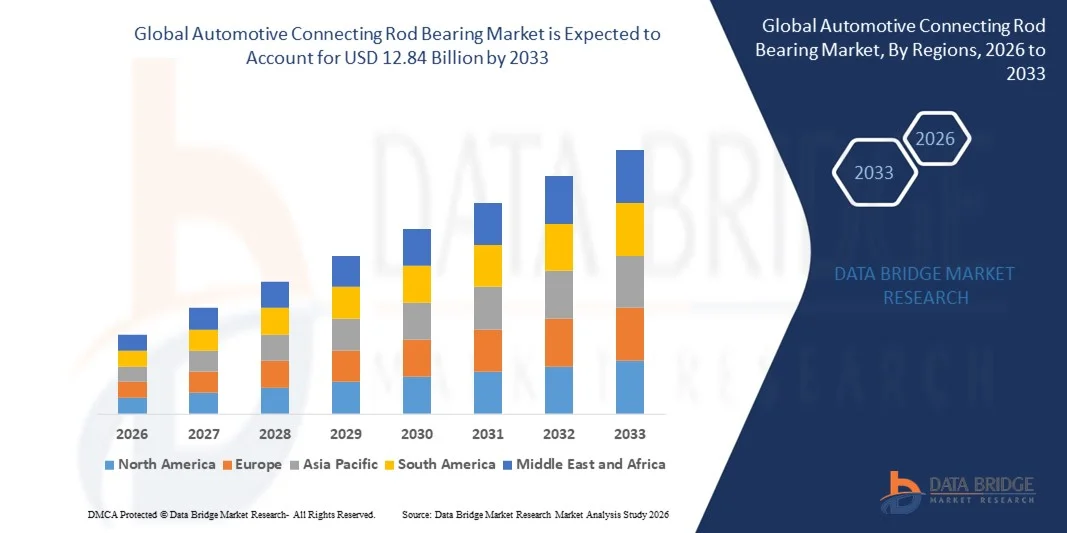
- As per Data Bridge Market Research Analysis the global automotive connecting rod bearing market size was valued at USD 5.49 billion in 2025 and is expected to reach USD 12.84 billion by 2033, at a CAGR of 11.20% during the forecast period
- The market growth is largely driven by increasing demand for high-performance and fuel-efficient engines across passenger vehicles, commercial vehicles, and hybrid electric vehicles, which is creating a sustained need for reliable and precision-engineered connecting rod bearings
- Furthermore, rising adoption of lightweight materials such as aluminum and high-carbon steel, along with advanced manufacturing technologies, is enabling improved engine efficiency, durability, and reduced emissions, thereby supporting the expansion of the automotive connecting rod bearing market
Market Size & Forecast
- Global Market Value (2025): USD 5.49 billion
- Expected Market Value (2033): USD 12.84 billion
- Forecast CAGR (2026–2033): 11.20%
What are the Major Takeaways of Global Automotive Connecting Rod Bearing Market?
- Automotive connecting rod bearings, essential components in internal combustion and hybrid engines, ensure smooth motion between the crankshaft and connecting rods while reducing friction and wear, making them critical for engine performance, longevity, and reliability across diverse vehicle types
- The escalating demand for connecting rod bearings is primarily fueled by increasing automotive production, stringent engine efficiency and emission regulations, and a growing focus on reducing maintenance costs, positioning these components as indispensable for both OEM and aftermarket applications
- North America dominated the automotive connecting rod bearing market with a share of 39.62% in 2025, due to a high concentration of automotive manufacturers, strong demand for commercial and passenger vehicles, and stringent engine performance standards
- Asia-Pacific is expected to be the fastest growing region in the automotive connecting rod bearing market during the forecast period due to increasing automotive production, rising disposable incomes, and rapid industrialization in countries such as China, India, and Japan
- Aluminum segment dominated the market with a market share of 45.5% in 2025, due to its lightweight characteristics, high load-bearing capacity, and excellent thermal conductivity that enhance engine efficiency. Aluminum bearings are widely used in passenger cars and light commercial vehicles due to their durability and compatibility with high-speed engine operations. The demand is further supported by automotive manufacturers focusing on fuel efficiency and emission reduction, which favor lighter engine components
Report Scope and Automotive Connecting Rod Bearing Market Segmentation
|
Attributes |
Automotive Connecting Rod Bearing Key Market Insights |
|
Segments Covered |
|
|
Countries Covered |
North America
Europe
Asia-Pacific
Middle East and Africa
South America
|
|
Key Market Players |
|
|
Market Opportunities |
|
|
Value Added Data Infosets |
In addition to the market insights such as market value, growth rate, market segments, geographical coverage, market players, and market scenario, the market report curated by the Data Bridge Market Research team includes in-depth expert analysis, import/export analysis, pricing analysis, production consumption analysis, and pestle analysis. |
What is the Key Trend in the Global Automotive Connecting Rod Bearing Market?
Increasing Use of Lightweight, High-Strength Materials
- A significant trend in the automotive connecting rod bearing market is the increasing adoption of lightweight and high-strength materials, such as aluminum alloys, titanium, and advanced composites, to enhance engine efficiency and reduce overall vehicle weight. This trend is driven by the need for fuel economy, emission reduction, and improved engine performance in modern vehicles
- For instance, Federal-Mogul Motorparts (a Tenneco company) and Mahle have introduced high-strength aluminum and steel bearing solutions that optimize durability while reducing mass, enabling smoother engine operation and higher RPM performance. Such material innovations are enhancing the longevity of bearings while supporting stricter environmental regulations
- The focus on lightweight materials is also facilitating better thermal management within engines, as materials with high heat dissipation properties reduce wear and prevent early failure. This positions these advanced bearings as critical enablers for high-performance and turbocharged engines
- Automakers are increasingly integrating these advanced bearings into engines designed for hybrid and electric vehicles, where minimizing mechanical losses and improving energy efficiency are paramount. This is accelerating demand for bearings capable of handling high loads without adding unnecessary weight
- The trend is further reinforced by the automotive industry's shift toward downsized engines that require high-performance materials to maintain structural integrity under elevated pressures. Bearings with superior fatigue resistance are becoming standard in modern internal combustion engines
- Overall, the rising use of lightweight and high-strength materials is shaping a more competitive market environment where manufacturers invest in material innovation to meet performance, efficiency, and sustainability goals
Automotive Connecting Rod Bearing Market Dynamics
Driver
Rising Demand for Fuel-Efficient and High-Performance Engines
- The growing focus on fuel efficiency and high engine performance is driving demand for advanced connecting rod bearings that can withstand higher loads, friction, and rotational speeds while reducing energy losses. These bearings are critical for ensuring reliability and longevity in modern high-performance engines
- For instance, NSK Ltd. supplies high-precision engine bearings for turbocharged and high-performance engines used in vehicles from BMW and Toyota. Their bearings enhance durability, reduce friction, and enable engines to achieve higher efficiency without compromising performance
- The trend toward stricter emission norms globally is encouraging the adoption of bearings that improve mechanical efficiency and contribute to reduced fuel consumption. This is supporting the broader transition toward environmentally sustainable automotive technologies
- Increasing consumer demand for sporty and high-powered vehicles is also elevating the need for bearings that provide consistent performance under extreme operating conditions. This is reinforcing R&D investments in high-load and low-friction bearing designs
- The integration of advanced engine management systems and turbocharging technologies is creating a demand for bearings that can handle fluctuating pressures and temperatures while maintaining precise tolerances. This dynamic is shaping the market toward technologically advanced, performance-oriented solutions
Restraint/Challenge
High Manufacturing Costs and Precision Requirements for Advanced Bearings
- The automotive connecting rod bearing market faces challenges due to the high costs and precision engineering required to manufacture advanced bearings capable of meeting stringent performance and durability standards. Manufacturing these bearings involves specialized materials, tight tolerances, and advanced surface treatments, increasing overall production costs
- For instance, Clevite (a Tenneco brand) utilizes sophisticated metallurgical processes and precision machining to produce high-performance bearings for commercial and passenger vehicles. These processes require skilled labor and advanced technology, contributing to elevated manufacturing expenses
- Maintaining dimensional accuracy, surface finish quality, and fatigue resistance demands rigorous quality control and inspection methods, extending production timelines and further increasing operational costs
- The use of premium materials such as bimetallic alloys and copper-lead composites introduces supply chain challenges, including sourcing specialized raw materials and managing production consistency. These factors add complexity to scaling manufacturing for mass-market applications
- Overall, the combination of high material costs, precision requirements, and production complexity continues to restrain market expansion and places pressure on manufacturers to optimize processes while ensuring performance and reliability
How is the Global Automotive Connecting Rod Bearing Market Segmented?
The market is segmented on the basis of sales channels, material type, and vehicle type.
- By Sales Channels
On the basis of sales channels, the automotive connecting rod bearing market is segmented into Original Equipment Manufacturers (OEM) and Aftermarket. The OEM segment dominated the market with the largest revenue share in 2025, driven by the growing global automotive production and stringent quality standards that favor factory-installed bearings. OEM bearings are often preferred due to their high reliability, precise tolerances, and warranty-backed performance, ensuring longer engine life and reduced maintenance needs. Vehicle manufacturers frequently standardize OEM bearings across models to maintain consistency and compliance with regulatory norms. In addition, OEM partnerships with leading bearing manufacturers ensure timely supply and integration of advanced bearing technologies into new vehicles. The demand is further supported by rising production in emerging markets with expanding automotive industries.
The Aftermarket segment is anticipated to witness the fastest growth rate from 2026 to 2033, fueled by the increasing vehicle parc and the need for engine maintenance and replacement components. For instance, companies such as Federal-Mogul Motorparts are expanding aftermarket offerings to cater to older vehicles requiring high-quality replacement bearings. The aftermarket demand is driven by cost-conscious consumers seeking reliable alternatives to OEM components, along with the availability of performance-enhancing and customized bearing solutions. In addition, aftermarket sales are supported by growth in service centers and repair workshops, particularly in regions with high vehicle aging rates. Ease of accessibility and shorter lead times also make aftermarket bearings attractive for both commercial and personal vehicle owners.
- By Material Type
On the basis of material type, the automotive connecting rod bearing market is segmented into Aluminum, Stainless Steel, High-Carbon Steel, and Babbitt. The Aluminum segment dominated the market with the largest share of 45.5% in 2025, owing to its lightweight characteristics, high load-bearing capacity, and excellent thermal conductivity that enhance engine efficiency. Aluminum bearings are widely used in passenger cars and light commercial vehicles due to their durability and compatibility with high-speed engine operations. The demand is further supported by automotive manufacturers focusing on fuel efficiency and emission reduction, which favor lighter engine components. Aluminum bearings also provide uniform wear resistance, reducing the risk of engine failure and enhancing overall vehicle performance. In addition, innovations in aluminum alloys are improving strength and fatigue resistance, further driving adoption in modern engines.
The Babbitt segment is expected to witness the fastest growth from 2026 to 2033, driven by its widespread use in heavy-duty applications requiring high load tolerance and durability. For instance, Clevite Engine Bearings manufactures Babbitt bearings specifically for high-performance and commercial engines. Babbitt material provides excellent conformability and embedability, which minimizes damage due to contaminants and reduces friction under varying operating conditions. The segment benefits from ongoing research in enhancing Babbitt alloys for longer service life and better heat dissipation. Moreover, growth in heavy commercial vehicles and industrial engines is creating significant demand for Babbitt bearings in both OEM and aftermarket channels.
- By Vehicle Type
On the basis of vehicle type, the automotive connecting rod bearing market is segmented into Heavy Commercial Vehicles (HCVs), Light Commercial Vehicles (LCVs), Hybrid Electric Vehicles (HEVs), and Two Wheelers. The HCV segment dominated the market in 2025, driven by the increasing demand for freight transportation and logistics, requiring durable and high-load-capacity engine components. HCV engines operate under higher stress and prolonged usage, which increases the need for high-quality connecting rod bearings to ensure engine longevity and operational efficiency. The demand is further supported by regulatory standards for vehicle safety and emission control, which necessitate precision-engineered engine components. In addition, HCV manufacturers are increasingly adopting advanced bearing materials to withstand heavy-duty cycles and reduce maintenance downtime.
The HEV segment is expected to witness the fastest growth rate from 2026 to 2033, fueled by the global shift toward electrification and hybrid technologies in the automotive sector. For instance, Federal-Mogul Motorparts has been developing bearings optimized for hybrid engines that balance mechanical strength with reduced friction to improve fuel efficiency. HEV bearings require precise material selection and design to accommodate frequent engine start-stop cycles and higher RPMs. The growth is further supported by government incentives promoting hybrid vehicles and rising consumer preference for environmentally friendly transportation. In addition, continuous R&D in hybrid powertrains is driving the demand for specialized connecting rod bearings that enhance performance and reliability.
Which Region Holds the Largest Share of the Global Automotive Connecting Rod Bearing Market?
- North America dominated the automotive connecting rod bearing market with the largest revenue share of 39.62% in 2025, driven by a high concentration of automotive manufacturers, strong demand for commercial and passenger vehicles, and stringent engine performance standards
- Consumers and OEMs in the region prioritize durable, high-performance bearings that enhance engine reliability and fuel efficiency
- This widespread adoption is further supported by advanced automotive R&D facilities, well-established supply chains, and increasing demand for replacement components in the growing vehicle parc, establishing connecting rod bearings as a critical engine component in both new and existing vehicles
U.S. Automotive Connecting Rod Bearing Market Insight
The U.S. automotive connecting rod bearing market captured the largest revenue share in North America in 2025, fueled by robust automotive production and modernization of engine designs. OEMs are increasingly adopting lightweight and high-strength bearings, particularly aluminum types, to improve fuel efficiency and reduce emissions. The growing preference for hybrid and commercial vehicles requiring advanced engine components further propels market growth. In addition, aftermarket demand for reliable, precision-engineered bearings continues to support market expansion, driven by vehicle maintenance and refurbishment needs.
Europe Automotive Connecting Rod Bearing Market Insight
The Europe automotive connecting rod bearing market is projected to expand at a substantial CAGR during the forecast period, driven by stringent emission regulations, demand for fuel-efficient engines, and a high adoption of lightweight engine components. Increasing urbanization and the growing production of commercial and passenger vehicles are fostering market adoption. European OEMs emphasize precision-engineered bearings for enhanced engine performance and longevity, while aftermarket demand is supported by vehicle maintenance requirements. Countries such as Germany and the U.K. are investing in advanced manufacturing and engine optimization technologies, supporting market growth across multiple vehicle segments.
U.K. Automotive Connecting Rod Bearing Market Insight
The U.K. market is anticipated to grow at a noteworthy CAGR during the forecast period, driven by rising demand for high-performance engine components in commercial and passenger vehicles. OEMs and aftermarket players are increasingly adopting aluminum and high-carbon steel bearings to meet efficiency and durability standards. In addition, growth in vehicle refurbishment and maintenance services supports aftermarket sales, while the U.K.’s strong automotive engineering infrastructure continues to stimulate market expansion.
Germany Automotive Connecting Rod Bearing Market Insight
The Germany automotive connecting rod bearing market is expected to expand at a considerable CAGR during the forecast period, fueled by the country’s advanced automotive manufacturing sector and focus on engine efficiency. German OEMs prioritize high-quality bearings to ensure engine reliability and compliance with stringent emission and performance standards. The integration of bearings with high-performance and hybrid engines is increasingly prevalent, with a strong preference for durable and precision-engineered solutions aligning with consumer and industrial expectations.
Asia-Pacific Automotive Connecting Rod Bearing Market Insight
The Asia-Pacific automotive connecting rod bearing market is poised to grow at the fastest CAGR during the forecast period of 2026 to 2033, driven by increasing automotive production, rising disposable incomes, and rapid industrialization in countries such as China, India, and Japan. Growing demand for passenger vehicles, commercial vehicles, and hybrid electric vehicles is accelerating the adoption of high-performance bearings. Furthermore, APAC is emerging as a manufacturing hub for connecting rod bearings, offering cost-effective solutions for both OEM and aftermarket applications, thereby expanding accessibility to a wider vehicle base.
Japan Automotive Connecting Rod Bearing Market Insight
The Japan market is gaining momentum due to high automotive technology standards, focus on engine efficiency, and demand for durable bearings in passenger and commercial vehicles. The integration of bearings with hybrid and high-performance engines is driving growth, supported by OEMs emphasizing lightweight and high-strength materials such as aluminum. Japan’s automotive innovation ecosystem and the preference for low-maintenance, long-lasting engine components continue to stimulate market adoption.
China Automotive Connecting Rod Bearing Market Insight
The China market accounted for the largest revenue share in Asia-Pacific in 2025, attributed to the country’s expanding automotive industry, rapid urbanization, and high manufacturing output. China is a key hub for both OEM and aftermarket bearing production, with domestic manufacturers supplying affordable and reliable components. Rising demand for commercial vehicles, passenger cars, and hybrid electric vehicles, coupled with government initiatives promoting automotive modernization and efficiency, are major factors propelling the market in China.
Which are the Top Companies in Global Automotive Connecting Rod Bearing Market?
The automotive connecting rod bearing industry is primarily led by well-established companies, including:
- Tianrun Crankshaft Co., Ltd. (China)
- Arrow Precision Ltd. (India)
- Albon Engineering & Manufacturing plc (U.K.)
- JD Norman Industries (U.K.)
- CP Carrillo (U.S.)
- Wossner Pistons (Germany)
- Wiseco Piston Company Inc. (U.S.)
- Pauter Machine Co. (U.S.)
- POWER INDUSTRIES (U.S.)
- Mahle GmbH (Germany)
- Cummins Inc. (U.S.)
- Honda Motor Co. Ltd. (Japan)
- Dover Corporation (U.S.)
- IT Forging (Thailand) Co. Ltd. (Thailand)
- Linamar (Canada)
- YASUNAGA CORPORATION (Japan)
- American Axle & Manufacturing, Inc. (U.S.)
What are Latest Developments in Global Automotive Connecting Rod Bearing Market?
- In February 2026, Timken Company completed the acquisition of CGI, Inc., a precision drive systems manufacturer focused on automation and robotics. This acquisition enables Timken to enhance manufacturing precision and efficiency for connecting rod bearings while integrating advanced automation technologies. By expanding its technological capabilities, Timken is positioned to meet growing demand for high-performance and low-tolerance bearings in both OEM and aftermarket segments, strengthening its global market presence and competitive advantage
- In September 2025, Schaeffler partnered with a leading electric vehicle manufacturer to develop specialized connecting rod bearings for electric drivetrains. This collaboration allows Schaeffler to align its product portfolio with the rapid electrification trend in the automotive industry. By focusing on high-durability and specialized bearings, the company is expected to strengthen its position in the EV sector while addressing evolving powertrain requirements and expanding market share
- In August 2025, Mahle launched a new line of lightweight connecting rod bearings designed to improve fuel efficiency in internal combustion engines. By leveraging advanced materials and innovative designs, Mahle enhances engine performance while supporting sustainability and emissions reduction goals. This strategic move strengthens Mahle’s market position and allows the company to capture a larger share in a market increasingly focused on greener automotive solutions
- In July 2025, Federal-Mogul completed the acquisition of a regional bearing manufacturer, expanding its product portfolio and manufacturing capabilities in North America. The acquisition improves operational efficiency, reduces production costs, and increases the company’s ability to meet rising demand from both OEMs and aftermarket customers. This consolidation reflects a broader trend of strategic mergers in the industry, strengthening Federal-Mogul’s competitive position in the market
- In June 2024, Daido Metal Company acquired a specialty bearing manufacturer in Mexico, enhancing its North American production footprint and supply chain resilience. The acquisition enables faster delivery of connecting rod bearings to regional OEMs and tier‑1 suppliers while improving service levels. By increasing capacity and local manufacturing capabilities, Daido Metal is positioned to capitalize on growing demand from internal combustion and hybrid vehicle programs, expanding its market share in a key automotive region

- Interactive Data Analysis Dashboard
- Company Analysis Dashboard for high growth potential opportunities
- Research Analyst Access for customization & queries
- Competitor Analysis with Interactive dashboard
- Latest News, Updates & Trend analysis
- Harness the Power of Benchmark Analysis for Comprehensive Competitor Tracking
Data collection and base year analysis are done using data collection modules with large sample sizes. The stage includes obtaining market information or related data through various sources and strategies. It includes examining and planning all the data acquired from the past in advance. It likewise envelops the examination of information inconsistencies seen across different information sources. The market data is analysed and estimated using market statistical and coherent models. Also, market share analysis and key trend analysis are the major success factors in the market report. To know more, please request an analyst call or drop down your inquiry.
The key research methodology used by DBMR research team is data triangulation which involves data mining, analysis of the impact of data variables on the market and primary (industry expert) validation. Data models include Vendor Positioning Grid, Market Time Line Analysis, Market Overview and Guide, Company Positioning Grid, Patent Analysis, Pricing Analysis, Company Market Share Analysis, Standards of Measurement, Global versus Regional and Vendor Share Analysis. To know more about the research methodology, drop in an inquiry to speak to our industry experts.
Data Bridge Market Research is a leader in advanced formative research. We take pride in servicing our existing and new customers with data and analysis that match and suits their goal. The report can be customized to include price trend analysis of target brands understanding the market for additional countries (ask for the list of countries), clinical trial results data, literature review, refurbished market and product base analysis. Market analysis of target competitors can be analyzed from technology-based analysis to market portfolio strategies. We can add as many competitors that you require data about in the format and data style you are looking for. Our team of analysts can also provide you data in crude raw excel files pivot tables (Fact book) or can assist you in creating presentations from the data sets available in the report.













