


What is the Automotive Connectors Market Size and Growth Rate?
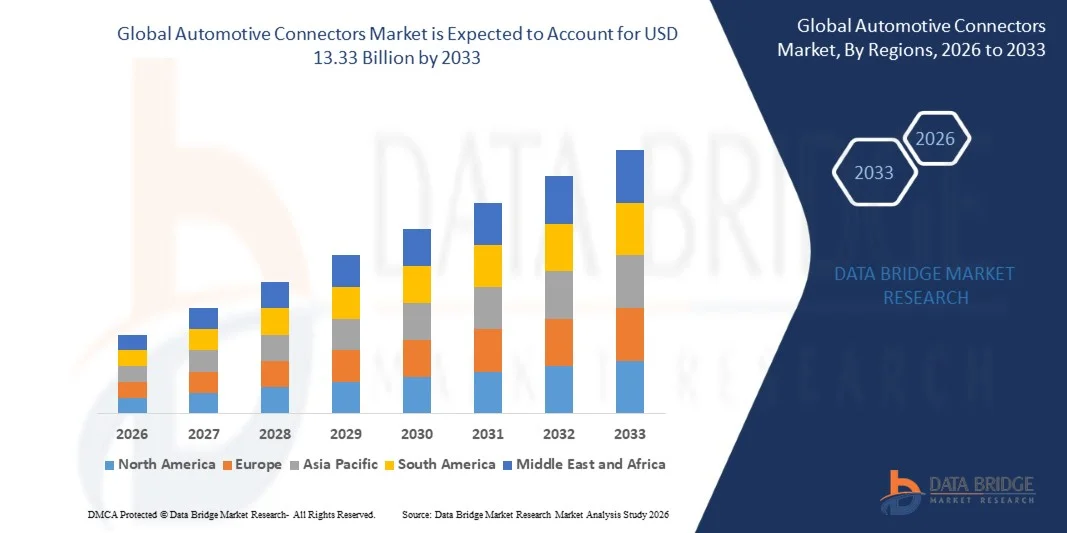
- As per Data Bridge Market Research analysis, the automotive connectors market was valued at USD 8.0 billion in 2025 and is projected to reach USD 13.33 billion by 2033, growing at a CAGR of 6.60% from 2026 to 2033.
- The market is experiencing consistent growth driven by rising demand for connected vehicles and in-car infotainment systems, rapid advancements in high-voltage and high-speed data connector technologies, and expanding applications across electric powertrains, ADAS, and autonomous driving platforms.
- The increasing integration of electronic components in vehicles, combined with stricter safety and emission regulations, is compelling automotive OEMs and Tier-1 suppliers to adopt advanced connector systems. High-voltage and fiber optic connectors are replacing traditional low-voltage architectures in many markets, offering higher data throughput, greater power density, and improved resistance to vibration, heat, and moisture.
Market Size & Forecast
- Global Market Value (2025): USD 8.0 Billion
- Expected Market Value (2033): USD 13.33 Billion
- Forecast CAGR (2026–2033): 6.60%
- Leading Region in 2025: Asia-Pacific
- Fastest Growing Region: Europe
What are the Major Takeaways of the Automotive Connectors Market?
- Asia-Pacific dominated the automotive connectors market with the largest revenue share of 40.30% in 2025, supported by extensive automotive manufacturing hubs, strong electronics supply chains, and rising vehicle electrification across China, Japan, and South Korea.
- Europe is expected to be the fastest-growing region from 2026 to 2033, fueled by stringent vehicle safety and emission regulations, strong presence of premium automotive OEMs, and rising investment in electric vehicle connector infrastructure across Germany, France, and the U.K.
- The fiber optic connectors segment led the market with the largest share in 2025, driven by rising demand for high-speed, low-latency data transmission required by ADAS, infotainment, and autonomous driving systems.
- The high voltage connectors segment is the fastest-growing voltage category, reflecting the surge in demand for 800V and 1000V connector systems supporting battery electric and plug-in hybrid vehicle architectures.
- The passenger cars segment dominated the vehicle type category, led by automotive OEMs integrating advanced connector systems for infotainment, safety, and electrified powertrain applications.
- The wire-to-board connection type segment is the fastest-growing connection category, driven by increasing use of compact, high-density board-level connectors in domain controllers and central computing architectures.
Report Scope and Automotive Connectors Market Segmentation
|
Attributes |
Automotive Connectors Key Market Insights |
|
Segments Covered |
|
|
Countries Covered |
North America
Europe
Asia-Pacific
Middle East and Africa
South America
|
|
Key Market Players |
|
|
Market Opportunities |
|
|
Value Added Data Infosets |
In addition to insights on market value, growth rate, segmentation, geographic coverage, and major players, reports curated by Data Bridge Market Research also include in-depth expert analysis, geographically represented company-wise production and capacity, distributor and partner network layouts, detailed and updated price trend analysis, and deficit analysis of supply and demand. |
What is the Key Trend in the Automotive Connectors Market?
- Automotive manufacturers are increasingly adopting modular, high-voltage connector systems that scale across auxiliary and primary power distribution needs in electric and hybrid vehicle architectures.
- Compact, drop-in connector designs enable engineers to reduce system footprint and simplify sourcing without revising existing vehicle platform layouts.
- For instance, in November 2025, Molex launched its eHV60 high-voltage automotive connector, the first product in its new eHV high-voltage connector and terminal system portfolio, purpose-built for auxiliary high-voltage functions including DC/DC converters, onboard chargers, electric compressors, and e-axles in battery electric and plug-in hybrid vehicles.
- As automakers continue to prioritize electrification, data connectivity, and software-defined vehicle architectures, the integration of compact, high-voltage, and high-speed connector systems is expected to accelerate, reinforcing connectors as a core enabling technology for next-generation vehicle platforms.
What are the Key Drivers of the Automotive Connectors Market?
- The rapid growth of electric vehicle production has significantly increased demand for high-voltage, high-current connectors capable of reliably transmitting power across battery packs, DC/DC converters, and electric drive units.
- For instance, in November 2025, Molex's eHV60 connector, supporting up to 1000V and 64A, was validated as a drop-in replacement offering automotive OEMs and Tier-1 suppliers dual-sourcing options while occupying up to 30% less space than existing alternatives.
- Automotive OEMs and Tier-1 suppliers are integrating advanced connector systems into their production lines to reduce costs, improve signal integrity, and meet tightening safety and electromagnetic compatibility regulations.
- For instance, TE Connectivity strengthened its position in the European electric vehicle charging segment through an agreement to acquire a major portion of Phoenix Contact's E-Mobility business, which includes CCS2 and NACS charging inlet connector technologies for electric vehicles.
- With the automotive industry increasingly relying on dense, high-performance connector networks for power distribution, data transmission, and sensor integration, automotive connectors will remain indispensable for both electrified and conventional vehicle platforms.
Which Factors are Challenging the Growth of the Automotive Connectors Market?
- Advanced automotive connectors require significant upfront investment due to the integration of precision-engineered contacts, EMI shielding, and high-voltage insulation materials.
- These high costs limit adoption among entry-level vehicle segments and manufacturers in cost-sensitive, price-competitive emerging markets.
- For instance, in 2025, Kyocera Corporation announced plans to acquire a 33.0% stake in Japan Aviation Electronics Industry from NEC Corporation, a transaction reflecting the substantial capital required to consolidate advanced connector manufacturing and engineering capabilities amid rising development costs.
- The high capital investment and recurring qualification and certification costs associated with advanced connector systems continue to restrict adoption, particularly among smaller component suppliers.
- This cost barrier slows market penetration in price-sensitive and emerging regions, limiting the widespread deployment of advanced connector technologies despite growing demand.
How is the Automotive Connectors Market Segmented?
The automotive connectors market is segmented on the basis of connection type, connector type, system type, vehicle type, voltage, material, sealing, application, end user and sales channel.
- By Connection Type
On the basis of connection type, the global automotive connectors market is segmented into wire-to-wire, wire-to-board, and board-to-board. The wire-to-wire segment dominated the market with the largest share in 2025, owing to extensive use across engine harnesses, chassis wiring, and body electronics where flexible, reliable point-to-point connections are essential. These connectors deliver dependable performance across varied routing paths, making them the preferred choice for OEM wiring harness integration.
The wire-to-board segment is projected to register the fastest growth from 2026 to 2033, driven by rising demand for compact, high-density connections in domain controllers, central computing units, and increasingly software-defined vehicle architectures.
- By Connector Type
On the basis of connector type, the global automotive connectors market is segmented into circular connectors, rectangular connectors, fiber optic connectors, and coaxial connectors. The fiber optic connectors segment led the market with the largest share in 2025, supported by extensive use in high-speed infotainment, camera, and ADAS data networks requiring low-latency, high-bandwidth signal transmission.
The coaxial connectors segment is expected to experience the fastest growth from 2026 to 2033, driven by increasing demand for radar, telematics, and antenna connectivity in connected and autonomous vehicle platforms.
- By System Type
On the basis of system type, the global automotive connectors market is segmented into powertrain, body & chassis, infotainment & telematics, and safety & security. The powertrain segment dominated the market with a leading share in 2025 due to its widespread adoption across engine control units, transmission systems, and electric drive units, increasing demand for high-current, vibration-resistant connectors, and growing integration with electrified powertrain architectures. additionally, rising focus on power density, thermal management, and reduced signal loss further supports the strong adoption of powertrain connector solutions.
The infotainment & telematics segment is anticipated to witness the fastest growth from 2026 to 2033, driven by this growth is fueled by the increasing reliance on high-speed data connectors for infotainment displays, telematics control units, and over-the-air update systems. automotive manufacturers, Tier-1 suppliers, and technology providers are adopting advanced connector architectures to conduct cost-effective, reliable, and high-bandwidth data transmission. additionally, the integration of 5G connectivity and cloud-based services is enhancing the accuracy and efficiency of infotainment connector systems, further driving segment growth.
- By Vehicle Type
On the basis of vehicle type, the global automotive connectors market is segmented into passenger cars, light commercial vehicles, and heavy commercial vehicles. The passenger cars segment dominated the market with the largest share in 2025 due to its critical role in supporting infotainment, safety, and electrified powertrain systems across high-volume OEM production lines. the widespread adoption of advanced driver-assistance systems, electric drivetrains, and connected car technologies is driving strong demand for connector solutions. additionally, increasing focus on vehicle safety, digital cockpit experiences, and electrification is reinforcing the dominance of this segment across global markets.
The light commercial vehicles segment is expected to witness the fastest CAGR from 2026 to 2033, driven by the rising need for fleet connectivity, telematics tracking, and electrified delivery vehicle platforms. additionally, the growing emphasis on last-mile logistics efficiency and regulatory compliance is further accelerating the adoption of advanced connector technologies across commercial vehicle operations.
- By Voltage
On the basis of voltage, the global automotive connectors market is segmented into low voltage and high voltage. The low voltage segment dominated the market with the largest share in 2025 due to its critical role in powering lighting, infotainment, sensors, and body control modules across both conventional and electrified vehicle platforms. additionally, growing investment by automotive OEMs and Tier-1 suppliers to improve signal reliability, miniaturization, and cost efficiency is reinforcing the leading position of this segment in the market.
The high voltage segment is expected to witness the fastest CAGR from 2026 to 2033, this growth is driven by increasing demand for 800V and 1000V connector systems used in battery packs, onboard chargers, and electric drive units. advanced connector designs, including shielded, sealed, and interlock-enabled architectures, are improving safety and reliability. additionally, the adoption of these connectors in electric and plug-in hybrid vehicle platforms is further accelerating market expansion.
- By Material
On the basis of material, the global automotive connectors market is segmented into metallic and plastic/polymer. The plastic/polymer segment dominated the market with the largest share in 2025 due to its widespread use in connector housings that require lightweight construction, corrosion resistance, and cost-effective manufacturing at scale.
The metallic segment is expected to witness the fastest CAGR from 2026 to 2033, driven by rising demand for high-conductivity contact materials capable of supporting high-current, high-voltage applications in electric vehicle powertrains.
- By Sealing
On the basis of sealing, the global automotive connectors market is segmented into sealed and unsealed. The sealed segment dominated the market with the largest share in 2025 due to its critical role in protecting electrical connections from moisture, dust, and vibration in under-the-hood and exterior applications. the widespread presence of stringent ingress protection requirements is facilitating strong adoption of sealed connector solutions.
The sealed segment is also expected to witness the fastest CAGR from 2026 to 2033, driven by this growth is primarily driven by the increasing adoption of sealed high-voltage connectors in battery enclosures and electric drive systems, which require robust protection against environmental exposure throughout the vehicle lifecycle.
- By Application
On the basis of application, the global automotive connectors market is segmented into engine management, ADAS & safety systems, infotainment & connectivity, and lighting & body electronics. The ADAS & safety systems segment dominated the market with the largest share in 2025 due to widespread OEM adoption of connectors supporting cameras, radar, and lidar sensor networks essential for advanced driver-assistance functionality. rising adoption of autonomous driving features across global markets, combined with increasing regulatory mandates for safety systems, is enabling manufacturers to enhance vehicle safety credentials. additionally, increasing investment by automotive OEMs and Tier-1 suppliers is accelerating adoption and reinforcing this segment's leading position in the market.
The infotainment & connectivity segment is expected to witness the fastest CAGR from 2026 to 2033, driven by this growth is driven by the increasing adoption of high-speed data connectors supporting digital cockpits, 5G connectivity, and over-the-air software updates, making these systems more efficient and valuable for next-generation vehicle architectures.
- By End User
On the basis of end user, the global automotive connectors market is segmented into original equipment manufacturers (OEM) and aftermarket. The OEM segment dominated the market with the largest share in 2025 due to its critical role in factory-integrated connector systems designed and validated for specific vehicle platforms. additionally, established supplier relationships between OEMs and Tier-1 connector manufacturers are reinforcing the dominance of this segment.
The aftermarket segment is expected to witness the fastest CAGR from 2026 to 2033, driven by rising demand for replacement and upgraded connector components in an expanding global vehicle parc, particularly for electric vehicle charging and infotainment retrofits.
- By Sales Channel
On the basis of sales channel, the global automotive connectors market is segmented into direct/OEM supply and distributors & aftermarket retailers. The direct/OEM supply segment dominated the market with the largest share in 2025 due to its critical role in ensuring precision-validated integration of connector systems during vehicle assembly. the widespread presence of long-term OEM supplier contracts facilitates faster production cycles and reinforces this segment's leading market position.
The distributors & aftermarket retailers segment is expected to witness the fastest CAGR from 2026 to 2033, driven by this growth is primarily driven by the increasing demand for replacement connectors and wiring harness components among independent repair shops and electric vehicle service providers.
Which Region Holds the Largest Share of the Automotive Connectors Market?
- Asia-Pacific dominated the automotive connectors market and accounted for the largest revenue share of 40.30% in 2025, supported by extensive automotive manufacturing hubs, cost-effective electronics supply chains, and the presence of established connector suppliers across China, Japan, and South Korea.
- The region also benefits from rapidly expanding electric vehicle production, growing Tier-1 and Tier-2 supplier networks, and increasing government support for domestic automotive electronics manufacturing. Rising investment in high-voltage and high-speed connector technologies continues to strengthen Asia-Pacific's leadership position in the global market.
China Automotive Connectors Market Insight
The China automotive connectors market is experiencing steady growth, supported by the country's large automotive production base, expanding electric vehicle manufacturing, and increasing adoption of high-voltage and high-speed data connector technologies. Rising investments in domestic connector manufacturing capacity and growing demand for cost-effective, high-volume component production are contributing to market growth. Furthermore, integration of advanced driver-assistance systems and connected car technologies is improving component sophistication, positioning China as a key manufacturing hub in the automotive connectors industry.
Japan Automotive Connectors Market Insight
The Japan automotive connectors market is expanding steadily due to the country's strong precision engineering base, established presence of global connector manufacturers, and increasing adoption of next-generation connector technologies. Component manufacturers and Tier-1 suppliers are increasingly investing in high-voltage and fiber optic connector development to meet rising domestic and export demand. Continuous advancements in miniaturization and material formulations are further driving market growth in Japan.
Europe Automotive Connectors Market Insight
The Europe automotive connectors market is expected to witness the fastest growth globally, driven by stringent vehicle safety and emission regulations, strong presence of premium automotive OEMs, and increasing investment in electric vehicle connector infrastructure across Germany, France, and the U.K. Growing awareness regarding sustainable manufacturing, rising adoption of high-voltage connector technologies, and increasing demand for scalable, high-performance solutions are supporting regional market expansion. Additionally, the growing presence of automotive R&D centers and Tier-1 supplier facilities is accelerating connector technology investment across the region.
Germany Automotive Connectors Market Insight
The Germany automotive connectors market is witnessing consistent growth due to rising investments in advanced connector technologies, expanding electric vehicle manufacturing, and strong automotive R&D infrastructure. Automotive OEMs, Tier-1 suppliers, and specialized connector manufacturers are increasingly adopting high-precision connector systems for component production, testing, and validation. Moreover, increasing integration of high-voltage architectures and the country's focus on efficient, resilient supply chains are further contributing to market growth.
U.K. Automotive Connectors Market Insight
The U.K. automotive connectors market is growing steadily, driven by expanding electric vehicle assembly operations, rising investment in domestic connector manufacturing, and increasing government focus on automotive industrial development. Growing adoption of high-voltage and fiber optic connector platforms across OEM-adjacent supplier facilities is significantly boosting market demand. In addition, rising investments from global Tier-1 suppliers and increasing integration into European automotive supply chains are positioning the U.K. as a key growth market for automotive connectors.
Which are the Top Companies in the Automotive Connectors Market?
The automotive connectors industry is primarily led by well-established companies, including:
- TE Connectivity Ltd. (Switzerland)
- Molex LLC (U.S.)
- Amphenol Corporation (U.S.)
- Aptiv PLC (Ireland)
- Sumitomo Electric Industries, Ltd. (Japan)
- Yazaki Corporation (Japan)
- JST Manufacturing Co., Ltd. (Japan)
- LEONI AG (Germany)
- Furukawa Electric Co., Ltd. (Japan)
- Proterial, Ltd. (formerly Hitachi Metals) (Japan)
- Hirose Electric Co., Ltd. (Japan)
- Japan Aviation Electronics Industry, Ltd. (Japan)
- Kyocera AVX (Kyocera Corporation) (Japan)
- Lumberg Holding GmbH & Co. KG (Germany)
- Rosenberger Group (Germany)
- Sumitomo Wiring Systems, Ltd. (Japan)
- BorgWarner Inc. (U.S.)
- Fujikura Ltd. (Japan)
- Bosch Connected Devices and Solutions GmbH (Germany)
- Delphi Technologies (U.S.)
- ITT Cannon LLC (U.S.)
- Anderson Power Products (U.S.)
- Corning Incorporated (U.S.)
- PCT International, Inc. (U.S.)
What are Latest Developments in the Automotive Connectors Market?
- In November 2025, Molex launched its eHV60 high-voltage automotive connector, the first product in its new eHV high-voltage connector and terminal system portfolio, supporting up to 1000V and 64A for auxiliary high-voltage functions including DC/DC converters, onboard chargers, electric compressors, and e-axles in battery electric and plug-in hybrid vehicles.
- TE Connectivity announced an agreement to acquire a major portion of Phoenix Contact's E-Mobility business, including CCS2 charging inlet connectors rated up to 1,000 kW and all-new NACS (SAE J3400) plug technology, strengthening TE's position in the European electric vehicle charging connector segment.
- In February 2025, TE Connectivity completed the acquisition of Richards Manufacturing Co., a North American manufacturer of electrical and gas connectors, relays, and other accessories, for approximately $2.3 billion, expanding TE's connector and grid infrastructure portfolio.
- In 2025, Kyocera Corporation announced plans to acquire a 33.0% stake in Japan Aviation Electronics Industry, Ltd. from NEC Corporation, a move expected to strengthen Kyocera's connector engineering and manufacturing capabilities.
- At the International Suppliers Fair (IZB) 2024, TE Connectivity showcased its full E-mobility connectivity portfolio for electric and hybrid passenger cars, spanning low-voltage signal and power connectivity, high-voltage connectivity, and data connectivity solutions.

- Interactive Data Analysis Dashboard
- Company Analysis Dashboard for high growth potential opportunities
- Research Analyst Access for customization & queries
- Competitor Analysis with Interactive dashboard
- Latest News, Updates & Trend analysis
- Harness the Power of Benchmark Analysis for Comprehensive Competitor Tracking
Data collection and base year analysis are done using data collection modules with large sample sizes. The stage includes obtaining market information or related data through various sources and strategies. It includes examining and planning all the data acquired from the past in advance. It likewise envelops the examination of information inconsistencies seen across different information sources. The market data is analysed and estimated using market statistical and coherent models. Also, market share analysis and key trend analysis are the major success factors in the market report. To know more, please request an analyst call or drop down your inquiry.
The key research methodology used by DBMR research team is data triangulation which involves data mining, analysis of the impact of data variables on the market and primary (industry expert) validation. Data models include Vendor Positioning Grid, Market Time Line Analysis, Market Overview and Guide, Company Positioning Grid, Patent Analysis, Pricing Analysis, Company Market Share Analysis, Standards of Measurement, Global versus Regional and Vendor Share Analysis. To know more about the research methodology, drop in an inquiry to speak to our industry experts.
Data Bridge Market Research is a leader in advanced formative research. We take pride in servicing our existing and new customers with data and analysis that match and suits their goal. The report can be customized to include price trend analysis of target brands understanding the market for additional countries (ask for the list of countries), clinical trial results data, literature review, refurbished market and product base analysis. Market analysis of target competitors can be analyzed from technology-based analysis to market portfolio strategies. We can add as many competitors that you require data about in the format and data style you are looking for. Our team of analysts can also provide you data in crude raw excel files pivot tables (Fact book) or can assist you in creating presentations from the data sets available in the report.













