What is the Automotive Cylinder Liner Market Size and Growth Rate?
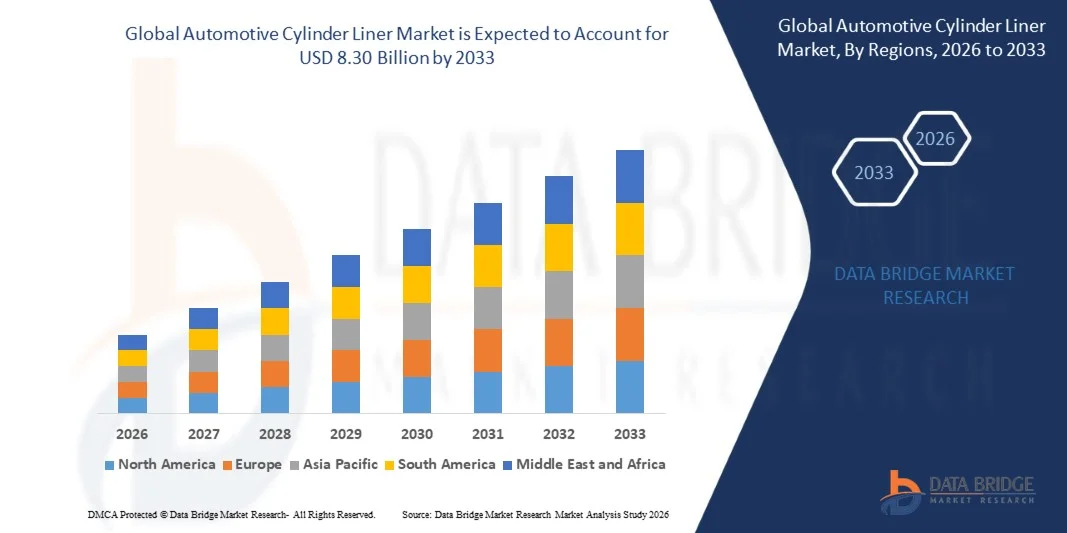
- As per Data Bridge Market Research analysis, the automotive cylinder liner market was valued at USD 5.60 billion in 2025 and is projected to reach USD 8.30 billion by 2033, growing at a CAGR of 5.05% from 2026 to 2033.
- The market is experiencing consistent growth driven by rising vehicle production, increasing demand for high-performance and fuel-efficient engines, and growing adoption of advanced cylinder liner materials and manufacturing technologies across passenger cars and commercial vehicles.
- The increasing focus on engine durability, fuel efficiency, and emission reduction, combined with stringent government regulations on vehicle emissions, is compelling automotive manufacturers to adopt lightweight, wear-resistant, and thermally efficient cylinder liners. Advanced cast iron, aluminum alloy, and surface-treated liners are increasingly being used to improve engine performance, reduce friction, and extend component service life.
Market Size & Forecast
- Global Market Value (2025): USD 5.60 Billion
- Expected Market Value (2033): USD 8.30 Billion
- Forecast CAGR (2026–2033): 5.05%
- Leading Region in 2025: North America
- Fastest Growing Region: Asia Pacific
What are the Major Takeaways of the Automotive Cylinder Liner Market?
- North America dominated the automotive cylinder liner market with the largest revenue share of 36.5% in 2025, supported by strong automotive manufacturing, established engine-component suppliers, and high demand for durable and high-performance engine components.
- Asia-Pacific is expected to be the fastest-growing region at a CAGR of 6.2% from 2026 to 2033, fueled by expanding vehicle production, increasing automotive manufacturing investments, and rising demand for engine components across China, India, and Japan.
- The nitriding cylinder liner segment led the market with a 48% share in 2025, driven by its enhanced surface hardness, superior wear resistance, and ability to withstand demanding engine operating conditions.
- Thin wall dry liner are the fastest-growing type, projected to register a CAGR of 15.5%, reflecting the surge in demand for lightweight and space-efficient engine components.
- The cast iron segment dominated the material category with a 55% revenue share in 2025, led by its proven durability, wear resistance, thermal stability, and cost-effectiveness
- Wet cylinder liners accounted for 60% of the market share in 2025, preferred by their effective cooling characteristics and widespread application in larger and high-load engines.
- The gasoline segment is the fastest-growing fuel type category, with a CAGR of 11.8%, driven by continued passenger vehicle production and increasing development of fuel-efficient gasoline engines.
Report Scope and Automotive Cylinder Liner Market Segmentation
|
Attributes |
Automotive Cylinder Liner Key Market Insights |
|
Segments Covered |
|
|
Countries Covered |
North America
Europe
Asia-Pacific
Middle East and Africa
South America
|
|
Key Market Players |
|
|
Market Opportunities |
|
|
Value Added Data Infosets |
In addition to the market insights such as market value, growth rate, market segments, geographical coverage, market players, and market scenario, the market report curated by the Data Bridge Market Research team includes in-depth expert analysis, import/export analysis, pricing analysis, production consumption analysis, and pestle analysis. |
What is the Key Trend in the Automotive Cylinder Liner Market?
- Automotive manufacturers are increasingly adopting advanced cylinder liner technologies that reduce friction, improve heat transfer, enhance wear resistance, and support higher engine efficiency while enabling lighter and more compact engine designs.
- For instance, in June 2024, ScienceDirect’s Wear journal published a study on Cr-plated cylinder liners, finding that the coating provided strong wear and corrosion resistance and was suitable for low-carbon-fuel engine applications, highlighting the growing use of surface-treated liners for improved durability and efficiency
- Advanced coatings, surface texturing, and precision-machined bore technologies are increasingly being integrated into cylinder liners to reduce mechanical losses and extend engine component service life.
- Automotive OEMs are also developing compact and lightweight engines that require cylinder liners capable of managing higher thermal and mechanical loads while maintaining durability under downsized and turbocharged operating conditions.
- For instance, in March 2025, ScienceDirect’s Tribology International published research on cylinder liner and piston-ring wear under starved lubrication, showing how tribo-layer formation influences friction and wear and identifying material microstructure as an important factor in liner durability.
- As automotive manufacturers continue prioritizing fuel efficiency, lower emissions, lightweight engine architectures, and longer component life, advanced cylinder liner technologies are expected to become increasingly important in next-generation internal combustion and hybrid powertrains.
What are the Key Drivers of the Automotive Cylinder Liner Market?
- The increasing production of passenger and commercial vehicles, particularly in emerging automotive manufacturing economies, is generating sustained demand for cylinder liners used in new engines and replacement applications.
- For instance, in February 2026, the Press Information Bureau (PIB) reported that India produced 53.8 lakh passenger vehicles and 11.1 lakh commercial vehicles during 2025, demonstrating the expanding vehicle production base that supports demand for engine components such as cylinder liners.
- Stricter vehicle emission standards and growing requirements for fuel efficiency are encouraging manufacturers to adopt low-friction, wear-resistant, and thermally efficient cylinder liner technologies that improve engine performance.
- The expansion of hybrid vehicles and continued optimization of internal combustion engines is sustaining demand for lightweight, compact, and high-durability cylinder liners capable of operating under frequent start-stop cycles and elevated thermal loads.
- For instance, in April 2025, SAE International published research on a rotating cylinder liner for heavy-duty diesel engines, reporting up to a 10% fuel-efficiency benefit at medium loads and up to 33% at idle through reduced friction, highlighting the growing focus on advanced liner technologies for improving engine efficiency.
- With automotive manufacturers increasingly optimizing internal combustion and hybrid powertrains for efficiency, durability, and emissions compliance, demand for advanced cylinder liners will remain supported across OEM and aftermarket applications.
What Factors are Challenging the Growth of the Automotive Cylinder Liner Market?
- The rapid transition toward battery electric vehicles is creating a structural challenge for automotive cylinder liner demand because fully electric powertrains eliminate the internal combustion engine and its cylinder liner requirements.
- For instance, in August 2025, The Economic Times reported that rising steel and other commodity prices were creating renewed cost pressures for India’s automotive industry, with automakers implementing price increases to offset higher input costs, highlighting the impact of raw-material volatility on automotive component manufacturers.
- Volatility in ferrous metal prices and the high capital intensity associated with advanced composite and precision-manufactured liners can increase production costs and pressure supplier margins, particularly among smaller manufacturers.
- The growing use of alternative bore technologies and linerless engine designs is also increasing competitive pressure on conventional cylinder liner manufacturers as automakers seek to reduce engine weight, friction, and component count.
- For instance, in October 2025, the Department of Scientific and Industrial Research (DSIR) reported that Indian auto-component manufacturers were facing high raw-material prices and supplier concentration, with pig iron prices having increased by as much as 40%, demonstrating the cost pressure faced by manufacturers of cast components such as cylinder liners.
- These electrification trends, material-cost pressures, high investment requirements, and competing linerless technologies continue to challenge conventional cylinder liner manufacturers, requiring suppliers to invest in advanced materials, coatings, precision manufacturing, and cost-efficient production processes.
How is the Automotive Cylinder Liner Market Segmented?
The automotive cylinder liner market is segmented on the basis of type, material, contact, fuel type, vehicle type, and sales channel.
- By Type
On the basis of type, the automotive cylinder liner market is segmented into phosphate coating cylinder liner, cast-in cylinder liner, nitriding cylinder liner, and thin wall dry liner. The nitriding cylinder liner segment dominated the market with 48% share in 2025, owing to its enhanced surface hardness, superior wear resistance, and ability to withstand demanding engine operating conditions. Nitriding strengthens the liner surface without significantly affecting the properties of the underlying material. These liners are particularly suitable for high-performance engines exposed to elevated temperatures and mechanical loads. Their improved resistance to scuffing and abrasive wear helps extend engine component life. Increasing demand for durable engine components is encouraging manufacturers to adopt advanced surface-treatment technologies.
The thin wall dry liner segment is projected to register the fastest growth at a CAGR of 15.5% from 2026 to 2033, driven by increasing demand for lightweight and space-efficient engine components. Thin wall liners enable manufacturers to reduce engine weight while maintaining the required cylinder-bore strength and dimensional stability. Their compact architecture is particularly beneficial for modern downsized and fuel-efficient engines. Increasing adoption of lightweight powertrain technologies is encouraging OEMs to optimize every engine component. Advances in manufacturing precision and material engineering are also improving the durability of thin wall designs. The technology supports improved packaging efficiency while helping manufacturers address fuel economy requirements. Rising demand for lightweight automotive components is therefore expected to accelerate adoption of thin wall dry liners.
- By Material
On the basis of material, the automotive cylinder liner market is segmented into stainless steel, cast iron, aluminium alloy, and titanium alloy. The cast iron segment dominated the market with an 55% share in 2025, supported by its proven durability, wear resistance, thermal stability, and cost-effectiveness. Cast iron remains widely used because it can withstand high combustion pressures and repeated thermal cycling. Its established manufacturing infrastructure enables large-volume production using mature casting technologies. The material also provides favorable machinability and dimensional stability for cylinder-bore applications. Heavy-duty and conventional internal combustion engines continue to rely extensively on cast iron liners because of their long service life. Strong availability of raw materials and established supplier capabilities further support its use.
The aluminium alloy segment is projected to register the fastest growth at a CAGR of 10.1% from 2026 to 2033, driven by increasing automotive lightweighting and fuel-efficiency requirements. Aluminium alloys offer lower weight and higher thermal conductivity than conventional cast iron materials. Their lightweight characteristics help manufacturers reduce overall engine mass and improve vehicle efficiency. Improved heat dissipation can also support thermal management within modern engine architectures. Advances in surface coatings and treatment technologies are addressing the lower wear resistance traditionally associated with aluminium. The material is particularly attractive for downsized, turbocharged, and hybrid-compatible engines. Increasing pressure to improve fuel economy and reduce vehicle emissions is therefore expected to accelerate aluminium alloy liner adoption.
- By Contact
On the basis of contact, the automotive cylinder liner market is segmented into dry cylinder liners and wet cylinder liners. The wet cylinder liners segment dominated the market with 60% share in 2025, owing to their effective cooling characteristics and widespread application in larger and high-load engines. Wet liners are directly exposed to engine coolant, allowing efficient heat transfer away from the combustion chamber. This configuration is particularly beneficial for engines operating under sustained thermal and mechanical loads. Wet liners can also be removed and replaced more easily during engine rebuilding and maintenance. Their established use in heavy-duty applications provides a stable demand base across commercial transportation and industrial equipment. Increasing requirements for engine durability and thermal management continue to support their adoption.
The dry cylinder liners segment is projected to register the fastest growth at a CAGR of 12.2% from 2026 to 2033, driven by increasing demand for lightweight and space-efficient engine designs. Dry liners are installed within the engine block without direct contact with engine coolant. This configuration can support compact engine construction and simplify certain manufacturing requirements. Growing vehicle lightweighting initiatives are encouraging manufacturers to optimize engine architecture and reduce component mass. Advances in material technology and surface treatment are improving the wear resistance and service life of dry liners. Their suitability for passenger vehicles and compact engine platforms is also supporting broader adoption. Increasing focus on fuel efficiency and efficient powertrain packaging is expected to further accelerate demand for dry cylinder liners.
- By Fuel Type
On the basis of fuel type, the automotive cylinder liner market is segmented into diesel and gasoline. The diesel segment dominated the market with 62% share in 2025, supported by extensive use of diesel engines in commercial vehicles and heavy-duty applications. Diesel engines operate under high compression pressures, creating significant requirements for durable and wear-resistant cylinder liners. These components must withstand high thermal loads and repeated mechanical stresses throughout extended operating cycles. Strong demand from freight transportation, construction, agriculture, and other heavy-duty applications continues to support diesel engine production. Wet cylinder liners are also widely used in several heavy-duty diesel engine configurations because of their thermal management and serviceability advantages. The established commercial vehicle fleet provides additional replacement demand for diesel engine components.
The gasoline segment is projected to register the fastest growth at a CAGR of 11.8% from 2026 to 2033, driven by continued passenger vehicle production and increasing development of fuel-efficient gasoline engines. Modern gasoline engines are adopting downsizing and turbocharging technologies that increase specific power and operating temperatures. These changes are creating demand for cylinder liners with improved wear resistance and thermal performance. Lightweight liner materials and advanced surface treatments are increasingly being incorporated into gasoline engine designs. Hybrid vehicles using gasoline internal combustion engines are also sustaining demand for advanced cylinder components. OEMs are continuing to optimize gasoline powertrains to meet increasingly stringent efficiency and emissions requirements. These developments are expected to strengthen demand for advanced cylinder liners in gasoline-powered and hybrid-compatible vehicles.
- By Vehicle Type
On the basis of vehicle type, the automotive cylinder liner market is segmented into passenger vehicle and commercial vehicle. The commercial vehicle segment dominated the market with 47% share in 2025, supported by the extensive use of high-displacement and heavy-duty engines requiring durable cylinder components. Commercial vehicles operate for long periods and typically accumulate high mileage, increasing the importance of component reliability and service life. Cylinder liners in these vehicles must withstand high combustion pressures, thermal cycling, and continuous mechanical loading. Freight transportation, construction, agriculture, and logistics applications continue to support demand for heavy-duty engine components. The large installed base of commercial vehicles also creates recurring demand through engine rebuilding and replacement activities. Continued reliance on internal combustion powertrains in heavy-duty applications provides further support.
The passenger vehicle segment is projected to register the fastest growth at a CAGR of 14.7% from 2026 to 2033, driven by high passenger vehicle production and increasing demand for lightweight, efficient engine technologies. Passenger vehicle manufacturers are increasingly optimizing engine architectures to improve fuel economy and reduce emissions. Downsized and turbocharged engines require cylinder liners capable of handling increased thermal and mechanical loads. Lightweight aluminium alloys and advanced surface treatments are gaining importance in these applications. Hybrid passenger vehicles are also maintaining demand for internal combustion engine components despite the expansion of battery-electric vehicles. Increasing consumer preference for fuel-efficient vehicles is encouraging continued powertrain innovation. The combination of high vehicle volumes and advanced engine development is therefore expected to accelerate cylinder liner demand in passenger vehicles.
- By Sales Channel
On the basis of sales channel, the automotive cylinder liner market is segmented into original equipment manufacturer (OEM) and aftermarket. The OEM segment dominated the market with an 70% share in 2025, supported by direct supply relationships with vehicle and engine manufacturers. OEM suppliers must meet stringent specifications covering material quality, dimensional accuracy, durability, and surface characteristics. Large vehicle production volumes generate consistent demand for cylinder liners across engine platforms. Long-term supplier relationships also provide component manufacturers with recurring production programs. Increasing use of advanced liner materials and treatments is creating additional opportunities for specialized OEM suppliers. The continued production of internal combustion and hybrid vehicles provides a substantial installed manufacturing base.
The aftermarket segment is projected to register the fastest growth at a CAGR of 9.5% from 2026 to 2033, driven by aging vehicle fleets, engine rebuilding, and increasing demand for cost-effective component replacement. Cylinder liners are replaced when engine bores experience excessive wear, scoring, or other forms of damage. Independent repair shops and engine rebuilders represent important customers for aftermarket liner suppliers. Commercial fleets with intensive utilization also require periodic engine refurbishment to extend vehicle operating life. Remanufacturing and engine-rebuilding activities provide an economical alternative to complete engine replacement. Growth in emerging automotive markets is further increasing the installed base of vehicles requiring maintenance and component replacement. These factors are expected to support faster expansion of the aftermarket channel compared with OEM demand.
Which Region Holds the Largest Share of the Automotive Cylinder Liner Market?
- North America dominated the automotive cylinder liner market with the largest revenue share of 36.5% in 2025, supported by strong automotive manufacturing, established engine-component suppliers, and high demand for durable and high-performance engine components.
- The region also benefits from stringent emission regulations, advanced engine technologies, substantial production of pickup trucks and heavy-duty vehicles, and continued demand for durable and high-performance cylinder liners. The presence of established automotive OEMs and component manufacturers, combined with increasing adoption of advanced coatings and precision-machined liners, continues to strengthen North America's leadership position in the global market.
U.S. Automotive Cylinder Liner Market Insight
The U.S. automotive cylinder liner market is witnessing steady growth due to rising demand for durable engine components, increasing vehicle production, and continued investments in advanced engine technologies. The country’s mature automotive manufacturing ecosystem, along with strong demand for passenger vehicles, commercial vehicles, and heavy-duty applications, is driving cylinder liner adoption. In addition, growing emphasis on fuel efficiency, emission reduction, engine durability, and advanced surface treatments is supporting demand for high-performance cylinder liners across OEM and aftermarket applications.
Asia-Pacific Automotive Cylinder Liner Market Insight
The Asia-Pacific automotive cylinder liner market is expected to witness rapid growth, driven by expanding automotive production, increasing vehicle ownership, and rising investments in engine manufacturing infrastructure across countries such as China, India, and Japan. Growing demand for fuel-efficient and durable engine components, increasing adoption of lightweight materials, and advancements in cylinder liner manufacturing technologies are supporting regional market expansion. In addition, the growing presence of automotive OEMs, component manufacturers, and engine R&D facilities is accelerating demand for advanced cylinder liners across passenger and commercial vehicle applications.
Japan Automotive Cylinder Liner Market Insight
The Japan automotive cylinder liner market is witnessing consistent growth due to rising investments in advanced engine technologies, automotive innovation, and high-performance vehicle components. Automotive manufacturers and component suppliers are increasingly adopting precision-engineered cylinder liners for improved engine durability, friction reduction, thermal management, and fuel efficiency. Moreover, increasing integration of advanced coatings, lightweight materials, and precision manufacturing technologies, along with the country’s focus on efficient and low-emission mobility solutions, is further contributing to market growth.
China Automotive Cylinder Liner Market Insight
The China automotive cylinder liner market is growing rapidly, driven by expanding vehicle production, increasing commercial vehicle demand, and rising investments in automotive manufacturing infrastructure. Growing adoption of advanced materials, surface treatments, and precision-engineered cylinder liners across passenger and commercial vehicles is significantly boosting market demand. In addition, rising investments in automotive R&D, increasing focus on fuel efficiency and emission reduction, and rapid development of domestic automotive component manufacturing are positioning China as one of the fastest-growing markets for automotive cylinder liners globally.
U.K. Automotive Cylinder Liner Market Insight
The U.K. automotive cylinder liner market is experiencing steady growth, supported by rising adoption of advanced engine components in passenger vehicles, commercial vehicles, motorsport, and specialty automotive applications. Increasing investments in lightweight and high-performance engine technologies and growing demand for durable, wear-resistant cylinder liners are contributing to market growth. Furthermore, integration of advanced coatings, precision machining, and innovative material technologies is improving engine efficiency and component life, positioning the U.K. as an important market for automotive cylinder liner technologies.
Germany Automotive Cylinder Liner Market Insight
The Germany automotive cylinder liner market is expanding steadily due to the country’s strong automotive manufacturing base, advanced engineering capabilities, and increasing adoption of next-generation engine technologies. Automotive companies and component manufacturers are increasingly utilizing high-performance cylinder liners for engine durability, friction reduction, thermal management, and R&D activities. Continuous advancements in lightweight materials, surface treatment technologies, precision manufacturing, and engine efficiency, along with Germany’s strong focus on automotive innovation and emission reduction, are further driving market growth.
Which are the Top Companies in Automotive Cylinder Liner Market?
The automotive cylinder liner industry is primarily led by well-established companies, including:
- MAHLE GmbH (Germany)
- TPR Co., Ltd. (Japan)
- Melling Tool Company (U.S.)
- Cooper Corporation (India)
- Aichi Machine Industry Co., Ltd. (Japan)
- India Pistons Limited (India)
- Liners India Limited (India)
- Kusalava International Limited (India)
- Bergmann Automotive GmbH (Germany)
- ZYNP Corporation (China)
- Zhongyuan Cylinder Liner Company Limited (China)
- Westwood Cylinder Liners Ltd (U.K.)
- Motordetal-Konotop TOV (Ukraine)
- Metalliic Auto Liners Pvt. Ltd. (India)
- Global Liners (India)
- Atrac Engineering Co. (India)
- Anand Enterprise (India)
- Fontec Foundry Pvt Ltd. (India)
- Garima Global (India)
- Esteem Auto (India)
What are Latest Developments in Automotive Cylinder Liner Market?
- In June 2025, Motilal Nehru National Institute of Technology (MNNIT), according to ETAuto, developed a new engine cylinder liner using protruding surface-texturing technology to reduce friction, wear, lubricant leakage, and emissions. Testing showed a 38% reduction in friction and wear between the piston ring and cylinder liner, while also improving component efficiency and durability.
- In November 2024, MAHLE announced, according to its official press release, that it had secured a contract from MAN Truck & Bus to supply components for the hydrogen-powered MAN hTGX truck, including pistons, piston rings, piston pins, and cylinder liners. The development highlights the adaptation of cylinder-liner technologies for hydrogen-fueled internal-combustion engines in commercial vehicles.
- In April 2023, Mahindra & Mahindra researchers, according to SAE International, presented the development of an aluminium cylinder block with slip-fit cylinder liners for a high-performance new-generation passenger-car diesel engine. The development focused on reducing engine weight while meeting higher demands for torque, fuel economy, and stringent emission requirements.
- In June 2022, researchers, according to MDPI’s Lubricants journal, investigated ZDDP tribofilm formation on textured cylinder liners to improve lubrication performance at the piston-ring and liner interface. The study examined how surface texturing can improve lubrication and capture wear debris while addressing the higher contact pressures that can accompany textured surfaces.
- In September 2021, researchers, according to SAE International, evaluated different material combinations for piston and cylinder-liner assemblies in high-performance engines. The study compared aluminium and steel liner configurations using finite-element analysis to assess structural behaviour, thermal effects, stress distribution, and fatigue performance, supporting the development of optimized lightweight engine components
- Interactive Data Analysis Dashboard
- Company Analysis Dashboard for high growth potential opportunities
- Research Analyst Access for customization & queries
- Competitor Analysis with Interactive dashboard
- Latest News, Updates & Trend analysis
- Harness the Power of Benchmark Analysis for Comprehensive Competitor Tracking
Data collection and base year analysis are done using data collection modules with large sample sizes. The stage includes obtaining market information or related data through various sources and strategies. It includes examining and planning all the data acquired from the past in advance. It likewise envelops the examination of information inconsistencies seen across different information sources. The market data is analysed and estimated using market statistical and coherent models. Also, market share analysis and key trend analysis are the major success factors in the market report. To know more, please request an analyst call or drop down your inquiry.
The key research methodology used by DBMR research team is data triangulation which involves data mining, analysis of the impact of data variables on the market and primary (industry expert) validation. Data models include Vendor Positioning Grid, Market Time Line Analysis, Market Overview and Guide, Company Positioning Grid, Patent Analysis, Pricing Analysis, Company Market Share Analysis, Standards of Measurement, Global versus Regional and Vendor Share Analysis. To know more about the research methodology, drop in an inquiry to speak to our industry experts.
Data Bridge Market Research is a leader in advanced formative research. We take pride in servicing our existing and new customers with data and analysis that match and suits their goal. The report can be customized to include price trend analysis of target brands understanding the market for additional countries (ask for the list of countries), clinical trial results data, literature review, refurbished market and product base analysis. Market analysis of target competitors can be analyzed from technology-based analysis to market portfolio strategies. We can add as many competitors that you require data about in the format and data style you are looking for. Our team of analysts can also provide you data in crude raw excel files pivot tables (Fact book) or can assist you in creating presentations from the data sets available in the report.