


What is the Automotive Door Hinges Market Size and Growth Rate?
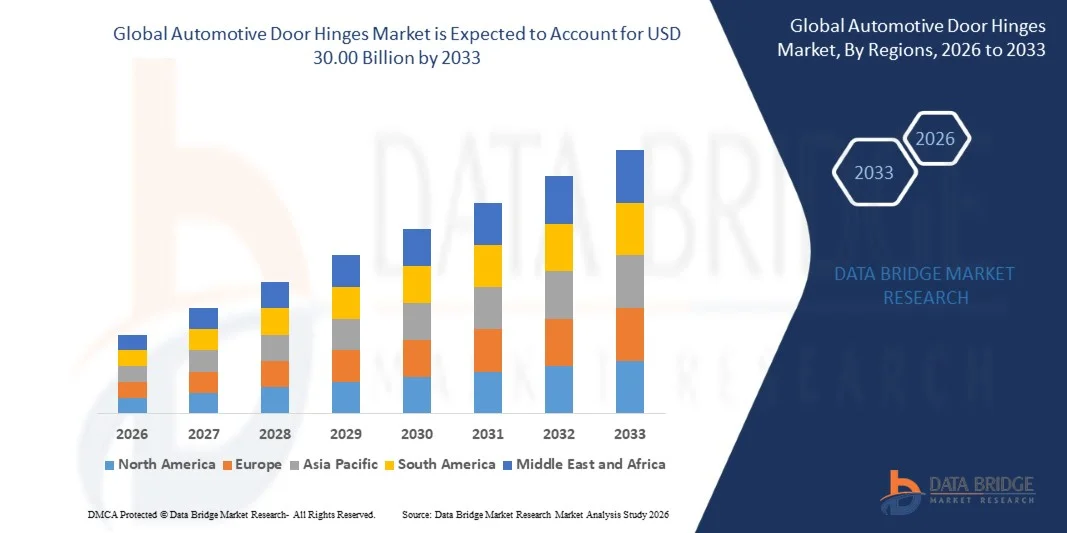
- As per Data Bridge Market Research analysis, the automotive door hinges market was valued at USD 14.10 billion in 2025 and is projected to reach USD 30.00 billion by 2033, growing at a CAGR of 9.90% from 2026 to 2033.
- The market is experiencing consistent growth driven by rising vehicle production, increasing demand for lightweight and durable door components, advancements in automotive body engineering, and expanding adoption of sophisticated hinge systems across passenger cars and commercial vehicles.
- The increasing focus on vehicle safety, weight reduction, improved door functionality, and enhanced passenger convenience, combined with the growing production of electric and premium vehicles, is compelling automotive manufacturers to adopt advanced door hinge technologies. Lightweight materials, concealed hinge designs, and optimized hinge mechanisms are increasingly being integrated into modern vehicle architectures to improve durability, aesthetics, and overall vehicle performance.
Market Size & Forecast
- Global Market Value (2025): USD 14.10 Billion
- Expected Market Value (2033): USD 30.00 Billion
- Forecast CAGR (2026–2033): 9.90%
- Leading Region in 2025: North America
- Fastest Growing Region: Asia Pacific
What are the Major Takeaways of the Automotive Door Hinges Market?
- North America dominated the automotive door hinges market with the largest revenue share of 35.0% in 2025, supported by established automotive manufacturing infrastructure, high vehicle production, and strong demand for advanced and durable door components.
- Asia-Pacific is expected to be the fastest-growing region at a CAGR of 11.4% from 2026 to 2033, fueled by expanding automotive production, rising vehicle sales, increasing electric vehicle adoption, and growing investments in automotive manufacturing across China, India, and Japan.
- The butt hinges segment led the market with a 57.0% share in 2025, driven by its established use in conventional vehicle door and access-panel assemblies.
- Multi-leaf hinges are the fastest-growing hinge type, projected to register a CAGR of 11.0%, reflecting the surge in demand for robust hinge systems capable of distributing loads across multiple leaves or links.
- The steel segment dominated the material type category with a 77.0% revenue share in 2025, led by its high strength, durability, fatigue resistance, and cost efficiency.
- Passenger cars accounted for 72.0% of the market share in 2025, preferred by the large global passenger vehicle production base and extensive use of hinge assemblies across vehicle doors and access panels.
- The tailgate hinge segment is the fastest-growing application category, with a CAGR of 12.5%, driven by increasing adoption of SUVs, crossovers, electric vehicles, and advanced tailgate systems
Report Scope and Automotive Door Hinges Market Segmentation
|
Attributes |
Automotive Door Hinges Key Market Insights |
|
Segments Covered |
|
|
Countries Covered |
North America
Europe
Asia-Pacific
Middle East and Africa
South America
|
|
Key Market Players |
|
|
Market Opportunities |
|
|
Value Added Data Infosets |
In addition to the market insights such as market value, growth rate, market segments, geographical coverage, market players, and market scenario, the market report curated by the Data Bridge Market Research team includes in-depth expert analysis, import/export analysis, pricing analysis, production consumption analysis, and pestle analysis. |
What is the Key Trend in the Automotive Door Hinges Market?
- Automotive manufacturers are increasingly adopting lightweight, high-strength, and advanced door hinge systems to reduce vehicle weight, improve energy efficiency, and support the changing requirements of electric and premium vehicles.
- For instance, in January 2025, Gestamp showcased its latest lightweight automotive component solutions at the Bharat Mobility Global Expo, highlighting technologies designed to support lighter, safer, and more sustainable vehicles amid increasing electrification and connectivity.
- The increasing use of lightweight materials such as aluminum and composite materials is enabling hinge manufacturers to reduce component weight while maintaining the strength and durability required for repeated door operation.
- Automotive suppliers are also developing more sophisticated hinge systems for electric vehicles, powered doors, tailgates, and modern vehicle-access architectures, creating demand for compact and high-performance hinge designs.
- For instance, in June 2024, Pan Taiwan introduced new automotive door component products, including hinges designed to OE specifications for a wide range of vehicles, demonstrating continued product development in the automotive door closure component market.
- As vehicle manufacturers increasingly prioritize lightweighting, electrification, safety, and advanced vehicle design, the adoption of innovative automotive door hinges is expected to accelerate, reinforcing high-performance hinge systems as an important component of next-generation vehicle architectures.
What are the Key Drivers of the Automotive Door Hinges Market?
- The rapid expansion of global vehicle production is significantly increasing demand for automotive door hinges, as every vehicle requires multiple hinge assemblies for doors and other access panels.
- For instance, in April 2025, Gestamp showcased its latest lightweight automotive component technologies at Auto Shanghai, highlighting solutions designed to reduce component weight while maintaining safety and durability, supporting the industry's transition toward electric mobility.
- Automotive OEMs and component manufacturers are increasingly investing in lightweighting, localization, and advanced manufacturing technologies to improve vehicle efficiency, reduce production costs, and meet evolving vehicle design requirements.
- For instance, in September 2025, Magna showcased its SmartAccess Power Frunk system at IAA Mobility 2025, integrating latches, hinges, power spindles, drive and control units to provide automated front-trunk access for electric vehicles.
- With global vehicle production, electrification, lightweighting, and automotive component localization continuing to expand, demand for durable and technologically advanced door hinge systems is expected to remain strong across OEM and aftermarket applications.
What Factors are Challenging the Growth of the Automotive Door Hinges Market?
- Fluctuating raw material prices and high manufacturing costs remain major challenges for automotive door hinge manufacturers, particularly because steel, aluminum, and other materials represent a substantial portion of production costs.
- For instance, in February 2025, the Associated Press reported that newly announced 25% U.S. tariffs on steel and aluminum were expected to increase manufacturing costs for automakers, with industry leaders warning that higher metal prices could flow through automotive supply chains.
- These cost pressures can reduce manufacturer margins and constrain investments in advanced hinge technologies, particularly among smaller suppliers operating in price-sensitive automotive markets.
- In addition, automotive hinge manufacturers face pressure to continuously upgrade products as OEMs demand lighter, stronger, corrosion-resistant, and more sophisticated hinge systems for electric and next-generation vehicles.
- For instance, in December 2025, Business Standard reported that aluminum and copper prices had increased by 10–25% over the preceding three months, creating renewed margin pressure for Indian automakers and auto-component manufacturers.
- The combination of volatile material costs, stringent quality requirements, and continuous technological upgrades continues to pressure automotive door hinge manufacturers, particularly smaller suppliers, potentially limiting investments and slowing adoption of advanced hinge technologies in cost-sensitive markets.
How is the Automotive Door Hinges Market Segmented?
The automotive door hinges market is segmented on the basis of hinge type, material type, vehicle type, and application.
- By Hinge Type
On the basis of hinge type, the automotive door hinges market is segmented into butt hinges, latch hinges, multi-leaf hinges, strap hinges, concealed hinges, piano hinges, scissor hinges, and others. The butt hinges segment dominated the market with a 57.0% share in 2025, owing to its established use in conventional vehicle door and access-panel assemblies. These hinges offer a simple mechanical structure that supports reliable door opening and closing. Their structural strength and durability make them suitable for high-volume automotive applications. Established stamping, forming, machining, and welding processes also enable cost-efficient mass production. Butt hinges are widely compatible with conventional vehicle body structures and are used across different vehicle categories.
The multi-leaf hinges segment is projected to register the fastest growth at CAGR of 11.0% from 2026 to 2033, driven by increasing demand for robust hinge systems capable of distributing loads across multiple leaves or links. These designs provide improved structural stability for heavier vehicle doors and access systems. Growing adoption of SUVs, trucks, and utility vehicles is supporting demand for higher-load-bearing hinge solutions. Vehicle manufacturers are also seeking hinge designs that can accommodate changing door architectures and larger access panels. Advancements in material engineering are helping suppliers improve strength and durability while maintaining efficient designs. Increasing demand for high-performance hinges in modern vehicle architectures is expected to further accelerate the adoption of multi-leaf hinges.
- By Material Type
On the basis of material type, the automotive door hinges market is segmented into steel, aluminum, stainless steel, plastic, composite materials, and others. The steel segment dominated the market with a 77.0% share in 2025, supported by its high strength, durability, fatigue resistance, and cost efficiency. Steel is well suited to hinge applications requiring reliable load-bearing performance and repeated opening and closing cycles. Automotive manufacturers benefit from established stamping, forming, welding, and assembly processes for steel components. The material also provides the structural robustness required for conventional vehicle doors and other access panels. Its broad availability through established automotive supply chains further supports cost-effective production.
The aluminum segment is projected to register the fastest growth at a CAGR of 12.0% from 2026 to 2033, driven by increasing emphasis on vehicle lightweighting and electrification. Aluminum provides lower density than steel while offering suitable strength for appropriately designed hinge applications. Reducing hinge weight can contribute to overall vehicle weight reduction and improved energy efficiency. This is particularly relevant for electric vehicles, where manufacturers are seeking to offset the weight of battery systems. Advancements in aluminum alloys and manufacturing techniques are improving the performance of lightweight hinge components. Growing adoption of lightweighting strategies by automotive OEMs is therefore expected to accelerate demand for aluminum-based hinge solutions.
- By Vehicle Type
On the basis of vehicle type, the automotive door hinges market is segmented into passenger cars, light commercial vehicles, heavy commercial vehicles, electric vehicles, off-road vehicles, two-wheelers, and others. The passenger cars segment dominated the market with 72.0% share in 2025, driven by the large global passenger vehicle production base and extensive use of hinge assemblies across vehicle doors and access panels. Passenger vehicles require multiple hinge systems for front doors, rear doors, tailgates, and bonnets. Increasing production of SUVs, crossovers, premium vehicles, and electrified passenger cars is further supporting demand. Manufacturers are also focusing on door durability, alignment, safety, and smooth operation, which increases the importance of reliable hinge systems. Growing consumer demand for convenience and improved vehicle design is encouraging the use of advanced hinge technologies.
The electric vehicles segment is projected to register the fastest growth at CAGR of 14.0% from 2026 to 2033, supported by the rapid expansion of electric vehicle production and the development of new vehicle architectures. EV manufacturers increasingly require lightweight components to improve energy efficiency and driving range. This is encouraging the use of aluminum and other lightweight materials in door hinge systems. EV platforms are also supporting innovative vehicle designs with powered doors, automated tailgates, and other advanced access mechanisms. Such applications require durable hinges capable of supporting higher functional and operational requirements. Increasing investment in EV manufacturing capacity across major automotive markets is further expanding the addressable demand for advanced hinge systems. The combination of electrification, lightweighting, and innovative vehicle design is expected to make EVs the fastest-growing vehicle category.
- By Application
On the basis of application, the automotive door hinges market is segmented into front door hinges, rear door hinges, tailgate hinges, bonnet hinges, trunk door hinges, sliding door hinges, and others. The front door hinges segment dominated the market with 65.0% share in 2025, supported by their widespread use across passenger cars and commercial vehicles. Front doors represent a core vehicle access point and require reliable hinge systems for repeated operation. These hinges must maintain accurate door alignment while withstanding mechanical loads and operating stresses. Increasing focus on vehicle safety and door structural integrity is supporting demand for durable front-door hinge systems. OEMs are also improving hinge mechanisms to support smoother operation and enhanced vehicle fit and finish.
The tailgate hinges segment is projected to register the fastest growth at CAGR of 12.5% from 2026 to 2033, driven by increasing adoption of SUVs, crossovers, electric vehicles, and advanced tailgate systems. Modern tailgates are increasingly designed for improved cargo accessibility and user convenience. This is creating demand for durable hinge systems capable of supporting larger and more sophisticated tailgate structures. Powered and automated tailgates also require hinge mechanisms compatible with advanced opening and closing systems. Manufacturers are increasingly focusing on lightweight, corrosion-resistant, and high-strength designs for these applications. Rising consumer preference for automated vehicle-access features is further supporting demand. As vehicle manufacturers continue integrating advanced tailgate functionality, tailgate hinges are expected to remain one of the fastest-growing application categories.
Which Region Holds the Largest Share of the Automotive Door Hinges Market?
- North America dominated the automotive door hinges market with the largest revenue share of 35.0% in 2025, supported by established automotive manufacturing infrastructure, high vehicle production, and strong demand for advanced and durable door components.
- The region also benefits from the presence of major automotive manufacturers and component suppliers, growing production of electric and premium vehicles, and increasing demand for lightweight and high-durability door hinge systems. Rising investments in vehicle electrification, advanced access systems, and automotive manufacturing technologies further strengthen North America’s leading position in the global automotive door hinges market.
U.S. Automotive Door Hinges Market Insight
The U.S. automotive door hinges market is witnessing steady growth due to strong automotive manufacturing activity, rising demand for passenger and commercial vehicles, and increasing adoption of advanced vehicle access systems. The country’s mature automotive ecosystem, along with growing demand for lightweight, durable, and corrosion-resistant hinge components, is driving market expansion across vehicle applications. In addition, increasing production of electric and premium vehicles and continued investments in advanced automotive technologies are supporting demand for innovative door hinge solutions.
Asia-Pacific Automotive Door Hinges Market Insight
The Asia-Pacific automotive door hinges market is expected to witness rapid growth, driven by expanding automotive production, rising vehicle ownership, and increasing investments in automotive manufacturing infrastructure across countries such as China, India, and Japan. Growing adoption of lightweight vehicle components, electric vehicles, and advanced door systems is supporting regional market expansion. Additionally, the strong presence of automotive manufacturers and component suppliers, along with increasing investments in vehicle electrification and advanced mobility technologies, is accelerating demand for automotive door hinges across the region.
Japan Automotive Door Hinges Market Insight
The Japan automotive door hinges market is witnessing consistent growth due to the country’s strong automotive manufacturing base, technological capabilities, and increasing adoption of lightweight and advanced vehicle components. Automotive manufacturers and component suppliers are increasingly developing high-strength, compact, and durable hinge systems for passenger and electric vehicles. Moreover, growing integration of advanced vehicle access technologies and continued focus on vehicle weight reduction, safety, and manufacturing efficiency are further contributing to market growth.
China Automotive Door Hinges Market Insight
The China automotive door hinges market is growing rapidly, driven by expanding vehicle production, increasing electric vehicle manufacturing, and rising demand for advanced automotive components. Growing adoption of lightweight materials, high-strength hinge systems, and sophisticated vehicle access technologies across passenger and commercial vehicles is significantly boosting market demand. In addition, increasing investments in automotive manufacturing, technological development, and new energy vehicles are positioning China as one of the fastest-growing markets for automotive door hinges globally.
U.K. Automotive Door Hinges Market Insight
The U.K. automotive door hinges market is experiencing steady growth, supported by established automotive manufacturing capabilities, increasing adoption of lightweight vehicle components, and growing demand for advanced door systems. Rising investments in electric and premium vehicles and the development of innovative automotive technologies are contributing to market expansion. Furthermore, increasing emphasis on vehicle weight reduction, durability, and efficient component design is supporting the adoption of advanced automotive door hinges across the U.K. automotive industry.
Germany Automotive Door Hinges Market Insight
The Germany automotive door hinges market is expanding steadily due to the country’s strong automotive manufacturing base, advanced engineering capabilities, and increasing adoption of next-generation vehicle components. Automotive companies and component manufacturers are increasingly utilizing lightweight, high-strength, and precision-engineered hinges for passenger, commercial, and electric vehicles. Continuous advancements in vehicle electrification, lightweight construction, and automated manufacturing technologies, along with strong focus on automotive innovation and quality, are further driving market growth in Germany.
Which are the Top Companies in Automotive Door Hinges Market?
The automotive door hinges industry is primarily led by well-established companies, including:
- Gestamp Automoción, S.A. (Spain)
- MAGNA INTERNATIONAL INC. (Canada)
- Multimatic Inc. (Canada)
- Brose Fahrzeugteile SE & Co. KG (Germany)
- AISIN CORPORATION (Japan)
- TOKAIRIKA,CO, LTD. (Japan)
- Huf Hülsbeck & Fürst GmbH & Co. KG (Germany)
- KIRCHHOFF Automotive GmbH (Germany)
- Aditya Auto Products & Engineering Pvt. Ltd. (India)
- BENTELER International Aktiengesellschaft (Austria)
- CIE Automotive, S.A. (Spain)
- Flex-N-Gate Automotive, Inc. (U.S.)
- Dorman Products, Inc. (U.S.)
- Ficosa International, S.A. (Spain)
- Kiekert AG (Germany)
- U-Shin Ltd. (Japan)
- Mitsui Kinzoku ACT Corporation (Japan)
- Inteva Products, LLC (U.S.)
- voestalpine AG (Austria)
- Grupo Antolin-Irausa, S.A.U. (Spain)
What are Latest Developments in Automotive Door Hinges Market?
- In May 2025, Edscha, together with Gestamp, showcased its Active Frunk system at the Automotive Engineering Exposition in Japan. The system was specifically developed for electric vehicles and combines automatic front-hood opening and closing with an active pedestrian protection function, highlighting the increasing integration of advanced hinge and closure technologies into next-generation vehicles.
- In October 2024, Gestamp presented its latest automotive body and closure technologies at the International Suppliers Fair in Germany, including Edscha’s electrically powered sliding door system. The system incorporates an actuator, dedicated software, anti-pinch functionality, and a lightweight rail using aluminum and plastic components, supporting improved vehicle comfort, safety, and manufacturing efficiency.
- In March 2023, Magna launched its SmartAccess Power Door System on the Ferrari Purosangue. The system integrates a power door drive unit, SmartLatch with a cinch actuator, and Haptronik motion-control software to enable smoother door operation, obstacle detection, anti-slam functionality, and a more advanced vehicle-access experience.
- In May 2022, Edscha and Aditya Auto Products & Engineering signed a joint venture agreement to develop, manufacture, and distribute hinge systems, door checks, latches, and parking brakes. The partnership strengthened Edscha’s presence in the Indian automotive market and created a localized platform for supplying advanced closure technologies to vehicle manufacturers.
- In July 2021, Edscha’s Power Door received the Automotive INNOVATIONS Award in the chassis, body, and exterior category. The electrically driven side-door technology automatically opens and closes vehicle doors while allowing heavy doors to be moved manually with minimal effort, while integration with vehicle environment-monitoring systems enhances safety and helps prevent accidents.

- Interactive Data Analysis Dashboard
- Company Analysis Dashboard for high growth potential opportunities
- Research Analyst Access for customization & queries
- Competitor Analysis with Interactive dashboard
- Latest News, Updates & Trend analysis
- Harness the Power of Benchmark Analysis for Comprehensive Competitor Tracking
Data collection and base year analysis are done using data collection modules with large sample sizes. The stage includes obtaining market information or related data through various sources and strategies. It includes examining and planning all the data acquired from the past in advance. It likewise envelops the examination of information inconsistencies seen across different information sources. The market data is analysed and estimated using market statistical and coherent models. Also, market share analysis and key trend analysis are the major success factors in the market report. To know more, please request an analyst call or drop down your inquiry.
The key research methodology used by DBMR research team is data triangulation which involves data mining, analysis of the impact of data variables on the market and primary (industry expert) validation. Data models include Vendor Positioning Grid, Market Time Line Analysis, Market Overview and Guide, Company Positioning Grid, Patent Analysis, Pricing Analysis, Company Market Share Analysis, Standards of Measurement, Global versus Regional and Vendor Share Analysis. To know more about the research methodology, drop in an inquiry to speak to our industry experts.
Data Bridge Market Research is a leader in advanced formative research. We take pride in servicing our existing and new customers with data and analysis that match and suits their goal. The report can be customized to include price trend analysis of target brands understanding the market for additional countries (ask for the list of countries), clinical trial results data, literature review, refurbished market and product base analysis. Market analysis of target competitors can be analyzed from technology-based analysis to market portfolio strategies. We can add as many competitors that you require data about in the format and data style you are looking for. Our team of analysts can also provide you data in crude raw excel files pivot tables (Fact book) or can assist you in creating presentations from the data sets available in the report.













