


What is the Automotive E-Commerce Market Size and Growth Rate?
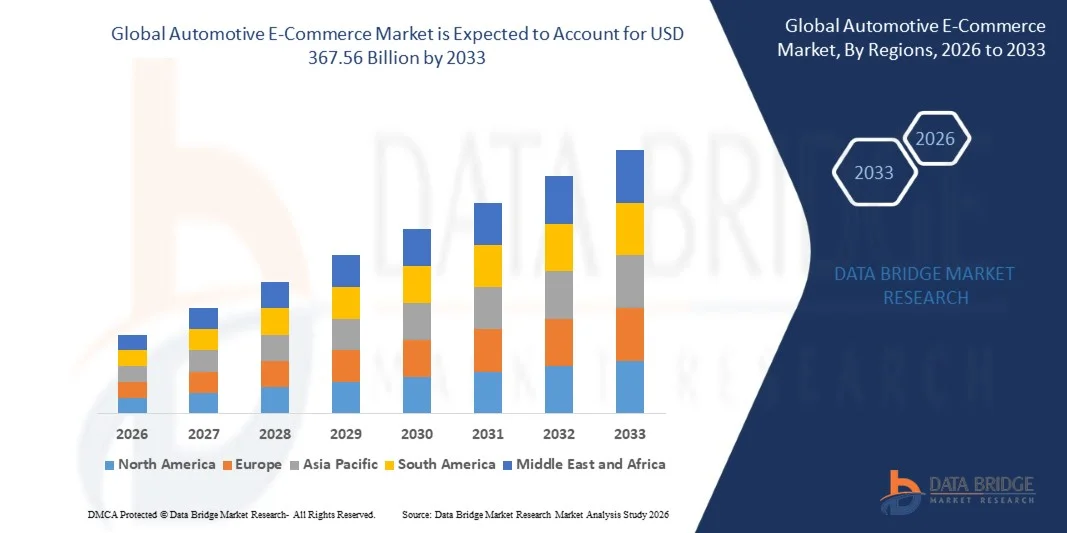
- As per Data Bridge Market Research analysis, the automotive e-commerce market was valued at USD 118.50 billion in 2025 and is projected to reach USD 367.56 billion by 2033, growing at a CAGR of 15.20% from 2026 to 2033.
- The market is experiencing consistent growth driven by increasing consumer preference for online automotive purchases, rapid digitalization of automotive retail, expanding e-commerce platforms, and growing availability of automotive parts, accessories, and vehicles through digital channels.
- The increasing adoption of smartphones, digital payment solutions, and online vehicle comparison platforms, combined with greater demand for convenience and price transparency, is compelling consumers, automotive retailers, and manufacturers to expand their digital sales channels. Online marketplaces and third-party vendors are gaining traction by offering wider product availability, competitive pricing, and convenient purchasing and delivery options.
Market Size & Forecast
- Global Market Value (2025): USD 118.50 Billion
- Expected Market Value (2033): USD 367.56 Billion
- Forecast CAGR (2026–2033): 15.20%
- Leading Region in 2025: North America
- Fastest Growing Region: Asia Pacific
What are the Major Takeaways of the Automotive E-Commerce Market?
- North America dominated the automotive e-commerce market with the largest revenue share of 36.5% in 2025, supported by high internet penetration, widespread digital payment adoption, strong consumer preference for online shopping, and the presence of established automotive e-commerce platforms.
- Asia-Pacific is expected to be the fastest-growing region at a CAGR of 15.8% from 2026 to 2033, fueled by rapid e-commerce expansion, increasing smartphone penetration, rising disposable incomes, and growing adoption of online automotive parts and accessories purchasing.
- The component parts segment led the market with a 52.8% share in 2025, driven by frequent replacement and maintenance requirements across passenger and commercial vehicles.
- Automotive accessories are the fastest-growing product type, projected to register a CAGR of 14.8%, reflecting the surge in consumer spending on vehicle personalization, convenience, and aesthetic upgrades.
- The passenger cars segment dominated the vehicle type category with a 71.6% revenue share in 2025, led by the large global passenger-vehicle parc and strong consumer demand for online automotive products.
- Business-to-consumer (B2C) accounted for 68.4% of the market share in 2025, preferred by increasing consumer preference for purchasing automotive products directly through digital platforms.
- The business-to-business (B2B) segment is the fastest-growing sales model category, with a CAGR of 15.2%, driven by increasing digital procurement among repair workshops, dealerships, distributors, and fleet-management companies.
Report Scope and Automotive E-Commerce Market Segmentation
|
Attributes |
Automotive E-Commerce Key Market Insights |
|
Segments Covered |
|
|
Countries Covered |
North America
Europe
Asia-Pacific
Middle East and Africa
South America
|
|
Key Market Players |
|
|
Market Opportunities |
|
|
Value Added Data Infosets |
In addition to the market insights such as market value, growth rate, market segments, geographical coverage, market players, and market scenario, the market report curated by the Data Bridge Market Research team includes in-depth expert analysis, import/export analysis, pricing analysis, production consumption analysis, and pestle analysis. |
What is the Key Trend in the Automotive E-Commerce Market?
- Automotive e-commerce platforms are increasingly adopting AI-powered fitment, personalization, and omnichannel tools to improve product discovery, reduce incorrect purchases, and provide seamless shopping journeys across online marketplaces, mobile applications, and networks.
- For instance, in March 2025, Boston Consulting Group reported that e-commerce penetration among European DIY and IIFM automotive aftermarket customers is expected to increase from approximately 30% to 70% by 2035, supported by improved parts identification, digital shopping experiences, and omnichannel services such as click-and-collect
- Digital retailers are combining vehicle-specific compatibility data, real-time inventory visibility, click-and-collect services, and personalized recommendations to increase customer confidence while allowing buyers to compare prices, identify suitable parts, complete purchases efficiently, and move smoothly between digital and physical retail channels globally.
- Online transparency is encouraging consumers and workshops to shift procurement away from offline channels toward digital marketplaces.
- For instance, in November 2025, the Auto Care Association and MEMA reported that retailers were increasingly implementing logistics improvements, real-time inventory management, and vehicle year-make-model-trim compatibility technologies to enhance online automotive parts shopping.
- Online parts sellers are expanding fulfillment capabilities, offering faster delivery, broader assortments, and integrated installation options to strengthen convenience for customers.
What are the Key Drivers of the Automotive E-Commerce Market?
- The rising consumer preference for convenient online purchasing, transparent pricing, and broader product selection is significantly increasing demand for automotive e-commerce platforms across replacement parts, accessories, tires, maintenance products, vehicle-related services, and aftersales channels worldwide.
- For instance, in August 2025, Amazon expanded Amazon Autos to include used and certified pre-owned vehicles, with participating dealers in more than 130 U.S. cities, providing consumers with greater online vehicle selection and purchasing convenience
- Automotive retailers, distributors, and manufacturers are expanding digital sales capabilities to capture consumers who research products online, compare fitment and prices, and increasingly begin their purchasing journey through websites, marketplaces, and mobile platforms.
- Improved logistics, real-time inventory management, and vehicle compatibility technologies are making online automotive purchases faster, more reliable, and easier for consumers to complete confidently across channels.
- For instance, in January 2025, eBay announced an agreement to acquire Caramel, an online automotive transaction platform that handles payments, paperwork, ownership transfers, financing, shipping, and insurance, demonstrating the industry's shift toward fully integrated digital vehicle transactions.
- Digital channels also enable aftermarket suppliers to reach customers beyond traditional store footprints, improve inventory utilization, expand product availability, and compete effectively on convenience, price transparency, fulfillment speed, and broader geographic coverage.
Which Factors are Challenging the Growth of the Automotive E-Commerce Market?
- Automotive e-commerce faces persistent challenges from counterfeit parts, inaccurate fitment information, complex returns, cybersecurity risks, and difficulty assuring product authenticity across online channels.
- For instance, in March 2024, the European Union Intellectual Property Office (EUIPO) reported that Operation “Spare Off” was addressing the illicit trade of counterfeit automotive spare parts, including parts sold through e-commerce platforms, highlighting concerns over product authenticity, consumer safety, and online marketplace enforcement.
- These issues reduce trust, increase returns, create safety concerns, and discourage purchases of critical components online.
- Online marketplaces must invest in stronger seller verification, product traceability, fitment databases, authentication controls, and enforcement mechanisms while coordinating with manufacturers and authorities to prevent unsafe or counterfeit automotive components from reaching consumers through digital sales channels globally today.
- For instance, in July 2025, Delhi Police dismantled a counterfeit automobile spare-parts racket and recovered more than 100,000 fake components worth approximately ₹50 lakh; authorities reported that the sellers also used online marketplaces and classified advertisements to reach customers, highlighting the authenticity and consumer-trust risks associated with digital automotive commerce.
- Complex vehicle fitment and fragmented product data remain major challenges because automotive parts must match precise vehicle specifications, increasing the risk of incorrect orders, returns, customer dissatisfaction, and additional reverse-logistics costs.
How is the Automotive E-Commerce Market Segmented?
The automotive e-commerce market is segmented on the basis of product type, vehicle type, sales model, and end user
- By Product Type
On the basis of product type, the automotive e-commerce market is segmented into component parts, tires & wheels, vehicles, automotive accessories, services, infotainment & multimedia, lubricants & fluids, and tools & garage equipment. The component parts segment dominated the market with 52.8% share in 2025, owing to frequent replacement and maintenance requirements across passenger and commercial vehicles. Consumers increasingly purchase engine components, braking systems, suspension parts, filters, electrical components, and other replacement products through online platforms. E-commerce channels provide wider product availability and allow buyers to compare prices, specifications, reviews, and vehicle compatibility before purchasing. The increasing age of vehicles in several markets is generating recurring demand for replacement components and maintenance products. Digital fitment technologies are also improving the accuracy of component selection and reducing uncertainty during online purchases. Wider catalogs, competitive pricing, and convenient home delivery are further strengthening online component purchasing.
The automotive accessories segment is projected to be among the fastest-growing product categories at 14.8% CAGR during forecast period, driven by rising consumer spending on vehicle personalization, convenience, and aesthetic upgrades. Online platforms provide access to a broad selection of interior and exterior accessories from multiple manufacturers and retailers. Consumers can conveniently compare product designs, prices, specifications, and reviews before making purchasing decisions. Growing interest in vehicle customization is increasing demand for products such as floor mats, seat covers, lighting systems, exterior styling products, and performance accessories. Social media and digital marketing are also increasing consumer awareness of aftermarket customization products. Improved logistics and doorstep delivery are making online purchasing of automotive accessories increasingly convenient
- By Vehicle Type
On the basis of vehicle type, the automotive e-commerce market is segmented into passenger cars, commercial vehicles, two-wheelers, and electric vehicles & hybrids. The passenger cars segment dominated the market with 71.6% share in 2025, supported by the large global passenger-vehicle parc and strong consumer demand for online automotive products. Passenger-car owners regularly purchase replacement components, tires, accessories, lubricants, and maintenance products through digital channels. Online platforms provide convenient access to extensive catalogs covering multiple passenger-car brands and models. Increasing smartphone usage and digital payment adoption are encouraging consumers to purchase automotive products through online channels. The growing availability of vehicle-specific product information is also improving consumer confidence when purchasing replacement components. Automotive manufacturers and retailers are increasingly strengthening digital sales and aftersales channels for passenger vehicles.
The commercial vehicles segment is expected to witness the fastest growth at 13.9% CAGR during forecast period, driven by increasing digital procurement among logistics companies, fleet operators, and commercial workshops. Commercial fleets require frequent replacement of tires, components, lubricants, and maintenance products, creating recurring opportunities for online purchasing. B2B platforms allow fleet operators to streamline procurement and reduce the time required to source replacement products. Digital purchasing also improves inventory visibility and enables businesses to compare suppliers and pricing more efficiently. Growth in logistics, last-mile delivery, and commercial transportation is increasing the number of vehicles requiring regular maintenance. Fleet operators are increasingly adopting technology-enabled procurement to reduce vehicle downtime and operating costs.
- By Sales Model
On the basis of sales model, the automotive e-commerce market is segmented into business-to-consumer (B2C), business-to-business (B2B), and consumer-to-consumer (C2C). The business-to-consumer (B2C) segment dominated the market with 68.4% share in 2025, supported by increasing consumer preference for purchasing automotive products directly through digital platforms. Consumers benefit from convenient product comparisons, competitive pricing, extensive product availability, secure payment options, and doorstep delivery. B2C platforms allow vehicle owners to purchase replacement parts, accessories, tires, lubricants, and other automotive products without visiting physical stores. Product reviews, detailed specifications, and vehicle compatibility information are also improving consumer confidence in online purchasing. Growing smartphone adoption is making automotive e-commerce platforms increasingly accessible to individual buyers.
The business-to-business (B2B) segment is projected to be the fastest-growing sales model at an 15.2% CAGR during forecast period, driven by increasing digital procurement among repair workshops, dealerships, distributors, and fleet-management companies. B2B platforms enable professional buyers to streamline recurring purchases and manage larger automotive-product orders efficiently. Digital procurement can reduce administrative workloads and improve visibility into product availability and pricing. Integration with inventory-management systems can help workshops and fleets maintain appropriate stock levels and minimize procurement delays. Commercial customers increasingly require rapid sourcing of replacement components to reduce vehicle downtime. E-commerce platforms are responding with bulk ordering, professional pricing, digital catalogs, and faster fulfillment capabilities.
- By End User
On the basis of end user, the automotive e-commerce market is segmented into individual consumers, professional installers, fleet operators & mobility providers, and automotive dealerships & independent retailers. Individual consumers represented the dominant end-user segment, accounting for 60% share in 2025, supported by increasing consumer comfort with online purchasing and the convenience offered by digital automotive platforms. Private vehicle owners increasingly purchase replacement parts, accessories, tires, lubricants, tools, and maintenance products through online channels. Digital platforms allow consumers to compare product specifications, prices, reviews, and vehicle compatibility before completing purchases. The growing DIY vehicle-maintenance trend is further encouraging vehicle owners to source products directly through e-commerce platforms. Wider product catalogs and improved delivery networks are reducing dependence on traditional physical automotive stores. Increasing availability of vehicle-specific product information is also improving online purchasing confidence.
The fleet operators & mobility providers segment is expected to witness the fastest growth at 15% CAGR during forecast period, driven by increasing adoption of digital procurement across logistics, ride-hailing, delivery, rental, and shared-mobility fleets. Fleet operators require continuous supplies of components, tires, lubricants, and maintenance products to keep vehicles operational. Online procurement enables centralized purchasing while providing greater visibility into inventory, supplier pricing, and order history. Digital platforms can also support recurring orders and standardized procurement across geographically dispersed fleets. The expansion of logistics and mobility services is increasing the number of commercial vehicles requiring regular maintenance and replacement products. The need to minimize vehicle downtime is encouraging fleet managers to adopt faster and more efficient purchasing channels.
Which Region Holds the Largest Share of the Automotive E-Commerce Market?
- North America dominated the automotive e-commerce market with the largest revenue share of 36.5% in 2025, supported by high internet penetration, widespread digital payment adoption, strong consumer preference for online shopping, and the presence of established automotive e-commerce platforms
- The region also benefits from high vehicle ownership, advanced logistics infrastructure, widespread smartphone and internet usage, and growing adoption of online automotive parts and accessories purchasing. Increasing consumer preference for convenient digital transactions, rapid delivery, and broader product availability continues to strengthen North America’s leadership position in the global market.
U.S. Automotive E-Commerce Market Insight
The U.S. automotive e-commerce market is witnessing strong growth due to rising adoption of online automotive retail, digital aftermarket purchasing, and convenient vehicle buying platforms. The country’s mature automotive aftermarket ecosystem, along with increasing adoption of digital financing, mobile commerce, and AI-powered fitment technologies, is driving demand across consumers, workshops, and automotive businesses. In addition, growing emphasis on faster fulfillment, product availability, and seamless online purchasing experiences is accelerating e-commerce adoption across the automotive sector.
Asia-Pacific Automotive E-Commerce Market Insight
The Asia-Pacific automotive e-commerce market is expected to witness rapid growth, driven by expanding digital commerce platforms, rising vehicle ownership, and improving online payment infrastructure across countries such as China, India, and Japan. Growing smartphone penetration, increasing consumer preference for online automotive purchases, and expansion of organized marketplaces are supporting regional market expansion. In addition, the growing adoption of electric vehicles, digital lending platforms, and AI-enabled customer engagement is accelerating automotive e-commerce adoption across commercial and consumer sectors.
Japan Automotive E-Commerce Market Insight
The Japan automotive e-commerce market is witnessing consistent growth due to rising adoption of online automotive retail, digital purchasing platforms, and advanced automotive technologies. Consumers and automotive businesses are increasingly utilizing e-commerce platforms for vehicle components, accessories, electronics, and other automotive products. Moreover, increasing integration of digital payments, mobile commerce, and technology-driven purchasing experiences, along with Japan’s advanced automotive ecosystem, is further contributing to market growth.
China Automotive E-Commerce Market Insight
The China automotive e-commerce market is growing rapidly, driven by extensive digital marketplace adoption, rising vehicle ownership, and increasing consumer preference for online automotive purchases. Growing utilization of mobile commerce, digital payments, and AI-enabled retail platforms across automotive and aftermarket applications is significantly boosting market demand. In addition, rising electric vehicle adoption, expanding logistics infrastructure, increasing automotive technology investments, and rapid digital transformation are positioning China as one of the fastest-growing markets for automotive e-commerce globally.
U.K. Automotive E-Commerce Market Insight
The U.K. automotive e-commerce market is experiencing steady growth, supported by rising adoption of online automotive parts purchasing, digital vehicle marketplaces, and aftermarket e-commerce platforms. Increasing investments in advanced digital retail infrastructure and growing demand for convenient, cost-effective purchasing solutions are contributing to market growth. Furthermore, integration of mobile commerce, digital payment technologies, product comparison tools, and improved logistics capabilities is enhancing customer experience and strengthening the U.K.’s position in the automotive e-commerce industry.
Germany Automotive E-Commerce Market Insight
The Germany automotive e-commerce market is expanding steadily due to the country’s strong automotive manufacturing base, advanced digital infrastructure, and increasing adoption of online automotive purchasing platforms. Automotive companies, dealerships, aftermarket suppliers, and consumers are increasingly utilizing e-commerce for vehicle components, accessories, tires, and other automotive products. Continuous advancements in digital cataloging, vehicle compatibility tools, online marketplaces, and logistics technologies, along with Germany’s strong automotive ecosystem, are further driving market growth.
Which are the Top Companies in Automotive E-Commerce Market?
The automotive e-commerce industry is primarily led by well-established companies, including:
- Carvana, LLC (U.S.)
- CarMax, Inc. (U.S.)
- Auto Trader Group plc (U.K.)
- Cars.com (U.S.)
- TrueCar, Inc. (U.S.)
- CarGurus, Inc. (U.S.)
- Cars24 Services Private Limited (India)
- CarTrade Tech Ltd. (India)
- AUTO1 Group SE (Germany)
- Carwow Ltd. (U.K.)
- Cinch Cars Limited (U.K.)
- TRADER Corporation (Canada)
- AutoScout24 GmbH (Germany)
- Copart Inc. (U.S.)
- OPENLANE (U.S.)
- ACV Auctions Inc. (U.S.)
- Cars and Bids LLC (U.S.)
- AutoNation.com (U.S.)
- Amazon.com, Inc. (U.S.)
- eBay Inc. (U.S.)
What are Latest Developments in Automotive E-Commerce Market?
- In August 2025, Hertz Global Holdings announced a strategic partnership with Amazon Autos to sell pre-owned vehicles online, expanding digital vehicle purchasing beyond new-car sales. The initiative initially covered customers within 75 miles of Dallas, Houston, Los Angeles, and Seattle, with plans to expand to Hertz Car Sales’ U.S. locations. Customers can browse and purchase used vehicles through Amazon’s automotive retail platform, strengthening the integration of online marketplaces with traditional automotive dealerships. The partnership also includes vehicle trade-in opportunities, highlighting the growing adoption of end-to-end digital automotive transactions.
- In December 2024, Amazon officially launched Amazon Autos, enabling customers to purchase new Hyundai vehicles online through participating dealers in the U.S. Customers could browse available inventory, configure vehicles, obtain financing, complete the purchase process, and arrange pickup or delivery through the platform. The initial launch covered 48 U.S. cities and represented Amazon’s first major move into online vehicle sales. The launch demonstrated how large e-commerce platforms are extending their digital retail infrastructure into high-value automotive purchases.
- In November 2023, Amazon and Hyundai announced a partnership to enable Hyundai vehicles to be sold online through Amazon in the U.S. beginning in 2024. The initiative was designed to allow customers to search for vehicles, select configurations, and complete purchases through Amazon.com, while local Hyundai dealers would handle delivery or pickup. The partnership represented a major step toward integrating mainstream e-commerce platforms with automotive retail and provided automakers with an additional digital sales channel.
- In January 2022, General Motors introduced CarBravo, an online marketplace designed to expand digital shopping for used vehicles. The platform provided customers with access to a broad inventory of used vehicles, including GM and non-GM models, while combining online shopping with dealer-based services. CarBravo was designed around an omnichannel model, allowing consumers to research and shop online while retaining options such as dealership visits, trade-ins, test drives, and vehicle delivery. The launch strengthened the shift of used-vehicle retail toward digital marketplaces.
- In November 2021, Wipro launched Click-Shift-Drive, a cloud-based automotive e-commerce solution designed to support contactless and direct-to-consumer vehicle purchasing. The solution was developed to help automakers and dealers establish digital car-buying journeys covering multiple stages of the purchasing process. It incorporated Salesforce technologies and digital tools, enabling companies to provide virtual vehicle-buying experiences and respond to increasing consumer demand for online automotive transactions. The launch reflected the acceleration of automotive retail digitization following the COVID-19 pandemic.

- Interactive Data Analysis Dashboard
- Company Analysis Dashboard for high growth potential opportunities
- Research Analyst Access for customization & queries
- Competitor Analysis with Interactive dashboard
- Latest News, Updates & Trend analysis
- Harness the Power of Benchmark Analysis for Comprehensive Competitor Tracking
Data collection and base year analysis are done using data collection modules with large sample sizes. The stage includes obtaining market information or related data through various sources and strategies. It includes examining and planning all the data acquired from the past in advance. It likewise envelops the examination of information inconsistencies seen across different information sources. The market data is analysed and estimated using market statistical and coherent models. Also, market share analysis and key trend analysis are the major success factors in the market report. To know more, please request an analyst call or drop down your inquiry.
The key research methodology used by DBMR research team is data triangulation which involves data mining, analysis of the impact of data variables on the market and primary (industry expert) validation. Data models include Vendor Positioning Grid, Market Time Line Analysis, Market Overview and Guide, Company Positioning Grid, Patent Analysis, Pricing Analysis, Company Market Share Analysis, Standards of Measurement, Global versus Regional and Vendor Share Analysis. To know more about the research methodology, drop in an inquiry to speak to our industry experts.
Data Bridge Market Research is a leader in advanced formative research. We take pride in servicing our existing and new customers with data and analysis that match and suits their goal. The report can be customized to include price trend analysis of target brands understanding the market for additional countries (ask for the list of countries), clinical trial results data, literature review, refurbished market and product base analysis. Market analysis of target competitors can be analyzed from technology-based analysis to market portfolio strategies. We can add as many competitors that you require data about in the format and data style you are looking for. Our team of analysts can also provide you data in crude raw excel files pivot tables (Fact book) or can assist you in creating presentations from the data sets available in the report.













