


What is the Automotive Elastomer Market Size and Growth Rate?
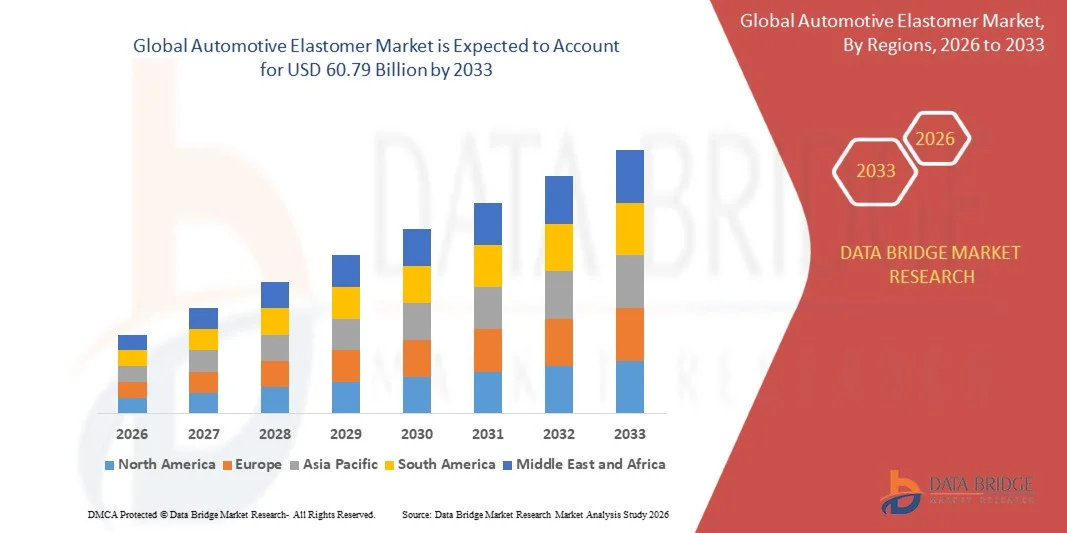
- As per Data Bridge Market Research analysis, the automotive elastomer market was valued at USD 40.37 billion in 2025 and is projected to reach USD 60.79 billion by 2033, growing at a CAGR of 5.25% from 2026 to 2033.
- The market is experiencing consistent growth driven by the global transition toward vehicle lightweighting to enhance fuel efficiency, the surge in Electric Vehicle (EV) production, and increasing consumer demand for refined interior aesthetics and cabin quietness.
- The increasing adoption of elastomers in vehicle assembly, tire manufacturing, powertrain systems, and EV infrastructure, combined with demand for materials offering vibration isolation, thermal stability, and resistance to oils and chemicals, is supporting market expansion. The development of recyclable Thermoplastic Elastomers (TPEs), smart elastomers with sensing capabilities, and EMI-shielding gaskets is also creating new opportunities for automotive elastomer applications.
Market Size & Forecast
- Global Market Value (2025): USD 40.37 Billion
- Expected Market Value (2033): USD 60.79 Billion
- Forecast CAGR (2026–2033): 5.25%
- Leading Region in 2025: North America
- Fastest Growing Region: Asia Pacific
What are the Major Takeaways of the Automotive Elastomer Market?
- North America dominated the automotive elastomer market with the largest revenue share of 34.8% in 2025, supported by advancements in automotive technology, the rise of electric vehicles, and demand for lightweight, high-performance elastomer materials.
- Asia-Pacific is expected to be the fastest-growing region at a CAGR of 6.67% from 2026 to 2033, fueled by expanding automotive production, vehicle electrification, supply-chain localization, and increasing demand for advanced elastomer materials.
- The ethylene-propylene (EPM/EPDM) elastomers segment led the market with a 28.3% share in 2025, driven by their excellent resistance to heat, ozone, weathering, oxidation, and aging, making them widely suitable for automotive seals, weatherstripping, hoses, gaskets, radiator components, and other applications
- Thermoplastic polyurethane (TPU) are the fastest-growing type, projected to register a CAGR of 11.4%, reflecting the surge in demand for lightweight, flexible, abrasion-resistant, and high-performance materials for electric vehicles, battery systems, cable protection, sealing components, and interior and exterior applications
- The tire segment dominated the application category with a 51.22% revenue share in 2025, led by the extensive use of elastomers in tire manufacturing for providing flexibility, traction, abrasion resistance, durability, and load-bearing performance
- Passenger cars accounted for 58.2% of the market share in 2025, preferred by the high global production and sales volume of passenger vehicles
- The light commercial vehicles segment is the fastest-growing vehicle type category, with a CAGR of 8.9%, driven by expanding e-commerce, last-mile delivery, logistics, construction, and urban transportation activities
Report Scope and Automotive Elastomer Market Segmentation
|
Attributes |
Automotive Elastomer Key Market Insights |
|
Segments Covered |
|
|
Countries Covered |
North America
Europe
Asia-Pacific
Middle East and Africa
South America
|
|
Key Market Players |
|
|
Market Opportunities |
|
|
Value Added Data Infosets |
In addition to the insights on market scenarios such as market value, growth rate, segmentation, geographical coverage, and major players, the market reports curated by the Data Bridge Market Research also include import export analysis, production capacity overview, production consumption analysis, price trend analysis, climate change scenario, supply chain analysis, value chain analysis, raw material/consumables overview, vendor selection criteria, PESTLE Analysis, Porter Analysis, and regulatory framework. |
What is the Key Trend in the Automotive Elastomer Market?
- Automotive manufacturers are increasingly adopting advanced elastomers for electric vehicles, supporting battery sealing, thermal management, cable protection, and vibration isolation as electrified powertrains create new material requirements across rapidly expanding vehicle platforms and architectures worldwide.
- For instance, in July 2024, Volkswagen highlighted the need for greater collaboration with elastomer developers to advance sustainable elastomer materials for automotive applications, including thermoplastic elastomers, recycled materials, and bio-based materials, supporting the industry's shift toward more sustainable vehicle components.
- Thermoplastic elastomers are gaining adoption because recyclability, easier processing, lightweighting, and improved thermal and chemical resistance support manufacturers responding to sustainability requirements while maintaining performance across demanding automotive applications and increasingly complex vehicle architectures worldwide.
- Automotive elastomer development is increasingly focused on sustainability, with recyclable thermoplastic elastomers, bio-based rubber alternatives, recycled content, and low-VOC formulations gaining attention as manufacturers respond to environmental regulations and circular-design requirements across global markets today.
- Advanced elastomers are increasingly being developed for noise, vibration, and harshness reduction, helping automotive manufacturers improve cabin quietness, ride comfort, and perceived vehicle quality while supporting quieter electric vehicles and automotive applications across automotive markets.
- For instance, in February 2026, Celanese highlighted that Santoprene thermoplastic vulcanizates can provide up to 50% weight reduction through part consolidation and lower material density compared with EPDM, supporting the growing adoption of lightweight elastomer solutions in automotive components.
- Vehicle lightweighting remains a major trend as elastomers replace heavier materials in seals, hoses, gaskets, and related components, helping manufacturers improve fuel efficiency, reduce emissions, and support electric-vehicle driving range without compromising durability and safety.
What are the Key Drivers of the Automotive Elastomer Market?
- The global transition toward vehicle lightweighting is driving demand for elastomers because their strength-to-weight ratio, flexibility, and viscoelasticity support weight reduction, fuel efficiency, emissions reduction, and improved Noise, Vibration, and Harshness performance across vehicles worldwide.
- For instance, in September 2021, Continental introduced specially developed elastomer compounds for electric vehicles that absorb high-frequency vibrations generated by electric motors while remaining lightweight, helping reduce vehicle energy consumption and extend driving range.
- Electric vehicle production is increasing demand for specialty elastomers used in battery seals, thermal-management systems, electrical insulation, and cable protection, as electrified powertrains require materials capable of handling thermal cycling, vibration, chemicals, and demanding environments.
- Stricter government regulations targeting emissions, fuel economy, passenger safety, and vehicle efficiency are encouraging manufacturers to adopt elastomer components that provide sealing, damping, durability, and lightweighting benefits across increasingly stringent automotive design requirements globally today.
- For instance, in April 2025, Freudenberg Sealing Technologies introduced a new PFAS-free elastomer sealing material for electric vehicle battery cells, designed to provide superior sealing performance, extend battery life, and withstand thermal runaway while meeting increasingly stringent environmental regulations
- Growing vehicle production and rising consumer demand for new cars are supporting elastomer consumption because tires, hoses, seals, gaskets, weatherstripping, vibration-control components, and other applications require durable flexible materials across passenger and commercial vehicles globally.
Which Factors are Challenging the Growth of the Automotive Elastomer Market?
- Volatility in petroleum-derived monomers and natural rubber prices can increase manufacturing costs and compress producer margins, making automotive elastomer pricing less predictable and complicating long-term supply contracts for automotive component manufacturers globally and downstream buyers.
- For instance, in March 2025, Reuters reported that global natural rubber production was expected to fall short of consumption for the fifth consecutive year, with 2025 demand projected at 15.6 million metric tons versus production of 14.9 million metric tons, keeping rubber prices elevated and increasing input-cost pressure for rubber and elastomer manufacturers serving the automotive industry.
- Environmental regulations create additional compliance costs as manufacturers address volatile organic compounds, hazardous substances, microplastics, and end-of-life disposal requirements, increasing testing, formulation, certification, and research expenditures for elastomer suppliers and compounders worldwide today.
- Recycling challenges constrain circular adoption because thermoset elastomers are crosslinked and difficult to reprocess, while inconsistent recyclate properties can affect component performance, manufacturing yields, and OEM qualification for safety-critical automotive applications today globally increasingly.
- For instance, in August 2026, Reuters reported that Continental expected raw-material cost pressures to increase during the second half of 2026 after benefiting from lower oil-derived input costs in the first half, highlighting the vulnerability of synthetic rubber and other elastomer-related materials to fluctuations in petroleum prices and increasing manufacturing costs.
- Specialty elastomers require stringent performance validation across temperature, chemical exposure, compression set, aging, and durability conditions, increasing development timelines and qualification requirements when suppliers introduce new materials for electric and advanced automotive systems before production.
How is the Automotive Elastomer Market Segmented?
The automotive elastomer market is segmented on the basis of type, application, and vehicle type.
- By Type
On the basis of type, the automotive elastomer market is segmented into natural rubbers (NR), butyl elastomers (IIR), butadiene (BR) (polybutadiene) elastomers, ethylene-propylene (EPM/EPDM) elastomers, polyisoprene (IR) elastomers, nitrile (NBR) elastomers, silicones (Q), polychloroprene (CR) (neoprene) elastomers, acrylic (ACM) elastomers, fluoroelastomers, styrene block copolymers (SBC), thermoplastic polyolefins, thermoplastic polyurethanes, thermoplastic vulcanizates, thermoplastic copolyesters, and thermoplastic polyether block amides. The ethylene-propylene (EPM/EPDM) elastomers segment dominated the individual elastomer categories, accounting for 28.3% of the automotive elastomers market in 2025. EPDM is widely used because of its excellent resistance to ozone, weathering, heat, oxidation, and aging. It is extensively incorporated into door seals, window seals, weatherstrips, hoses, gaskets, and other automotive components. Its ability to maintain flexibility under changing temperatures makes it particularly suitable for exterior and under-the-hood applications. Increasing vehicle production and demand for durable sealing systems are supporting its consumption. The material also provides reliable performance against moisture and environmental exposure, which is important for long-term vehicle durability.
The thermoplastic polyurethane (TPU) segment is projected to register the fastest growth, at a CAGR of 11.4% during the forecast period. TPUs combine rubber-like elasticity with the processing advantages of thermoplastics, making them suitable for seals, protective covers, cables, interior components, and other automotive parts. Their strong abrasion resistance, flexibility, chemical resistance, and mechanical strength support their use in demanding vehicle applications. Increasing vehicle electrification is creating additional opportunities for TPU in battery-related components, electrical insulation, wire protection, and sealing systems. The growing focus on lightweight vehicle construction is also encouraging manufacturers to adopt advanced thermoplastic elastomers. TPUs can be processed efficiently through injection molding and other high-volume manufacturing techniques, supporting their use in automotive production.
- By Application
On the basis of application, the automotive elastomer market is segmented into tire, interior, exterior, and under the hood. The tire segment dominated the market with 51.22% share in 2025. Elastomers are essential in tire manufacturing because they provide flexibility, traction, abrasion resistance, durability, and load-bearing performance. Natural rubber, polybutadiene, and other synthetic elastomers are extensively used in different tire components. Rising global vehicle production directly increases demand for original-equipment and replacement tires, thereby supporting elastomer consumption. The expansion of vehicle ownership in emerging economies is also increasing replacement tire demand. Manufacturers are developing advanced rubber compounds to reduce rolling resistance while improving wet grip, durability, and fuel or energy efficiency.
The under-the-hood segment is projected to register the fastest growth at a CAGR of 6.2% during forecast period, Demand is being supported by the increasing requirement for elastomers capable of withstanding high temperatures, pressure, chemicals, oils, and mechanical stresses. Elastomer materials are widely used in hoses, gaskets, seals, O-rings, vibration mounts, and thermal-management components. The increasing complexity of modern powertrain and thermal-management systems is creating demand for higher-performance elastomer formulations. Vehicle electrification is also generating new applications in battery cooling, electrical protection, high-voltage sealing, and thermal-management systems. Advanced silicone, EPDM, fluoroelastomer, and thermoplastic elastomer grades are increasingly being engineered for these demanding environments.
- By Vehicle Type
On the basis of vehicle type, the automotive elastomer market is segmented into passenger cars, light commercial vehicles, and medium and heavy commercial vehicles. The passenger cars segment dominated the market with 58.2% share in 2025, supported by the high global production and sales volume of passenger vehicles. Elastomers are extensively used in passenger cars for tires, seals, hoses, vibration-control components, weatherstripping, interior parts, and exterior components. Increasing passenger vehicle production in Asia-Pacific and other emerging automotive markets is supporting elastomer consumption. The growing adoption of electric and hybrid passenger vehicles is also creating demand for specialized elastomers in battery systems, thermal management, electrical components, and sealing applications. Automakers are increasingly emphasizing lightweighting, noise reduction, ride comfort, safety, and durability, creating additional opportunities for advanced elastomer materials.
The light commercial vehicles segment is projected to register the fastest growth, at a CAGR of 8.9% during the forecast period. Growth is being supported by expanding e-commerce, last-mile delivery, logistics, construction, and urban transportation activities. Light commercial vehicles require durable elastomer components for tires, seals, hoses, vibration isolation, suspension systems, and other frequently stressed applications. Increasing electrification of delivery vans and commercial fleets is creating additional demand for elastomers in battery sealing, thermal management, charging systems, and electrical protection. The rapid expansion of logistics networks is encouraging businesses to increase their commercial vehicle fleets, particularly in emerging markets. Demand for longer-lasting components is also increasing as fleet operators seek to reduce maintenance costs and vehicle downtime
Which Region Holds the Largest Share of the Automotive Elastomer Market?
- North America dominated the automotive elastomer market with the largest revenue share of 34.8% in 2025, supported by advancements in automotive technology, the rise of electric vehicles, and demand for lightweight, high-performance elastomer materials.
- The region also benefits from sustained demand for light trucks and sport utility vehicles, continued vehicle production, and increasing adoption of electric vehicles. The presence of major automakers such as General Motors, Ford, and Stellantis supports consistent demand for high-performance elastomer solutions, while investments in EV manufacturing and infrastructure are expanding applications in sealing, thermal management, and electrical protection.
U.S. Automotive Elastomer Market Insight
The U.S. automotive elastomer market is witnessing steady growth due to strong automotive manufacturing activity, increasing electric vehicle production, and rising demand for lightweight and high-performance elastomer components. The country’s established automotive industry is supporting demand for elastomers across tires, seals, hoses, vibration-control components, and battery-related applications. Increasing vehicle electrification is creating additional requirements for specialized elastomers with improved thermal, chemical, and electrical resistance. The shift toward lightweight vehicle architectures is also encouraging the adoption of thermoplastic and specialty elastomers. In addition, domestic battery and EV supply-chain investments are strengthening demand for advanced polymer materials. In March 2025, BASF expanded production of its Licity anode binders at Monaca, Pennsylvania, and Chattanooga, Tennessee, while building on its existing styrene-butadiene rubber capabilities for electric-vehicle batteries.
Asia-Pacific Automotive Elastomer Market Insight
The Asia-Pacific automotive elastomer market is expected to witness rapid growth, driven by expanding vehicle production, increasing electric vehicle manufacturing, and strong demand for tires and automotive components across China, India, Japan, and South Korea. China’s growing polyolefin elastomer production and integrated petrochemical supply chain are strengthening regional material availability. Increasing adoption of lightweight and low-VOC materials is also supporting thermoplastic elastomer demand. Rising EV production is further expanding applications in battery systems, sealing, insulation, and thermal management. China’s polyolefin elastomer production reached approximately 60,000 tons and is projected to exceed 300,000 tons by the end of 2026.
Japan Automotive Elastomer Market Insight
The Japan automotive elastomer market is witnessing consistent growth due to advanced automotive manufacturing, increasing demand for lightweight materials, and rising emphasis on fuel efficiency and environmental sustainability. Japan’s automotive manufacturers and component suppliers are increasingly adopting advanced elastomers for tires, seals, vibration-control systems, and other high-performance applications. The transition toward electric vehicles is creating additional demand for elastomer materials offering durability, thermal resistance, and lightweight properties. Japan is also emphasizing circularity and the use of recycled and renewable materials in automotive products. Continuous development of advanced rubber formulations is strengthening the country’s position in high-performance automotive materials. In February 2024, Bridgestone launched the REGNO GR-XIII in Japan with synthetic rubber partially allocated through the ISCC PLUS-certified mass-balance approach.
China Automotive Elastomer Market Insight
The China automotive elastomer market is growing rapidly, driven by its large automotive manufacturing base, expanding electric vehicle production, and strong domestic petrochemical and synthetic-rubber industries. China has developed vertically integrated supply chains extending from petrochemical feedstocks to synthetic elastomers, tires, and finished automotive components. Increasing EV production is generating demand for lightweight elastomers used in insulation, sealing, vibration control, and durability applications. Regulatory requirements for lower volatile organic compound emissions are also encouraging the adoption of thermoplastic elastomers in automotive interiors. Growing domestic production of polyolefin elastomers is reducing dependence on imported materials and strengthening local supply. China’s polyolefin elastomer production reached approximately 60,000 tons, with capacity expected to exceed 300,000 tons by the end of 2026
U.K. Automotive Elastomer Market Insight
The U.K. automotive elastomer market is experiencing steady growth, supported by vehicle manufacturing, increasing electric vehicle adoption, and investments in domestic EV supply chains. Demand for elastomers is increasing across tires, seals, hoses, vibration-control components, and battery-related applications as vehicle manufacturers transition toward electrified platforms. The country’s growing zero-emission vehicle fleet is creating opportunities for advanced elastomer materials designed for thermal management, sealing, and electrical protection. Automotive manufacturing investments are further supporting demand for specialized polymer materials. In addition, government-backed investments in EV manufacturing and battery infrastructure are strengthening the domestic automotive ecosystem. In May 2025, the U.K. government announced a USD 1.35 billion investment deal for a new Sunderland gigafactory expected to support 1,000 jobs and provide battery capacity for 100,000 electric vehicles annually.
Germany Automotive Elastomer Market Insight
The Germany automotive elastomer market is expanding steadily due to its strong automotive manufacturing base, advanced materials research, and increasing adoption of electric mobility. Automotive manufacturers and suppliers are increasingly utilizing elastomers for seals, vibration control, thermal management, interior applications, and electric vehicle components. Demand is also supported by the need for lightweight materials that can improve vehicle efficiency while maintaining durability and safety. Germany’s established specialty chemical and polymer industry provides advanced thermoplastic and thermoset elastomer technologies for automotive applications. Increasing focus on sustainable materials and circularity is further encouraging innovation in rubber and elastomer products. Freudenberg Sealing Technologies began construction of a new elastomer mixing plant at its Weinheim facility to serve the automotive and general industry sectors.
Which are the Top Companies in Automotive Elastomer Market?
The automotive elastomer industry is primarily led by well-established companies, including:
- Dow (U.S.)
- Celanese Corporation (U.S.)
- Exxon Mobil Corporation (U.S.)
- DuPont (U.S.)
- Momentive (U.S.)
- Continental AG (Germany)
- Trelleborg AB (publ) (Sweden)
- Freudenberg Group (Germany)
- KRAIBURG TPE (Germany)
- Bridgestone Corporation (Japan)
- THE YOKOHAMA RUBBER CO., LTD. (Japan)
- Sumitomo Rubber Industries, Ltd. (Japan)
- Shin-Etsu Chemical Co., Ltd. (Japan)
- Mitsui Chemicals, Inc. (Japan)
- Asahi Kasei Corporation (Japan)
- Kumho Petrochemical (South Korea)
- HYOSUNG CHEMICAL (South Korea)
- LG Chem (South Korea)
- KURARAY CO., LTD. (Japan)
- Tosoh Corporation (Japan)
What are Latest Developments in Automotive Elastomer Market?
- In September 2025, Stahl launched RelcaDur, a water-based rubber-to-substrate bonding system designed for automotive noise, vibration, and harshness (NVH) applications. The two-layer system combines a primer and bonding agent to provide adhesion between elastomers and substrates including steel, aluminum, and plastic. Stahl stated that the formulation is water-based and non-toxic, providing an alternative to conventional solvent-based bonding agents used for automotive NVH components. The development supports increasing demand for durable, high-performance, and lower-impact elastomer bonding solutions in vehicle manufacturing.
- In May 2025, KRAIBURG TPE introduced new EPDM adhesion compounds for automotive sealing and exterior applications. The thermoplastic elastomer compounds were developed to provide adhesion, durability, and processability for automotive sealing systems and exterior components. The company stated that the compounds were designed to address requirements across Europe and North, South, and Central America. The development expands the use of thermoplastic elastomers in applications traditionally served by conventional rubber materials.
- In July 2024, Dow launched NORDEL REN EPDM, a bio-based version of its EPDM rubber material for automotive, infrastructure, and consumer applications. The material was introduced at the German Rubber Conference and was specifically positioned for automotive weatherseals and hoses. Dow stated that the product is intended to help automotive customers reduce their Scope 3 emissions and support decarbonization goals. The launch represents the development of more sustainable elastomer materials while retaining the performance characteristics required in automotive sealing applications.
- In December 2022, Dow launched the SILASTIC SA 994X liquid silicone rubber series for mobility and transportation applications. The new series included primerless, self-adhesive, general-purpose, and self-lubricating liquid silicone rubbers designed for two-component injection molding with thermoplastic substrates. The materials were developed for automotive applications including connector seals, battery vent gaskets, radiator gasket seals for electric and hybrid vehicles, and protective seals for autonomous-vehicle lidar and radar housings.
- In October 2021, Continental developed special elastomer compounds for electric vehicles that absorb high-frequency vibrations while reducing component weight. The company developed tailor-made rubber bearing elements for electric vehicles in collaboration with manufacturers in Europe, the U.S., and China. Continental explained that electric motors generate high-frequency excitations and higher torque characteristics that require different elastomer compounds than conventional combustion-engine applications.

- Interactive Data Analysis Dashboard
- Company Analysis Dashboard for high growth potential opportunities
- Research Analyst Access for customization & queries
- Competitor Analysis with Interactive dashboard
- Latest News, Updates & Trend analysis
- Harness the Power of Benchmark Analysis for Comprehensive Competitor Tracking
Global Automotive Elastomer Market, Supply Chain Analysis and Ecosystem Framework
To support market growth and help clients navigate the impact of geopolitical shifts, DBMR has integrated in-depth supply chain analysis into its Global Automotive Elastomer Market research reports. This addition empowers clients to respond effectively to global changes affecting their industries. The supply chain analysis section includes detailed insights such as Global Automotive Elastomer Market consumption and production by country, price trend analysis, the impact of tariffs and geopolitical developments, and import and export trends by country and HSN code. It also highlights major suppliers with data on production capacity and company profiles, as well as key importers and exporters. In addition to research, DBMR offers specialized supply chain consulting services backed by over a decade of experience, providing solutions like supplier discovery, supplier risk assessment, price trend analysis, impact evaluation of inflation and trade route changes, and comprehensive market trend analysis.
Data collection and base year analysis are done using data collection modules with large sample sizes. The stage includes obtaining market information or related data through various sources and strategies. It includes examining and planning all the data acquired from the past in advance. It likewise envelops the examination of information inconsistencies seen across different information sources. The market data is analysed and estimated using market statistical and coherent models. Also, market share analysis and key trend analysis are the major success factors in the market report. To know more, please request an analyst call or drop down your inquiry.
The key research methodology used by DBMR research team is data triangulation which involves data mining, analysis of the impact of data variables on the market and primary (industry expert) validation. Data models include Vendor Positioning Grid, Market Time Line Analysis, Market Overview and Guide, Company Positioning Grid, Patent Analysis, Pricing Analysis, Company Market Share Analysis, Standards of Measurement, Global versus Regional and Vendor Share Analysis. To know more about the research methodology, drop in an inquiry to speak to our industry experts.
Data Bridge Market Research is a leader in advanced formative research. We take pride in servicing our existing and new customers with data and analysis that match and suits their goal. The report can be customized to include price trend analysis of target brands understanding the market for additional countries (ask for the list of countries), clinical trial results data, literature review, refurbished market and product base analysis. Market analysis of target competitors can be analyzed from technology-based analysis to market portfolio strategies. We can add as many competitors that you require data about in the format and data style you are looking for. Our team of analysts can also provide you data in crude raw excel files pivot tables (Fact book) or can assist you in creating presentations from the data sets available in the report.













