


What is the Global Automotive Energy Absorption (EA) Pads Market Size and Growth Rate?
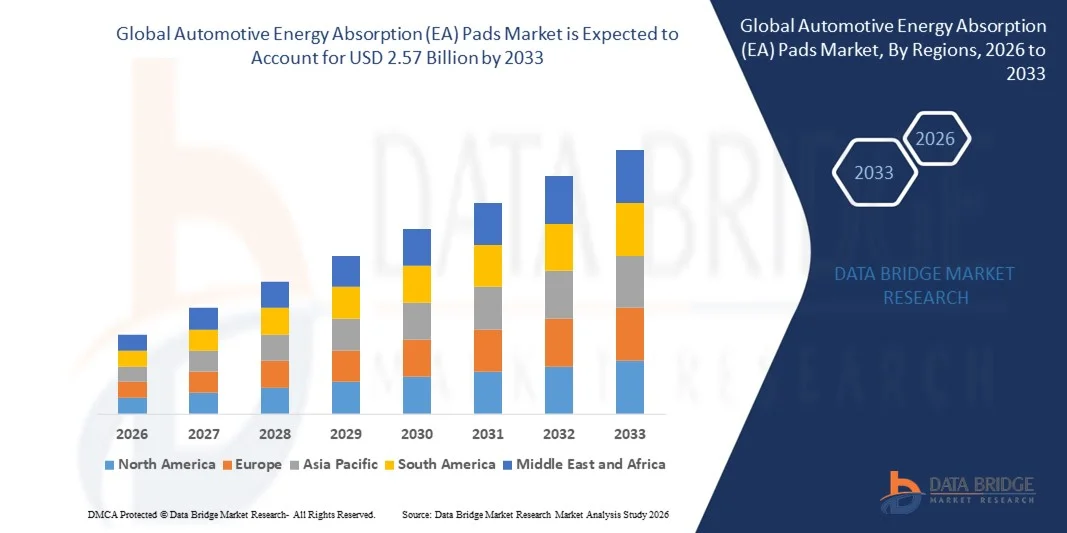
- As per Data Bridge Market Research Analysis the Global automotive energy absorption (EA) Pads market size was valued at USD 1.83 billion in 2025 and is expected to reach USD 2.57 billion by 2033, at a CAGR of 4.30% during the forecast period
- Increase in the automotive safety standards is a crucial factor accelerating the market growth, also rise in the use of automotive energy absorption (EA) pads, increase in the production of vehicles, increase in the disposable income and rise in the research and development activities in the market are the major factors among others boosting the automotive energy absorption (EA) pads market
Market Size & Forecast
- Global Market Value (2025): USD 1.83 Billion
- Expected Market Value (2033): USD 2.57 Billion
- Forecast CAGR (2026–2033): 4.30%
What are the Major Takeaways of Automotive Energy Absorption (EA) Pads Market?
- Increase in the technological advancements and modernization in the production techniques and rise in the demand from the emerging economies will further create new opportunities for automotive energy absorption (EA) pads market
- However, rise in the cost of research and development activities in the market acts as the major factors among others restraining the market growth, and will further challenge the automotive energy absorption (EA) pads market
- Asia-Pacific dominated the automotive energy absorption (EA) pads market with a 44.8% revenue share in 2025, driven by high vehicle production volumes across China, Japan, India, and South Korea
- North America is projected to register the fastest CAGR of 10.69% from 2026 to 2033, driven by increasing EV adoption, stricter crash safety regulations, and growing demand for advanced occupant protection systems across the U.S. and Canada
- The Bumper Absorber segment dominated the market with a 37.6% share in 2025, driven by its critical role in front and rear crash management systems
Report Scope and Automotive Energy Absorption (EA) Pads Market Segmentation
|
Attributes |
Automotive Energy Absorption (EA) Pads Key Market Insights |
|
Segments Covered |
|
|
Countries Covered |
North America
Europe
Asia-Pacific
Middle East and Africa
South America
|
|
Key Market Players |
|
|
Market Opportunities |
|
|
Value Added Data Infosets |
In addition to the insights on market scenarios such as market value, growth rate, segmentation, geographical coverage, and major players, the market reports curated by the Data Bridge Market Research also include in-depth expert analysis, pricing analysis, brand share analysis, consumer survey, demography analysis, supply chain analysis, value chain analysis, raw material/consumables overview, vendor selection criteria, PESTLE Analysis, Porter Analysis, and regulatory framework. |
What is the Key Trend in the Automotive Energy Absorption (EA) Pads Market?
Increasing Shift Toward Lightweight, High-Performance, and Sustainable Energy-Absorbing Materials
- The automotive energy absorption (EA) pads market is witnessing strong adoption of lightweight foam, expanded polypropylene (EPP), and thermoplastic-based materials designed to enhance passenger safety while reducing overall vehicle weight
- Manufacturers are introducing advanced impact-resistant, recyclable, and multi-layered EA pad solutions that improve crash energy dissipation in bumpers, door panels, dashboards, and side-impact structures
- Growing demand for electric vehicles (EVs) and fuel-efficient vehicles is accelerating the need for lightweight crash management components that support extended driving range and regulatory compliance
- For instance, companies such as Bridgestone Corporation, UNO Minda, JSP, and Woodbridge are expanding their portfolios with advanced energy-absorbing foam technologies for next-generation vehicles
- Increasing focus on pedestrian safety standards and global crash test regulations is accelerating innovation in high-durability, impact-optimized pad designs
- As vehicle architectures become more compact and electrified, Automotive Energy Absorption (EA) Pads will remain vital for structural protection, occupant safety, and regulatory compliance
What are the Key Drivers of Automotive Energy Absorption (EA) Pads Market?
- Rising global emphasis on vehicle safety standards and crash performance requirements is significantly boosting demand for high-efficiency energy-absorbing components
- For instance, in 2025, companies such as Kyoraku Co., Ltd., The Oakwood Group, and Coastal Automotive enhanced their lightweight interior and structural foam solutions to meet evolving OEM safety mandates
- Growing production of passenger vehicles, commercial vehicles, and EVs across the U.S., Europe, China, and India is expanding application scope
- Advancements in material engineering, including closed-cell foam structures and hybrid composite pads, have improved shock absorption, durability, and recyclability
- Rising adoption of modular vehicle platforms and integrated bumper systems is creating opportunities for customized EA pad integration
- Supported by increasing R&D investments in automotive safety technologies and stricter global crash norms, the Automotive Energy Absorption (EA) Pads market is expected to witness strong long-term growth
Which Factor is Challenging the Growth of the Automotive Energy Absorption (EA) Pads Market?
- High costs associated with advanced lightweight materials and specialized molding technologies can increase overall vehicle component expenses
- For instance, during 2024–2025, fluctuations in raw material prices such as polypropylene and specialty polymers impacted manufacturing costs for automotive suppliers
- Technical complexity in designing pads that meet multiple crash scenarios, pedestrian protection norms, and space constraints increases development timelines
- Limited adoption of advanced safety components in low-cost vehicle segments, particularly in emerging economies, restricts uniform market penetration
- Intense competition among material suppliers and pressure from OEMs for cost reduction create margin challenges for manufacturers
- To address these issues, companies are focusing on recyclable material innovation, cost-optimized production processes, strategic OEM partnerships, and performance-driven product differentiation to strengthen global adoption of Automotive Energy Absorption (EA) Pads
How is the Automotive Energy Absorption (EA) Pads Market Segmented?
The market is segmented on the basis of product type, material type, production method, and application.
- By Product Type
On the basis of product type, the automotive energy absorption (EA) pads market is segmented into Side EA Pad, Head Collision Pad, Bumper Absorber, and Knee Bolster. The Bumper Absorber segment dominated the market with a 37.6% share in 2025, driven by its critical role in front and rear crash management systems. Bumper absorbers are widely integrated into passenger and commercial vehicles to minimize structural damage and reduce injury risk during low- and high-speed collisions. Increasing enforcement of global crash safety norms and pedestrian protection regulations has significantly boosted their adoption across OEM platforms.
The Knee Bolster segment is expected to grow at the fastest CAGR from 2026 to 2033, fueled by rising demand for enhanced interior safety systems and stricter occupant protection standards in both developed and emerging automotive markets.
- By Material Type
On the basis of material type, the market is segmented into Expanded Polypropylene (EPP), Polyurethane, Polyethylene, and Thermoformed Plastics. The Expanded Polypropylene (EPP) segment dominated the market with a 42.3% share in 2025, owing to its superior energy absorption capacity, lightweight characteristics, recyclability, and durability. EPP is extensively used in bumper cores, door panels, and head impact protection systems due to its high resilience and cost-effectiveness.
The Thermoformed Plastics segment is projected to grow at the fastest CAGR from 2026 to 2033, driven by increasing demand for customized, design-flexible, and lightweight components that support modular vehicle architectures and EV platform integration.
- By Production Method
On the basis of production method, the automotive energy absorption (EA) pads market is segmented into Blow-Molded and Others. The Blow-Molded segment dominated the market with a 54.1% share in 2025, supported by its efficiency in producing lightweight, hollow, and impact-resistant components at large volumes. Blow molding enables consistent structural integrity, cost optimization, and faster manufacturing cycles, making it highly suitable for automotive safety components.
The Others segment is expected to grow at the fastest CAGR from 2026 to 2033, driven by advancements in injection molding, compression molding, and hybrid forming techniques that enhance structural precision and material performance.
- By Application
On the basis of application, the market is segmented into Compact Cars, Mid-Size Cars, SUVs, Luxury Cars, LCVs, and HCVs. The SUVs segment dominated the market with a 34.9% share in 2025, attributed to rising global SUV sales and higher safety component integration per vehicle. SUVs require enhanced front, side, and knee impact protection systems due to their larger body structures.
The LCVs segment is projected to grow at the fastest CAGR from 2026 to 2033, fueled by expanding logistics networks, e-commerce growth, and rising production of light commercial vehicles demanding durable and regulation-compliant safety components.
Which Region Holds the Largest Share of the Automotive Energy Absorption (EA) Pads Market?
- Asia-Pacific dominated the automotive energy absorption (EA) pads market with a 44.8% revenue share in 2025, driven by high vehicle production volumes across China, Japan, India, and South Korea. Strong presence of automotive OEMs, expanding EV manufacturing, and increasing implementation of crash safety regulations continue to fuel demand for advanced energy-absorbing components across passenger and commercial vehicles
- Leading manufacturers in Asia-Pacific are investing in lightweight foam technologies, recyclable materials, and cost-efficient mass production techniques to support large-scale automotive manufacturing. Growing integration of modular platforms and electric vehicle architectures further strengthens regional demand
- High automotive exports, competitive labor costs, and strong supplier ecosystems reinforce Asia-Pacific’s leadership in the global Automotive Energy Absorption (EA) Pads market
China Automotive Energy Absorption (EA) Pads Market Insight
China is the largest contributor in Asia-Pacific, supported by its position as the world’s largest automobile producer. Expanding EV production, strict crash safety mandates, and strong domestic component manufacturing capabilities are accelerating adoption of advanced EA pads. Government-backed safety standards and export-oriented production further boost market growth.
Japan Automotive Energy Absorption (EA) Pads Market Insight
Japan shows steady growth driven by strong automotive R&D, focus on vehicle lightweighting, and high safety benchmarks. Established OEMs and Tier-1 suppliers increasingly integrate high-performance energy-absorbing materials in next-generation vehicle platforms.
India Automotive Energy Absorption (EA) Pads Market Insight
India is emerging as a high-growth market due to rising passenger vehicle demand, expanding production capacity, and increasing awareness of crash safety norms. Growth in compact cars and SUVs supports broader EA pad adoption.
South Korea Automotive Energy Absorption (EA) Pads Market Insight
South Korea contributes significantly due to advanced automotive manufacturing, EV innovation, and strong export activity. Integration of lightweight and recyclable materials continues to support sustainable vehicle production.
North America Automotive Energy Absorption (EA) Pads Market
North America is projected to register the fastest CAGR of 10.69% from 2026 to 2033, driven by increasing EV adoption, stricter crash safety regulations, and growing demand for advanced occupant protection systems across the U.S. and Canada. Rising investments in lightweight materials and high-performance structural components are accelerating regional expansion.
U.S. Automotive Energy Absorption (EA) Pads Market Insight
The U.S. leads regional growth due to high SUV and EV production, strong safety compliance standards, and continuous innovation in automotive materials engineering. Growing focus on pedestrian safety and crash optimization further boosts demand.
Canada Automotive Energy Absorption (EA) Pads Market Insight
Canada supports regional growth through expanding automotive assembly operations and increasing adoption of advanced safety technologies, reinforcing steady market penetration.
Which are the Top Companies in Automotive Energy Absorption (EA) Pads Market?
The automotive energy absorption (EA) pads industry is primarily led by well-established companies, including:
- Thieme (Germany)
- UNO Minda (India)
- Bridgestone Corporation (Japan)
- Kyoraku Co., Ltd. (Japan)
- Nagase America LLC (U.S.)
- JSP (Japan)
- Woodbridge (Canada)
- The Oakwood Group (U.S.)
- Coastal Automotive (U.S.)

- Interactive Data Analysis Dashboard
- Company Analysis Dashboard for high growth potential opportunities
- Research Analyst Access for customization & queries
- Competitor Analysis with Interactive dashboard
- Latest News, Updates & Trend analysis
- Harness the Power of Benchmark Analysis for Comprehensive Competitor Tracking
Data collection and base year analysis are done using data collection modules with large sample sizes. The stage includes obtaining market information or related data through various sources and strategies. It includes examining and planning all the data acquired from the past in advance. It likewise envelops the examination of information inconsistencies seen across different information sources. The market data is analysed and estimated using market statistical and coherent models. Also, market share analysis and key trend analysis are the major success factors in the market report. To know more, please request an analyst call or drop down your inquiry.
The key research methodology used by DBMR research team is data triangulation which involves data mining, analysis of the impact of data variables on the market and primary (industry expert) validation. Data models include Vendor Positioning Grid, Market Time Line Analysis, Market Overview and Guide, Company Positioning Grid, Patent Analysis, Pricing Analysis, Company Market Share Analysis, Standards of Measurement, Global versus Regional and Vendor Share Analysis. To know more about the research methodology, drop in an inquiry to speak to our industry experts.
Data Bridge Market Research is a leader in advanced formative research. We take pride in servicing our existing and new customers with data and analysis that match and suits their goal. The report can be customized to include price trend analysis of target brands understanding the market for additional countries (ask for the list of countries), clinical trial results data, literature review, refurbished market and product base analysis. Market analysis of target competitors can be analyzed from technology-based analysis to market portfolio strategies. We can add as many competitors that you require data about in the format and data style you are looking for. Our team of analysts can also provide you data in crude raw excel files pivot tables (Fact book) or can assist you in creating presentations from the data sets available in the report.













