


What is the Automotive Engine Valve Market Size and Growth Rate?
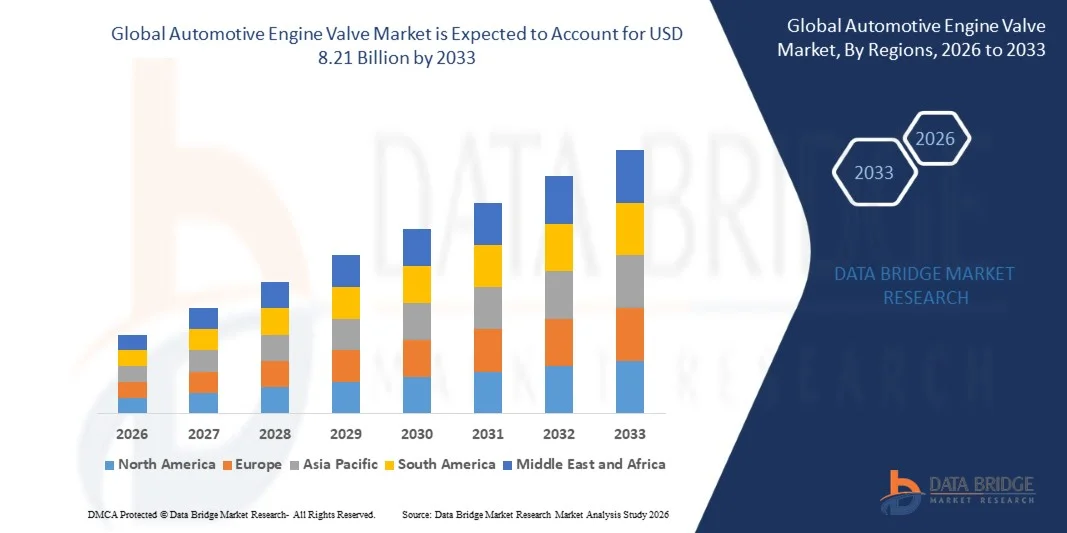
- As per Data Bridge Market Research analysis, the automotive engine valve market was valued at USD 5.60 billion in 2025 and is projected to reach USD 8.21 billion by 2033, growing at a CAGR of 4.90% from 2026 to 2033.
- The market is experiencing consistent growth driven by increasing global vehicle production, rising demand for fuel-efficient and high-performance engines, advancements in engine technologies, and growing adoption of turbocharged and direct-injection engines.
- The increasing focus on reducing vehicle emissions, improving fuel efficiency, and meeting stringent environmental regulations is compelling automakers to adopt advanced engine valve technologies. Lightweight, hollow, and high-temperature-resistant valves are gaining importance as manufacturers pursue engine downsizing and enhanced thermal efficiency while maintaining vehicle performance
Market Size & Forecast
- Global Market Value (2025): USD 5.60 Billion
- Expected Market Value (2033): USD 8.21 Billion
- Forecast CAGR (2026–2033): 4.90%
- Leading Region in 2025: North America
- Fastest Growing Region: Asia Pacific
What are the Major Takeaways of the Automotive Engine Valve Market?
- North America dominated the automotive engine valve market with the largest revenue share of 33.2% in 2025, supported by its established automotive manufacturing base, strong presence of major vehicle manufacturers, and continued demand for high-performance and fuel-efficient engines.
- Asia-Pacific is expected to be the fastest-growing region at a CAGR of 5.4% from 2026 to 2033, fueled by increasing vehicle production, rising vehicle ownership, and expanding automotive manufacturing activities across China, Japan, and India.
- The mono-metallic valves segment led the market with a 39.6% share in 2025, driven by its cost-effectiveness, high heat resistance, and excellent anti-friction properties.
- Hollow valves are the fastest-growing valve type, projected to register a CAGR of 4.0%, reflecting the surge in demand for lightweight and thermally efficient engine components.
- The passenger cars segment dominated the vehicle type category with a 79.8% revenue share in 2025, led by the significantly larger global passenger-vehicle production base.
- Steel accounted for 41.1% of the market share in 2025, preferred by its durability, heat resistance, wear resistance, and cost advantages
- The hybrid engines segment is the fastest-growing engine type category, with a CAGR of 6.8%, driven by increasing adoption of hybrid and plug-in hybrid powertrains that continue to use internal combustion engines alongside electric propulsion.
Report Scope and Automotive Engine Valve Market Segmentation
|
Attributes |
Automotive Engine Valve Key Market Insights |
|
Segments Covered |
|
|
Countries Covered |
North America
Europe
Asia-Pacific
Middle East and Africa
South America
|
|
Key Market Players |
|
|
Market Opportunities |
|
|
Value Added Data Infosets |
In addition to the market insights such as market value, growth rate, market segments, geographical coverage, market players, and market scenario, the market report curated by the Data Bridge Market Research team includes in-depth expert analysis, import/export analysis, pricing analysis, production consumption analysis, and pestle analysis. |
What is the Key Trend in the Automotive Engine Valve Market?
- Automakers are increasingly adopting lightweight, hollow, and sodium-cooled engine valves to manage higher combustion temperatures, reduce reciprocating mass, and improve efficiency in downsized, turbocharged, and high-performance engines.
- For instance, in April 2026, Eaton announced its Turbulator-equipped hollow engine valves for commercial vehicles, designed to increase sodium circulation and improve internal valve cooling, helping manufacturers manage higher engine temperatures and loads while improving durability and efficiency.
- Variable Valve Timing (VVT) and advanced valvetrain technologies are gaining importance as manufacturers seek improved combustion control, fuel efficiency, power output, and lower emissions across gasoline, diesel, and hybrid powertrains.
- Engine-valve manufacturers are increasingly developing advanced materials, coatings, and surface treatments to withstand higher combustion pressures, temperatures, corrosion, and valve-seat wear in modern high-output engines.
- For instance, in August 2026, Eaton announced that its Late Intake Valve Closing (LIVC) technology had been selected for commercial-vehicle engine programs across North America, Europe, and Asia, with production expected by the end of 2026; testing showed fuel-economy improvements of up to 2%, highlighting the growing adoption of advanced variable valve technologies to improve efficiency and emissions performance.
- As automakers continue pursuing higher engine efficiency, lower emissions, and greater power density, demand for thermally optimized, lightweight, and precision-engineered valves is expected to accelerate, particularly across turbocharged, hybrid, commercial-vehicle, and alternative-fuel applications.
What are the Key Drivers of the Automotive Engine Valve Market?
- The increasing adoption of turbocharged, downsized, direct-injection, and high-compression engines is driving demand for engine valves capable of operating under higher temperatures, pressures, and thermal loads.
- For instance, in February 2025, BorgWarner announced that it would supply its Variable Cam Timing (VCT) technology to a major East Asian OEM for next-generation hybrid and gasoline engines, with production scheduled to begin in Q1 2026; the system optimizes intake and exhaust valve timing to improve fuel economy, power output, and emissions performance.
- Growing adoption of hybrid powertrains is also sustaining demand for advanced engine valves because hybrid combustion engines undergo frequent start-stop cycles and require optimized thermal and combustion management.
- For instance, in June 2025, Cummins highlighted its Cylinder Deactivation (CDA) technology, which uses advanced valvetrain solutions to deactivate selected cylinders during low-load operation, reducing fuel consumption and CO₂ emissions while supporting compliance with upcoming emissions standards in North America and Europe.
- With global vehicle manufacturers continuing to optimize combustion efficiency and comply with increasingly stringent emissions requirements, advanced valve materials, variable valve technologies, and thermal-management solutions will remain important drivers of automotive engine valve demand.
Which Factors are Challenging the Growth of the Automotive Engine Valve Market?
- The rapid expansion of battery-electric vehicles is creating a long-term challenge for automotive engine valve manufacturers because BEVs eliminate the internal-combustion engine and therefore require substantially fewer conventional engine-valve components.
- For instance, in May 2025, the International Energy Agency (IEA) reported that global electric car sales were on track to exceed 20 million units in 2025, representing more than one-quarter of worldwide car sales, highlighting the accelerating shift toward electrified vehicles that do not require conventional engine valves.
- This transition is increasing pressure on valve suppliers to diversify toward hybrid, commercial-vehicle, alternative-fuel, and aftermarket applications, while managing the risk of declining demand from conventional passenger-car engines
- For instance, in May 2026, the IEA reported that electric car sales exceeded 20 million units globally in 2025, with electric vehicles accounting for 25% of new-car sales and the global electric-car fleet reaching about 5% of the total car stock, demonstrating the continuing structural shift away from internal-combustion powertrains..
- The accelerating electrification of passenger vehicles, combined with continued investment in BEV technologies, can gradually reduce the addressable market for conventional engine valves, creating capacity-planning and technology-transition challenges for manufacturers despite continued demand from hybrid and heavy-duty combustion applications.
How is the Automotive Engine Valve Market Segmented?
The automotive engine valve market is segmented on the basis of valve type, vehicle type, material, and engine type.
- By Valve Type
On the basis of valve type, the automotive engine valve market is segmented into mono-metallic valves, bi-metallic valves, and hollow valves. The mono-metallic valves segment dominated the market with a 39.6% revenue share in 2025, owing to its cost-effectiveness, high heat resistance, and excellent anti-friction properties. These valves are manufactured using a single material, commonly specialized steel alloys, which enables them to withstand demanding engine operating conditions. Their relatively straightforward manufacturing process supports economical production for high-volume automotive applications. Mono-metallic valves are widely used across passenger cars and commercial vehicles because they provide a practical balance between durability, performance, and manufacturing cost. Established manufacturing capabilities and compatibility with conventional internal combustion engines further support their widespread adoption.
The hollow valves segment is projected to register the fastest growth at 4.0% CAGR during forecast period, driven by increasing demand for lightweight and thermally efficient engine components. Hollow valves reduce reciprocating mass, which can contribute to improved engine efficiency and performance. Sodium-filled designs can also improve heat transfer from the valve head, helping manage the elevated temperatures generated by turbocharged and high-output engines. These characteristics make hollow valves particularly suitable for high-performance gasoline engines and demanding commercial-vehicle applications. Engine downsizing, turbocharging, and stricter emission and fuel-efficiency requirements are encouraging manufacturers to adopt advanced valve designs.
- By Vehicle Type
On the basis of vehicle type, the automotive engine valve market is segmented into passenger cars, light commercial vehicles (LCVs), medium & heavy commercial vehicles (MHCVs), and buses & coaches. The passenger cars segment dominated the market with a 79.8% revenue share in 2025, supported by the significantly larger global passenger-vehicle production base. Passenger cars require multiple intake and exhaust valves for controlling airflow and combustion gases within internal combustion engines. Demand for gasoline, diesel, and hybrid passenger vehicles therefore continues to generate substantial requirements for engine valves. Increasing adoption of turbocharging, direct injection, variable valve timing, and downsized engines is also supporting demand for advanced valve technologies. The large installed passenger-vehicle base creates additional replacement opportunities through the aftermarket.
The light commercial vehicles segment is projected to register the fastest growth at a 5.4% CAGR from 2026 to 2033, supported by expanding last-mile delivery, e-commerce logistics, urban transportation, and small-business fleet activity. LCVs require durable engine components because many vehicles operate frequently and accumulate substantial mileage. Continued demand for efficient commercial transportation is encouraging manufacturers to improve engine performance while controlling fuel consumption and emissions. Advanced engine technologies in LCVs are consequently creating requirements for reliable and thermally resistant valve systems. The expansion of logistics and delivery fleets across emerging economies is providing additional opportunities for engine-valve suppliers. Increasing fleet utilization and replacement requirements can further strengthen aftermarket demand.
- By Material
On the basis of material, the automotive engine valve market is segmented into steel, titanium, and nickel alloys. The steel segment dominated the market with a 41.1% revenue share in 2025, owing to its durability, heat resistance, wear resistance, and cost advantages. Steel valves are particularly suitable for high-volume vehicle production where manufacturers require consistent performance at competitive costs. Specialized steel alloys can withstand the thermal and mechanical stresses experienced inside modern combustion engines. Their resistance to wear and abrasion helps maintain valve geometry and functionality over extended operating periods. The widespread availability of steel and established manufacturing processes also support large-scale production.
The nickel alloy segment is projected to register the fastest growth at 4.0% CAGR during forecast period, driven by increasing requirements for materials capable of operating under high temperatures and severe mechanical conditions. Nickel alloys provide strong resistance to oxidation, corrosion, and wear, making them particularly suitable for demanding exhaust-valve applications. Increasing engine temperatures associated with turbocharging and downsizing are raising the need for high-temperature-resistant valve materials. These materials are also beneficial in heavy-duty and high-performance engines where component reliability is critical. Although nickel alloys generally carry higher material costs than conventional steel, their performance advantages support adoption in technologically demanding applications.
- By Engine Type
On the basis of engine type, the automotive engine valve market is segmented into gasoline engines, diesel engines, and hybrid engines. The gasoline engines segment dominated the market, accounting for 51% of market in 2025, supported by its extensive application across passenger vehicles and continued production of gasoline-powered internal combustion engines. Gasoline engines require intake and exhaust valves to regulate air-fuel flow and combustion-gas discharge. The growing use of turbocharging, direct injection, variable valve timing, and engine downsizing is increasing requirements for valves capable of operating under elevated temperatures and pressures. Gasoline engines also remain an important component of hybrid vehicles, providing an additional source of valve demand.
The hybrid engines segment is projected to register the fastest growth at 6.8% CAGR during forecast period, supported by increasing adoption of hybrid and plug-in hybrid powertrains that continue to use internal combustion engines alongside electric propulsion. Hybrid engines require sophisticated combustion-management technologies to maximize efficiency across different operating conditions. Advanced valve timing and valvetrain technologies can improve airflow, combustion efficiency, and emissions performance in these highly optimized engines. Frequent engine start-stop operation also increases the importance of durable and precisely engineered valve components. Hybrid powertrains provide an important transition technology between conventional internal combustion vehicles and fully electric vehicles, sustaining demand for engine-valve components
Which Region Holds the Largest Share of the Automotive Engine Valve Market?
- North America dominated the automotive engine valve market with the largest revenue share of 33.2% in 2025, supported by its established automotive manufacturing base, strong presence of major vehicle manufacturers, and continued demand for high-performance and fuel-efficient engines.
- The region also benefits from continued investments in fuel-efficient and high-performance engine technologies, stringent emission standards, and increasing adoption of advanced valve systems for modern powertrains. Growing demand for turbocharged engines, hybrid vehicles, and technologically advanced engine components continues to support North America's position in the global automotive engine valve market.
U.S. Automotive Engine Valve Market Insight
The U.S. automotive engine valve market is witnessing steady growth due to rising demand for fuel-efficient vehicles, increasing production of passenger and commercial vehicles, and continuous advancements in internal combustion engine technologies. The country’s strong automotive manufacturing base, along with growing adoption of lightweight and high-performance engine components, is driving demand across vehicle segments. In addition, increasing emphasis on engine efficiency, emissions reduction, and improved valve durability is supporting the adoption of advanced engine valve technologies.
Asia-Pacific Automotive Engine Valve Market Insight
The Asia-Pacific automotive engine valve market is expected to witness rapid growth, driven by expanding automotive production, increasing vehicle ownership, and rising investments in automotive manufacturing across countries such as China, India, and Japan. Growing demand for fuel-efficient engines, advancements in engine technologies, and increasing adoption of lightweight components are supporting regional market expansion. In addition, the strong presence of automotive component manufacturers and expanding vehicle production capacities are accelerating demand for engine valves across passenger and commercial vehicle applications.
Japan Automotive Engine Valve Market Insight
The Japan automotive engine valve market is witnessing consistent growth due to rising investments in advanced engine technologies, automotive innovation, and fuel-efficient vehicle systems. Automotive manufacturers and component suppliers are increasingly adopting high-performance engine valves for improved combustion efficiency, durability, and emissions control. Moreover, increasing integration of lightweight materials and precision manufacturing technologies, along with Japan’s strong focus on efficient and environmentally sustainable mobility solutions, is further contributing to market growth.
China Automotive Engine Valve Market Insight
The China automotive engine valve market is growing rapidly, driven by expanding vehicle production, increasing automotive demand, and rising investments in advanced engine manufacturing technologies. Growing adoption of lightweight, high-strength, and precision-engineered engine valves across passenger and commercial vehicles is significantly boosting market demand. In addition, rising investments in automotive component manufacturing, increasing focus on fuel efficiency and emissions reduction, and rapid advancements in engine technologies are positioning China as one of the fastest-growing markets for automotive engine valves globally.
U.K. Automotive Engine Valve Market Insight
The U.K. automotive engine valve market is experiencing steady growth, supported by continued demand for advanced engine components, automotive manufacturing, and high-performance vehicle applications. Increasing investments in precision-engineered and lightweight valve technologies are contributing to market growth, particularly across performance vehicles and specialized automotive applications. Furthermore, integration of advanced materials, improved manufacturing processes, and growing emphasis on fuel efficiency and emissions reduction are enhancing engine valve performance and supporting market development in the U.K.
Germany Automotive Engine Valve Market Insight
The Germany automotive engine valve market is expanding steadily due to the country’s strong automotive manufacturing base, advanced engineering capabilities, and increasing adoption of high-performance engine technologies. Automotive companies and component manufacturers are increasingly utilizing precision-engineered valves for improved engine efficiency, durability, and emissions performance across passenger and commercial vehicles. Continuous advancements in lightweight materials, precision manufacturing, and engine optimization, along with Germany’s strong focus on automotive innovation and efficiency, are further driving market growth.
Which are the Top Companies in Automotive Engine Valve Market?
The automotive engine valve industry is primarily led by well-established companies, including:
- Eaton Corporation plc (U.S.)
- MAHLE GmbH (Germany)
- NITTAN Corporation (Japan)
- FUJI OOZX Inc. (Japan)
- SPR Auto Technologies Limited (India)
- Ferrea Racing Components (U.S.)
- Manley Performance Products, Inc. (U.S.)
- Supertech Performance (U.S.)
- Melling Engine Parts (U.S.)
- Kibblewhite Precision Machining, Inc. (U.S.)
- SI Valves (U.S.)
- OSVAT S.r.l. (Italy)
- Schaeffler AG (Germany)
- BorgWarner Inc. (U.S.)
- AISIN CORPORATION (Japan)
- Daido Steel Co., Ltd. (Japan)
- Rane Holdings Limited (India)
- AVL List GmbH (Austria)
- Rheinmetall AG (Germany)
- Motorservice (Germany)
What are Latest Developments in Automotive Engine Valve Market?
- In August 2024, Ford announced a recall of 90,736 vehicles because certain engine intake valves could break while the vehicles were being driven. The recall covered selected 2021–2022 Ford Bronco, F-150, Edge, Explorer, Lincoln Nautilus, and Lincoln Aviator models equipped with 2.7-liter or 3.0-liter Nano EcoBoost engines. Dealers were instructed to conduct engine-cycle testing and replace the engine when necessary at no cost to owners. The action highlighted the importance of valve durability, material integrity, and rigorous validation in modern high-output automotive engines.
- In April 2024, Eaton highlighted its next-generation engine valve technologies designed to improve combustion efficiency and thermal performance. The portfolio includes solid valves, sodium-cooled hollow-stem valves, and sodium-cooled hollow-head valves for modern turbocharged gasoline applications. Eaton emphasized that hollow-head valve technology can improve temperature management within high-performance engines while supporting fuel efficiency and emissions reduction. The development reflects the industry’s continued shift toward lightweight, thermally optimized, and high-durability valve designs for downsized and higher-output engines.
- In February 2023, Eaton announced that its variable valve actuation (VVA) technologies had demonstrated significant reductions in both nitrogen oxide (NOx) and carbon dioxide (CO₂) emissions during testing of an 11-liter diesel commercial-vehicle engine. The testing evaluated Eaton’s cylinder deactivation and late intake valve closing technologies, with cylinder deactivation reducing NOx emissions by up to 38% and fuel consumption by 3% in a low-load cycle. The development demonstrated how advanced valve-actuation systems can improve engine efficiency while helping commercial vehicle manufacturers meet increasingly stringent emissions requirements.
- In September 2022, Eaton announced that it was developing new valve technologies for future commercial vehicles, including hydrogen internal combustion engines. The company presented a portfolio covering monometallic and bimetallic, solid and sodium-cooled hollow valves, as well as coated and seat-faced solutions. The development addressed the higher thermal stresses associated with hydrogen combustion and demonstrated the potential for advanced valve materials and cooling technologies to support emerging alternative-fuel engines. This development reinforced engine valves as an important enabling component for next-generation internal combustion powertrains.
- In August 2021, Eaton introduced its next-generation sodium-filled hollow-head engine valves to improve fuel economy, reduce emissions, and increase performance in gasoline engines. The valves use a two-section head design welded during production, enabling greater flexibility in the sodium cavity and improved sodium flow for cooling. By lowering cylinder-head temperatures and helping mitigate engine knock, the technology was designed to support higher engine efficiency and performance. The launch represented an important advancement in lightweight and thermally managed valve technology for modern gasoline engines.

- Interactive Data Analysis Dashboard
- Company Analysis Dashboard for high growth potential opportunities
- Research Analyst Access for customization & queries
- Competitor Analysis with Interactive dashboard
- Latest News, Updates & Trend analysis
- Harness the Power of Benchmark Analysis for Comprehensive Competitor Tracking
Data collection and base year analysis are done using data collection modules with large sample sizes. The stage includes obtaining market information or related data through various sources and strategies. It includes examining and planning all the data acquired from the past in advance. It likewise envelops the examination of information inconsistencies seen across different information sources. The market data is analysed and estimated using market statistical and coherent models. Also, market share analysis and key trend analysis are the major success factors in the market report. To know more, please request an analyst call or drop down your inquiry.
The key research methodology used by DBMR research team is data triangulation which involves data mining, analysis of the impact of data variables on the market and primary (industry expert) validation. Data models include Vendor Positioning Grid, Market Time Line Analysis, Market Overview and Guide, Company Positioning Grid, Patent Analysis, Pricing Analysis, Company Market Share Analysis, Standards of Measurement, Global versus Regional and Vendor Share Analysis. To know more about the research methodology, drop in an inquiry to speak to our industry experts.
Data Bridge Market Research is a leader in advanced formative research. We take pride in servicing our existing and new customers with data and analysis that match and suits their goal. The report can be customized to include price trend analysis of target brands understanding the market for additional countries (ask for the list of countries), clinical trial results data, literature review, refurbished market and product base analysis. Market analysis of target competitors can be analyzed from technology-based analysis to market portfolio strategies. We can add as many competitors that you require data about in the format and data style you are looking for. Our team of analysts can also provide you data in crude raw excel files pivot tables (Fact book) or can assist you in creating presentations from the data sets available in the report.













