


What is the Automotive Engineering Service Provider Market Size and Growth Rate?
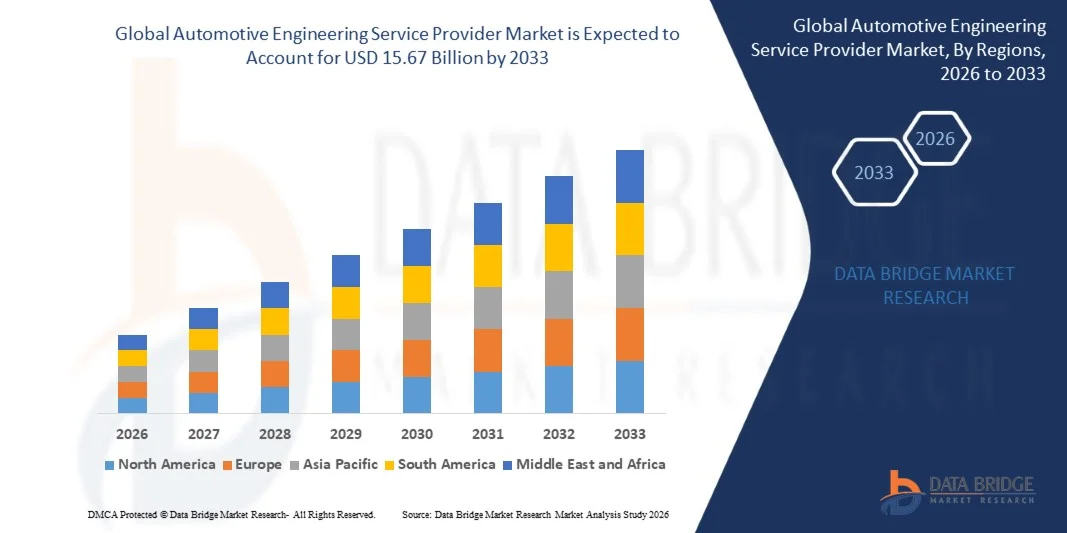
- As per Data Bridge Market Research analysis, the automotive engineering service provider market was valued at USD 9.54 billion in 2025 and is projected to reach USD 15.67 billion by 2033, growing at a CAGR of 6.40% from 2026 to 2033.
- The market is experiencing consistent growth driven by increasing vehicle electrification, rising demand for advanced automotive software and electronics, and expanding outsourcing of engineering, design, testing, and validation activities by automotive OEMs and component manufacturers.
- The rapid development of electric vehicles, autonomous driving, connected vehicles, and advanced driver-assistance systems, combined with growing pressure on automakers to reduce development time and costs, is compelling OEMs and Tier-1 suppliers to increasingly partner with specialized engineering service providers. Design, simulation, software development, prototyping, and testing services are gaining adoption as automotive companies accelerate next-generation vehicle development.
Market Size & Forecast
- Global Market Value (2025): USD 9.54 Billion
- Expected Market Value (2033): USD 15.67 Billion
- Forecast CAGR (2026–2033): 6.40%
- Leading Region in 2025: North America
- Fastest Growing Region: Asia Pacific
What are the Major Takeaways of the Automotive Engineering Service Provider Market?
- North America dominated the automotive engineering service provider market with the largest revenue share of 37.2% in 2025, supported by strong automotive OEM and Tier-1 supplier spending, advanced R&D capabilities, and high demand for engineering outsourcing.
- Asia-Pacific is expected to be the fastest-growing region at a CAGR of 12.8% from 2026 to 2033, fueled by expanding vehicle production, increasing electric vehicle investments, growing engineering hubs, and rising outsourcing activities across China, India, Japan, and South Korea.
- The intelligent power module (IPM) segment led the market with a 55% share in 2025, driven by increasing demand for integrated power-control solutions in electrified vehicles.
- Power integrated module (PIM) are the fastest-growing module type, projected to register a CAGR of 9.5%, reflecting the surge in requirements for high-power conversion in electric and hybrid vehicles
- The internal combustion engine (ICE) segment dominated the propulsion type category with a 45% revenue share in 2025, led by the extensive global installed base of conventional vehicles
- Passenger cars accounted for 36.54% of the market share in 2025, preferred by high global production volumes and increasing integration of advanced automotive technologies.
- The cooling and HVAC segment is the fastest-growing services category, with a CAGR of 9.8%, driven by increasingly complex thermal-management requirements across electric, hybrid, and software-intensive vehicles.
Report Scope and Automotive Engineering Service Provider Market Segmentation
|
Attributes |
Automotive Engineering Service Provider Key Market Insights |
|
Segments Covered |
|
|
Countries Covered |
North America
Europe
Asia-Pacific
Middle East and Africa
South America
|
|
Key Market Players |
|
|
Market Opportunities |
|
|
Value Added Data Infosets |
In addition to the market insights such as market value, growth rate, market segments, geographical coverage, market players, and market scenario, the market report curated by the Data Bridge Market Research team includes in-depth expert analysis, import/export analysis, pricing analysis, production consumption analysis, and pestle analysis. |
What is the Key Trend in the Automotive Engineering Service Provider Market?
- Automotive OEMs are increasingly shifting from traditional mechanical engineering outsourcing toward software-defined vehicle (SDV), embedded software, cloud, and electrical/electronic engineering services as vehicle architectures become more software-centric.
- For instance, in September 2025, Capgemini reported that 92% of automotive organizations expected every automotive company to evolve into a software company, while only 14% had fully scaled at least one software-driven mobility use case.
- Engineering service providers are expanding beyond conventional design work to offer end-to-end development, verification, validation, cybersecurity, and software lifecycle management, enabling OEMs to manage increasingly complex vehicle platforms.
- Demand for EV engineering services is also increasing as manufacturers require specialized expertise in battery systems, electric drivetrains, thermal management, charging systems, and power electronics for next-generation vehicle programs.
- For instance, in June 2025, Tata Technologies was selected as a strategic engineering supplier by Volvo Cars, covering product engineering, vehicle and component engineering, embedded software, and product lifecycle management across global delivery hubs.
- As OEMs increasingly combine internal engineering teams with specialized external providers to accelerate product development, reduce development costs, and access specialized digital skills, integrated engineering partnerships are expected to become increasingly important across the automotive value chain.
What are the Key Drivers of the Automotive Engineering Service Provider Market?
- The rapid transition toward electric vehicles, connected vehicles, autonomous driving, and software-defined architectures has significantly increased demand for specialized engineering capabilities that many OEMs cannot efficiently maintain entirely in-house.
- For instance, in June 2025, Tata Technologies was selected as a strategic engineering supplier by Volvo Cars, with the collaboration covering product engineering, vehicle system and component engineering, embedded software, and product lifecycle management. This demonstrates how OEMs are increasingly relying on external engineering providers for specialized electrification and software-defined vehicle capabilities.
- Automotive OEMs and Tier-1 suppliers are increasingly integrating external engineering partners into development programs to shorten development cycles, control costs, scale engineering capacity, and access specialized software, electronics, simulation, and validation expertise.
- For instance, in April 2025, Tata Elxsi secured a USD 58.30 million multi-year engineering deal with a leading European automotive OEM to establish a dedicated Global Engineering Centre focused on software-defined vehicle platforms, electrification, body and chassis systems, and cloud-native development, demonstrating the growing outsourcing of specialized engineering capabilities by automotive OEMs.
- With automotive development becoming increasingly dependent on software, electrification, AI, cybersecurity, and advanced electronics, engineering service providers will remain critical partners for OEMs seeking faster innovation, flexible technical capacity, and efficient development of next-generation vehicles.
Which Factors are Challenging the Growth of the Automotive Engineering Service Provider Market?
- Automotive engineering projects are becoming increasingly complex as providers must integrate software, electronics, cybersecurity, functional safety, AI, and mechanical systems, requiring highly specialized multidisciplinary engineering capabilities.
- For instance, in June 2025, Accenture and IIT Madras's Centre for Automotive Research and Analytics (CAAR) launched the SDV Academy to address the shortage of specialized automotive software talent, with training focused on automated driving, ADAS, electrical/electronic architecture, connectivity, and infotainment. This highlights the difficulty of sourcing engineers with the multidisciplinary skills required for increasingly complex automotive engineering programs.
- The shortage of engineers with combined automotive and digital expertise can increase project costs, extend development timelines, and make it difficult for service providers to scale complex programs across multiple OEM customers and regions.
- Data security and intellectual-property risks can also restrain outsourcing, as automotive engineering projects involve sensitive vehicle designs, proprietary software, source code, customer data, and connected-vehicle technologies that require strict cybersecurity controls and secure cross-border data management.
- For instance, in October 2025, the National Council of Applied Economic Research (NCAER) reported significant skill shortages and skill gaps in India’s automotive sector, noting that the shift toward EVs, automation, AI, and robotics is causing demand for skilled engineers and technicians to grow faster than supply
- The growing complexity of engineering programs, combined with strict cybersecurity, functional-safety, regulatory, and intellectual-property requirements, continues to increase the resources required to deliver outsourced engineering services, particularly for smaller providers and organizations entering advanced automotive programs.
How is the Automotive Engineering Service Provider Market Segmented?
The automotive engineering service provider market is segmented on the basis of module type, propulsion type, vehicle type, services, and application.
- By Module Type
On the basis of module type, the automotive engineering service provider market is segmented into intelligent power module (IPM) and power integrated module (PIM). The intelligent power module (IPM) segment is estimated to dominated the market with 55% share in 2025, supported by increasing demand for integrated power-control solutions in electrified vehicles. IPMs combine power semiconductors, gate drivers, and protection functions into compact modules. Their integration helps improve power efficiency, reliability, and thermal performance across vehicle electrical systems. Growing electrification is increasing engineering requirements for power-module design, simulation, testing, and system integration. Automotive manufacturers are also seeking compact architectures that can accommodate increasingly complex electronic functions.
The power integrated module (PIM) segment is projected to register the fastest growth at a CAGR of 9.5% from 2026 to 2033, driven by increasing requirements for high-power conversion in electric and hybrid vehicles. PIM architectures integrate multiple power components to support efficient power delivery within vehicle systems. Growing adoption of high-voltage electric powertrains is increasing demand for specialized power-electronics engineering. Service providers are developing capabilities in module design, thermal management, electromagnetic compatibility, and reliability validation. The transition toward advanced 400-volt and 800-volt architectures is creating additional requirements for sophisticated power integration. Increasing adoption of silicon carbide-based power electronics is further supporting demand for advanced module engineering.
- By Propulsion Type
On the basis of propulsion type, the automotive engineering service provider market is segmented into internal combustion engine (ICE), hybrid electric vehicles (HEV), plug-in hybrid electric vehicles (PHEV), battery electric vehicles (BEV), and fuel cell electric vehicles (FCEV). The internal combustion engine (ICE) segment is estimated to dominated the market with 45% share in 2025, supported by the extensive global installed base of conventional vehicles. Engineering providers continue to support ICE programs through engine optimization, transmission development, emissions compliance, thermal management, and durability engineering. Many automotive manufacturers continue to upgrade conventional powertrains to meet increasingly stringent emissions and efficiency requirements. Hybrid programs also require engineering expertise that combines combustion engines with electric propulsion systems. Established manufacturing infrastructure continues to sustain demand for ICE-related engineering services.
The battery electric vehicles (BEV) segment is projected to witness the fastest growth at a CAGR of 11.5% from 2026 to 2033, driven by accelerating vehicle electrification and increasing investment in dedicated electric platforms. BEVs require specialized engineering across batteries, electric motors, inverters, thermal management, charging systems, and vehicle software. OEMs are increasingly engaging engineering service providers to access specialized technical capabilities and accelerate electric-platform development. Increasing deployment of high-voltage architectures is creating additional requirements for battery and power-electronics engineering. Battery-management systems, functional safety, cybersecurity, and software integration are also expanding engineering workloads. Government electrification policies and expanding charging infrastructure are supporting continued development of new BEV platforms.
- By Vehicle Type
On the basis of vehicle type, the automotive engineering service provider market is segmented into passenger cars, light commercial vehicles, heavy commercial vehicles, buses, trucks, and two-wheelers. The passenger cars segment dominated the market with 36.54% share in 2025, supported by high global production volumes and increasing integration of advanced automotive technologies. Passenger vehicles increasingly incorporate electrification, ADAS, connectivity, infotainment, and autonomous-driving functions. These technologies require extensive engineering, simulation, software development, testing, and validation throughout the vehicle lifecycle. OEMs are also investing heavily in new passenger-car platforms to respond to changing consumer preferences and regulatory requirements. Engineering service providers support these programs through vehicle architecture, component design, embedded software, and system validation.
The two-wheelers segment is projected to experience the fastest growth at a CAGR of 10.5% from 2026 to 2033, driven by rapid electrification and technological development across motorcycles and scooters. Electric two-wheelers require specialized engineering for batteries, electric motors, power electronics, thermal systems, and vehicle controls. Manufacturers are increasingly incorporating connected functions and digital interfaces, creating additional software and electronics engineering requirements. Growing urban mobility demand is encouraging manufacturers to introduce more efficient and technologically advanced two-wheelers. Engineering providers can support lightweight vehicle design, battery optimization, embedded software, and safety validation. Increasing regulatory pressure on emissions and fuel efficiency is further accelerating electrification across the segment.
- By Services
On the basis of services, the automotive engineering service provider market is segmented into engine, transmission, chassis, car and BIW, cooling and HVAC, interior and exterior trims, seating systems, and other services. The engine segment is estimated to dominated the market with 35% share in 2025, supported by the continuing global presence of internal-combustion and hybrid powertrains. Engine engineering encompasses design optimization, performance improvement, emissions reduction, thermal management, and durability testing. Engineering providers continue to assist OEMs in meeting increasingly stringent fuel-efficiency and emissions requirements. Hybrid vehicles are also creating demand for engineering expertise combining combustion engines with electric propulsion systems. Advanced simulation and digital engineering enable manufacturers to optimize engine performance while reducing physical prototype requirements.
The cooling and HVAC segment is projected to register the fastest growth at a CAGR of 9.8% from 2026 to 2033, driven by increasingly complex thermal-management requirements across electric, hybrid, and software-intensive vehicles. EV batteries, electric motors, and power electronics require precise temperature management to maintain safety, efficiency, and durability. Engineering providers are increasingly developing battery cooling, cabin climate-control, heat-pump, and integrated thermal-management systems. Rising adoption of fast charging is further increasing the importance of advanced cooling technologies. Passenger comfort requirements are also encouraging manufacturers to improve HVAC efficiency and intelligent climate-control functions. Digital simulation is being used to optimize airflow, heat transfer, and energy consumption during vehicle development.
- By Application
On the basis of application, the automotive engineering service provider market is segmented into mechanical, software, electrical and electronics, and safety. The mechanical segment dominated the market with 66.84% share in 2025, supported by continuing demand for vehicle architecture, chassis, powertrain, component, and structural engineering. Mechanical engineering remains fundamental throughout vehicle development, including concept development, detailed design, prototyping, simulation, and validation. Engineering providers continue to support OEMs through CAD, finite-element analysis, computational fluid dynamics, and design optimization. Electric vehicles also require extensive mechanical engineering for lightweight structures, suspension, braking, thermal systems, and vehicle packaging. Increasing pressure to improve vehicle efficiency is driving demand for lightweight materials and optimized mechanical designs.
The software segment is projected to witness the fastest growth at a CAGR of 9.0% from 2026 to 2033, driven by the transition toward software-defined, connected, autonomous, and increasingly intelligent vehicles. Modern vehicles require software for ADAS, infotainment, connectivity, vehicle controls, cybersecurity, battery management, and over-the-air updates. Automotive OEMs are increasingly partnering with engineering service providers to access specialized embedded-software and cloud-development capabilities. Growing complexity in electrical/electronic architectures is further increasing software-development requirements. Artificial intelligence and machine learning are expanding software applications in autonomous driving and driver-assistance systems. Engineering providers are increasingly offering software development, integration, verification, validation, and cybersecurity as integrated services.
Which Region Holds the Largest Share of the Automotive Engineering Service Provider Market?
- North America dominated the automotive engineering service provider market with the largest revenue share of 37.2% in 2025, supported by strong automotive OEM and Tier-1 supplier spending, advanced R&D capabilities, and high demand for engineering outsourcing.
- The region also benefits from substantial investments in electric vehicles, autonomous driving, ADAS, connected vehicles, and software-defined vehicle technologies, which are increasing demand for outsourced engineering capabilities. Automotive OEMs and Tier-1 suppliers are increasingly working with specialized providers for vehicle architecture, embedded software, system integration, prototyping, testing, and validation. The U.S. represented the majority of North America's automotive engineering services outsourcing activity, supported by strong investments in autonomous vehicle development, ADAS validation, and software-defined vehicle programs.
U.S. Automotive Engineering Service Provider Market Insight
The U.S. automotive engineering service provider market is witnessing strong growth due to rising investments in electric vehicles, autonomous driving, software-defined vehicles, and advanced vehicle electronics. The country's mature automotive ecosystem, along with the presence of leading OEMs, technology companies, and specialized engineering providers, is driving demand across vehicle design, software development, testing, and validation. In addition, growing vehicle complexity and increasing pressure to shorten development cycles and control engineering costs are encouraging automotive manufacturers to outsource specialized engineering activities.
Asia-Pacific Automotive Engineering Service Provider Market Insight
The Asia-Pacific automotive engineering service provider market is expected to witness rapid growth, driven by expanding automotive production, increasing electric vehicle manufacturing, and rising investments in automotive engineering capabilities across China, India, Japan, and South Korea. Growing availability of skilled engineering talent, competitive development costs, and increasing outsourcing by global OEMs are supporting regional market expansion. In addition, the growing presence of automotive technology centers and increasing demand for software, electronics, simulation, and vehicle-development services are accelerating engineering service adoption across the region.
Japan Automotive Engineering Service Provider Market Insight
The Japan automotive engineering service provider market is witnessing consistent growth due to rising investments in electric mobility, autonomous driving, connected vehicles, and advanced automotive electronics. Automotive manufacturers and technology companies are increasingly utilizing engineering service providers for vehicle development, embedded software, system integration, testing, and validation activities. Moreover, increasing integration of artificial intelligence, advanced driver-assistance systems, and software-defined vehicle technologies, combined with Japan's strong automotive R&D ecosystem, is further contributing to market growth.
China Automotive Engineering Service Provider Market Insight
The China automotive engineering service provider market is growing rapidly, driven by expanding electric vehicle production, increasing investments in autonomous driving, and rapid development of connected and intelligent vehicles. Growing adoption of advanced software, battery technologies, vehicle electronics, and digital engineering platforms across automotive manufacturers is significantly boosting demand for specialized engineering services. In addition, rising investments in automotive R&D, increasing competition among domestic EV manufacturers, and rapid technological advancements are positioning China as one of the fastest-growing markets for automotive engineering services globally.
U.K. Automotive Engineering Service Provider Market Insight
The U.K. automotive engineering service provider market is experiencing steady growth, supported by increasing investments in electric vehicles, autonomous mobility, advanced vehicle software, and automotive research and development. Automotive manufacturers, technology companies, and engineering firms are increasingly utilizing external providers for vehicle design, embedded software, simulation, testing, and validation activities. Furthermore, integration of artificial intelligence, connected technologies, and software-defined vehicle architectures is increasing demand for specialized engineering capabilities, positioning the U.K. as an important innovation and engineering hub within the European automotive industry.
Germany Automotive Engineering Service Provider Market Insight
The Germany automotive engineering service provider market is expanding steadily due to the country's strong automotive manufacturing base, advanced research capabilities, and increasing adoption of electrification and software-defined vehicle technologies. Automotive companies, component manufacturers, and technology firms are increasingly utilizing engineering providers for vehicle development, powertrain engineering, embedded software, electronics, simulation, and validation activities. Continuous advancements in electric mobility, autonomous driving, artificial intelligence, and vehicle electronics, along with Germany's strong focus on automotive innovation and engineering excellence, are further driving market growth.
Which are the Top Companies in Automotive Engineering Service Provider Market?
The automotive engineering service provider industry is primarily led by well-established companies, including:
- Tata Consultancy Services Limited (India)
- Infosys Limited (India)
- Capgemini (France)
- Wipro (India)
- HCL Technologies Limited (India)
- Tech Mahindra (India)
- LTM Limited (India)
- Tata Elxsi (India)
- Tata Technologies Limited (India)
- KPIT Technologies Limited (India)
- Cyient Limited (India)
- Quest Global (U.S.)
- Akkodis (Switzerland)
- ALTEN Group (France)
- SEGULA Technologies (France)
- EDAG Group (Germany)
- Bertrandt (Germany)
- Expleo Group (France)
- AVL (Austria)
- Ricardo (U.K.)
What are Latest Developments in Automotive Engineering Service Provider Market?
- In October 2025, Tata Technologies collaborated with Synopsys to accelerate software-defined vehicle innovation, combining automotive engineering expertise with Synopsys’ electronic design automation and semiconductor design capabilities. The collaboration is intended to help automotive manufacturers address the increasing complexity of software-defined vehicles and accelerate development of next-generation automotive systems
- In September 2025, Tata Technologies acquired Germany-based ES-Tec Group for USD 87.47 million, strengthening its European automotive engineering capabilities in areas including ADAS, connected vehicles, software-defined vehicles, and next-generation mobility. The acquisition expanded Tata Technologies’ engineering expertise and strengthened its ability to support global automotive OEMs with advanced vehicle-development programs.
- In June 2025, Tata Technologies was selected as a strategic engineering supplier by Volvo Cars, expanding their long-standing relationship to cover product engineering, vehicle and component engineering, embedded software, and product lifecycle management. The collaboration strengthens Tata Technologies’ role in supporting Volvo Cars’ next-generation vehicle-development programs and demonstrates increasing reliance on specialized engineering service providers by global OEMs.
- In August 2023, Tata Technologies joined the AUTOSAR consortium as a Premium Partner, strengthening its involvement in the development of standardized automotive software architectures. The move supported Tata Technologies’ capabilities in software-defined vehicles and enabled closer participation in industry-wide efforts to develop scalable, interoperable automotive software platforms for next-generation vehicles.
- In September 2021, Capgemini highlighted the growing need for strategic partnerships between automotive OEMs and software and technology service providers, emphasizing that automakers would increasingly need external expertise across the automotive software value chain. The development reflected the industry's shift toward connected, software-intensive vehicles and reinforced the role of engineering and technology service providers in automotive digital transformation.

- Interactive Data Analysis Dashboard
- Company Analysis Dashboard for high growth potential opportunities
- Research Analyst Access for customization & queries
- Competitor Analysis with Interactive dashboard
- Latest News, Updates & Trend analysis
- Harness the Power of Benchmark Analysis for Comprehensive Competitor Tracking
Data collection and base year analysis are done using data collection modules with large sample sizes. The stage includes obtaining market information or related data through various sources and strategies. It includes examining and planning all the data acquired from the past in advance. It likewise envelops the examination of information inconsistencies seen across different information sources. The market data is analysed and estimated using market statistical and coherent models. Also, market share analysis and key trend analysis are the major success factors in the market report. To know more, please request an analyst call or drop down your inquiry.
The key research methodology used by DBMR research team is data triangulation which involves data mining, analysis of the impact of data variables on the market and primary (industry expert) validation. Data models include Vendor Positioning Grid, Market Time Line Analysis, Market Overview and Guide, Company Positioning Grid, Patent Analysis, Pricing Analysis, Company Market Share Analysis, Standards of Measurement, Global versus Regional and Vendor Share Analysis. To know more about the research methodology, drop in an inquiry to speak to our industry experts.
Data Bridge Market Research is a leader in advanced formative research. We take pride in servicing our existing and new customers with data and analysis that match and suits their goal. The report can be customized to include price trend analysis of target brands understanding the market for additional countries (ask for the list of countries), clinical trial results data, literature review, refurbished market and product base analysis. Market analysis of target competitors can be analyzed from technology-based analysis to market portfolio strategies. We can add as many competitors that you require data about in the format and data style you are looking for. Our team of analysts can also provide you data in crude raw excel files pivot tables (Fact book) or can assist you in creating presentations from the data sets available in the report.













