


Automotive Ethernet Testing Market Size
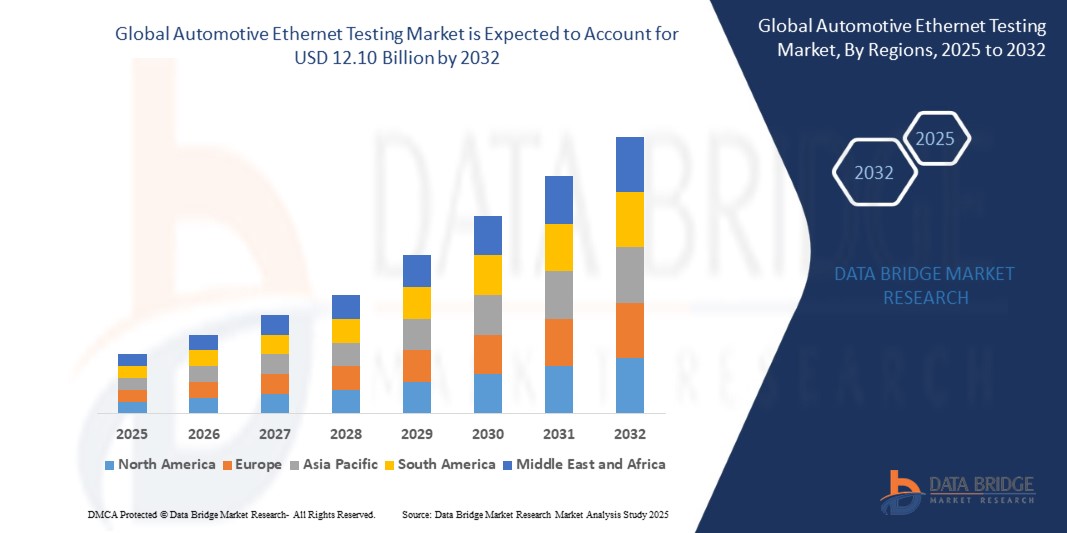
- The global automotive ethernet testing market size was valued at USD 2.87 billion in 2024 and is expected to reach USD 12.10 billion by 2032, at a CAGR of 19.7% during the forecast period
- The market growth is largely fueled by the increasing adoption of connected, electric, and autonomous vehicles, which require high-speed, secure, and reliable in-vehicle communication networks. Growing integration of advanced driver-assistance systems (ADAS), infotainment, and body electronics is accelerating the demand for comprehensive Ethernet testing solutions
- Furthermore, the rising emphasis on vehicle safety, network reliability, and compliance with automotive standards is establishing automotive Ethernet testing as a critical step in vehicle development. These converging factors are driving the adoption of advanced testing tools and solutions, thereby significantly boosting the industry's growth
Automotive Ethernet Testing Market Analysis
- Automotive Ethernet testing solutions validate, monitor, and troubleshoot high-speed in-vehicle networks, ensuring seamless communication between electronic control units (ECUs), sensors, and connected vehicle systems. These solutions support both hardware and software testing, enabling OEMs and Tier-1 suppliers to meet stringent safety and performance requirements
- The escalating demand for Ethernet testing is primarily fueled by rapid technological advancements in in-vehicle networks, increasing adoption of connected and autonomous vehicles, and growing investments by OEMs and suppliers to enhance system reliability and compliance across passenger cars and commercial vehicles
- North America dominated the automotive ethernet testing market in 2024, due to the presence of leading automotive OEMs and Tier-1 suppliers investing heavily in connected, electric, and autonomous vehicle technologies
- Asia-Pacific is expected to be the fastest growing region in the automotive ethernet testing market during the forecast period due to rapid automotive manufacturing growth, increasing EV production, and urbanization in countries such as China, Japan, and India
- Network analyzers segment dominated the market with a market share of 39% in 2024, due to their critical role in monitoring, validating, and troubleshooting high-speed in-vehicle Ethernet networks. Automotive manufacturers and Tier-1 suppliers rely on network analyzers to ensure seamless data transmission and maintain communication reliability across infotainment, ADAS, and body electronics systems. The increasing complexity of in-vehicle networks and stringent automotive standards further boost the demand for advanced network analysis solutions. Network analyzers also support integration with multiple protocols and testing environments, making them indispensable for OEMs and testing labs
Report Scope and Automotive Ethernet Testing Market Segmentation
|
Attributes |
Automotive Ethernet Testing Key Market Insights |
|
Segments Covered |
|
|
Countries Covered |
North America
Europe
Asia-Pacific
Middle East and Africa
South America
|
|
Key Market Players |
|
|
Market Opportunities |
|
|
Value Added Data Infosets |
In addition to the market insights such as market value, growth rate, market segments, geographical coverage, market players, and market scenario, the market report curated by the Data Bridge Market Research team includes in-depth expert analysis, import/export analysis, pricing analysis, production consumption analysis, and pestle analysis. |
Automotive Ethernet Testing Market Trends
Increasing Adoption of Multi-Gigabit Automotive Ethernet Standards
- The growing use of Ethernet within advanced vehicle systems is leading to significant demand for testing solutions that can validate compliance with multi-gigabit automotive Ethernet standards. As ADAS, autonomous driving, and infotainment expand, vehicles require faster connectivity that must be rigorously tested for performance and safety
- For instance, Keysight Technologies has introduced specialized automotive Ethernet test solutions supporting 10BASE-T1S and multi-gigabit standards. These tools enable OEMs and Tier 1 suppliers to evaluate latency, interference, and interoperability challenges across high-speed networking components being integrated into new vehicle platforms
- The rising demand for multi-camera ADAS, LiDAR, and advanced radar systems is fueling the need for multi-gigabit Ethernet validation. Testing solutions help ensure data integrity, system safety, and low-latency performance required for timely driver decision support
- The rapid shift toward next-generation infotainment systems that involve ultra-HD video streaming, immersive in-cabin experiences, and real-time connectivity is another driver for Ethernet bandwidth testing. Multi-gigabit standards are designed to support these services without compromising on signal quality or system safety
- In addition, the alignment of Ethernet standards with cybersecurity protocols is pushing test equipment providers to integrate advanced security validation. Multi-gigabit testing platforms are being enhanced to identify vulnerabilities, protect against intrusions, and ensure robust network security in connected vehicles
- Collaborations between OEMs, chipset manufacturers, and testing service providers are accelerating standards adoption. By validating interoperability and performance under diverse operating conditions, multi-gig Ethernet testing is establishing itself as a crucial step in the automotive design chain
Automotive Ethernet Testing Market Dynamics
Driver
Rising Demand for Higher Bandwidth
- As modern vehicles incorporate more sensors, high-resolution displays, and real-time monitoring systems, the need for higher bandwidth networks is a strong driver of automotive Ethernet testing. Advanced vehicle systems require seamless communication at extremely high data transfer speeds, making network validation indispensable
- For instance, Rohde & Schwarz has expanded its suite of automotive Ethernet test solutions to support bandwidth validation for applications such as automated driving and connected infotainment. Their tools enable OEMs to ensure compliance with high-bandwidth standards while maintaining network quality and interoperability
- The emergence of autonomous driving platforms and ADAS infrastructure is creating a surge in data traffic. High-bandwidth networks powered by multi-gigabit Ethernet are needed to support vehicle decision-making systems, and testing ensures that this infrastructure operates reliably under all circumstances
- In addition, higher demand for bandwidth is linked to in-vehicle connectivity needs for passengers. From real-time navigation to 5G-powered entertainment services, vehicles are expected to act as mobile hubs which increases the requirement for robust Ethernet validation systems
- Testing solutions also enable faster product launches by validating complex Ethernet topologies within the R&D phase, helping automakers meet time-to-market pressures while ensuring quality assurance in high-data environments
Restraint/Challenge
Integration Complexity of Ethernet Networks
- The growing technical complexity of integrating Ethernet into vehicles is a major challenge. Unlike traditional CAN or LIN networks, Ethernet requires more precise design, robust testing, and greater expertise, which increases product development timelines and costs
- For instance, OEMs working with solutions from Vector Informatik have highlighted difficulties in validating Ethernet’s compatibility with legacy in-vehicle systems, as integrating multi-protocol data frameworks often requires extensive testing of signal integrity, electromagnetic compatibility, and latency issues
- The complexity of evolving standards such as 100BASE-T1, 1000BASE-T1, and multi-gigabit variants makes it harder for manufacturers to ensure interoperability across suppliers and components. This adds challenges in scaling universal Ethernet adoption in global supply chains
- In addition, the introduction of advanced cybersecurity protocols within Ethernet frameworks further complicates integration. Testing must extend beyond network performance into encryption, authentication, and intrusion-prevention layers, increasing system design challenges
- The shortage of skilled professionals with expertise in Ethernet network validation is also a challenge. Smaller suppliers in the automotive ecosystem struggle to adopt Ethernet testing, slowing down overall ecosystem readiness for future connectivity requirements
Automotive Ethernet Testing Market Scope
The market is segmented on the basis of type, component type, and vehicle type.
• By Type
On the basis of type, the automotive Ethernet testing market is segmented into network analyzers, protocol testers, conformance testers, physical layer testers, and others. The network analyzers segment dominated the largest market revenue share of 39% in 2024, driven by their critical role in monitoring, validating, and troubleshooting high-speed in-vehicle Ethernet networks. Automotive manufacturers and Tier-1 suppliers rely on network analyzers to ensure seamless data transmission and maintain communication reliability across infotainment, ADAS, and body electronics systems. The increasing complexity of in-vehicle networks and stringent automotive standards further boost the demand for advanced network analysis solutions. Network analyzers also support integration with multiple protocols and testing environments, making them indispensable for OEMs and testing labs.
The protocol testers segment is expected to witness the fastest CAGR from 2025 to 2032, fueled by the rising need for validating Ethernet protocol compliance and ensuring interoperability across diverse ECUs and automotive subsystems. Protocol testers are essential for verifying data integrity, latency, and error handling in complex automotive networks. Their ability to simulate real-world network conditions and perform automated testing makes them highly sought after in EVs, connected vehicles, and next-generation ADAS applications. Growing emphasis on cybersecurity and in-vehicle communication standards further accelerates the adoption of protocol testing solutions.
• By Component Type
On the basis of component type, the market is segmented into hardware, software, and services. The hardware segment held the largest market revenue share in 2024, driven by the extensive use of physical testing instruments, analyzers, and connectors required for in-vehicle Ethernet validation. Automotive Ethernet testing hardware ensures precise measurement, reliable signal integrity, and accurate assessment of both legacy and high-speed networks, making it critical for R&D and production testing. Increasing vehicle electrification, advanced infotainment systems, and ADAS applications are creating higher demand for robust and scalable hardware testing solutions. Hardware tools are also valued for their long lifecycle and compatibility with multiple testing protocols, reinforcing their dominant market position.
The software segment is expected to witness the fastest CAGR from 2025 to 2032, fueled by the rising adoption of automated testing platforms, simulation tools, and virtual network testing environments. Software solutions enable engineers to perform comprehensive testing without the constraints of physical setups, saving time and costs during prototyping and validation. Features such as protocol simulation, fault injection, and remote monitoring make software testing highly adaptable for passenger cars, commercial vehicles, and EV networks. The growing focus on digital twin technology and software-defined automotive networks further drives software testing demand.
• By Vehicle Type
On the basis of vehicle type, the market is segmented into passenger cars and commercial vehicles. The passenger car segment dominated the largest market revenue share in 2024, supported by the rapid integration of Ethernet-based infotainment, ADAS, and body electronics systems in modern vehicles. OEMs are increasingly relying on Ethernet testing solutions to ensure high-speed, reliable, and secure communication within passenger cars, particularly in luxury and connected vehicle models. The growing emphasis on vehicle safety, connectivity, and comfort features makes passenger car Ethernet testing a critical step during R&D and production stages.
The commercial vehicle segment is anticipated to witness the fastest CAGR from 2025 to 2032, driven by the rising deployment of Ethernet-based telematics, fleet management systems, and autonomous driving technologies in trucks, buses, and vans. Ethernet testing in commercial vehicles ensures uninterrupted communication between control units, sensors, and onboard networks, which is vital for operational efficiency and regulatory compliance. Increasing adoption of electric commercial vehicles and smart fleet solutions is also fueling the demand for high-speed Ethernet testing in this segment.
Automotive Ethernet Testing Market Regional Analysis
- North America dominated the automotive ethernet testing market with the largest revenue share in 2024, driven by the presence of leading automotive OEMs and Tier-1 suppliers investing heavily in connected, electric, and autonomous vehicle technologies
- The region’s focus on vehicle safety, high-speed communication networks, and advanced infotainment systems is propelling the demand for reliable Ethernet testing solutions
- Widespread adoption is further supported by stringent regulatory standards, high R&D expenditure, and the preference for early deployment of innovative automotive technologies, positioning Ethernet testing as a critical step in vehicle development
U.S. Automotive Ethernet Testing Market Insight
The U.S. automotive Ethernet testing market captured the largest revenue share in 2024 within North America, fueled by rapid adoption of connected car technologies, ADAS, and electric vehicles. OEMs and suppliers are increasingly prioritizing high-speed, secure, and error-free in-vehicle communication systems. The rising trend of autonomous vehicles and the integration of Ethernet networks across infotainment and body electronics systems further drives market growth. In addition, growing investments in testing labs and validation platforms, along with stringent safety standards, are accelerating the adoption of comprehensive Ethernet testing solutions.
Europe Automotive Ethernet Testing Market Insight
The Europe automotive Ethernet testing market is projected to expand at a notable CAGR during the forecast period, primarily driven by strict safety and vehicle communication regulations, and the increasing penetration of connected and electric vehicles. Countries such as Germany, France, and Italy are witnessing high demand for Ethernet testing due to their well-established automotive manufacturing sectors. The focus on vehicle cybersecurity, interoperability, and high-speed networking is promoting the adoption of advanced testing solutions.
U.K. Automotive Ethernet Testing Market Insight
The U.K. automotive Ethernet testing market is expected to grow at a significant CAGR during the forecast period, fueled by rising adoption of connected vehicles and ADAS systems. The growing emphasis on autonomous driving research and electric mobility is creating a robust demand for Ethernet testing solutions. The U.K.’s automotive industry, supported by strong R&D infrastructure and government initiatives in smart mobility, is driving the uptake of advanced testing platforms.
Germany Automotive Ethernet Testing Market Insight
The Germany automotive Ethernet testing market is anticipated to expand at a considerable CAGR during the forecast period, supported by the country’s focus on automotive innovation, electric vehicles, and intelligent transport systems. The presence of major automotive OEMs and Tier-1 suppliers, along with stringent vehicle network standards, reinforces the adoption of Ethernet testing solutions. The integration of high-speed, reliable Ethernet networks across passenger and commercial vehicles is fueling market demand.
Asia-Pacific Automotive Ethernet Testing Market Insight
The Asia-Pacific automotive Ethernet testing market is poised to grow at the fastest CAGR during the forecast period of 2025 to 2032, driven by rapid automotive manufacturing growth, increasing EV production, and urbanization in countries such as China, Japan, and India. The region’s emergence as a hub for connected car technologies and the push for high-speed vehicle communication networks is boosting demand for Ethernet testing solutions. In addition, government initiatives promoting smart mobility and the expansion of domestic automotive R&D facilities are further propelling market growth.
Japan Automotive Ethernet Testing Market Insight
The Japan automotive Ethernet testing market is gaining traction due to the country’s high adoption of connected and autonomous vehicles, focus on vehicle safety, and strong technological infrastructure. The integration of Ethernet networks in passenger cars and commercial vehicles, along with increasing R&D in EVs and ADAS, is fueling market growth. Japan’s advanced automotive electronics ecosystem is supporting rapid adoption of testing solutions to ensure reliability and compliance with domestic and international standards.
China Automotive Ethernet Testing Market Insight
The China automotive Ethernet testing market accounted for the largest revenue share in Asia-Pacific in 2024, driven by rapid EV adoption, urbanization, and the expansion of connected vehicle technologies. China’s automotive sector, supported by government incentives and strong domestic OEM and supplier networks, is increasingly implementing Ethernet networks in both passenger and commercial vehicles. The push for smart mobility, autonomous driving, and domestic manufacturing of Ethernet components is accelerating the demand for testing and validation solutions in the region.
Automotive Ethernet Testing Market Share
The automotive ethernet testing industry is primarily led by well-established companies, including:
- Broadcom Inc. (U.S.)
- NXP Semiconductors NV (Netherlands)
- Marvell Technology Group Ltd. (Bermuda)
- Microchip Technology Inc. (U.S.)
- Texas Instruments Inc. (U.S.)
- Vector Informatik GmbH (Germany)
- Keysight Technologies (U.S.)
- Cadence Design Systems (U.S.)
- Aukua Systems Inc. (U.S.)
- Texas Instruments Inc. (U.S.)
Latest Developments in Global Automotive Ethernet Testing Market
- In April 2025, Rohde & Schwarz, in collaboration with Analog Devices, Inc. (ADI), accelerated the development of the 10BASE-T1S automotive Ethernet variant by offering compliance, trigger, and decode options using the R&S MXO 4 and 5 series oscilloscopes with the MXOx-K560 option. This collaboration enhances the ability to capture, trigger, and decode Ethernet packets with high precision, enabling detection of intermittent faults and ensuring reliable in-vehicle network performance. The adoption of the 10BASE-T1S standard, facilitated by this development, is expected to drive market demand for advanced testing solutions that support low-complexity, high-flexibility edge node implementations, particularly in ADAS and connected vehicle applications
- In February 2025, Keysight Technologies, Inc. expanded its Automotive Ethernet Rx Compliance Solution to support MultiGBASE-T1 data rates. The enhanced solution, featuring new receiver test compliance software and a custom-designed Noise Injection Fixture, addresses the next generation of in-vehicle Ethernet technologies. This expansion strengthens Keysight’s position in the market by enabling OEMs and Tier-1 suppliers to validate high-speed Ethernet networks, ensuring reliable data transmission and compliance with emerging standards, thereby boosting adoption of next-generation automotive Ethernet solutions
- In February 2025, Semtech Corporation launched the RClamp10022PWQ, a two-line transient voltage suppressor specifically designed for automotive Ethernet applications, fully compliant with Open Alliance specifications for 10BASE-T1S, 100BASE-T1, and 1000BASE-T1 interfaces. This development supports the growing need for robust signal protection and network reliability in automotive Ethernet systems. By addressing voltage transients and enhancing system durability, Semtech’s product strengthens the overall testing ecosystem and facilitates broader adoption of Ethernet-based vehicle networks
- In January 2024, NXP Semiconductors N.V. expanded its automotive radar one-chip family with the SAF86xx, combining a high-performance radar transceiver with a MACsec hardware engine for secure Automotive Ethernet data transmission. This integration enhances the efficiency of radar-supported functions, including level 4 automated driving, and underscores NXP’s growing market presence in secure, high-speed in-vehicle networks. The innovation is expected to drive demand for comprehensive testing solutions capable of validating integrated radar and Ethernet systems in advanced driver-assistance and autonomous vehicle applications
- In February 2023, Spirent Communications launched the M1 Appliance for Ethernet testing, a solution designed to simplify and accelerate validation of in-vehicle Ethernet networks. This appliance addresses the increasing complexity of automotive Ethernet systems, enabling OEMs and suppliers to perform comprehensive network testing efficiently. By facilitating accurate protocol compliance and network performance assessment, Spirent’s M1 Appliance supports faster development cycles and higher reliability, contributing to market growth in Ethernet testing solutions.

- Interactive Data Analysis Dashboard
- Company Analysis Dashboard for high growth potential opportunities
- Research Analyst Access for customization & queries
- Competitor Analysis with Interactive dashboard
- Latest News, Updates & Trend analysis
- Harness the Power of Benchmark Analysis for Comprehensive Competitor Tracking
Data collection and base year analysis are done using data collection modules with large sample sizes. The stage includes obtaining market information or related data through various sources and strategies. It includes examining and planning all the data acquired from the past in advance. It likewise envelops the examination of information inconsistencies seen across different information sources. The market data is analysed and estimated using market statistical and coherent models. Also, market share analysis and key trend analysis are the major success factors in the market report. To know more, please request an analyst call or drop down your inquiry.
The key research methodology used by DBMR research team is data triangulation which involves data mining, analysis of the impact of data variables on the market and primary (industry expert) validation. Data models include Vendor Positioning Grid, Market Time Line Analysis, Market Overview and Guide, Company Positioning Grid, Patent Analysis, Pricing Analysis, Company Market Share Analysis, Standards of Measurement, Global versus Regional and Vendor Share Analysis. To know more about the research methodology, drop in an inquiry to speak to our industry experts.
Data Bridge Market Research is a leader in advanced formative research. We take pride in servicing our existing and new customers with data and analysis that match and suits their goal. The report can be customized to include price trend analysis of target brands understanding the market for additional countries (ask for the list of countries), clinical trial results data, literature review, refurbished market and product base analysis. Market analysis of target competitors can be analyzed from technology-based analysis to market portfolio strategies. We can add as many competitors that you require data about in the format and data style you are looking for. Our team of analysts can also provide you data in crude raw excel files pivot tables (Fact book) or can assist you in creating presentations from the data sets available in the report.













