


What is the Automotive Helicol Coil Market Size and Overview?
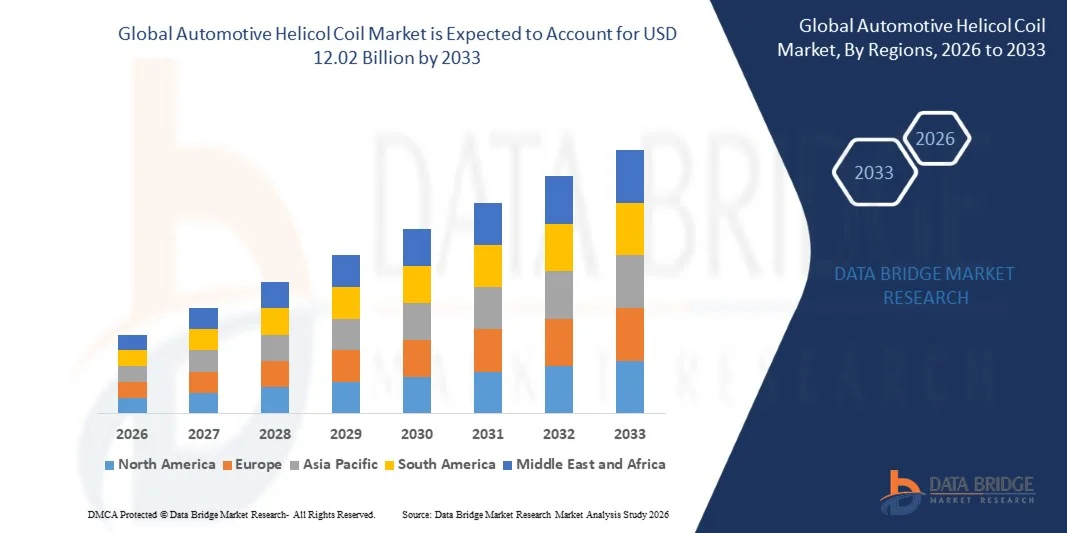
As per Data Bridge Market Research analysis, the Automotive Helicol Coil Market was valued at USD 5.18 billion in 2025 and is projected to reach USD 12.02 billion by 2033, growing at a CAGR of 5.50% from 2026 to 2033. The market is experiencing steady growth driven by increasing vehicle production, rising demand for durable threaded fastening solutions, and the growing use of lightweight materials in automotive manufacturing. Helicol coils are widely utilized to reinforce threaded connections in engine components, transmission systems, chassis assemblies, and other critical automotive applications where reliability and resistance to wear are essential.
The increasing focus on vehicle performance, safety, and longevity, combined with the growing adoption of aluminum and other lightweight alloys in modern vehicles, is encouraging automotive manufacturers to integrate helicol coils for enhanced thread strength and load-bearing capacity. In addition, the expansion of electric vehicle production and advancements in automotive engineering are creating new opportunities for precision fastening solutions. Helicol coils provide cost-effective thread repair and reinforcement capabilities, helping manufacturers improve component durability, reduce maintenance requirements, and enhance overall vehicle reliability across passenger and commercial vehicle segments.
Market Size & Forecast
- Global Market Value (2025): USD 5.18 Billion
- Expected Market Value (2033): USD 12.02 Billion
- Forecast CAGR (2026–2033): 5.50%
- Leading Region in 2025: North America
- Fastest Growing Region: Asia-Pacific
Key Market Trends & Insights
- North America dominated the automotive helicol coil market with the largest revenue share of 36.8% in 2025, supported by strong automotive manufacturing activities, increasing integration of lightweight components, and rising demand for high-performance fastening and thread reinforcement technologies across passenger and commercial vehicles.
- Asia-Pacific is expected to be the fastest-growing region, recording a CAGR of 6.4% from 2026 to 2033. Growth is driven by expanding vehicle production, rapid growth of the electric vehicle industry, increasing automotive manufacturing investments, and rising demand for cost-effective fastening solutions across China, India, Japan, and South Korea.
- The Below 4 Inch segment held the largest market revenue share of approximately 68.5% in 2025 driven by its extensive use in passenger vehicles, motorcycles, engine assemblies, transmission housings, and lightweight automotive components. These helicol coils are widely preferred due to their compatibility with compact threaded applications and increasing adoption in modern vehicle platforms utilizing aluminum and magnesium alloys.
- The Above 4 Inch segment is projected to register the fastest growth at a CAGR of 6.2% from 2026 to 2033, driven by increasing deployment in heavy-duty vehicles, commercial transportation systems, and large structural automotive assemblies requiring enhanced load-bearing capacity and thread durability. Growing investments in heavy vehicle production and industrial transportation fleets are supporting segment expansion.
- The Cold Cooling segment held the largest market revenue share of approximately 61.8% in 2025 driven by its ability to deliver superior dimensional accuracy, improved thread consistency, and enhanced mechanical properties. Automotive manufacturers increasingly prefer cold-processed helicol coils for precision fastening applications in engines, suspension systems, and electric vehicle components.
- The Hot Cooling segment is projected to register the fastest growth at a CAGR of 5.9% from 2026 to 2033, driven by growing demand for high-strength threaded inserts used in heavy-duty automotive applications and large structural components exposed to elevated operating temperatures and mechanical stress.
- The Four-Wheeler segment held the largest market revenue share of approximately 57.4% in 2025 driven by high global passenger vehicle production and increasing utilization of thread reinforcement solutions across engines, transmissions, battery packs, and chassis assemblies. The growing adoption of lightweight materials in passenger vehicles is further accelerating demand for helicol coil installations.
- The Heavy Vehicle segment is projected to register the fastest growth at a CAGR of 6.4% from 2026 to 2033, driven by rising commercial vehicle production, expanding logistics networks, and increasing demand for durable fastening systems capable of withstanding continuous vibration and high-load operating conditions.
- The Automotive OEM segment held the largest market revenue share of approximately 72.1% in 2025 driven by large-scale integration of helicol coils during vehicle manufacturing processes to improve thread reliability, component lifespan, and assembly performance. Increasing production of electric vehicles and lightweight automotive platforms is further strengthening OEM demand for advanced thread reinforcement technologies.
- The Automotive Aftermarket segment is projected to register the fastest growth at a CAGR of 6.0% from 2026 to 2033, driven by increasing vehicle maintenance activities, rising average vehicle age, and growing adoption of thread repair solutions that enable restoration of damaged components without complete replacement. Expanding automotive repair networks globally are further supporting segment growth.
Report Scope and Automotive Helicol Coil Market Segmentation
|
Attributes |
Automotive Helicol Coil Key Market Insights |
|
Segments Covered |
|
|
Countries Covered |
North America
Europe
Asia-Pacific
Middle East and Africa
South America
|
|
Key Market Players |
• Kilen Springs (Sweden) |
|
Market Opportunities |
• Growing Adoption Of Lightweight Automotive Materials |
|
Value Added Data Infosets |
In addition to the market insights such as market value, growth rate, market segments, geographical coverage, market players, and market scenario, the market report curated by the Data Bridge Market Research team includes in-depth expert analysis, import/export analysis, pricing analysis, production consumption analysis, and pestle analysis. |
What is the Key Trend in the Automotive Helicol Coil Market?
Trend: Growing Adoption Of Lightweight Materials And Precision Thread Reinforcement In Vehicles
Increasing demand for lightweight, high-strength, and durable fastening solutions across automotive manufacturing is driving the adoption of helicol coils in critical vehicle assemblies. Automakers are increasingly replacing traditional steel components with lightweight materials such as aluminum and magnesium alloys to improve fuel efficiency and reduce vehicle weight. However, these materials often possess lower thread strength, creating a growing need for reinforced threaded inserts capable of maintaining structural integrity under high-load operating conditions.
In modern passenger and commercial vehicles, manufacturers are integrating helicol coils, For instance in engine blocks, transmission housings, suspension systems, and brake assemblies, to improve thread durability and resistance to vibration-induced wear. Electric vehicle manufacturers are also utilizing thread reinforcement solutions in battery enclosures and lightweight structural components to ensure reliable fastening while minimizing material fatigue.
The rapid expansion of electric mobility and advanced vehicle architectures is increasing demand for precision-engineered fastening systems capable of supporting long-term reliability and reduced maintenance requirements. In addition, automotive aftermarket repair facilities continue to rely on helicol thread repair systems for restoring damaged threads without replacing expensive components. Growing industry validation through EV production programs in 2025 showed that lightweight aluminum battery housing assemblies reinforced with threaded inserts demonstrated approximately 20–30% higher thread retention strength compared to conventional threaded designs under repeated stress testing conditions.
Automotive Helicol Coil Market Dynamics
Key Market Driver: Rising Adoption Of Lightweight Automotive Components
Automotive manufacturers worldwide are under increasing pressure to improve fuel efficiency, reduce vehicle emissions, and comply with stringent environmental regulations. The growing use of lightweight materials such as aluminum alloys in vehicle production is creating significant demand for thread reinforcement technologies that can maintain fastening reliability under dynamic operating conditions.
Automotive OEMs are increasingly deploying helicol coils to strengthen threaded joints in lightweight engine components, transmission systems, and structural assemblies. For instance, modern electric vehicles extensively utilize aluminum battery casings and lightweight chassis components where reinforced threaded inserts help prevent thread stripping and improve assembly longevity.
Similarly, commercial vehicle manufacturers are incorporating thread reinforcement solutions into high-load applications exposed to continuous vibration and mechanical stress. Real-world automotive engineering studies conducted in Europe and North America during 2024 demonstrated that helicol-reinforced aluminum assemblies improved thread life by nearly 2–3 times compared to conventional tapped threads in high-cycle operational environments.
Key Restraint/Challenge: Availability Of Alternative Thread Reinforcement Solutions And Cost Sensitivity
The automotive helicol coil market faces challenges from the availability of alternative fastening technologies, including solid threaded inserts, self-tapping fasteners, and advanced mechanical fastening systems. These alternatives often compete directly with helicol coils in applications requiring thread reinforcement or repair, particularly in cost-sensitive manufacturing environments.
In addition, fluctuations in stainless steel and specialty alloy prices can increase production costs, impacting profitability for manufacturers and affordability for end users. Automotive suppliers operating under strict cost optimization targets may limit adoption in lower-value applications where conventional fastening methods are considered sufficient.
Commercial benchmarking studies indicate that alternative threaded insert solutions can offer installation time reductions of approximately 10–15% in certain automated assembly environments, creating competitive pressure on traditional helicol coil deployment in high-volume production facilities.
Key Market Opportunity: Expansion Of Electric Vehicle Manufacturing And Automotive Aftermarket Repairs
The rapid growth of electric vehicle production and increasing vehicle parc worldwide are creating substantial opportunities for helicol coil manufacturers. Modern EV platforms require extensive use of lightweight materials and precision fastening systems, creating demand for thread reinforcement technologies capable of ensuring long-term reliability under varying thermal and mechanical loads.
Automotive companies are increasingly integrating helicol coils, For instance in battery packs, electric drive units, and lightweight structural assemblies, to improve durability while reducing the risk of thread failure. In the automotive aftermarket, rising vehicle age and increasing repair activities are driving demand for thread restoration solutions that allow damaged components to be repaired rather than replaced.
In addition, advancements in corrosion-resistant alloys and automated installation technologies are improving product performance and expanding adoption across passenger vehicles, commercial fleets, and performance vehicles. EV manufacturing programs conducted in 2025 across China, Germany, and the U.S. reported growing use of reinforced threaded inserts in battery housing assemblies, contributing to fastening reliability improvements of approximately 15–25% in high-vibration operating environments.
How is the Automotive Helicol Coil Market Segmented?
The market is segmented on the basis of diameter, process method, application, and end user.
• By Diameter
On the basis of diameter, the market is segmented into Below 4 Inch and Above 4 Inch. The Below 4 Inch segment held the largest market revenue share of approximately 68.5% in 2025 driven by its extensive use in passenger vehicles, motorcycles, engine assemblies, transmission housings, and lightweight automotive components. These helicol coils are widely preferred due to their compatibility with compact threaded applications and increasing adoption in modern vehicle platforms utilizing aluminum and magnesium alloys.
The Above 4 Inch segment is projected to register the fastest growth at a CAGR of 6.2% from 2026 to 2033, driven by increasing deployment in heavy-duty vehicles, commercial transportation systems, and large structural automotive assemblies requiring enhanced load-bearing capacity and thread durability. Growing investments in heavy vehicle production and industrial transportation fleets are supporting segment expansion.
• By Process Method
On the basis of process method, the market is segmented into Hot Cooling and Cold Cooling. The Cold Cooling segment held the largest market revenue share of approximately 61.8% in 2025 driven by its ability to deliver superior dimensional accuracy, improved thread consistency, and enhanced mechanical properties. Automotive manufacturers increasingly prefer cold-processed helicol coils for precision fastening applications in engines, suspension systems, and electric vehicle components.
The Hot Cooling segment is projected to register the fastest growth at a CAGR of 5.9% from 2026 to 2033, driven by growing demand for high-strength threaded inserts used in heavy-duty automotive applications and large structural components exposed to elevated operating temperatures and mechanical stress.
• By Application
On the basis of application, the market is segmented into Two-Wheeler, Four-Wheeler, and Heavy Vehicle. The Four-Wheeler segment held the largest market revenue share of approximately 57.4% in 2025 driven by high global passenger vehicle production and increasing utilization of thread reinforcement solutions across engines, transmissions, battery packs, and chassis assemblies. The growing adoption of lightweight materials in passenger vehicles is further accelerating demand for helicol coil installations.
The Heavy Vehicle segment is projected to register the fastest growth at a CAGR of 6.4% from 2026 to 2033, driven by rising commercial vehicle production, expanding logistics networks, and increasing demand for durable fastening systems capable of withstanding continuous vibration and high-load operating conditions.
• By End User
On the basis of end user, the market is segmented into Automotive OEM and Automotive Aftermarket. The Automotive OEM segment held the largest market revenue share of approximately 72.1% in 2025 driven by large-scale integration of helicol coils during vehicle manufacturing processes to improve thread reliability, component lifespan, and assembly performance. Increasing production of electric vehicles and lightweight automotive platforms is further strengthening OEM demand for advanced thread reinforcement technologies.
The Automotive Aftermarket segment is projected to register the fastest growth at a CAGR of 6.0% from 2026 to 2033, driven by increasing vehicle maintenance activities, rising average vehicle age, and growing adoption of thread repair solutions that enable restoration of damaged components without complete replacement. Expanding automotive repair networks globally are further supporting segment growth.
Which Region Holds the Largest Share of the Automotive Helicol Coil Market?
North America Automotive Helicol Coil Market Insight
North America dominated the automotive helicol coil market with the largest revenue share of 36.8% in 2025, supported by strong automotive manufacturing activities, increasing adoption of lightweight vehicle components, and rising demand for durable thread reinforcement solutions. Automotive OEMs across the region are increasingly utilizing helicol coils in engine systems, transmission assemblies, and electric vehicle battery enclosures to improve fastening reliability and component lifespan. The presence of major automotive manufacturers, coupled with growing investments in electric mobility and advanced vehicle engineering, continues to support market expansion across both passenger and commercial vehicle segments.
U.S. Automotive Helicol Coil Market Insight
The U.S. automotive helicol coil market captured the largest revenue share in 2025 within North America, fueled by high vehicle production volumes and growing integration of lightweight materials in automotive manufacturing. Automakers are increasingly focusing on improving structural durability while reducing vehicle weight, driving demand for thread reinforcement technologies in aluminum and magnesium components. The rapid expansion of electric vehicle manufacturing and strong aftermarket repair activities further contribute to market growth. Moreover, increasing investments in advanced automotive engineering and precision fastening systems are supporting broader adoption of helicol coil solutions across the country.
Europe Automotive Helicol Coil Market Insight
The Europe automotive helicol coil market is expected to witness the fastest growth rate from 2026 to 2033, primarily driven by stringent vehicle emission regulations and increasing adoption of lightweight materials across automotive manufacturing. European automakers are aggressively pursuing weight reduction strategies to improve fuel efficiency and electric vehicle performance, increasing demand for thread reinforcement technologies. The region is experiencing strong growth in electric vehicle production and advanced automotive engineering applications, with helicol coils being widely utilized in critical structural and powertrain assemblies.
U.K. Automotive Helicol Coil Market Insight
The U.K. automotive helicol coil market is expected to witness the fastest growth rate from 2026 to 2033, driven by growing electric vehicle production and increasing demand for high-performance fastening solutions. Automotive manufacturers are increasingly adopting lightweight alloys and advanced engineering materials that require enhanced thread durability and load-bearing performance. In addition, the country's expanding automotive aftermarket sector and rising vehicle maintenance activities are supporting increased adoption of thread repair and reinforcement solutions across both passenger and commercial vehicles.
Germany Automotive Helicol Coil Market Insight
The Germany automotive helicol coil market is expected to witness the fastest growth rate from 2026 to 2033, fueled by the country's strong automotive manufacturing base and leadership in premium vehicle production. German automakers are increasingly integrating lightweight materials and advanced structural components into vehicle designs, creating strong demand for precision thread reinforcement systems. The rapid development of electric vehicles and next-generation mobility platforms is further accelerating adoption. In addition, Germany’s focus on engineering excellence, durability, and manufacturing efficiency continues to support market growth.
Asia-Pacific Automotive Helicol Coil Market Insight
The Asia-Pacific automotive helicol coil market is expected to witness the fastest growth rate from 2026 to 2033, supported by expanding vehicle production, rapid industrialization, and increasing investments in electric mobility across countries such as China, Japan, India, and South Korea. The region’s growing automotive manufacturing sector is driving demand for cost-effective and durable fastening technologies capable of supporting large-scale production requirements. Furthermore, increasing adoption of lightweight materials and rising automotive aftermarket activities are contributing significantly to market expansion.
Japan Automotive Helicol Coil Market Insight
The Japan automotive helicol coil market is expected to witness the fastest growth rate from 2026 to 2033 due to the country's advanced automotive engineering capabilities and strong focus on vehicle reliability. Japanese automakers are increasingly utilizing helicol coils in precision automotive assemblies to enhance thread strength and long-term component durability. The growing adoption of hybrid and electric vehicles is further increasing demand for reinforced fastening solutions in battery systems and lightweight vehicle structures. Moreover, Japan’s emphasis on quality manufacturing and technological innovation continues to support market growth.
China Automotive Helicol Coil Market Insight
The China automotive helicol coil market accounted for the largest market revenue share in Asia-Pacific in 2025, attributed to the country's position as the world's largest automotive manufacturing hub and rapidly expanding electric vehicle industry. China continues to witness strong demand for thread reinforcement solutions across passenger vehicles, commercial vehicles, and electric mobility platforms. The growing use of lightweight aluminum components, increasing vehicle production volumes, and strong presence of domestic automotive manufacturers are key factors driving market growth. In addition, government initiatives promoting electric vehicle adoption and advanced manufacturing technologies are further accelerating market expansion in China.
Which are the Top Companies in Automotive Helicol Coil Market?
The Automotive Helicol Coil industry is primarily led by well-established companies, including:
• Kilen Springs (Sweden)
• GKN Automotive Limited (U.K.)
• Sogefi SpA (Italy)
• NHK of America Suspension Components, Inc. (U.S.)
• Muhr und Bender KG (Germany)
• Betts Spring (U.S.)
• MW Industries, Inc. (U.S.)
• Draco Spring Mfg. Co. (U.S.)
• UNI AUTO PARTS MANUFACTURE CO., LTD. (Taiwan)
• MITSUBISHI STEEL MFG. CO., LTD. (Japan)
• Lesjöfors Automotive (Sweden)
• Fuda Group (China)
• Clifford Springs Ltd (U.K.)
• Hendrickson USA, L.L.C. (U.S.)
• Jamna Auto Industries Ltd (India)

- Interactive Data Analysis Dashboard
- Company Analysis Dashboard for high growth potential opportunities
- Research Analyst Access for customization & queries
- Competitor Analysis with Interactive dashboard
- Latest News, Updates & Trend analysis
- Harness the Power of Benchmark Analysis for Comprehensive Competitor Tracking
Data collection and base year analysis are done using data collection modules with large sample sizes. The stage includes obtaining market information or related data through various sources and strategies. It includes examining and planning all the data acquired from the past in advance. It likewise envelops the examination of information inconsistencies seen across different information sources. The market data is analysed and estimated using market statistical and coherent models. Also, market share analysis and key trend analysis are the major success factors in the market report. To know more, please request an analyst call or drop down your inquiry.
The key research methodology used by DBMR research team is data triangulation which involves data mining, analysis of the impact of data variables on the market and primary (industry expert) validation. Data models include Vendor Positioning Grid, Market Time Line Analysis, Market Overview and Guide, Company Positioning Grid, Patent Analysis, Pricing Analysis, Company Market Share Analysis, Standards of Measurement, Global versus Regional and Vendor Share Analysis. To know more about the research methodology, drop in an inquiry to speak to our industry experts.
Data Bridge Market Research is a leader in advanced formative research. We take pride in servicing our existing and new customers with data and analysis that match and suits their goal. The report can be customized to include price trend analysis of target brands understanding the market for additional countries (ask for the list of countries), clinical trial results data, literature review, refurbished market and product base analysis. Market analysis of target competitors can be analyzed from technology-based analysis to market portfolio strategies. We can add as many competitors that you require data about in the format and data style you are looking for. Our team of analysts can also provide you data in crude raw excel files pivot tables (Fact book) or can assist you in creating presentations from the data sets available in the report.













