


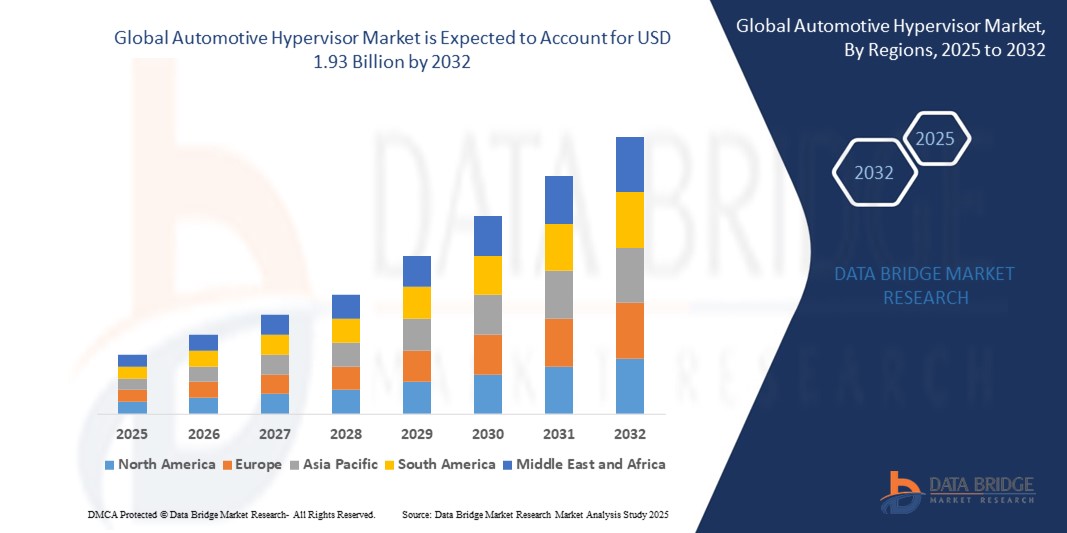
Global Automotive Hypervisor Market Size
- The Global Automotive Hypervisor Market size was valued at USD 333.2 Million in 2024 and is expected to reach USD 1.93 billion by 2032, at a CAGR of 28.5% during the forecast period
- The Market expansion is driven by Key technological trends include the adoption of Type 1 hypervisors, which run directly on vehicle hardware, offering high performance and security.
- Growing adoption of advanced driver-assistance systems (ADAS) and autonomous vehicles.
Global Automotive Hypervisor Market Analysis
- The rising adoption of ADAS features—such as lane assist, adaptive cruise control, and automated parking—requires complex, real-time computing environments that automotive hypervisors can manage efficiently.
- The growth in electric and self-driving cars demands a consolidated electronic control system. Hypervisors enable such consolidation by running multiple virtual machines on shared hardware.
- North America holds the largest market share, accounting for 44.5% of global revenue in 2025, driven by Advanced Driver Assistance Systems.
- Asia-Pacific is anticipated to be the fastest-growing region during the forecast period, fuelled by the growth in electric and self-driving cars demands a consolidated electronic control system. Hypervisors enable such consolidation by running multiple virtual machines on shared hardware.
- The Type 1 segment is expected to dominate the market with a share of 59.1% in 2025 due to Increasing ECU Consolidation.
Report Scope and Global Automotive Hypervisor Market Segmentation
|
Attributes |
Global Automotive Hypervisor Market Insights |
|
Segments Covered |
|
|
Countries Covered |
North America
Europe
Asia-Pacific
Middle East and Africa
South America
|
|
Key Market Players |
|
|
Market Opportunities |
|
|
Value Added Data Infosets |
In addition to the insights on market scenarios such as market value, growth rate, segmentation, geographical coverage, and major players, the market reports curated by the Data Bridge Market Research also include in-depth expert analysis, pricing analysis, brand share analysis, consumer survey, demography analysis, supply chain analysis, value chain analysis, raw material/consumables overview, vendor selection criteria, PESTLE Analysis, Porter Analysis, and regulatory framework. |
Global Automotive Hypervisor Market Trends
“Sustainability and Eco-Friendly Materials”
- Key technological trends include the adoption of Type 1 hypervisors, which run directly on vehicle hardware, offering high performance and security. These are preferred for safety-critical applications like ADAS and autonomous driving systems.
- For instance, In April 2024, BlackBerry partnered with ETAS GmbH to enhance safety-critical functions in next-generation software-defined vehicles.
- Vehicle manufacturers are reducing the number of Electronic Control Units (ECUs) in cars to save cost and improve efficiency. Hypervisors allow multiple functions to run on fewer ECUs without compromising system isolation.
- Hypervisors offer a layer of isolation between systems, improving cybersecurity by reducing vulnerabilities between mission-critical and non-critical applications.
- With vehicles increasingly becoming connected to external infrastructure and devices, hypervisors enable the safe separation of infotainment from vehicle control systems.
Global Automotive Hypervisor Market Dynamics
Driver
“Growing Adoption of Connected and Autonomous Vehicles”
- The rising integration of advanced driver-assistance systems (ADAS), infotainment, and connectivity features in modern vehicles has driven demand for hypervisors that can support multiple operating systems and applications simultaneously.
- For instance, in February 2024, Elektrobit announced enhancements to its EB tresos and EB corbos software platforms, enabling greater compatibility with automotive hypervisors for next-gen vehicle E/E architectures.
- Hypervisors allow for efficient hardware utilization by running multiple virtual machines (VMs), ensuring functional safety and isolation between critical and non-critical vehicle functions.
- OEMs such as BMW and Hyundai have accelerated investments in domain controller architectures that depend heavily on hypervisors to manage real-time tasks, connectivity, and security.
Restraint/Challenge
“High Complexity in System Integration and Compliance Requirements”
- Deploying hypervisors in automotive environments requires meticulous integration with Electronic Control Units (ECUs), sensor fusion systems, and real-time OS platforms, which increases development complexity and time.
- For example, in 2025, Green Hills Software, a leader in embedded safety software, continues to provide hypervisor solutions tailored for ISO 26262 ASIL-D certification. However, customization and compliance validation with safety standards add to engineering and verification costs.
- Ensuring deterministic performance and fault tolerance across multiple virtual environments poses a major challenge, especially in safety-critical applications such as braking or steering systems.
- Moreover, regulatory requirements across regions (e.g., UNECE WP.29, ISO 21434) demand rigorous cybersecurity and software update capabilities, further complicating hypervisor deployment and lifecycle management.
Global Automotive Hypervisor Market Scope
The market is segmented based on Type, Level of Autonomous Driving, Bus System, Vehicle Type, End User, Product, Sales Channel.
- By Type
On the basis of Type, the Global Automotive Hypervisor Market is segmented into Type 1, and Type 2. The Type 1 segment dominates the market, The growing market for Increasing ECU Consolidation is the reason.
The Type 2 segment, encompassing Type 1, is projected to grow at a robust CAGR of 12.2% from 2025 to 2032, fueled by the growth in electric and self-driving cars demands a consolidated electronic control system.
- By Level of Autonomous Driving
On the basis of Level of Autonomous Driving, the market is segmented into Autonomous Vehicles, and Semi-Autonomous Vehicles. The Autonomous Vehicles segment holds the largest market share 51.2 in 2025, driven by Enhanced Vehicle Cybersecurity.
The Semi-Autonomous Vehicles segment is anticipated to witness the fastest CAGR of 11.1% from 2025 to 2032, propelled by Rise of Connected Vehicles.
- By Bus System
On the basis of Bus System, the market is segmented into Can, Ethernet, Flexray, Lin. The Can segment holds the largest market share in 2025, driven by With vehicles increasingly becoming connected to external infrastructure and devices, hypervisors enable the safe separation of infotainment from vehicle control systems.
The Ethernet segment is anticipated to witness the fastest CAGR of 15.1% from 2025 to 2032, propelled by OEM Push for Cost Optimization.
- By Vehicle Type
On the basis of Vehicle Type, the market is segmented into Passenger Car, Light Commercial Vehicle (LCV), Heavy Commercial Vehicles. The Passenger Car segment holds the largest market share in 2025, driven by the rising adoption of ADAS features—such as lane assist, adaptive cruise control, and automated parking—requires complex, real-time computing environments that automotive hypervisors can manage efficiently.
The Light Commercial Vehicle segment is anticipated to witness the fastest CAGR of 12.1% from 2025 to 2032, propelled by Electric and Autonomous Vehicles.
- By End User
On the basis of End User, the market is segmented into Economy Vehicles, Mid-Priced Vehicle, Luxury Vehicles. The Economy Vehicles segment holds the largest market share in 2025, driven by Automakers aim to reduce hardware dependency and lower development costs. Virtualization through hypervisors supports the reuse of software across vehicle platforms, enhancing scalability and cost efficiency.
The Mid-Priced Vehicle segment is anticipated to witness the fastest CAGR of 13.2% from 2025 to 2032, propelled by Regulatory Compliance.
- By Product
On the basis of Product, the market is segmented into Native (Bare-Metal) Hypervisors, Hosted Hypervisors. The Native segment holds the largest market share in 2025, driven by Stricter automotive safety standards like ISO 26262 push manufacturers to ensure robust and fail-safe software architecture—hypervisors offer a strong foundation for functional safety compliance.
The Hypervisors segment is anticipated to witness the fastest CAGR of 13.2% from 2025 to 2032, propelled by Rise of Connected Vehicles.
- By Sales Channel
On the basis of Sales Channel, the market is segmented into Original Equipment Manufacturers (OEMs), Aftermarket. The OEMs segment holds the largest market share in 2025, driven by increasing ECU Consolidation.
The Aftermarket segment is anticipated to witness the fastest CAGR of 13.7% from 2025 to 2032, propelled by Enhanced Vehicle Cybersecurity.
Global Automotive Hypervisor Market Regional Analysis
- Asia Pacific dominates the Global Automotive Hypervisor Market, capturing a substantial revenue share of 41.9% in 2025, driven by the rising adoption of ADAS features—such as lane assist, adaptive cruise control, and automated parking—requires complex, real-time computing environments that automotive hypervisors can manage efficiently.
- The growth in electric and self-driving cars demands a consolidated electronic control system. Hypervisors enable such consolidation by running multiple virtual machines on shared hardware.
U.S. Global Automotive Hypervisor Market Insight
The United States accounts for an impressive 36.9% of the North American market share in 2025, fueled by Market Expansion in Emerging Economies.
Europe Global Automotive Hypervisor Market Insight
The European Global Automotive Hypervisor Market is projected to grow at a significant CAGR throughout the forecast period, driven by The ability to run both real-time and general-purpose operating systems side by side is a major opportunity for Tier 1 suppliers and OEMs building complex multi-domain systems.
U.K. Global Automotive Hypervisor Market Insight
The United Kingdom’s Global Automotive Hypervisor Market is anticipated to grow with vehicles increasingly becoming connected to external infrastructure and devices, hypervisors enable the safe separation of infotainment from vehicle control systems.
Germany Global Automotive Hypervisor Market Insight
Germany’s Global Automotive Hypervisor Market is expected to expand at a considerable CAGR, fueled by Automakers aim to reduce hardware dependency and lower development costs. Virtualization through hypervisors supports the reuse of software across vehicle platforms, enhancing scalability and cost efficiency.
Asia-Pacific Global Automotive Hypervisor Market Insight
The Asia-Pacific region is poised to register the fastest CAGR of 31.8% in 2025, driven by Hypervisors offer a layer of isolation between systems, improving cybersecurity by reducing vulnerabilities between mission-critical and non-critical applications.
Japan Global Automotive Hypervisor Market Insight
The Japan’s Global Automotive Hypervisor Market is gaining significant momentum, driven by With vehicles increasingly becoming connected to external infrastructure and devices, hypervisors enable the safe separation of infotainment from vehicle control systems.
China Global Automotive Hypervisor Market Insight
The China commands the largest market share in the Asia-Pacific region in 2025, The growth in electric and self-driving cars demands a consolidated electronic control system. Hypervisors enable such consolidation by running multiple virtual machines on shared hardware.
Global Automotive Hypervisor Market Share
The automotive Hypervisor Market is primarily led by well-established companies, including:
- Siemens Digital Industries Software.
- Renesas Electronics Corporation.
- NXP Semiconductors.
- Continental AG
- Wind River Systems, Inc.
- Green Hills Software
- Sasken Technologies Ltd
- DENSO CORPORATION.
- Visteon Corporation.
- Nutanix
- LUXOFT
- Panasonic Corporation of North America.
- HARMAN International.
- KPIT
- TATA ELXSI.
- SYSGO GmbH
- Open Synergy GmbH
- HANGSHENG TECHNOLOGY GmbH
- The Qt Company
- IBM Corporation
- Qualcomm Technologies, Inc.
- VMware, Inc
- Texas Instruments Incorporated.
Latest Developments in Global Automotive Hypervisor Market
- In April 2024: BlackBerry partnered with ETAS GmbH to enhance safety-critical functions in next-generation software-defined vehicles.
- In January 2024: Panasonic launched a high-performance compute system that consolidates multiple computing units into a single platform, improving functions like driving support and entertainment.
- In June 2024: Qualcomm acquired virtualization assets, including the COQOS Hypervisor, from Open Synergy GmbH to advance solutions for managing multiple software environments on a single hardware platform.
- In April 2022: Renesas introduced an Automotive ECU Virtualization platform enabling designers to integrate multiple applications into a single ECU, ensuring safe and secure separation.
- In April 2022: NXP launched the S32G vehicle network processors to address real-time and application development challenges in software-defined vehicles.

- Interactive Data Analysis Dashboard
- Company Analysis Dashboard for high growth potential opportunities
- Research Analyst Access for customization & queries
- Competitor Analysis with Interactive dashboard
- Latest News, Updates & Trend analysis
- Harness the Power of Benchmark Analysis for Comprehensive Competitor Tracking
Data collection and base year analysis are done using data collection modules with large sample sizes. The stage includes obtaining market information or related data through various sources and strategies. It includes examining and planning all the data acquired from the past in advance. It likewise envelops the examination of information inconsistencies seen across different information sources. The market data is analysed and estimated using market statistical and coherent models. Also, market share analysis and key trend analysis are the major success factors in the market report. To know more, please request an analyst call or drop down your inquiry.
The key research methodology used by DBMR research team is data triangulation which involves data mining, analysis of the impact of data variables on the market and primary (industry expert) validation. Data models include Vendor Positioning Grid, Market Time Line Analysis, Market Overview and Guide, Company Positioning Grid, Patent Analysis, Pricing Analysis, Company Market Share Analysis, Standards of Measurement, Global versus Regional and Vendor Share Analysis. To know more about the research methodology, drop in an inquiry to speak to our industry experts.
Data Bridge Market Research is a leader in advanced formative research. We take pride in servicing our existing and new customers with data and analysis that match and suits their goal. The report can be customized to include price trend analysis of target brands understanding the market for additional countries (ask for the list of countries), clinical trial results data, literature review, refurbished market and product base analysis. Market analysis of target competitors can be analyzed from technology-based analysis to market portfolio strategies. We can add as many competitors that you require data about in the format and data style you are looking for. Our team of analysts can also provide you data in crude raw excel files pivot tables (Fact book) or can assist you in creating presentations from the data sets available in the report.













