What is the Automotive In-Cabin Air Quality Market Size and Growth Rate?
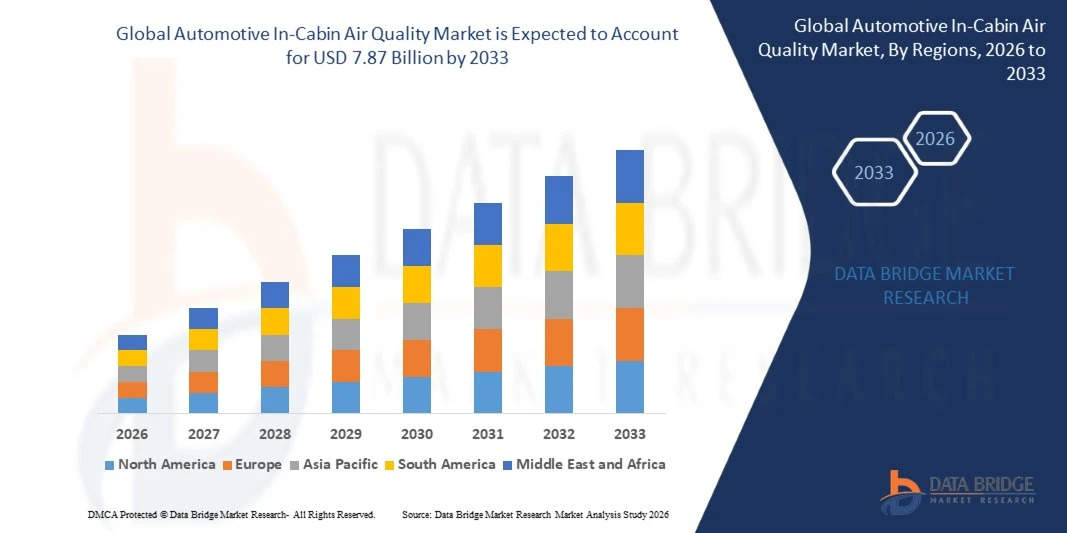
- As per Data Bridge Market Research analysis, the automotive in-cabin air quality market was valued at USD 3.09 billion in 2025 and is projected to reach USD 7.87 billion by 2033, growing at a CAGR of 12.40% from 2026 to 2033.
- The market is experiencing rapid growth driven by rising urban air pollution, increasing consumer awareness of cabin health, and expanding integration of sensors, filters, and purification technologies in new vehicles.
- The increasing shift toward healthier cabins, connected vehicles, and electric platforms, combined with stricter cabin filtration standards and growing demand for allergen, odor, and particle control, is supporting market adoption. Cabin air solutions are being applied across passenger cars, commercial vehicles, and shared mobility fleets, offering occupants cleaner air through automotive in-cabin air quality systems, air quality improvement solutions, and cabin air purification technologies.
Market Size & Forecast
- Global Market Value (2025): USD 3.09 Billion
- Expected Market Value (2033): USD 7.87 Billion
- Forecast CAGR (2026–2033): 12.40%
- Leading Region in 2025: Asia-Pacific
- Fastest Growing Region: Asia-Pacific
What are the Major Takeaways of the Automotive In-Cabin Air Quality Market?
- Asia-Pacific dominated the automotive in-cabin air quality market with the largest revenue share of 39.80% in 2025, supported by high vehicle production, severe urban air pollution, and strong cabin filtration standards in China.
- Asia-Pacific is also expected to be the fastest-growing region at a CAGR of 14.20% from 2026 to 2033, fueled by rising electric vehicle output, growing middle-class car ownership, and increasing health awareness.
- The HVAC-integrated systems segment led the market with a 52.60% share in 2025, driven by factory fitment, compact design, and seamless control of airflow and filtration.
- Cloud-based monitoring systems are the fastest-growing type, projected to register a CAGR of 15.80%, reflecting rising demand for connected sensing, data analytics, and over-the-air updates.
- The passenger cars segment dominated the vehicle category with a 78.40% revenue share in 2025, led by high volumes and strong consumer demand for comfort and health features.
- Particulate filtration accounted for 44.30% of the market share in 2025, preferred for removing PM2.5, pollen, and dust from outside and inside air.
- The VOC & gas removal segment is the fastest-growing function, with a CAGR of 14.60%, driven by concern over odors, nitrogen oxides, and chemical emissions from interior materials.
Report Scope and Automotive In-Cabin Air Quality Market Segmentation
|
Attributes |
Automotive In-Cabin Air Quality Key Market Insights |
|
Segments Covered |
|
|
Countries Covered |
North America
Europe
Asia-Pacific
Middle East and Africa
South America
|
|
Key Market Players |
|
|
Market Opportunities |
|
|
Value Added Data Infosets |
In addition to the market insights such as market value, growth rate, market segments, geographical coverage, market players, and market scenario, the market report curated by the Data Bridge Market Research team includes in-depth expert analysis, import/export analysis, pricing analysis, production consumption analysis, and pestle analysis. |
What is the Key Trend in the Automotive In-Cabin Air Quality Market?
- In-cabin air quality is increasingly evolving from a basic pollen filter into an intelligent system, combining particle, gas, and humidity sensors with HVAC control, multi-layer filtration, and cloud-connected monitoring.
- For instance, in September 2026, the MAHLE company presented the CareMetix Natural cabin air filter at Automechanika 2026, using sheep’s wool in the filter medium while removing particles and pollutants and reducing volatile organic compounds and odors, showing the shift toward sustainable materials without compromising filtration performance
- Sensor-driven control is gaining traction, as vehicles use air quality data to switch between fresh air and recirculation, trigger purification, and alert occupants when filters need replacement.
- Suppliers are increasingly offering combined solutions, as automakers compare systems on filtration efficiency, energy use, noise, packaging space, and compatibility with electric vehicle thermal management.
- For instance, in March 2026, according to Sensirion’s 2025 Annual Report, demand for vehicle-interior air quality sensor solutions is growing, with additional OEM nominations for next-generation automotive environmental sensing, highlighting rising adoption of cabin sensors by automakers and their suppliers across vehicle platforms
- As sensor accuracy, connected platforms, sustainable filter materials, and electric vehicle architectures continue to advance, in-cabin air quality systems are expected to expand beyond filtration into personalized, data-driven cabin health management.
What are the Key Drivers of the Automotive In-Cabin Air Quality Market?
- Rising urban air pollution and growing awareness of exposure during commutes have significantly increased demand for cabin technologies that clean the air that drivers and passengers breathe.
- For instance, in April 2026, according to the Journal of the Air & Waste Management Association via PubMed, a real-world driving study found that recirculation mode suppressed ambient fine particle infiltration but allowed cabin carbon dioxide to exceed 4000 ppm, highlighting the need for optimized ventilation strategies and sensor-based control.
- Automakers, suppliers, fleet operators, and ride-hailing companies are adopting cabin air technologies to improve occupant comfort, differentiate vehicles, meet regulations, and support premium and electric vehicle positioning.
- For instance, in June 2025, MANN+HUMMEL announced an expansion of cabin air filter manufacturing capacity in Marklkofen, Germany, targeting a 25% increase in HEPA media output to support Euro 7 OEM program ramp-ups, reflecting stronger regulatory demand for high-performance filtration.
- With governments tightening standards and automakers adding health features to new models, in-cabin air quality systems can gain wider visibility, qualification, and repeat orders across passenger and commercial vehicle programs.
What Factors Are Challenging the Growth of the Automotive In-Cabin Air Quality Market?
- In-cabin air quality systems add cost, weight, and packaging complexity to vehicles, and automakers must balance purification performance with energy use and price pressure.
- For instance, in September 2025, according to PubMed, a study published in Environmental Science: Processes & Impacts found that built-in cabin filter efficiency for particles drops significantly as vehicle fan speed increases, and a small portable purifier showed no added reduction over the stock filter.
- These performance and cost limits can slow adoption in entry-level vehicles, while filter aging and lack of replacement awareness may reduce real-world benefits and consumer confidence.
- Differences in regulations across regions, limited common test methods, and concerns about ozone or by-products from some active purifiers further restrict growth, requiring suppliers to invest in validation, certification, and safe technologies that may increase development costs.
- For instance, in July 2026, according to an Aerosol Research Discussions preprint, on-road tests in the Paris region found average cabin filter efficiencies of about 51–57% for PM1 and PM2.5 with two filters, compared with 9.5% and 32% without a filter, showing the variability of real-world performance and the need for better validation methods.
- The combination of added cost, variable real-world performance, regulatory fragmentation, and safety concerns for some purification methods can constrain adoption among cost-sensitive buyers and smaller suppliers, particularly where basic filters already meet minimum requirements.
How is the Automotive In-Cabin Air Quality Market Segmented?
The automotive in-cabin air quality market is segmented on the basis of type, vehicle type, function, and distribution channel.
- By Type
On the basis of type, the automotive in-cabin air quality market is segmented into HVAC-integrated systems, independent air purifiers & ionizers, activated carbon solutions, and cloud-based monitoring systems. The HVAC-integrated systems segment dominated the market with 52.60% share in 2025, supported by factory fitment, compact design, and seamless control of airflow and filtration. These systems combine filters, sensors, and software inside the climate control unit. Automakers favor them because they use existing ducts and controls. Multi-layer filters, carbon media, and automatic recirculation logic are increasingly standard. Strong OEM partnerships with major HVAC suppliers continue to strengthen the segment’s leadership. Over-the-air software updates also let automakers refine filtration logic after sale.
The cloud-based monitoring systems segment is projected to register the fastest growth at a CAGR of 15.80% from 2026 to 2033, driven by increasing demand for connected sensing, data analytics, and over-the-air updates. Sensors measure particles, gases, humidity, and temperature in real time. Data can be shared with drivers through apps and with fleet managers through dashboards. Predictive alerts for filter replacement support service revenue. Cybersecurity, data privacy, and connectivity costs remain important considerations. Fleet operators are also using cloud dashboards to compare air quality across routes and times of day, helping them plan maintenance and schedule filter changes.
- By Vehicle Type
On the basis of vehicle type, the automotive in-cabin air quality market is segmented into passenger cars and commercial vehicles. The passenger cars segment dominated the market with 78.40% share in 2025, supported by high production volumes and strong consumer demand for comfort and health features. Buyers increasingly check for air purification in premium and mid-range models. Electric vehicles often include advanced cabin air modes as a selling point. Shared mobility and ride-hailing add further interest in clean cabins. Established OEM programs and wide model coverage continue to reinforce this segment's leadership. Safety, comfort, and brand image all support continued investment in better cabin air features across vehicle segments.
The commercial vehicles segment is projected to register the fastest growth at a CAGR of 13.70% from 2026 to 2033, driven by rising driver comfort expectations, fleet health programs, and regulations on occupational exposure. Buses, taxis, and delivery fleets spend long hours in polluted traffic. Operators see cleaner cabins as a way to reduce fatigue and absenteeism. Retrofit kits and integrated systems are both gaining use. Cost, durability, and ease of maintenance are key purchasing considerations. Government and municipal fleets are also beginning to specify cabin air quality in tenders for buses and service vehicles, which is expected to support steady demand.
- By Function
On the basis of function, the automotive in-cabin air quality market is segmented into particulate filtration, VOC & gas removal, allergen & pathogen control, and others. The particulate filtration segment dominated the function category with 44.30% share in 2025, supported by the need to remove PM2.5, pollen, and dust from outside and inside air. Cabin filters are standard in most vehicles and are upgraded to combination and HEPA-type media. Studies show that high-efficiency filters can lower commuter exposure. Established supply chains and regulatory attention continue to reinforce this segment's leadership. Rising interest in HEPA-type media and electrostatic layers is also increasing the performance expectations placed on standard cabin filters.
The VOC & gas removal segment is projected to register the fastest growth at a CAGR of 14.60% from 2026 to 2033, driven by concern over odors, nitrogen oxides, and chemical emissions from interior materials. Activated carbon and advanced adsorbent layers capture gases that particle filters miss. Sensors for VOCs and nitrogen dioxide allow automatic control of fresh air intake. New vehicle odor and cabin emissions are receiving more attention, especially in markets with strict standards. Sustainable and bio-based adsorbents are creating additional opportunities. Vehicle interior materials and new-car off-gassing also make gas removal more relevant for both automakers and suppliers.
- By Distribution Channel
On the basis of distribution channel, the automotive in-cabin air quality market is segmented into OEMs, OESs, and aftermarket. The OEMs segment dominated the market with 63.70% share in 2025, supported by factory-installed systems, platform-level integration, and long-term supply agreements with automakers. OEM programs ensure system compatibility and warranty coverage. Regulations and brand positioning encourage standard fitment of better filters and sensors. Large suppliers work with automakers from early design through production. Established relationships continue to reinforce this channel's leadership. Standard fitment of upgraded filters in new platforms also helps suppliers plan long production runs and secure multi-year contracts.
The aftermarket segment is projected to register the fastest growth at a CAGR of 13.90% from 2026 to 2033, driven by rising consumer interest in replacement filters, upgrades, and add-on purifiers. Drivers replace filters regularly and increasingly choose higher-grade carbon and HEPA-type options. Online retail makes products easy to find and compare. Retrofit sensors and plug-in purifiers appeal to owners of older vehicles. Product performance claims and compatibility remain important considerations. Independent workshops and e-commerce retailers are also educating drivers about replacement intervals, which supports repeat purchases and brand loyalty.
Which Region Holds the Largest Share of the Automotive In-Cabin Air Quality Market?
- Asia-Pacific dominated the automotive in-cabin air quality market with the largest revenue share of 39.80% in 2025, supported by high vehicle production, severe urban air pollution, and strong cabin filtration standards in China.
- The region also benefits from a large automotive manufacturing base, rapid electric vehicle growth, and strong public awareness of fine particle pollution, along with domestic filter and sensor suppliers. Increasing health awareness and regulatory attention continue to strengthen Asia-Pacific’s position in the global market. Strong domestic demand and exports of vehicles also encourage suppliers to expand local production capacity.
Japan Automotive In-Cabin Air Quality Market Insight
The Japan automotive in-cabin air quality market is witnessing consistent growth due to strong demand for comfort, high quality expectations, and advanced automotive suppliers. Automakers and suppliers are increasingly adopting ion-based purification, anti-pollen filters, and compact sensors. Moreover, strong demand for quiet, efficient systems and ongoing innovation in cabin technology is further contributing to market growth in Japan. Close collaboration between automakers, filter makers, and electronics suppliers also supports innovation in compact purification modules.
China Automotive In-Cabin Air Quality Market Insight
The China automotive in-cabin air quality market is growing rapidly, driven by severe urban air pollution, the world’s largest electric vehicle market, and strong consumer demand for cabin health features. Growing adoption of high-efficiency filters and air quality displays is significantly boosting market demand. In addition, cabin filtration standards, strong domestic suppliers, and fierce competition among electric vehicle brands are positioning China as a key growth market across Asia-Pacific. Rapid product launches by domestic electric vehicle makers also keep competition high and encourage feature upgrades.
Europe Automotive In-Cabin Air Quality Market Insight
The Europe automotive in-cabin air quality market is expanding as consumers prioritize health, comfort, and cleaner vehicle interiors. Growing adoption of particulate matter sensors, VOC monitoring, HEPA filtration, and advanced air purification systems drives demand. Germany, France, and the United Kingdom are key markets, supported by strong automotive manufacturing and premium vehicle innovation. Electric vehicle growth further accelerates integration. Opportunities lie in affordable smart sensors, automated HVAC controls, aftermarket solutions, and sustainable filtration technologies.
U.K. Automotive In-Cabin Air Quality Market Insight
The U.K. automotive in-cabin air quality market is experiencing steady growth, supported by urban low-emission zones, rising public awareness of air pollution, and growing electric vehicle sales. Drivers and fleet operators are increasingly choosing higher-grade cabin filters and purification features. Furthermore, strong aftermarket networks, premium vehicle demand, and focus on health and wellbeing are supporting wider adoption of in-cabin air quality solutions in the U.K. Growing public awareness of traffic emissions in cities is also encouraging drivers to look for cabin filtration options.
Germany Automotive In-Cabin Air Quality Market Insight
The Germany automotive in-cabin air quality market is expanding steadily due to the country’s strong automotive industry, leading filter and HVAC suppliers, and high quality standards. Automakers and suppliers are increasingly utilizing multi-layer filters and sensor-based control. Continuous innovation in materials, Euro 7 preparation, and Germany’s focus on engineering quality and sustainability are further driving market growth in the country. Strong research cooperation between automakers, universities, and suppliers also helps move new filtration technologies into production vehicles.
Which are the Top Companies in Automotive In-Cabin Air Quality Market?
The automotive in-cabin air quality industry is primarily led by well-established companies, including:
- Robert Bosch GmbH (Germany)
- DENSO Corporation (Japan)
- Valeo SA (France)
- MAHLE GmbH (Germany)
- MANN+HUMMEL Group (Germany)
- Sensirion AG (Switzerland)
- Hanon Systems (South Korea)
- Panasonic Automotive Systems Co., Ltd. (Japan)
- Freudenberg Filtration Technologies SE & Co. KG (Germany)
- Marelli Holdings Co., Ltd. (Japan)
- Air International Thermal Systems (U.S.)
- Eberspächer Group (Germany)
- Hyundai Mobis Co., Ltd. (South Korea)
- Aisin Corporation (Japan)
- Honeywell International Inc. (U.S.)
- Sensata Technologies, Inc. (U.S.)
- Amphenol Corporation (U.S.)
- Continental AG (Germany)
- ADA Electrotech (Xiamen) Co., Ltd. (China)
- Sharp Corporation (Japan)
What are Latest Developments in Automotive In-Cabin Air Quality Market?
- In September 2026, MAHLE presented the CareMetix Natural cabin air filter at Automechanika 2026, using sheep’s wool in the filter medium to remove particles and pollutants and reduce volatile organic compounds and odors. The product highlights the move toward natural and sustainable filter materials. The company also emphasized that the filter is designed for easy installation in a wide range of vehicles.
- In June 2026, MANN+HUMMEL announced its filtration portfolio for Automechanika Frankfurt 2026, including new cabin air filter developments aimed at cleaner and more sustainable vehicle interiors. The portfolio targets both OEM and aftermarket customers seeking improved particle and gas filtration. The announcement reflects the importance of Automechanika as a venue for introducing new cabin filtration technologies.
- In March 2026, Sensirion’s 2025 Annual Report highlighted growing demand for vehicle-interior air quality sensor solutions and additional OEM nominations for next-generation automotive environmental sensing. The company continues to expand compact gas and particle sensing for cabins. Rising automotive pipeline activity points to continued demand for compact, reliable interior sensing modules.
- In September 2025, Valeo announced new Chinese OEM contracts for its Dual Layer HVAC system, with series production planned from 2026 and AI-based control of air volume and temperature across multiple cabin zones. The system supports more precise cabin climate and air management. The contracts show growing demand from Chinese automakers for advanced HVAC and cabin air management systems.
- In June 2025, MANN+HUMMEL announced an expansion of cabin air filter manufacturing capacity at its Marklkofen facility in Germany, targeting a 25% increase in HEPA media production output. The expansion supports Euro 7 OEM program ramp-ups scheduled across the second half of 2025 and the 2026 model year. The investment reflects expectations of stronger demand for high-efficiency cabin filtration in new European vehicles.
- Interactive Data Analysis Dashboard
- Company Analysis Dashboard for high growth potential opportunities
- Research Analyst Access for customization & queries
- Competitor Analysis with Interactive dashboard
- Latest News, Updates & Trend analysis
- Harness the Power of Benchmark Analysis for Comprehensive Competitor Tracking
Data collection and base year analysis are done using data collection modules with large sample sizes. The stage includes obtaining market information or related data through various sources and strategies. It includes examining and planning all the data acquired from the past in advance. It likewise envelops the examination of information inconsistencies seen across different information sources. The market data is analysed and estimated using market statistical and coherent models. Also, market share analysis and key trend analysis are the major success factors in the market report. To know more, please request an analyst call or drop down your inquiry.
The key research methodology used by DBMR research team is data triangulation which involves data mining, analysis of the impact of data variables on the market and primary (industry expert) validation. Data models include Vendor Positioning Grid, Market Time Line Analysis, Market Overview and Guide, Company Positioning Grid, Patent Analysis, Pricing Analysis, Company Market Share Analysis, Standards of Measurement, Global versus Regional and Vendor Share Analysis. To know more about the research methodology, drop in an inquiry to speak to our industry experts.
Data Bridge Market Research is a leader in advanced formative research. We take pride in servicing our existing and new customers with data and analysis that match and suits their goal. The report can be customized to include price trend analysis of target brands understanding the market for additional countries (ask for the list of countries), clinical trial results data, literature review, refurbished market and product base analysis. Market analysis of target competitors can be analyzed from technology-based analysis to market portfolio strategies. We can add as many competitors that you require data about in the format and data style you are looking for. Our team of analysts can also provide you data in crude raw excel files pivot tables (Fact book) or can assist you in creating presentations from the data sets available in the report.