


Automotive In Wheel Market Overview
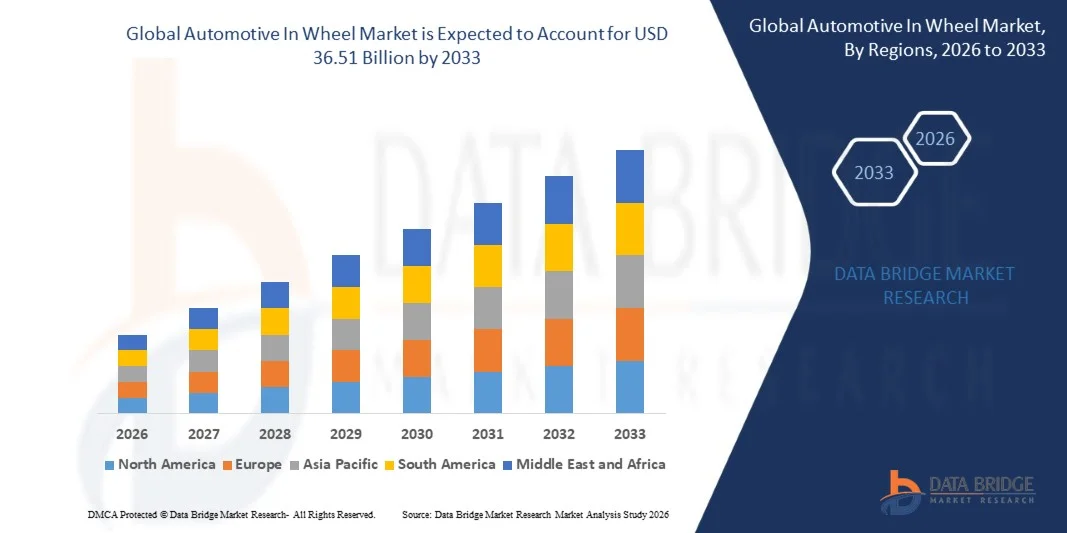
As per Data Bridge Market Research Analysis the automotive in wheel market was valued at USD 8.16 billion in 2025 and is projected to reach USD 36.51 billion by 2033, growing at a CAGR of 20.60 % from 2026 to 2033. The automotive in wheel market is experiencing steady growth, driven by increasing vehicle production, rising demand for lightweight automotive components, and the growing adoption of premium wheel solutions across passenger and commercial vehicles. Automotive manufacturers are increasingly incorporating advanced materials such as aluminum, magnesium, and carbon fiber to reduce vehicle weight, improve fuel efficiency, enhance driving dynamics, and comply with stringent emission regulations. The growing preference for alloy wheels, coupled with the increasing production of electric and luxury vehicles, is further supporting market expansion across OEM and aftermarket sales channels.
Moreover, rising consumer demand for aesthetically appealing and high-performance wheels, along with the expansion of the automotive aftermarket, is creating significant growth opportunities for manufacturers. Companies are focusing on advanced forging and casting technologies, precision machining, corrosion-resistant surface finishes, and sustainable manufacturing processes to improve product durability, performance, and design flexibility. Increasing investments in lightweight wheel technologies, continuous product innovation, and the growing demand for durable wheel solutions across passenger vehicles, commercial vehicles, and off-highway equipment are expected to support sustained market growth throughout the forecast period.
Market Size & Forecast
- Market Value (2025): 8.16 Billion
- Expected Market Value (2033): USD 36.51 Billion
- Forecast CAGR (2026–2033): 20.60%
- Leading Region in 2025: North America
- Fastest Growing Region: Asia-Pacific
Key Market Trends & Insights
- North America dominated the automotive in wheel market with the largest revenue share 40.5% in 2025, supported by increasing demand for lightweight vehicle components, rising production of electric vehicles, and growing consumer preference for premium alloy and high-performance wheels.
- Asia-Pacific automotive in wheel market is expected to witness the fastest growth rate from 2026 to 2033, supported by its strong automotive manufacturing base, high vehicle production volumes, and increasing demand for lightweight alloy wheels across passenger and commercial vehicles.
- The construction and mining equipment segment held the largest market revenue share in 2025 driven by increasing infrastructure development, mining activities, and demand for heavy-duty vehicles requiring durable, high-load-bearing wheels. Growing investments in construction projects and mineral extraction operations continue to support demand for high-strength steel and alloy wheels.
- The agriculture tractors segment is expected to witness the fastest growth during the forecast period from 2026 to 2033 driven by increasing farm mechanization, rising adoption of advanced agricultural equipment, and government initiatives promoting modern farming practices.
- The economy segment held the largest market revenue share in 2025 driven by high production volumes, widespread consumer adoption, and strong demand across emerging economies. Cost-effective steel and aluminum alloy wheels remain the preferred choice due to their durability, affordability, and fuel efficiency.
- The carbon fiber segment is projected to register the fastest growth during the forecast period from 2026 to 2033 driven by its exceptional strength-to-weight ratio, superior durability, and growing adoption in luxury, performance, and electric vehicles
Report Scope and Automotive In Wheel Market Segmentation
|
Attributes |
Automotive In Wheel Market Key Market Insights |
|
Segments Covered |
|
|
Countries Covered |
North America
Europe
Asia-Pacific
Middle East and Africa
South America
|
|
Key Market Players |
|
|
Market Opportunities |
|
|
Value Added Data Infosets |
In addition to the market insights such as market value, growth rate, market segments, geographical coverage, market players, and market scenario, the market report curated by the Data Bridge Market Research team includes in-depth expert analysis, import/export analysis, pricing analysis, production consumption analysis, and pestle analysis. |
Automotive In Wheel Market Trends
Trend: Rising Adoption of Lightweight and Aerodynamic Wheel Technologies
The automotive in wheel market is witnessing a growing shift toward lightweight materials, aerodynamic wheel designs, and advanced manufacturing technologies as automakers focus on improving fuel efficiency and extending electric vehicle (EV) driving range. Manufacturers are increasingly adopting aluminum alloys, forged wheels, flow-forming technologies, and aerodynamic wheel designs to reduce vehicle weight, enhance performance, and lower carbon emissions. Advanced wheel designs with optimized airflow are becoming an integral part of next-generation EV platforms, enabling manufacturers to improve battery efficiency without compromising structural strength or aesthetics.
For instance, in July 2022, Maxion Wheels continues to expand its portfolio of aerodynamic, low-carbon steel, and aluminum wheel solutions designed to improve EV efficiency. The company states that its aerodynamic wheel designs can improve EV battery range by 3–5% and is strengthening its lightweight manufacturing capabilities through a USD 150 million joint venture to establish a forged aluminum wheel manufacturing facility in Türkiye.
The rising adoption of lightweight and aerodynamic wheel technologies is expected to accelerate innovation and support long-term growth in the automotive in wheel market.
Automotive In Wheel Market Dynamics
Key Market Driver: Increasing Demand for Lightweight Wheels to Improve Fuel Efficiency and Vehicle Performance
The automotive in wheel market is primarily driven by the increasing adoption of lightweight wheel materials to enhance fuel efficiency, reduce vehicle emissions, and improve overall vehicle performance. Automakers are increasingly replacing conventional steel wheels with lightweight aluminum alloy and forged wheels to comply with stringent fuel economy and emission regulations while supporting vehicle electrification. Growing demand for premium vehicle customization and performance upgrades is further accelerating the adoption of advanced wheel technologies across OEM and aftermarket channels.
For instance, the U.S. National Highway Traffic Safety Administration (NHTSA) finalized updated Corporate Average Fuel Economy (CAFE) standards requiring fuel efficiency improvements of 8% annually for model years 2024–2025 and 10% for model year 2026, encouraging automakers to adopt lightweight components, including aluminum and forged alloy wheels, to reduce vehicle weight and improve fuel economy.
Increasing demand for lightweight wheels to improve fuel efficiency and vehicle performance is expected to remain a major driver of the automotive in wheel market.
Key Restraint/Challenge: Fluctuating Raw Material Prices and Trade Policies Increasing Manufacturing Costs
The automotive in wheel market faces significant challenges due to fluctuating raw material prices and evolving international trade policies, which continue to increase manufacturing costs and disrupt global supply chains. Since steel and aluminum are the primary materials used in wheel production, fluctuations in commodity prices and higher import tariffs are increasing procurement costs, compressing profit margins, and affecting long-term production planning for manufacturers.
For instance, in 2025, Superior Industries International disclosed that tariff-related disruptions and changing OEM sourcing strategies adversely affected sales volumes, prompting the company to secure additional liquidity support and pursue recapitalization initiatives. The company also highlighted that increasing localization strategies by automakers were reshaping procurement and manufacturing operations.
Fluctuating raw material prices and evolving trade policies are expected to remain key challenges impacting profitability and supply chain stability in the automotive in wheel market.
Key Market Opportunity: Growing Adoption of Lightweight and High-Performance Wheel Technologies
The increasing production of electric vehicles, premium vehicles, and high-performance automobiles is creating significant opportunities for the automotive in wheel market. Growing investments in forged aluminum wheels, carbon fiber wheels, and EV-specific aerodynamic wheel designs are enabling manufacturers to improve vehicle efficiency, driving range, and overall performance while meeting evolving OEM requirements.
For instance, Carbon Revolution continues to expand the adoption of its carbon fiber wheel technology across premium vehicle models, including the Chevrolet Corvette Z06, Corvette E-Ray, Range Rover Sport SV, and Ferrari vehicles. According to General Motors, the use of carbon fiber wheels reduced unsprung rotational mass, improving the Corvette Z06's lap time by approximately 1.5 seconds, demonstrating the performance benefits of lightweight wheel technologies.
Growing adoption of lightweight and high-performance wheel technologies is expected to create substantial long-term growth opportunities for the automotive in wheel market.
Automotive In Wheel Market Scope
The automotive in wheel market is segmented on the basis of off-highway, vehicle class, end-use, vehicle type, rim size, finish type, material, and product.
- By Off-Highway
On the basis of off-highway, the automotive in wheel market is segmented into construction and mining equipment and agriculture tractors. The construction and mining equipment segment held the largest market revenue share in 2025 driven by increasing infrastructure development, mining activities, and demand for heavy-duty vehicles requiring durable, high-load-bearing wheels. Growing investments in construction projects and mineral extraction operations continue to support demand for high-strength steel and alloy wheels.
The agriculture tractors segment is expected to witness the fastest growth during the forecast period from 2026 to 2033 driven by increasing farm mechanization, rising adoption of advanced agricultural equipment, and government initiatives promoting modern farming practices. Growing demand for lightweight, corrosion-resistant, and durable wheel solutions is expected to further support segment growth.
- By Vehicle Class
On the basis of vehicle class, the automotive in wheel market is segmented into economy, mid-priced, and luxury priced. The economy segment held the largest market revenue share in 2025 driven by high production volumes, widespread consumer adoption, and strong demand across emerging economies. Cost-effective steel and aluminum alloy wheels remain the preferred choice due to their durability, affordability, and fuel efficiency.
The luxury priced segment is expected to witness the fastest growth during the forecast period from 2026 to 2033 driven by increasing demand for premium vehicles, larger rim sizes, lightweight forged and carbon fiber wheels, and advanced wheel designs that enhance vehicle performance, aesthetics, and electric vehicle driving range.
- By End-Use
On the basis of end-use, the automotive in wheel market is segmented into aftermarket and OE (Original Equipment) market. The OE market held the largest market revenue share in 2025 driven by rising vehicle production, increasing integration of lightweight alloy wheels by automotive manufacturers, and growing demand for factory-fitted wheels that meet stringent performance, safety, and fuel efficiency standards. Expanding electric vehicle production and OEM partnerships with wheel manufacturers continue to strengthen this segment.
The aftermarket segment is expected to witness the fastest growth during the forecast period from 2026 to 2033 driven by increasing consumer preference for vehicle customization, replacement demand for damaged wheels, and rising adoption of premium alloy, forged, and high-performance wheels. Growing sales of larger rim sizes and aesthetic wheel finishes are further contributing to market expansion.
- By Vehicle Type
On the basis of vehicle type, the automotive in wheel market is segmented into passenger vehicle, light commercial vehicle (LCV), and heavy commercial vehicle (HCV). The passenger vehicle segment held the largest market revenue share in 2025 driven by high global passenger vehicle production, increasing adoption of lightweight alloy wheels, and growing consumer demand for enhanced vehicle aesthetics, fuel efficiency, and driving performance. Rising production of electric vehicles and premium passenger cars is further supporting demand for advanced wheel technologies.
The heavy commercial vehicle (HCV) segment is expected to witness the fastest growth during the forecast period from 2026 to 2033 driven by expanding freight transportation, infrastructure development, and mining and construction activities. Increasing demand for durable, high-load-bearing steel and forged wheels, along with growing adoption of lightweight wheel solutions to improve operational efficiency and reduce fuel consumption, is expected to drive segment growth.
- By Rim Size
On the basis of rim size, the automotive in wheel market is segmented into 13”–15”, 16”–18”, 19”–21”, and >21”. The 16”–18” segment held the largest market revenue in 2025 driven by its widespread adoption across compact and mid-sized passenger vehicles, broad tire availability, and cost-effective replacement, making it the preferred choice for both consumers and fleet operators.
The >21” segment is projected to register the fastest growth during the forecast period from 2026 to 2033 driven by increasing demand for luxury vehicles, premium SUVs, and high-performance electric vehicles. Larger rim sizes are increasingly adopted to accommodate advanced braking systems while enhancing vehicle aesthetics and aerodynamic performance.
- By Finish Type
On the basis of finish type, the automotive in wheel market is segmented into painted & polished, machined alloy wheel, two-toned alloy, chromed alloy, and anodized. The painted & polished segment held the largest market revenue share in 2025 driven by its cost-effectiveness, superior corrosion resistance, and widespread adoption across passenger and commercial vehicles by OEMs. The finish offers enhanced durability while maintaining an attractive appearance, making it the preferred choice for mass-market vehicle production.
The machined alloy wheel segment is expected to witness the fastest growth during the forecast period from 2026 to 2033 driven by increasing consumer preference for premium vehicle aesthetics, rising demand for alloy wheels in luxury and electric vehicles, and growing adoption of precision-machined finishes that provide improved visual appeal and enhanced surface durability.
- By Material
On the basis of material, the automotive in wheel market is segmented into alloy, aluminum, magnesium, steel, chrome-plated, and carbon fiber. The aluminum segment held the largest market revenue share in 2025 driven by its lightweight properties, excellent corrosion resistance, improved fuel efficiency, and widespread adoption across passenger vehicles and electric vehicles. Increasing OEM preference for aluminum wheels to enhance vehicle performance and comply with fuel economy regulations continues to support segment growth.
The carbon fiber segment is projected to register the fastest growth during the forecast period from 2026 to 2033 driven by its exceptional strength-to-weight ratio, superior durability, and growing adoption in luxury, performance, and electric vehicles. Increasing investments in advanced composite materials and rising demand for lightweight mobility solutions are further driving adoption.
- By Product
On the basis of product, the automotive in wheel market is segmented into regular and high performance. The regular segment held the largest market revenue share in 2025 driven by its extensive adoption across economy and mid-priced passenger vehicles, commercial vehicles, and OEM applications. Its affordability, durability, and compatibility with high-volume vehicle production make it the preferred choice among automotive manufacturers.
The high-performance segment is expected to witness the fastest growth during the forecast period from 2026 to 2033 driven by increasing demand for premium and luxury vehicles, expanding electric vehicle production, and rising consumer preference for lightweight, forged, and performance-oriented wheels. Growing interest in vehicle customization and motorsports-inspired designs is further contributing to segment growth.
Automotive In Wheel Market Analysis
North America Automotive In Wheel Market Insight
North America dominated the automotive in wheel market with the largest revenue share 40.5% in 2025, supported by increasing demand for lightweight vehicle components, rising production of electric vehicles, and growing consumer preference for premium alloy and high-performance wheels. The region is also benefiting from expanding investments in domestic automotive manufacturing, advanced materials, and EV charging infrastructure. In addition, increasing adoption of performance-oriented vehicles, stringent fuel efficiency regulations, and continuous advancements in wheel manufacturing technologies are expected to support sustained demand for lightweight and durable wheel solutions.
U.S. Automotive In Wheel Market Insight
The U.S. accounted for the largest share of the North America automotive in wheel market in 2025, driven by strong vehicle production, growing electric vehicle adoption, and increasing demand for lightweight alloy and premium performance wheels. The expansion of electric pickup trucks, SUVs, and luxury vehicles, along with rising consumer spending on vehicle customization and aftermarket upgrades, continues to support market growth. Furthermore, investments in advanced manufacturing technologies and the presence of leading automotive OEMs are expected to strengthen demand for innovative wheel solutions across the country.
Europe Automotive In Wheel Market Insight
Europe is expected to witness significant growth during the forecast period, driven by stringent vehicle emission regulations, increasing production of electric and premium vehicles, and strong demand for lightweight wheel technologies. Automakers across the region are increasingly adopting aluminum alloy, forged, and carbon fiber wheels to improve fuel efficiency, extend electric vehicle driving range, and enhance overall vehicle performance. Ongoing investments in sustainable mobility, advanced manufacturing technologies, and next-generation vehicle platforms are expected to further support the adoption of innovative wheel solutions throughout Europe.
Germany Automotive In Wheel Market Insight
Germany is expected to witness the fastest growth rate from 2026 to 2033, supported by its strong automotive manufacturing industry, globally recognized premium vehicle brands, and continuous investments in lightweight vehicle technologies. Increasing production of electric and luxury vehicles, combined with growing demand for forged aluminum and high-performance wheels, continues to strengthen the market. The country's focus on engineering innovation and advanced automotive manufacturing is expected to further accelerate demand for technologically advanced wheel solutions.
U.K. Automotive In Wheel Market Insight
The U.K. automotive in wheel market is expected to witness the fastest growth rate from 2026 to 2033, driven by rising demand for electric vehicles, increasing consumer preference for premium vehicle customization, and growing adoption of lightweight alloy wheels. Government support for zero-emission mobility, expanding EV infrastructure, and rising production of premium and performance vehicles are encouraging manufacturers to adopt advanced wheel technologies. These factors are expected to contribute to sustained growth of the automotive in wheel market across the U.K.
Asia-Pacific Automotive In Wheel Market Insight
Asia-Pacific automotive in wheel market is expected to witness the fastest growth rate from 2026 to 2033, supported by its strong automotive manufacturing base, high vehicle production volumes, and increasing demand for lightweight alloy wheels across passenger and commercial vehicles. The region benefits from the presence of major automotive OEMs, leading wheel manufacturers, and a highly integrated supply chain that enables cost-efficient production and rapid product innovation. Rising investments in electric vehicle manufacturing, advanced forging and casting technologies, and government initiatives promoting sustainable mobility continue to accelerate the adoption of lightweight, high-performance wheel solutions throughout the region.
China Automotive In Wheel Market Insight
China accounted for the largest share of the Asia-Pacific automotive in wheel market in 2025, driven by its position as the world's largest automotive producer and the rapid expansion of electric vehicle (EV) manufacturing. Strong production of passenger vehicles, commercial vehicles, and new energy vehicles (NEVs), coupled with government initiatives promoting lightweight vehicle components and energy-efficient mobility, continues to drive demand for aluminum alloy and high-performance wheels. The country's well-established automotive supply chain, large-scale manufacturing capabilities, and continuous investments in advanced production technologies further strengthen its leadership in the regional market while supporting increasing exports of automotive wheels.
Japan Automotive In Wheel Market Insight
Japan is expected to witness the fastest growth rate from 2026 to 2033, supported by its well-established automotive manufacturing industry, strong presence of global vehicle OEMs, and continuous focus on lightweight vehicle technologies. The country's emphasis on fuel-efficient, hybrid, and electric vehicles is driving the adoption of aluminum alloy, forged, and high-performance wheels that improve vehicle handling, reduce overall vehicle weight, and enhance energy efficiency. Continuous investments in precision engineering, advanced manufacturing processes, and research and development activities are expected to further strengthen Japan's position as a leading innovation hub for automotive wheel technologies.
Automotive In Wheel Market Share
The automotive in wheel industry is primarily led by well-established companies, including:
- CITIC Dicastal Co., Ltd. (China)
- Iochpe-Maxion S.A. (Brazil)
- Borbet GmbH (Germany)
- RONAL GROUP (Switzerland)
- Superior Industries International, Inc. (U.S.)
- Enkei Corporation (Japan)
- Topy Industries, Limited (Japan)
- Steel Strips Wheels Limited (India)
- Uno Minda Limited (India)
- Zhejiang Wanfeng Auto Wheel Co., Ltd. (China)
- Howmet Aerospace Inc. (U.S.)
- OZ S.p.A. (Italy)
- Central Motor Wheel Co., Ltd. (Japan)
- Mangels Industrial S.A. (Brazil)
- RAYS Co., Ltd. (Japan)
Latest Developments in Automotive In Wheel Market
- In November 2025, Iochpe-Maxion (Maxion Wheels) announced a strategic expansion of its light vehicle aluminum wheels business in South America. The company redeployed existing global assets to its Brazilian plants and acquired a 50.1% stake in Polimetal, Argentina, to increase production capacity. This initiative addresses the growing demand for aluminum wheels in the Mercosur region, strengthens OEM supply chains, and positions Maxion Wheels to capture rising market share in the South American passenger car segment.
- In December 2025, Superior Industries International, Inc. completed an acquisition by a group of its term loan investors, including Oaktree Capital Management, converting a portion of debt into equity and strengthening its balance sheet. The transaction positions Superior for long-term growth in the global wheel industry, allowing increased investment in operations, customer relationships, and regional supply capabilities, while also appointing Michael Dorah as the new CEO to lead the company's strategic expansion.

- Interactive Data Analysis Dashboard
- Company Analysis Dashboard for high growth potential opportunities
- Research Analyst Access for customization & queries
- Competitor Analysis with Interactive dashboard
- Latest News, Updates & Trend analysis
- Harness the Power of Benchmark Analysis for Comprehensive Competitor Tracking
Data collection and base year analysis are done using data collection modules with large sample sizes. The stage includes obtaining market information or related data through various sources and strategies. It includes examining and planning all the data acquired from the past in advance. It likewise envelops the examination of information inconsistencies seen across different information sources. The market data is analysed and estimated using market statistical and coherent models. Also, market share analysis and key trend analysis are the major success factors in the market report. To know more, please request an analyst call or drop down your inquiry.
The key research methodology used by DBMR research team is data triangulation which involves data mining, analysis of the impact of data variables on the market and primary (industry expert) validation. Data models include Vendor Positioning Grid, Market Time Line Analysis, Market Overview and Guide, Company Positioning Grid, Patent Analysis, Pricing Analysis, Company Market Share Analysis, Standards of Measurement, Global versus Regional and Vendor Share Analysis. To know more about the research methodology, drop in an inquiry to speak to our industry experts.
Data Bridge Market Research is a leader in advanced formative research. We take pride in servicing our existing and new customers with data and analysis that match and suits their goal. The report can be customized to include price trend analysis of target brands understanding the market for additional countries (ask for the list of countries), clinical trial results data, literature review, refurbished market and product base analysis. Market analysis of target competitors can be analyzed from technology-based analysis to market portfolio strategies. We can add as many competitors that you require data about in the format and data style you are looking for. Our team of analysts can also provide you data in crude raw excel files pivot tables (Fact book) or can assist you in creating presentations from the data sets available in the report.













