


What is the Automotive in Wheel Motors Market Size and Growth Rate?
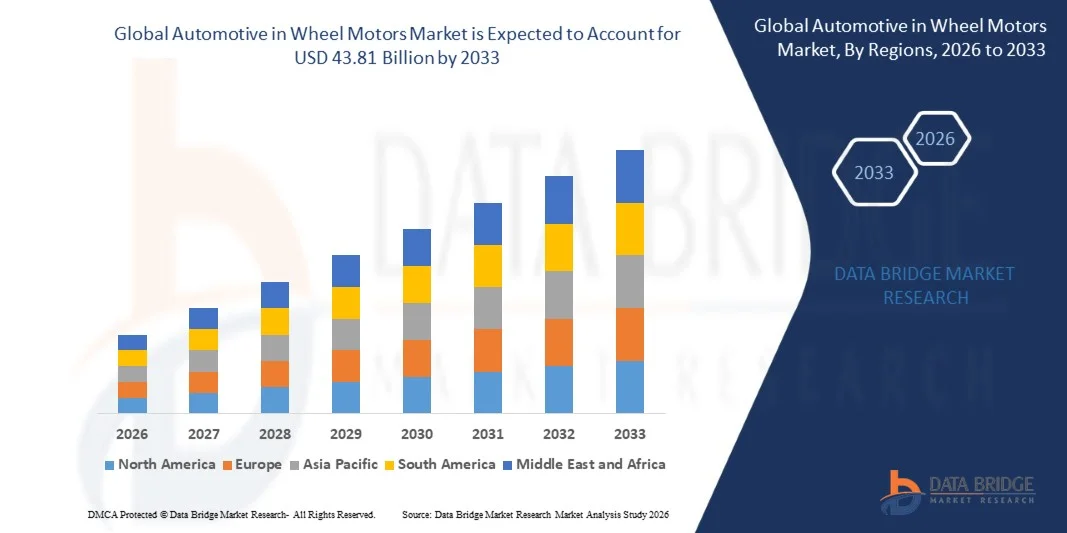
- As per Data Bridge Market Research analysis, the automotive in wheel motors market was valued at USD 3.75 billion in 2025 and is projected to reach USD 43.81 billion by 2033, growing at a CAGR of 35.97% from 2026 to 2033.
- The market is experiencing consistent growth driven by rising electric vehicle adoption, increasing demand for efficient and compact powertrain architectures, advancements in motor technology, and growing integration of independent wheel torque control across passenger and commercial vehicles.
- The increasing shift toward vehicle electrification, combined with stringent emissions-reduction targets and demand for improved vehicle dynamics, is encouraging automakers and technology suppliers to develop and commercialize in-wheel motor systems. These motors can eliminate conventional drivetrain components such as transmission, driveshaft, and differential systems while enabling precise torque vectoring, improved packaging flexibility, and enhanced energy efficiency, supporting their adoption in next-generation electric vehicles.
Market Size & Forecast
- Global Market Value (2025): USD 3.75 Billion
- Expected Market Value (2033): USD 43.81 Billion
- Forecast CAGR (2026–2033): 35.97%
- Leading Region in 2025: North America
- Fastest Growing Region: Asia Pacific
What are the Major Takeaways of the Automotive in Wheel Motors Market?
- North America dominated the automotive in-wheel motors market with the largest revenue share of 32.0% in 2025, supported by rising electric vehicle adoption, advanced automotive research infrastructure, and increasing investments in next-generation propulsion technologies.
- Asia-Pacific is expected to be the fastest-growing region at a CAGR of 10.3% from 2026 to 2033, fueled by rapid EV adoption, expanding automotive manufacturing, and increasing investments in next-generation electric powertrain technologies across China, Japan, South Korea, and India.
- The rotor and stator segment led the market with a 41.2% share in 2025, driven by its essential role in converting electrical energy into mechanical torque directly at the wheel
- Regenerative braking system are the fastest-growing component type, projected to register a CAGR of 20.0%, reflecting the surge in emphasis on energy recovery and improved electric vehicle efficiency.
- The liquid cooling segment dominated the cooling type category with a 62.4% revenue share in 2025, led by its ability to dissipate heat efficiently from high-performance motor systems.
- Axial flux motor accounted for 60.5% of the market share in 2025, preferred by its compact architecture, high power density, and strong torque-to-weight characteristics
- The light commercial vehicles (LCVs) segment is the fastest-growing vehicle type category, with a CAGR of 22.6%, driven by increasing electrification of delivery vans, urban logistics fleets, and last-mile transportation
Report Scope and Automotive in Wheel Motors Market Segmentation
|
Attributes |
Automotive in Wheel Motors Key Market Insights |
|
Segments Covered |
|
|
Countries Covered |
North America
Europe
Asia-Pacific
Middle East and Africa
South America
|
|
Key Market Players |
|
|
Market Opportunities |
|
|
Value Added Data Infosets |
|
What is the Key Trend in the Automotive in Wheel Motors Market?
- Automotive manufacturers and technology suppliers are increasingly developing integrated in-wheel motor systems that combine the motor, inverter, braking, and control functions within the wheel, supporting compact vehicle architectures and greater design flexibility.
- For instance, in January 2024, Hyundai Mobis showcased its Mobion technology with an integrated in-wheel motor and e-Corner system, enabling independent wheel control, crab driving, and zero-turning. Hyundai Mobis stated that the in-wheel system improved energy efficiency by more than 20% through torque distribution, supporting the trend toward integrated wheel-level propulsion and vehicle-control systems.
- Independent wheel control enables precise torque distribution, improving vehicle maneuverability, handling, and the integration of advanced vehicle-control functions.
- Automakers are also exploring in-wheel propulsion for passenger vehicles, purpose-built vehicles, and autonomous mobility platforms where flexible packaging and independent wheel control can provide additional design benefits.
- For instance, in August 2024, Protean Electric completed validation of its Gen 5 in-wheel motor, testing more than 80 in-wheel motors across 64 test programs. The Gen 5 system achieved 1,500 Nm peak torque in an 18-inch wheel and incorporated an integrated inverter, demonstrating the industry's movement toward higher-performance, compact, and integrated in-wheel propulsion systems.
- As automotive electrification increasingly shifts toward software-controlled and highly integrated vehicle architectures, the development of compact in-wheel motors with advanced torque-vectoring, integrated electronics, and independent wheel control is expected to accelerate, reinforcing in-wheel propulsion as an emerging technology for next-generation electric mobility.
What are the Key Drivers of the Automotive in Wheel Motors Market?
- The rapid expansion of electric vehicle platforms and the transition toward highly integrated electric powertrains are increasing demand for in-wheel motors that can reduce mechanical drivetrain components and provide direct wheel propulsion.
- For instance, in September 2025, Protean Electric announced that its next-generation ProteanDrive Pm18 2500 would enter production in 2026, delivering more than 2,500 Nm and 220 kW per wheel motor while targeting cost parity with twin e-axle solutions.
- Automakers and technology suppliers are integrating independent wheel propulsion with torque vectoring, electronic control, and advanced vehicle dynamics to improve maneuverability, packaging flexibility, and vehicle performance.
- For instance, in January 2023, Protean Electric announced that the Dongfeng Fengshen E70 became the first fully homologated passenger car with in-wheel motors, following approval by China's Ministry of Industry and Information Technology and supporting the commercialization of ProteanDrive technology.
- With electric vehicle architectures increasingly emphasizing compact packaging, software-based control, and improved drivetrain efficiency, in-wheel motors are gaining relevance as manufacturers pursue new approaches to propulsion, vehicle dynamics, and next-generation mobility design.
Which Factors are Challenging the Growth of the Automotive in Wheel Motors Market?
- In-wheel motors introduce engineering challenges related to increased unsprung mass, vibration, ride comfort, thermal management, durability, and integration within the limited space of a wheel assembly.
- For instance, in December 2024, A study published in the Journal of Automobile Engineering evaluated the effect of increased unsprung mass from in-wheel motors and found that it can deteriorate ride-comfort metrics on bump roads at low speeds, highlighting the challenge of integrating motor weight directly into the wheel assembly.
- These technical requirements can increase development complexity because manufacturers must simultaneously optimize motor weight, suspension characteristics, wheel packaging, cooling, braking, and reliability.
- The technical complexity associated with durability and mass-production readiness can also slow commercialization, particularly because motors installed directly in wheels are exposed to shock, vibration, thermal cycling, water, dust, and other harsh operating conditions.
- For instance, in August 2025, Researchers from Jiangsu University published a review identifying mechanical, electrical, and magnetic faults as significant reliability concerns for in-wheel motors because they operate under harsh conditions, including shock loads, vibration, moisture, and restricted heat dissipation.
- These engineering and validation requirements continue to create barriers to widespread adoption, as manufacturers must demonstrate that in-wheel motor systems can deliver the required performance, durability, ride comfort, and reliability while maintaining competitive vehicle costs.
How is the Automotive in Wheel Motors Market Segmented?
The automotive in wheel motors market is segmented on the basis of component, cooling type, motor type, power output, propulsion type, and vehicle type.
- By Component
On the basis of component, the automotive in-wheel motors market is segmented into suspension, rotor and stator, wheel bearings, and regenerative braking system. The rotor and stator segment dominated the market with an estimated 41.2% share in 2025, owing to its essential role in converting electrical energy into mechanical torque directly at the wheel. These components determine the motor's torque generation, efficiency, and overall operating performance. Advances in permanent-magnet materials and electromagnetic designs are improving power density within compact wheel assemblies. Manufacturers are also focusing on lightweight and durable rotor structures to improve vehicle dynamics. Increasing adoption of electric powertrains is supporting demand for efficient rotor and stator assemblies.
The regenerative braking system segment is projected to register the fastest growth at an estimated CAGR of 20.0% from 2026 to 2033, driven by increasing emphasis on energy recovery and improved electric vehicle efficiency. In-wheel architectures allow braking forces to be controlled independently at individual wheels. This capability supports precise braking-force distribution and energy recovery. Integration with electronic braking and vehicle-dynamics systems is further expanding its functionality. Rising EV adoption is increasing demand for technologies that can recover kinetic energy during deceleration. Automakers are also emphasizing improved driving range and powertrain efficiency. These developments are expected to accelerate the integration of regenerative braking systems within in-wheel motor architectures.
- By Cooling Type
On the basis of cooling type, the automotive in-wheel motors market is segmented into air cooling and liquid cooling. The liquid cooling segment dominated the market with an estimated 62.4% share in 2025, supported by its ability to dissipate heat efficiently from high-performance motor systems. In-wheel motors operate within a compact wheel environment where thermal management is particularly important. Liquid cooling enables motors to maintain suitable operating temperatures during sustained high-load conditions. It also supports higher power density and helps reduce thermal limitations during operation. Automotive manufacturers are increasingly evaluating liquid-cooled systems for high-performance electric vehicles. Improved thermal management can also support motor durability and reliability.
The air cooling is expected to be the fastest-growing segment, registering 17.5% CAGR during the forecast period. The technology offers a comparatively simple thermal-management architecture for lower-power and compact vehicle applications. Increasing development of lightweight electric vehicles is creating opportunities for air-cooled in-wheel motor systems. Its simpler construction can support easier integration where extreme thermal loads are not required. Manufacturers are exploring improved airflow paths and heat-dissipation structures to enhance cooling performance. Growing demand for cost-conscious electric mobility solutions is expected to support adoption of air cooling.
- By Motor Type
On the basis of motor type, the automotive in-wheel motors market is segmented into axial flux motor and radial flux motor. The axial flux motor segment dominated the market with an estimated 60.5% share in 2025, supported by its compact architecture, high power density, and strong torque-to-weight characteristics. Axial-flux designs can generate substantial torque from a relatively thin motor package. Their form factor is attractive for applications where wheel-space and vehicle packaging are important considerations. Manufacturers are investing in advanced winding, cooling, and permanent-magnet technologies to improve axial-flux performance. The architecture can also support efforts to reduce propulsion-system size while maintaining output.
The radial flux motor segment is projected to register the fastest growth at an estimated CAGR of 18.0% from 2026 to 2033, supported by its established motor architecture and compatibility with electric propulsion applications. Radial-flux designs have been extensively developed for electric vehicle powertrains. Their mature manufacturing processes can facilitate integration into production-oriented vehicle platforms. The architecture also provides strong torque characteristics suitable for electric mobility applications. Manufacturers are continuing to improve cooling, winding, and electromagnetic designs to enhance performance. Increasing interest in scalable and production-ready in-wheel motor systems is creating additional demand.
- By Power Output
On the basis of power output, the automotive in-wheel motors market is segmented into up to 60 KW, 60–90 KW, and above 90 KW. The up to 60 KW segment dominated the market with an estimated 46.5% share in 2025, supported by its suitability for compact electric vehicles and urban mobility applications. Lower-output motors can require comparatively smaller and lighter motor assemblies. They are particularly suitable for vehicles where efficiency, affordability, and packaging are important considerations. Compact EV platforms can benefit from direct wheel propulsion without requiring very high motor output. Growing electrification of smaller passenger vehicles and urban mobility platforms is supporting demand in this category. The segment also benefits from comparatively manageable thermal and electrical requirements.
The above 90 KW segment is expected to witness the fastest growth at an estimated CAGR of 24.8% from 2026 to 2033, driven by increasing demand for high-performance electric propulsion systems. Higher-output motors can provide greater wheel torque and acceleration capabilities. They are increasingly relevant for performance-oriented passenger vehicles and larger electric vehicle platforms. Improvements in motor cooling and power electronics are enabling higher output from compact assemblies. High-power in-wheel systems can also support advanced torque-vectoring strategies. As EV manufacturers pursue higher performance while reducing conventional drivetrain components, demand for high-output motors is increasing.
- By Propulsion Type
On the basis of propulsion type, the automotive in-wheel motors market is segmented into battery electric vehicle (BEV), fuel cell electric vehicle (FCEV), hybrid electric vehicle (HEV), and plug-in hybrid electric vehicle (PHEV). The battery electric vehicle (BEV) segment dominated the market with an estimated 48.0% share in 2025, driven by the strong compatibility between fully electric architectures and direct wheel propulsion. In-wheel motors can eliminate conventional drivetrain components in suitable BEV designs. This can create greater packaging flexibility for batteries and passenger compartments. BEVs can also benefit from independent wheel torque control and regenerative braking capabilities. Increasing adoption of fully electric vehicles is expanding the potential application base for in-wheel motors.
The fuel cell electric vehicle (FCEV) is expected to be the fastest-growing propulsion segment, registering 31.0% CAGR during the forecast period. FCEVs offer zero tailpipe emissions while providing rapid refueling and longer operating potential for selected applications. Increasing interest in hydrogen-based mobility is supporting development of fuel-cell-powered commercial and specialty vehicles. In-wheel motors can provide packaging flexibility and independent wheel control in such vehicle architectures. Government initiatives supporting hydrogen infrastructure and clean transportation are creating additional opportunities. Growing research into high-efficiency propulsion systems is also encouraging consideration of in-wheel motor technologies for fuel-cell platforms.
- By Vehicle Type
On the basis of vehicle type, the automotive in-wheel motors market is segmented into passenger cars, light commercial vehicles (LCVs), and heavy commercial vehicles (HCVs). The passenger cars segment dominated the market with an estimated 68.6% share in 2025, supported by expanding electric passenger-vehicle platforms and increasing demand for efficient electric mobility. In-wheel motors can provide passenger vehicles with greater drivetrain packaging flexibility. Independent wheel control can also support advanced handling and torque-vectoring functions. The technology is particularly relevant to compact and performance-oriented EV architectures. Automakers are increasingly evaluating direct-drive technologies to improve vehicle efficiency and packaging flexibility.
The light commercial vehicles (LCVs) segment is expected to witness the fastest growth at an estimated CAGR of 22.6% from 2026 to 2033, driven by increasing electrification of delivery vans, urban logistics fleets, and last-mile transportation. LCVs frequently operate in stop-and-go environments where regenerative braking and efficient torque delivery can provide operational benefits. In-wheel motors can also create additional packaging flexibility for purpose-built electric delivery vehicles. Fleet operators are increasingly seeking efficient electric drivetrains for urban delivery applications. The growing deployment of electric vans and compact commercial platforms is creating additional demand for distributed propulsion. Advances in high-torque motor and thermal-management technologies are improving suitability for commercial applications.
Which Region Holds the Largest Share of the Automotive in Wheel Motors Market?
- North America dominated the automotive in-wheel motors market with the largest revenue share of 32.0% in 2025, supported by rising electric vehicle adoption, advanced automotive research infrastructure, and increasing investments in next-generation propulsion technologies.
- The region also benefits from strong automotive innovation, growing development of wheel-hub motor technologies, and increasing investments in electric and autonomous transportation platforms. Growing demand for compact, high-efficiency propulsion systems across passenger cars, commercial vehicles, and emerging mobility applications continues to strengthen North America's position in the global market.
U.S. Automotive in Wheel Motors Market Insight
The U.S. automotive in-wheel motors market is witnessing strong growth due to rising investments in electric vehicle technologies, advanced propulsion systems, and next-generation vehicle architectures. Increasing development of high-performance in-wheel motor technologies by automotive suppliers and technology companies is supporting market demand across passenger and commercial vehicle applications. In addition, growing emphasis on vehicle efficiency, independent wheel control, and innovative EV platforms is accelerating interest in in-wheel motor solutions across the country.
Asia-Pacific Automotive In-Wheel Motors Market Insight
The Asia-Pacific automotive in-wheel motors market is expected to witness rapid growth, driven by expanding electric vehicle production, increasing automotive electrification, and rising investments in advanced electric powertrain technologies across countries such as China, Japan, and South Korea. Growing adoption of compact and efficient propulsion systems, along with increasing development of innovative EV platforms, is supporting regional market expansion. In addition, the presence of major automotive manufacturers and growing investments in electric mobility technologies are accelerating the development and adoption of in-wheel motor systems across the region.
Japan Automotive In-Wheel Motors Market Insight
The Japan automotive in-wheel motors market is witnessing consistent growth due to rising investments in advanced electric propulsion technologies, vehicle control systems, and innovative mobility solutions. Automotive manufacturers are increasingly exploring in-wheel motor architectures for improved vehicle dynamics, independent wheel control, and greater flexibility in EV design. Moreover, Nissan continues to develop in-wheel motor technology, highlighting its potential for precise torque control and more flexible electric vehicle layouts.
China Automotive In-Wheel Motors Market Insight
The China automotive in-wheel motors market is growing rapidly, driven by expanding electric vehicle manufacturing, increasing electrification of commercial transportation, and rising investments in advanced powertrain technologies. Growing development and production of in-wheel motor systems for automotive and mobility applications are supporting market demand in the country. In addition, the establishment of manufacturing capabilities for advanced in-wheel motor technologies, together with China's large electric vehicle ecosystem, is strengthening the adoption potential of these systems across passenger and commercial vehicles.
U.K. Automotive In-Wheel Motors Market Insight
The U.K. automotive in-wheel motors market is experiencing steady growth, supported by strong research and development activities, advanced automotive engineering capabilities, and increasing investments in electric propulsion technologies. U.K.-based Protean Electric is developing and commercializing in-wheel motor systems for passenger cars, light commercial vehicles, and future transport solutions, supporting domestic technology development. Furthermore, government-backed initiatives and collaborative automotive research programs are accelerating development of lightweight and efficient in-wheel motor technologies for future electric vehicles.
Germany Automotive In-Wheel Motors Market Insight
The Germany automotive in-wheel motors market is expanding steadily due to the country's strong automotive manufacturing base, advanced engineering capabilities, and increasing focus on electric mobility. Automotive technology companies are developing highly integrated wheel-hub drive solutions that combine electric motors with braking and wheel-end components, creating opportunities for more flexible vehicle architectures. Moreover, continued investment in efficient electric powertrains, vehicle dynamics, and integrated mobility technologies is supporting interest in in-wheel motor solutions across Germany's automotive industry.
Which are the Top Companies in Automotive in Wheel Motors Market?
The automotive in wheel motors industry is primarily led by well-established companies, including:
- Elaphe LTD. (Slovenia)
- HYUNDAI MOBIS CO., LTD. (South Korea)
- Hitachi Astemo, Ltd. (Japan)
- NTN Corporation (Japan)
- NSK Ltd. (Japan)
- NIDEC CORPORATION (Japan)
- Schaeffler AG (Germany)
- ZF Friedrichshafen AG (Germany)
- Robert Bosch GmbH (Germany)
- DENSO CORPORATION (Japan)
- MITSUBISHI ELECTRIC CORPORATION (Japan)
- MAGNA INTERNATIONAL INC. (Canada)
- BorgWarner Inc. (U.S.)
- Indigo Technologies, Inc. (U.S.)
- DeepDrive GmbH (Germany)
- REE Automotive Ltd. (Israel)
- Donut Lab OÜ (Estonia)
- Equipmake Ltd. (U.K.)
- Dana Incorporated (U.S.)
- AVL List GmbH (Austria)
What are Latest Developments in Automotive in Wheel Motors Market?
- In September 2025, Protean Electric announced its latest ProteanDrive in-wheel motor technology, which was entering production with the aim of achieving price parity with advanced twin e-axle systems. The company introduced the Pm18 2500, designed to deliver high-performance propulsion while simplifying vehicle architecture by eliminating conventional drivetrain components. The development also targeted greater modularity and space efficiency for next-generation electric vehicles, highlighting the continued commercialization of high-performance in-wheel motor technology.
- In July 2024, Protean Electric announced the production launch of its ProteanDrive Generation 5 in-wheel motor technology, developed for passenger cars, light commercial vehicles, and future transport applications. The Gen 5 system incorporated an integrated inverter within the wheel package and was designed to provide improved performance, scalability, and affordability. The launch represented an important step toward industrializing in-wheel motor technology and expanding its application across automotive and mobility platforms
- In March 2023, Hyundai Mobis announced the development of an in-wheel system that enables independent control of all four vehicle wheels. The system integrates the drive motor and controller within the wheel and forms a core technology of the company’s e-Corner System, which combines electronic steering, braking, and suspension technologies. Hyundai Mobis stated that the technology was being verified on an IONIQ 5 to assess reliability and support future mass-production applications.
- In March 2022, Protean Electric announced a new partnership involving Dongfeng Motor Corporation Technical Center and Wuxi Weifu Electric Drive Technology to accelerate the industrialization and adoption of ProteanDrive in-wheel motor technology. The collaboration combined Dongfeng’s distributed-drive expertise with Weifu’s manufacturing capabilities and was intended to advance production applications of Dongfeng’s Any-Drive technology powered by ProteanDrive. The development strengthened efforts to integrate in-wheel motors into future Chinese vehicle programs.
- In September 2021, Hitachi and Hitachi Astemo jointly announced the development of a compact, lightweight direct-drive system for electric vehicles that integrates the motor, inverter, and brake into a single unit installed inside the wheel. The Direct Electrified Wheel was designed to reduce the weight penalty associated with conventional in-wheel systems while enabling direct transmission of motor power to the wheels. The development represented a significant step toward practical implementation of integrated in-wheel propulsion systems for electric vehicles.

- Interactive Data Analysis Dashboard
- Company Analysis Dashboard for high growth potential opportunities
- Research Analyst Access for customization & queries
- Competitor Analysis with Interactive dashboard
- Latest News, Updates & Trend analysis
- Harness the Power of Benchmark Analysis for Comprehensive Competitor Tracking
Data collection and base year analysis are done using data collection modules with large sample sizes. The stage includes obtaining market information or related data through various sources and strategies. It includes examining and planning all the data acquired from the past in advance. It likewise envelops the examination of information inconsistencies seen across different information sources. The market data is analysed and estimated using market statistical and coherent models. Also, market share analysis and key trend analysis are the major success factors in the market report. To know more, please request an analyst call or drop down your inquiry.
The key research methodology used by DBMR research team is data triangulation which involves data mining, analysis of the impact of data variables on the market and primary (industry expert) validation. Data models include Vendor Positioning Grid, Market Time Line Analysis, Market Overview and Guide, Company Positioning Grid, Patent Analysis, Pricing Analysis, Company Market Share Analysis, Standards of Measurement, Global versus Regional and Vendor Share Analysis. To know more about the research methodology, drop in an inquiry to speak to our industry experts.
Data Bridge Market Research is a leader in advanced formative research. We take pride in servicing our existing and new customers with data and analysis that match and suits their goal. The report can be customized to include price trend analysis of target brands understanding the market for additional countries (ask for the list of countries), clinical trial results data, literature review, refurbished market and product base analysis. Market analysis of target competitors can be analyzed from technology-based analysis to market portfolio strategies. We can add as many competitors that you require data about in the format and data style you are looking for. Our team of analysts can also provide you data in crude raw excel files pivot tables (Fact book) or can assist you in creating presentations from the data sets available in the report.













