


Automotive Intelligent Park Assist Systems Market Size
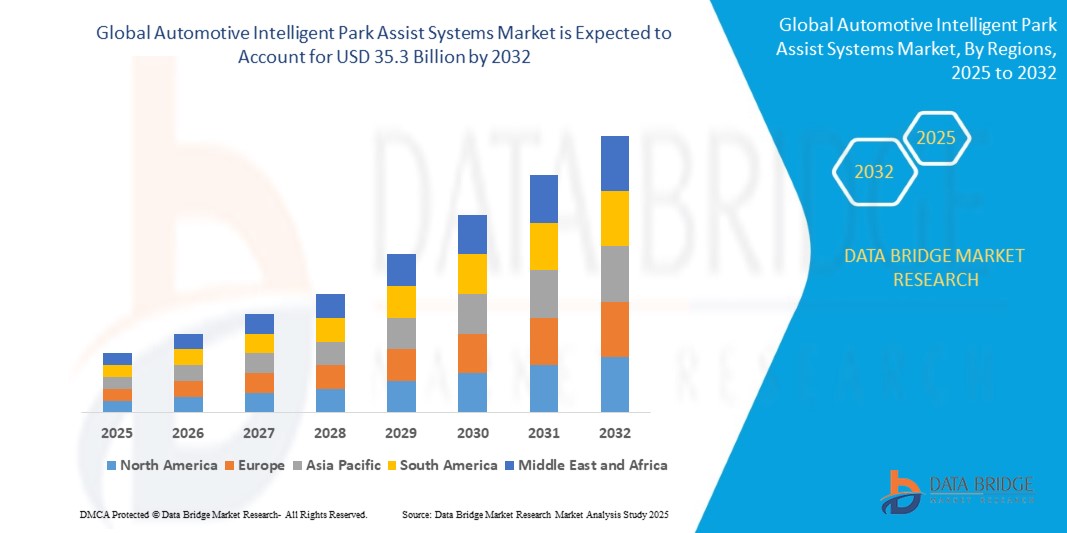
- The global automotive intelligent park assist systems market Size was valued at USD 23.53 Billion in 2024 and is expected to reach USD 35.3 Billion by 2032, at a CAGR of 6.1% during the forecast period
- The growth of the Global Automotive Intelligent Park Assist Systems Market is fueled by the increasing demand for fuel-efficient vehicles and stringent emission regulations worldwide.
Automotive Intelligent Park Assist Systems Market Analysis
The global automotive intelligent park assist systems market is witnessing rapid growth driven by the increasing demand for driver convenience, safety, and automation in modern vehicles. Intelligent park assist systems featuring sensors, cameras, and advanced software are becoming standard in mid- to high-end vehicles and are gaining traction in the mass market as part of broader ADAS (Advanced Driver Assistance Systems) integration.
A primary driver of market growth is the rise in traffic congestion, urbanization, and the shrinking availability of parking spaces, which have made parking more challenging and time-consuming. In response, automakers are incorporating semi-autonomous and fully autonomous parking technologies that enable vehicles to identify, navigate to, and park in tight spots with minimal or no driver intervention.
Technological advancements in ultrasonic sensors, radar, LiDAR, cameras, and AI-based image processing are enhancing the precision, safety, and responsiveness of these systems. Additionally, the integration of machine learning and sensor fusion algorithms allows for improved real-time decision-making and predictive capabilities. These technologies not only improve parking accuracy but also reduce the risk of collisions, making them especially appealing to safety-conscious consumers.
The market is also being propelled by government regulations mandating enhanced vehicle safety features, such as rearview cameras and collision avoidance systems. Furthermore, as electric vehicles (EVs) continue to grow in popularity, OEMs are embedding intelligent park assist systems to boost functionality and differentiate their offerings in a competitive EV landscape.
OEMs are increasingly offering Intelligent Park Assist as a part of bundled ADAS packages or as optional upgrades, while the aftermarket segment is expanding with retrofit kits for older vehicles. The emergence of connected and V2X (vehicle-to-everything) communication technologies is paving the way for automated valet parking systems, where cars park themselves after being dropped off by drivers in designated zones enhancing the long-term growth potential of the market.
However, the market faces challenges such as the high cost of advanced sensors and integration, especially in low-end vehicle segments. Other concerns include system reliability in extreme weather conditions, software glitches, and consumer trust in autonomous functions. Additionally, data privacy concerns related to camera and sensor data collection may pose regulatory and reputational risks.
Despite these obstacles, the outlook remains highly positive. Ongoing R&D investments by automakers and Tier 1 suppliers, increasing partnerships between technology firms and vehicle manufacturers, and government incentives for autonomous mobility are expected to drive innovation and market penetration. As cities evolve toward smart mobility and intelligent transport systems, intelligent parking assist solutions will play a key role in enabling safer and more efficient urban transportation.
With the convergence of AI, real-time mapping, and cloud connectivity, the Global Automotive Intelligent Park Assist Systems Market is well-positioned for sustained growth, deeper market penetration, and a transformative impact on the driving experience in the years ahead.
Report Scope and Automotive Intelligent Park Assist Systems Market Segmentation
|
Attributes |
Automotive Intelligent Park Assist Systems Market Insights |
|
Segments Covered |
|
|
Countries Covered |
North America
Europe
Asia-Pacific
Middle East and Africa
South America
|
|
Key Market Players |
|
|
Market Opportunities |
|
|
Value Added Data Infosets |
In addition to the insights on market scenarios such as market value, growth rate, segmentation, geographical coverage, and major players, the market reports curated by the Data Bridge Market Research also include in-depth expert analysis, pricing analysis, brand share analysis, consumer survey, demography analysis, supply chain analysis, value chain analysis, raw material/consumables overview, vendor selection criteria, PESTLE Analysis, Porter Analysis, and regulatory framework. |
Automotive Intelligent Park Assist Systems Market Trends
Advancements in cameras and ultrasonic sensors enhancing object detection precision and system reliability
- Advancements in cameras and ultrasonic sensors are playing a crucial role in enhancing the precision and reliability of automotive intelligent park assist systems. These technologies form the sensory foundation of modern parking aids, enabling vehicles to perceive their surroundings with increasing accuracy and clarity.
- Ultrasonic sensors, which use high-frequency sound waves to detect nearby objects, are now more compact, sensitive, and capable of detecting obstacles at various distances and angles. Positioned around the vehicle’s bumpers, these sensors provide real-time feedback about the proximity of surrounding objects, helping prevent collisions during parking maneuvers. Improvements in sensor resolution and range have significantly reduced blind spots, allowing for smoother and safer automatic or assisted parking in tight urban spaces.
- Simultaneously, advancements in camera technologies especially in high-definition wide-angle and 360-degree surround-view cameras—have transformed the way vehicles visualize their environment. Modern park assist systems integrate multiple camera feeds to create a bird’s-eye view, helping drivers and systems understand spatial relationships with remarkable clarity. This not only aids in precise parking but also enhances object recognition, pedestrian detection, and obstacle avoidance.
- Furthermore, the fusion of camera and sensor data through sophisticated image processing and AI algorithms enables the system to distinguish between different types of objects—like curbs, posts, or pedestrians and respond accordingly. This synergy allows vehicles to make intelligent, real-time decisions, reducing driver stress and the risk of minor accidents.
- As the technology matures and becomes more affordable, these enhanced sensors and cameras are being adopted not just in luxury models but also in mid-range and entry-level vehicles. Ultimately, these advancements are elevating the performance and trustworthiness of park assist systems, moving them closer to fully autonomous parking capabilities.
Automotive Intelligent Park Assist Systems Market Dynamics
Driver
Rising Demand for Driver Convenience and Safety
- The rising demand for driver convenience and safety is one of the most influential factors fueling the growth of the Global Automotive Intelligent Park Assist Systems Market. As urban environments become more congested and traffic density increases, parking has emerged as one of the most stressful and error-prone tasks for drivers. Consumers are now placing greater emphasis on features that enhance ease of use and reduce the risks associated with everyday driving tasks especially those involving low-speed maneuvers in tight spaces.
- Intelligent park assist systems directly address these concerns by automating or assisting with parking, thereby enhancing both convenience and safety. These systems allow vehicles to detect suitable parking spots, calculate the optimal steering angle, and in some cases, even perform the entire parking maneuver without driver intervention. This is particularly beneficial for drivers with limited experience or those who frequently park in crowded urban areas or narrow garage spaces.
- From a safety perspective, intelligent parking systems significantly reduce the risk of minor accidents, such as bumper scrapes, curb collisions, and accidental contact with pedestrians or objects. These small accidents are not only costly to repair but also contribute to insurance claims and vehicle depreciation. By minimizing human error, park assist systems improve overall vehicle safety and reduce long-term ownership costs.
- In addition, as consumers become more tech-savvy, they are increasingly seeking vehicles with modern, automated features that enhance their daily driving experience. Park assist technology adds tangible value to vehicles and is often considered a selling point especially in premium and mid-range segments. The growing availability of these systems across various price points has made them accessible to a broader consumer base.
- Moreover, automakers are using these features to differentiate themselves in a competitive market, offering various levels of parking automation as part of trim packages or technology bundles. As a result, the inclusion of intelligent parking systems is becoming a standard expectation among new car buyers, rather than a luxury add-on.
Restraint/Challenge
High cost of system integration and vehicle compatibility issues
- The high cost of system integration and vehicle compatibility issues is a significant restraint affecting the widespread adoption of Automotive Intelligent Park Assist Systems, particularly in cost-sensitive and emerging markets.
- Intelligent park assist systems rely on a combination of sophisticated components, including ultrasonic sensors, radar units, high-definition cameras, ECUs (electronic control units), and advanced software algorithms. The integration of these technologies into a vehicle's design requires extensive engineering, rigorous calibration, and seamless communication with other vehicle systems, such as steering, braking, and throttle control. This process adds considerable complexity and cost to vehicle development and manufacturing.
- For many automakers, especially those producing budget or entry-level vehicles, the addition of such high-tech systems can significantly raise the overall cost of the vehicle. In highly competitive markets, where price sensitivity is a critical factor for consumers, manufacturers may be reluctant to include intelligent park assist features as standard due to concerns about affordability and profit margins. Instead, these features are often offered as optional extras or reserved for premium models, limiting their availability across the broader vehicle market.
- Moreover, vehicle compatibility poses another barrier. Intelligent park assist systems are typically designed to work with modern vehicle architectures that support digital interfaces and modular component integration. Older vehicles, or those lacking the necessary sensors and drive-by-wire systems, are often incompatible with park assist technology. Retrofitting these systems into such vehicles is not only technically challenging but also economically impractical, due to the extensive modifications required. This severely restricts adoption in the aftermarket segment, which could otherwise serve as a significant opportunity for growth.
Automotive Intelligent Park Assist Systems Market Scope
The market is segmented on the basis of Sensor Type, Technology Type, Vehicle Type, Driver Assistance Tech Stack.
- By Sensor Type
The global automotive intelligent park assist systems market, when segmented by sensor type, comprises systems using ultrasonic sensors, cameras, or a combination of both. Ultrasonic sensor–based systems, which rely on sound waves to detect nearby obstacles, dominate due to their affordability, reliability, and ease of integration around bumpers effectively reducing minor parking collisions. Camera-based systems utilize wide-angle, rear-view, or 360° surround-view cameras to provide visual feedback, allowing drivers to better identify obstacles, curbs, and pedestrians during parking. Finally, combined ultrasonic + camera systems deliver a comprehensive solution by fusing data from both sensors, resulting in enhanced object detection accuracy, safety, and driver confidence, making them the preferred choice for mid- to high-end vehicles.
- By Technology Type
The Global Automotive Intelligent Park Assist Systems Market, segmented by technology type into Semi-Autonomous Parking Assist and Autonomous Parking Assist, reflects the industry's evolution toward enhanced vehicle automation. Semi-autonomous parking assist systems support drivers by controlling steering while the driver manages acceleration, braking, and gear shifts. These systems are widely adopted in mid-range vehicles, offering improved convenience and safety without fully removing driver control. In contrast, autonomous parking assist systems provide a higher level of automation, handling all aspects of the parking process including steering, acceleration, braking, and gear shifting allowing for hands-free and sometimes driverless parking in designated environments. This segment is gaining traction in premium vehicles and is expected to grow rapidly as advancements in AI, sensor fusion, and regulatory support accelerate the move toward fully autonomous parking solutions.
- By Vehicle Type
The global automotive intelligent park assist systems market, segmented by vehicle type into Passenger Cars and Commercial Vehicles, highlights varying adoption rates and technological integration across vehicle categories. Passenger cars represent the dominant segment, driven by increasing consumer demand for convenience, safety, and premium features in everyday vehicles. Intelligent park assist systems in this segment are becoming standard in mid- to high-end models, offering features like automated steering, obstacle detection, and 360-degree camera views. Meanwhile, commercial vehicles, including delivery vans, buses, and trucks, are gradually adopting these systems to enhance driver efficiency, reduce accident risk in urban environments, and improve overall fleet safety. As urbanization grows and driver assistance technologies become more affordable, both segments are expected to see expanded implementation of intelligent parking solutions.
- By Driver Assistance Tech Stack
The global automotive intelligent park assist systems market, segmented by driver assistance tech stack into ADAS (Advanced Driver Assistance Systems), Driver Monitoring, and V2X (Vehicle-to-Everything) Connectivity, reflects the increasing integration of smart technologies to improve parking precision and safety. ADAS plays a central role by enabling features such as automatic steering, obstacle detection, and predictive path planning, which form the foundation of intelligent park assist functions. Driver monitoring systems complement ADAS by assessing the driver’s attention and readiness, ensuring that interventions are made when the driver is distracted or fatigued—an important safety layer in semi-autonomous systems. V2X connectivity, though in earlier stages of adoption, enhances intelligent parking by allowing vehicles to communicate with nearby infrastructure, pedestrians, and other vehicles to access real-time spatial and traffic data. This connectivity supports features like remote parking and integration with smart city parking systems, paving the way for more autonomous and context-aware parking capabilities.
Automotive Intelligent Park Assist Systems Market Regional Analysis
- North America leads the Global Automotive Intelligent Park Assist Systems Market, driven by strong consumer appetite for convenience and safety features. The United States and Canada are at the forefront of adoption, supported by established automotive infrastructure, high vehicle ownership rates, and stringent regulatory standards requiring backup cameras and parking sensors. OEMs in the region are increasingly bundling park assist technology with ADAS packages, and tech-savvy consumers are quick to embrace semi-autonomous parking solutions. With continued investments in sensor innovation and software, North America remains a key market for smart parking technologies.
- In Europe, the market is characterized by a high demand for intelligent park assist systems, driven by urban congestion, narrow streets, and elevated safety standards. Countries like Germany, the UK, and France lead in adoption, with automakers offering advanced parking solutions as standard or optional features to meet EU regulations and consumer expectations. EU-wide safety mandates, combined with an eco-conscious urban mobility focus, are fueling interest in fully automated and connected parking systems that can integrate with smart city infrastructure.
- Asia Pacific is the fastest-growing region for intelligent park assist systems, fueled by rapid urbanization, rising vehicle ownership, and strong demand for EVs. China, Japan, and South Korea are leading this trend, with tech-forward consumers seeking convenience and efficiency in high-density metropolitan settings. The region’s aggressive rollout of electric and hybrid vehicles, often equipped with ADAS features, has accelerated market penetration. Additionally, growing local partnerships between automakers and technology providers promise continued innovation in both semi-autonomous and fully autonomous parking solutions.
- In Latin America, adoption of intelligent park assist systems is gradually evolving, with growth centered in Brazil, Mexico, and Argentina. Vehicle buyers in these markets are increasingly looking for safety and convenience features, creating a developing aftermarket for parking assist retrofits. However, affordability concerns and varied regulatory landscapes have limited adoption to mid-to-upper-tier vehicle segments. As infrastructure and regulatory frameworks mature, OEMs are expected to bring more accessible parking technologies to market.
- In the Middle East and Africa, the uptake of intelligent park assist systems remains in nascent stages, with adoption strongest in the UAE, Saudi Arabia, and South Africa. Increasing disposable incomes and luxury vehicle demand are driving OEMs to offer advanced parking features as part of modern car packages. Nevertheless, inconsistent infrastructure development, lower vehicle penetration in certain areas, and cultural preferences continue to inhibit widespread deployment. Still, regional smart city initiatives and a growing premium automotive market signal potential for future expansion across the MEA region.
North America Automotive Intelligent Park Assist Systems Market Insight
North America leads the Automotive Intelligent Park Assist Systems market, driven by strong consumer demand for vehicle safety and convenience features. High vehicle ownership rates in the U.S. and Canada, combined with stringent safety regulations requiring backup cameras and parking sensors, have accelerated adoption. Automakers frequently include semi-autonomous park assist as part of ADAS suites or higher trim packages, ensuring broader reach across model lines. Additionally, ongoing advancements in sensor technology and AI-driven parking algorithms in regionally manufactured vehicles are enhancing functionality and consumer trust. With continued focus on urban mobility and premium vehicle features, North America remains a pivotal market for intelligent parking innovation.
Europe Automotive Intelligent Park Assist Systems Market Insight
Europe stands out as a rapidly evolving market for intelligent park assist systems, driven by dense urban living, strict safety standards, and a strong emphasis on advanced driver assistance technologies. Consumers in Germany, the UK, and France are embracing these systems not just as luxury extras, but as essential tools for flexible and stress-free parking in tight metropolitan environments. Regulatory support from entities like the European Union, which mandates features such as rear-view cameras and sophisticated parking aids, further accelerates adoption. Automakers in Europe are currently integrating park assist as standard or optional tech across mass-market and premium models, bolstering innovation and establishing a foundation for connected city parking ecosystems in smart city frameworks.
Asia Pacific Automotive Intelligent Park Assist Systems Market Insight
Asia Pacific is rapidly emerging as the fastest-growing market for intelligent park assist systems, led by surging vehicle ownership, dense urban environments, and the aggressive adoption of electric vehicles (EVs). China, Japan, and South Korea are at the forefront, where consumers increasingly demand advanced parking technologies to navigate congested cities and tight parking spaces. Automakers in the region are integrating semi-autonomous and fully autonomous parking solutions into both mainstream and premium vehicle models, often bundling them with popular EVs and ADAS packages. Furthermore, collaboration between regional OEMs, ADAS technology providers, and local governments is fostering the development of smart mobility solutions and V2X-integrated parking infrastructure. This convergence of urbanization, technology adoption, and smart city initiatives positions Asia Pacific as a critical growth engine for park assist innovation.
Latin America Automotive Intelligent Park Assist Systems Market Insight
Latin America’s intelligent park assist systems market is gradually gaining traction, especially in urban hubs like Brazil, Mexico, and Argentina. Growing interest in vehicle safety and convenience among middle- and upper-income buyers is prompting OEMs to include semi-autonomous parking features in their mid-range and premium models. However, widespread adoption remains limited due to affordability challenges, less advanced regulatory support, and variable infrastructure quality. As automotive manufacturers locally manufacture more ADAS-equipped vehicles and urban road conditions worsen, the region is expected to see steady growth in intelligent parking system integration in the coming years.
Middle East and Africa Automotive Intelligent Park Assist Systems Market Insight
The Middle East and Africa (MEA) market for intelligent park assist systems is in the early stages of growth, spurred primarily by rising incomes and increasing luxury vehicle ownership in urban areas like the Gulf Cooperation Council (GCC) countries and South Africa. Drivers in this region value advanced parking features for convenience and status, prompting OEMs to offer semi-autonomous and autonomous parking solutions as part of premium trim packages. However, uneven infrastructure development, lower vehicle penetration, and cultural factors continue to limit broader adoption. As smart city investments and road safety initiatives gain traction, the MEA market is set to evolve, presenting promising opportunities for manufacturers of intelligent park assist technology.
Automotive Intelligent Park Assist Systems Market Share
The Global Automotive Intelligent Park Assist Systems industry is primarily led by well-established companies, including:
- Robert Bosch GmbH
- Continental AG
- ZF Friedrichshafen AG
- Valeo SA
- Magna International Inc.
- Siemens AG
- Denso Corporation
- NXP Semiconductors N.V.
- Aisin Seiki Co. Ltd.
- HELLA GmbH & Co. KGaA
- Hitachi Ltd.
- Delphi Automotive LLP
- Toshiba Corporation
Latest Developments in Global Automotive Intelligent Park Assist Systems Market
- In June 2025, Volvo launched its new EX30 subcompact EV featuring enhanced auto park assist capabilities. The system detects parking spaces almost immediately using high-quality surround cameras and completes maneuvers in approximately 30 seconds—significantly improving convenience and reliability for everyday users
- In February 2025, Stellantis (Jeep, Dodge, Ram) introduced the STLA AutoDrive Level 3 partial autonomous driving system. While the feature includes hands‑free, eyes‑off functionality in stop-and-go traffic and integrates ultrasonic sensors and cameras for parking assistance, its rollout was delayed due to regulatory and market readiness concerns
- In June 2024, Toyota, in collaboration with Momenta and Huawei, announced the upcoming Bozhi 3X EV for China in 2025. It will include advanced autonomous driving features for parking and urban navigation boosting the adoption of intelligent park assist in one of the world’s largest auto markets
- In December 2023, Tesla rolled out an upgrade to its Full Self-Driving Beta software, significantly enhancing parallel/perpendicular parking and “Smart Summon” capabilities—supporting self-parking and vehicle retrieval via app
- In September 2023, Hyundai Mobis introduced a one-touch Memory Parking Assist, allowing vehicles to learn and replicate parking maneuvers automatically, marking a shift toward intuitive semi-autonomous parking

- Interactive Data Analysis Dashboard
- Company Analysis Dashboard for high growth potential opportunities
- Research Analyst Access for customization & queries
- Competitor Analysis with Interactive dashboard
- Latest News, Updates & Trend analysis
- Harness the Power of Benchmark Analysis for Comprehensive Competitor Tracking
Global Automotive Intelligent Park Assist Systems Market, Supply Chain Analysis and Ecosystem Framework
To support market growth and help clients navigate the impact of geopolitical shifts, DBMR has integrated in-depth supply chain analysis into its Global Automotive Intelligent Park Assist Systems Market research reports. This addition empowers clients to respond effectively to global changes affecting their industries. The supply chain analysis section includes detailed insights such as Global Automotive Intelligent Park Assist Systems Market consumption and production by country, price trend analysis, the impact of tariffs and geopolitical developments, and import and export trends by country and HSN code. It also highlights major suppliers with data on production capacity and company profiles, as well as key importers and exporters. In addition to research, DBMR offers specialized supply chain consulting services backed by over a decade of experience, providing solutions like supplier discovery, supplier risk assessment, price trend analysis, impact evaluation of inflation and trade route changes, and comprehensive market trend analysis.
Data collection and base year analysis are done using data collection modules with large sample sizes. The stage includes obtaining market information or related data through various sources and strategies. It includes examining and planning all the data acquired from the past in advance. It likewise envelops the examination of information inconsistencies seen across different information sources. The market data is analysed and estimated using market statistical and coherent models. Also, market share analysis and key trend analysis are the major success factors in the market report. To know more, please request an analyst call or drop down your inquiry.
The key research methodology used by DBMR research team is data triangulation which involves data mining, analysis of the impact of data variables on the market and primary (industry expert) validation. Data models include Vendor Positioning Grid, Market Time Line Analysis, Market Overview and Guide, Company Positioning Grid, Patent Analysis, Pricing Analysis, Company Market Share Analysis, Standards of Measurement, Global versus Regional and Vendor Share Analysis. To know more about the research methodology, drop in an inquiry to speak to our industry experts.
Data Bridge Market Research is a leader in advanced formative research. We take pride in servicing our existing and new customers with data and analysis that match and suits their goal. The report can be customized to include price trend analysis of target brands understanding the market for additional countries (ask for the list of countries), clinical trial results data, literature review, refurbished market and product base analysis. Market analysis of target competitors can be analyzed from technology-based analysis to market portfolio strategies. We can add as many competitors that you require data about in the format and data style you are looking for. Our team of analysts can also provide you data in crude raw excel files pivot tables (Fact book) or can assist you in creating presentations from the data sets available in the report.













