


What is the Automotive Mini Light Emitting Diode (LED) Market Size and Growth Rate?
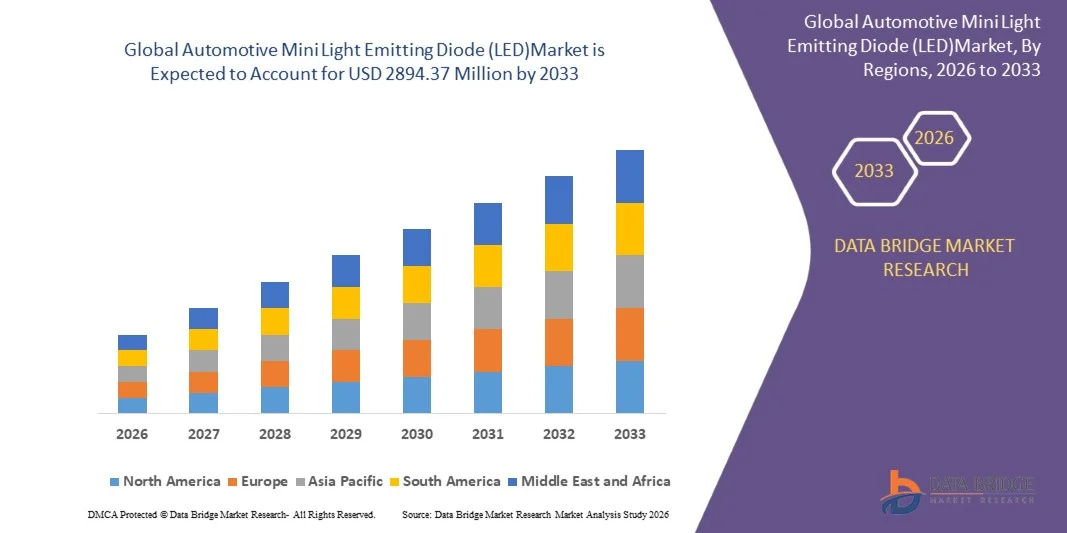
- As per Data Bridge Market Research analysis, the automotive mini light emitting diode (LED) market was valued at USD 424.47 Million in 2025 and is projected to reach USD 2894.37 Million by 2033, growing at a CAGR of 27.12% from 2026 to 2033.
- The market is experiencing exponential growth driven by rising demand for high performance automotive displays, rapid advancements in Mini LED backlighting and adaptive lighting technologies, and expanding applications across instrument clusters, infotainment systems, head up displays (HUDs), and exterior lighting solutions.
- The increasing adoption of electric vehicles (EVs) and autonomous driving systems, combined with growing consumer preference for immersive, high resolution in vehicle visual experiences, is compelling automotive OEMs, Tier 1 suppliers, and display manufacturers to adopt advanced Mini LED technologies. Mini LED displays are increasingly replacing traditional LCD and OLED solutions in many automotive applications, offering superior brightness, contrast, energy efficiency, and durability for next generation vehicle interiors and exteriors.
Market Size & Forecast
- Global Market Value (2025): USD 424.47 Million
- Expected Market Value (2033): USD 2894.37 Million
- Forecast CAGR (2026 to 2033): 27.12%
- Leading Region in 2025: North America
- Fastest Growing Region: Asia Pacific
What are the Major Takeaways of the Automotive Mini Light Emitting Diode (LED) Market?
- North America dominated the global automotive mini light emitting diode (LED) market with the largest revenue share in 2025, supported by the presence of major automotive manufacturing hubs, a robust electronics supply chain, and increasing investments in smart vehicle technologies across the U.S. and Canada.
- Asia-Pacific is expected to be the fastest growing region, fueled by rapid urbanization, rising disposable incomes, expanding automotive production, and the proliferation of electric vehicles, with a CAGR of 27.12% from 2026 to 2033.
- The displays segment led the market in 2025, driven by the increasing integration of Mini LED technology into instrument clusters, infotainment systems, and head up displays due to its superior brightness, contrast, and energy efficiency.
- Electric vehicles (EVs) represent the fastest growing vehicle type segment, reflecting the surge in demand for advanced display and lighting solutions that enhance battery efficiency and driver interaction.
- The passenger vehicles segment dominated the vehicle type category, led by automotive OEMs adopting Mini LED displays for digital cockpits, ADAS visualization, and premium in vehicle entertainment systems.
- Mini LED backlit displays accounted for a significant share of the technology segment, preferred by OEMs and Tier 1 suppliers for their superior local dimming, higher contrast ratios, and better durability compared to OLED and traditional LED technologies.
- The adaptive lighting systems segment is among the fastest growing application categories, driven by demand for intelligent, energy efficient exterior lighting solutions including headlights, taillights, and interior ambient lighting.
Report Scope and Automotive Mini Light Emitting Diode (LED) Market Segmentation
|
Attributes |
Automotive Mini Light Emitting Diode (LED)Key Market Insights |
|
Segments Covered |
|
|
Countries Covered |
North America
Europe
Asia-Pacific
Middle East and Africa
South America
|
|
Key Market Players |
|
|
Market Opportunities |
|
|
Value Added Data Infosets |
In addition to the insights on market scenarios such as market value, growth rate, segmentation, geographical coverage, and major players, the market reports curated by the Data Bridge Market Research also include in-depth expert analysis, geographically represented company-wise production and capacity, network layouts of distributors and partners, detailed and updated price trend analysis and deficit analysis of supply chain and demand. |
What is the Key Trend in the Automotive Mini Light Emitting Diode (LED) Market?
- Automotive OEMs and display manufacturers are increasingly adopting high-performance Mini LED displays to enhance in vehicle visual experiences, optimize cockpit designs, and develop advanced human machine interfaces while reducing the cost and complexity associated with traditional display technologies.
- For instance, leading automotive brands including Hongqi, Zeekr, Xiaomi, Yangwang, Rising Auto, NIO, Li Auto, and SAIC Roewe have already adopted Mini LED technology in their production vehicles, demonstrating the accelerating commercialization of this technology.
- The trend toward HDR (high dynamic range), local dimming, wide color gamut, and curved screen design has significantly driven the Mini LED display market. Additionally, panoramic HUDs and holographic HUDs are beginning to adopt Mini LED technology to enhance contrast ratio, which is expected to drive further growth momentum.
- As automotive manufacturers and Tier 1 suppliers continue to prioritize display performance optimization and cost effective cockpit solutions, the adoption of advanced Mini LED technology is expected to accelerate, reinforcing Mini LED as a core component of next generation vehicle interiors and smart mobility solutions.
What are the Key Drivers of the Automotive Mini Light Emitting Diode (LED) Market?
- Mini LED technology is increasingly being integrated into instrument clusters, infotainment systems, and head up displays (HUDs) due to its superior brightness, contrast, and energy efficiency. The growing preference for immersive and high resolution vehicle displays is propelling market growth.
- Modern vehicles are incorporating advanced driver assistance systems (ADAS) and digital cockpits, where Mini LED displays play a crucial role in enhancing visibility, clarity, and durability. The shift toward connected mobility solutions is boosting the demand for Mini LED panels.
- As EV manufacturers focus on enhancing battery efficiency, Mini LEDs are preferred due to their low power consumption. Additionally, autonomous vehicles require advanced lighting and display systems for improved driver interaction, further fueling demand. Sony Honda Mobility, BMW, Hyundai Motor Group, BAIC, and GWM are expected to release vehicles equipped with Mini LED displays between 2026 and 2029.
- With improved miniaturization and backlight control, Mini LEDs offer superior local dimming, higher contrast ratios, and better durability compared to OLED and traditional LED technologies. These advancements are making Mini LEDs the preferred choice for next generation automotive displays.
- Mini LEDs are increasingly being used in headlights, taillights, interior ambient lighting, and adaptive driving beams. The enhanced brightness, longer lifespan, and improved energy efficiency of Mini LED lighting solutions are driving widespread adoption.
- With the automotive industry increasingly relying on advanced display and lighting technologies to accelerate innovation and ensure safety, Mini LEDs will remain indispensable for the development of next generation vehicles and smart mobility solutions.
Which Factors are Challenging the Growth of the Automotive Mini Light Emitting Diode (LED) Market ?
- Advanced Mini LED manufacturing requires significant upfront investment due to the integration of high precision epitaxial growth, chip fabrication, and mass transfer technologies. The substantial capital required for production facility setup, equipment procurement, and ongoing R&D limits the entry of new players and constrains capacity expansion.
- Mini LED faces intense competition from OLED displays, which offer superior contrast ratios and thinner form factors, as well as emerging Micro LED technology. While Mini LED has surpassed OLED in market penetration for automotive displays in 2024, ongoing technological evolution requires continuous innovation to maintain competitive positioning.
- The Mini LED supply chain involves complex coordination among LED chip manufacturers, backplane suppliers, and module assemblers. Fluctuations in raw material costs, particularly for sapphire substrates and gallium nitride (GaN), coupled with yield challenges in mass transfer processes, impact production costs and profit margins.
- The high capital investment and manufacturing complexity associated with advanced Mini LED production continue to restrict market entry and capacity expansion, particularly among small and medium sized manufacturers. This cost barrier slows market penetration in price sensitive segments and emerging regions, limiting the widespread deployment of Mini LED technology despite growing demand.
How is the Automotive Mini Light Emitting Diode (LED) Market Segmented?
The automotive mini light emitting diode (led)market is segmented on the basis of application, vehicle type, technology, form factor, end use, display type, and sales channel.
-
By Application
On the basis of application, the global automotive mini light emitting diode (led)market Automotive Mini Light Emitting Diode (LED)is segmented into displays, and lighting systems. The displays segment dominated the market in 2025, owing to the increasing integration of Mini LED technology into instrument clusters, infotainment systems, and head up displays (HUDs). These systems deliver superior brightness, contrast, and energy efficiency, making them the preferred choice for automotive OEMs, Tier 1 suppliers, and smart cockpit developers.
The lighting systems segment is projected to register significant growth from 2026 to 2033, driven by rising demand for adaptive driving beams, intelligent headlights, and interior ambient lighting solutions. Advances in Mini LED lighting technology, combined with growing adoption in electric and autonomous vehicles, are accelerating segment expansion.
-
By Vehicle Type
On the basis of vehicle type, the global automotive mini light emitting diode (LED) market is segmented into passenger vehicles, commercial vehicles, electric vehicles, two-wheelers and luxury vehicles. The passenger vehicles segment led the market in 2025, supported by extensive use in digital cockpits, ADAS visualization, and premium in vehicle entertainment systems by major OEMs and technology providers globally.
The electric vehicles (EVs) segment is expected to experience the fastest growth from 2026 to 2033, driven by increasing demand for energy efficient display and lighting solutions that enhance battery efficiency and driver interaction.
-
By Technology
On the basis of technology, the global automotive mini light emitting diode (LED) market is segmented into Mini LED backlit displays, Mini LED based adaptive lighting systems, standard Mini LED and smart Mini LED. The Mini LED backlit displays segment dominated the market in 2025 due to its widespread adoption in instrument clusters, center stack displays, and infotainment systems, offering superior local dimming, higher contrast ratios, and better durability compared to alternative technologies.
The smart Mini LED segment is expected to witness significant growth from 2026 to 2033, driven by the increasing demand for intelligent, adaptive display and lighting solutions that leverage AI and sensor integration for enhanced performance and user experience.
-
By Form Factor
On the basis of form factor, the global automotive mini light emitting diode (LED) market is segmented into surface mount device, chip on board, integrated module, flexible LED and panel LED. The integrated module segment dominated the market in 2025 due to its critical role in providing compact, high performance display and lighting solutions for space constrained automotive applications.
The flexible LED segment is expected to witness the fastest growth from 2026 to 2033, driven by increasing demand for curved and customizable display solutions that enhance interior aesthetics and user experience.
-
By End Use
On the basis of end use, the global automotive mini light emitting diode (LED) market is segmented into OEM, and aftermarket. The OEM segment dominated the market in 2025 due to its critical role in vehicle design, manufacturing, and integration of advanced display and lighting systems. The widespread adoption of Mini LED technology by automotive manufacturers for production vehicles is driving strong demand for OEM solutions.
The OEM segment is expected to witness the fastest growth from 2026 to 2033, driven by the rising need for advanced display and lighting solutions in next generation vehicles. OEMs are increasingly integrating Mini LED technology into vehicle R&D, production, and quality assurance processes to enhance vehicle aesthetics, safety, and user experience.
-
By Display Type
On the basis of display type, the global automotive mini light emitting diode (LED) market is segmented into instrument cluster, center stack display, head up display, rear seat entertainment display and central console display. The instrument cluster segment dominated the market in 2025 due to its critical role in providing drivers with essential vehicle information through high brightness, high contrast displays that enhance readability and safety.
The head up display (HUD) segment is expected to witness the fastest growth from 2026 to 2033, driven by increasing adoption of panoramic and holographic HUDs that leverage Mini LED technology to enhance contrast ratio and provide immersive driver information.
-
By Sales Channel
On the basis of sales channel, the global automotive mini light emitting diode (LED) market is segmented into direct and indirect. The direct segment dominated the market in 2025 due to its preference among automotive OEMs and large Tier 1 suppliers that require customized solutions, direct technical support, and long term supply agreements.
The indirect segment is expected to witness the fastest growth from 2026 to 2033, driven by the increasing presence of distributors, value added resellers, and aftermarket channels that facilitate wider market access and faster adoption across diverse customer segments.
Which Region Holds the Largest Share of the Automotive Mini Light Emitting Diode (LED) Market?
- North America dominated the automotive mini light emitting diode (LED) market and accounted for the largest revenue share in 2025, supported by the presence of major automotive manufacturing hubs, a robust electronics supply chain, and increasing investments in smart vehicle technologies.
- The region benefits from the high penetration of smart vehicles, strong presence of luxury car manufacturers, and early adoption of advanced display technologies. The U.S. and Canada are early adopters of automotive mini light emitting diode (LED) technology, supported by robust R&D ecosystems and the presence of key market players in automotive innovation and display manufacturing. Stringent government regulations regarding vehicle safety and the rapid adoption of connected car technologies further catalyze the deployment of Mini LED displays in instrument clusters, center stacks, and head up displays.
- Asia Pacific is the fastest growing region, supported by strong electronics manufacturing in China, Japan, and South Korea, along with increasing automotive production and investments in innovative display technologies. Asia Pacific is projected to account for 64.86% of the 2025 volume and grow at a CAGR of 23.85% through 2031. The region benefits from rapid urbanization, rising disposable incomes, expanding automotive production, and increasing adoption of energy-efficient display technologies.
China Automotive Mini Light Emitting Diode (LED) Market Insight
The China automotive mini light emitting diode (LED) market demonstrated early and rapid adoption, with Chinese automakers NIO and Roewe adopting Mini LED backlit displays in 2022. In 2023, multiple automakers showcased vehicles equipped with Mini LED backlit screens at the Shanghai International Auto Show. By the first half of 2023, Mini LED-equipped vehicle sales in China grew 1.3 times year-over-year, with penetration rising to 1.1%. The market continues to experience rapid growth driven by increasing urbanization, expanding electric vehicle production, and rising government focus on new energy vehicles and smart mobility solutions. Major display manufacturers including BOE Technology Group and Tianma Microelectronics are actively expanding their Mini LED display portfolios.
U.S. Automotive Mini Light Emitting Diode (LED) Market Insight
The U.S. emerged as a key early adopter of automotive mini light emitting diode (LED) technology. U.S. carmaker General Motors offered a 33.4-inch automotive display system featuring Mini LED backlight technology in 2022-2023. U.S. automakers including Ford and Jeep gradually introduced Mini LED display technology to more vehicle models in 2023. The U.S. market benefits from strong demand across automotive and consumer electronics sectors, supported by federal funding, sustainability mandates, and strong EV adoption driving market growth.
Europe Automotive Mini Light Emitting Diode (LED) Market Insight
Europe is a significant market for automotive mini light emitting diode (LED), with Germany, France, and the U.K. leading in adoption across luxury and premium vehicle segments. European and U.S. carmakers such as Ford and Jeep were expected to gradually introduce Mini LED display technology to more of their models in 2023. Combined European and U.S. carmaker shipments were forecast to reach 450,000 units for 2023. The region benefits from strong automotive manufacturing capabilities, advanced research infrastructure, and stringent safety and environmental regulations that encourage the adoption of energy efficient display and lighting technologies. Germany, as Europe's largest automotive manufacturing hub, represents a primary market for adoption in luxury and premium vehicle segments.
Japan Automotive Mini Light Emitting Diode (LED) Market Insight
Japan is identified as a key Asia Pacific market for Mini LED backlit automotive display modules. The Japan automotive mini light emitting diode (LED) market is witnessing consistent growth due to rising investments in advanced display technologies, automotive innovation, and smart mobility initiatives. Automotive manufacturers, electronics companies, and research institutes are increasingly adopting high performance Mini LED solutions for vehicle displays, lighting systems, and R&D purposes.
South Korea Automotive Mini Light Emitting Diode (LED) Market Insight
South Korea is listed among the key Asia Pacific countries in the Mini LED backlit automotive display module market. The South Korea automotive mini light emitting diode (LED) market is expanding steadily, supported by the country's strong electronics manufacturing base, advanced display technology capabilities, and increasing adoption of next generation automotive display solutions. Major display manufacturers including Samsung Display and LG Display are increasingly utilizing Mini LED technology for instrument clusters, infotainment systems, and smart cockpit applications.
Which are the Top Companies in Automotive Mini Light Emitting Diode (LED)Market?
The automotive mini light emitting diode (LED)industry is primarily led by well-established companies, including:
- Cree LED (a Penguin Solutions brand) (U.S.)
- NICHIA CORPORATION (Japan)
- OSRAM GmbH (Germany)
- SAMSUNG ELECTRONICS CO., LTD. (South Korea)
- EVERLIGHT ELECTRONICS CO., LTD. (Taiwan)
- Lumileds Holding B.V. (Netherlands)
- EPISTAR Corporation (Taiwan)
- LG Innotek Co., Ltd. (South Korea)
- Broadcom Inc. (U.S.)
- Seoul Semiconductor Co., Ltd. (South Korea)
- BOE Technology Group Co., Ltd. (China)
- TCL China Star Optoelectronics Technology Co., Ltd. (TCL CSOT) (China)
- Tianma Microelectronics Co., Ltd. (China)
- Innolux Corporation (Taiwan)
- AU Optronics Corp. (Taiwan)
- LG Display Co., Ltd. (South Korea)
- Lumens Co., Ltd. (South Korea)
- Plessey Semiconductors Limited (U.K.)
- Luckylight Electronics Co., Ltd. (China)
- Lite-On Technology Corporation (Taiwan)
- STANLEY ELECTRIC CO., LTD. (Japan)
What are Latest Developments in Automotive Mini Light Emitting Diode (LED)Market?
- In March 2025, BOE Technology Group announced the expansion of its automotive mini light emitting diode (LED) display production capacity to meet growing demand from major automotive OEMs in China, Europe, and North America. The company's next generation Mini LED modules feature enhanced brightness, improved color accuracy, and reduced power consumption for advanced cockpit applications.
- In January 2025, TCL CSOT unveiled its latest automotive mini light emitting diode (LED) display solutions at CES 2025, featuring high dynamic range imaging, local dimming technology, and curved form factors designed for next generation smart cockpits. The company demonstrated 17 inch and 27 inch Mini LED display modules targeting premium passenger vehicles and electric vehicles.
- In November 2025, Samsung Electronics announced the acquisition of JDI's automotive display unit to accelerate its Mini LED vehicle display roadmap, strengthening its position in the rapidly growing automotive display market.
- In October 2025, LG Display partnered with a leading automotive OEM to co develop a next generation Mini LED cockpit display for mass production, targeting premium electric vehicle models scheduled for launch in 2027.
- In September 2025, Epistar launched a significant new Mini LED vehicle display module, targeting high brightness cockpit visibility under sunlight conditions. The module features advanced local dimming capabilities and enhanced durability for demanding automotive applications.
- In August 2025, Nichia Corporation announced the development of next generation Mini LED chips with improved luminous efficiency and reduced power consumption, specifically designed for automotive display and lighting applications. The new chips enable thinner, lighter, and more energy efficient display modules for next generation vehicles.

- Interactive Data Analysis Dashboard
- Company Analysis Dashboard for high growth potential opportunities
- Research Analyst Access for customization & queries
- Competitor Analysis with Interactive dashboard
- Latest News, Updates & Trend analysis
- Harness the Power of Benchmark Analysis for Comprehensive Competitor Tracking
Global Automotive Mini Led Market, Supply Chain Analysis and Ecosystem Framework
To support market growth and help clients navigate the impact of geopolitical shifts, DBMR has integrated in-depth supply chain analysis into its Global Automotive Mini Led Market research reports. This addition empowers clients to respond effectively to global changes affecting their industries. The supply chain analysis section includes detailed insights such as Global Automotive Mini Led Market consumption and production by country, price trend analysis, the impact of tariffs and geopolitical developments, and import and export trends by country and HSN code. It also highlights major suppliers with data on production capacity and company profiles, as well as key importers and exporters. In addition to research, DBMR offers specialized supply chain consulting services backed by over a decade of experience, providing solutions like supplier discovery, supplier risk assessment, price trend analysis, impact evaluation of inflation and trade route changes, and comprehensive market trend analysis.
Data collection and base year analysis are done using data collection modules with large sample sizes. The stage includes obtaining market information or related data through various sources and strategies. It includes examining and planning all the data acquired from the past in advance. It likewise envelops the examination of information inconsistencies seen across different information sources. The market data is analysed and estimated using market statistical and coherent models. Also, market share analysis and key trend analysis are the major success factors in the market report. To know more, please request an analyst call or drop down your inquiry.
The key research methodology used by DBMR research team is data triangulation which involves data mining, analysis of the impact of data variables on the market and primary (industry expert) validation. Data models include Vendor Positioning Grid, Market Time Line Analysis, Market Overview and Guide, Company Positioning Grid, Patent Analysis, Pricing Analysis, Company Market Share Analysis, Standards of Measurement, Global versus Regional and Vendor Share Analysis. To know more about the research methodology, drop in an inquiry to speak to our industry experts.
Data Bridge Market Research is a leader in advanced formative research. We take pride in servicing our existing and new customers with data and analysis that match and suits their goal. The report can be customized to include price trend analysis of target brands understanding the market for additional countries (ask for the list of countries), clinical trial results data, literature review, refurbished market and product base analysis. Market analysis of target competitors can be analyzed from technology-based analysis to market portfolio strategies. We can add as many competitors that you require data about in the format and data style you are looking for. Our team of analysts can also provide you data in crude raw excel files pivot tables (Fact book) or can assist you in creating presentations from the data sets available in the report.













