


What is the Automotive Mirror Dimming Market Size and Growth Rate?
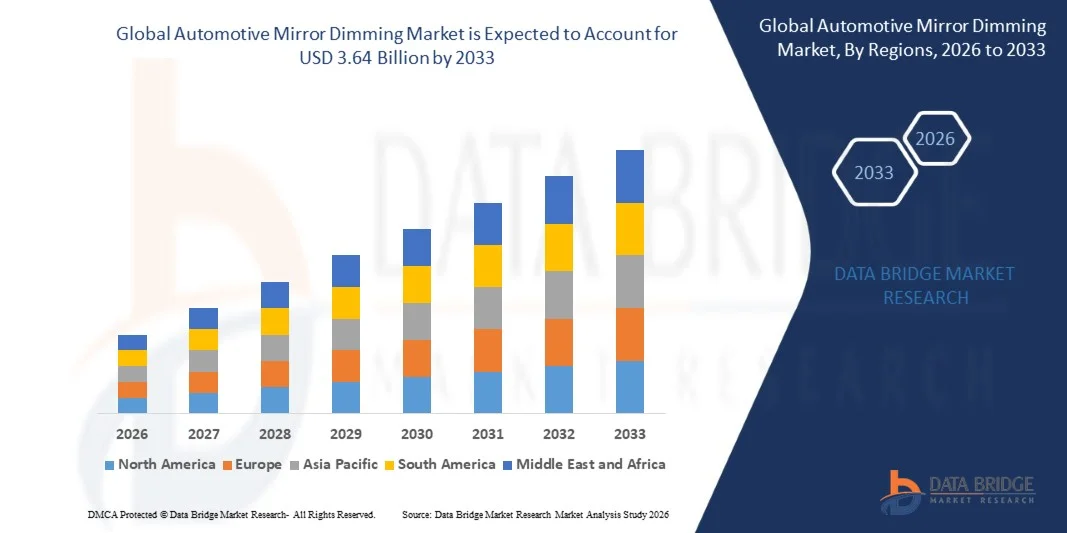
- As per Data Bridge Market Research Analysis the global automotive mirror dimming market size was valued at USD 2.41 billion in 2025 and is expected to reach USD 3.64 billion by 2033, at a CAGR of 5.30% during the forecast period
- The market growth is largely fuelled by the increasing production of passenger and commercial vehicles and rising integration of advanced driver assistance systems to enhance driving safety and comfort
- Growing consumer preference for premium vehicle features such as automatic glare reduction, improved night visibility, and enhanced driving convenience is further supporting market expansion
Market Size & Forecast
- Global Market Value (2025): USD 2.41 Billion
- Expected Market Value (2033): USD 3.64 Billion
- Forecast CAGR (2026–2033): 5.30%
What are the Major Takeaways of Automotive Mirror Dimming Market?
- The market is witnessing steady growth driven by increasing adoption of electrochromic mirror technology as it improves driver visibility, reduces accident risks, and enhances overall vehicle safety
- Rising technological advancements, increasing demand for luxury and mid-segment vehicles, and growing focus of automakers on integrating smart and connected vehicle features are contributing to sustained market development
- North America dominated the automotive mirror dimming market with the largest revenue share in 2025, driven by high vehicle ownership, strong presence of leading automotive manufacturers, and increasing integration of advanced safety features
- Asia-Pacific region is expected to witness the highest growth rate in the global automotive mirror dimming market, driven by rapid expansion of automotive manufacturing, increasing vehicle ownership, and rising integration of advanced vehicle technologies. In addition, strong economic growth, expanding middle-class population, and increasing focus on vehicle safety and comfort are supporting regional market growth
- The Internal Combustion Engine (ICE) segment held the largest market revenue share in 2025 driven by the high global production and sales volume of ICE-based passenger and commercial vehicles. The widespread availability, established infrastructure, and affordability of ICE vehicles have supported the large-scale integration of auto-dimming mirrors, particularly in mid-range and premium vehicle categories
Report Scope and Automotive Mirror Dimming Market Segmentation
|
Attributes |
Automotive Mirror Dimming Key Market Insights |
|
Segments Covered |
|
|
Countries Covered |
North America
Europe
Asia-Pacific
Middle East and Africa
South America
|
|
Key Market Players |
|
|
Market Opportunities |
|
|
Value Added Data Infosets |
In addition to the market insights such as market value, growth rate, market segments, geographical coverage, market players, and market scenario, the market report curated by the Data Bridge Market Research team includes in-depth expert analysis, import/export analysis, pricing analysis, production consumption analysis, and pestle analysis. |
What is the Key Trend in the Automotive Mirror Dimming Market?
“Increasing Integration Of Electrochromic Technology In Modern Vehicles”
• The growing integration of electrochromic mirror dimming technology is significantly influencing the automotive mirror dimming market, as automakers increasingly focus on improving driver safety, comfort, and visibility. These mirrors automatically adjust reflectivity in response to glare from trailing vehicles, enhancing night-time driving experience. This trend is strengthening adoption across passenger and premium vehicles, encouraging manufacturers to develop advanced and cost-efficient dimming solutions that align with evolving automotive safety standards
• Rising consumer expectations for enhanced comfort, convenience, and advanced vehicle features have accelerated the demand for auto-dimming mirrors in both interior rear-view and exterior side-view applications. Automakers are incorporating these systems to enhance vehicle appeal and differentiate models in competitive markets. Increasing production of luxury and mid-segment vehicles is also supporting the integration of such technologies, contributing to consistent market expansion
• Technological advancements such as sensor integration, camera-based mirror systems, and connected vehicle features are influencing product innovation. Manufacturers are focusing on improving responsiveness, durability, and compatibility with advanced driver assistance systems. These innovations are helping automotive companies enhance overall vehicle safety while strengthening their product portfolios and competitive positioning
• For instance, in 2024, Gentex Corporation in the U.S. and Magna International in Canada expanded production of advanced auto-dimming mirrors integrated with electronic features and driver assistance technologies. These products were introduced for passenger and premium vehicles across North America and Europe. The launch supported automakers in improving safety ratings, vehicle value, and consumer appeal, contributing to increased adoption of electrochromic mirrors
• While adoption is increasing, sustained growth depends on continued technological innovation, cost optimization, and expanding integration into mid-range vehicles. Manufacturers are focusing on improving manufacturing efficiency, enhancing product reliability, and developing scalable solutions to support wider adoption across global automotive segments
Automotive Mirror Dimming Market Dynamics
Driver
“Growing Focus On Vehicle Safety And Increasing Adoption Of Premium Features”
• Increasing emphasis on vehicle safety and accident prevention is a major driver for the automotive mirror dimming market. Auto-dimming mirrors help reduce glare-related visibility issues, improving driver awareness and reducing accident risks. Automakers are integrating these systems to comply with safety standards and enhance vehicle safety performance, supporting increased adoption globally
• Rising demand for premium and technologically advanced vehicles is influencing market growth. Consumers are increasingly seeking comfort and convenience features, encouraging manufacturers to integrate auto-dimming mirrors into both luxury and mid-range vehicles. This trend is supporting product differentiation and enhancing overall vehicle value, contributing to sustained demand
• Automotive manufacturers and component suppliers are actively promoting advanced mirror technologies through product innovation and strategic partnerships. These efforts are supported by growing production of passenger vehicles and increasing integration of electronic systems in automobiles. Partnerships between OEMs and technology providers are further accelerating innovation and product deployment
• For instance, in 2023, BMW in Germany and Mercedes‑Benz expanded the integration of advanced auto-dimming mirrors across multiple vehicle models. The initiative was aimed at improving safety, comfort, and driving experience. These enhancements helped strengthen brand positioning, improve safety features, and increase consumer demand for advanced mirror systems
• Although safety and premiumization trends support growth, continued expansion depends on reducing system costs, improving compatibility with emerging vehicle technologies, and expanding adoption in entry-level vehicles. Investment in research, innovation, and manufacturing efficiency will be critical to maintaining competitive advantage
Restraint/Challenge
“High Cost And Limited Adoption In Low-Cost Vehicle Segments”
• The relatively higher cost of automotive mirror dimming systems compared to conventional mirrors remains a key challenge, particularly in price-sensitive markets. Advanced components such as electrochromic materials, sensors, and electronic controls increase overall system costs. This limits adoption in entry-level and economy vehicle segments where cost reduction is a priority
• Limited awareness and lower penetration in developing regions also affect market growth. Many consumers prioritize affordability over advanced features, reducing demand for premium mirror technologies. This slows adoption rates in emerging automotive markets where vehicle affordability is a key purchasing factor
• Integration and manufacturing challenges also impact adoption, as automakers must ensure compatibility with vehicle electronics, safety systems, and design requirements. Additional testing, certification, and production complexity increase operational costs. Manufacturers must invest in advanced production technologies and engineering expertise to maintain product performance and reliability
• For instance, in 2024, automotive suppliers working with mass-market vehicle manufacturers such as Maruti Suzuki in India and Hyundai Motor Company reported limited adoption of auto-dimming mirrors in entry-level models due to pricing constraints and cost-optimization strategies. This affected the penetration rate of advanced mirror technologies in economy vehicles and emerging markets
• Overcoming these challenges will require cost reduction strategies, increased production efficiency, and expanding awareness of safety benefits. Collaboration between suppliers and automakers, along with technological innovation and scalable manufacturing, will be essential to support wider adoption and long-term growth of the global automotive mirror dimming market
How is the Automotive Mirror Dimming Market Segmented?
The market is segmented on the basis of fuel type, application, vehicle type, functionality, and material.
• By Fuel Type
On the basis of fuel type, the automotive mirror dimming market is segmented into Battery Electric Vehicle (BEV), Internal Combustion Engine (ICE), and Hybrid Vehicle. The Internal Combustion Engine (ICE) segment held the largest market revenue share in 2025 driven by the high global production and sales volume of ICE-based passenger and commercial vehicles. The widespread availability, established infrastructure, and affordability of ICE vehicles have supported the large-scale integration of auto-dimming mirrors, particularly in mid-range and premium vehicle categories.
The Battery Electric Vehicle (BEV) segment is expected to witness the fastest growth rate from 2026 to 2033, driven by the rapid expansion of electric vehicle adoption and increasing integration of advanced electronic and safety features. BEVs often incorporate advanced mirror technologies to enhance efficiency, safety, and overall vehicle performance, supporting higher adoption of dimming mirrors.
• By Application
On the basis of application, the market is segmented into Inside Rear-View Mirror (IRVM) and Outside Rear-View Mirror (ORVM). The Inside Rear-View Mirror (IRVM) segment held the largest market revenue share in 2025 driven by its standard integration across a wide range of vehicles and its critical role in reducing glare from trailing vehicles. IRVM dimming systems are widely adopted due to their cost-effectiveness, safety benefits, and ease of integration.
The Outside Rear-View Mirror (ORVM) segment is expected to witness the fastest growth rate from 2026 to 2033, driven by increasing adoption in premium vehicles and growing focus on enhancing side visibility and driver safety. Automakers are increasingly integrating dimming functionality into ORVMs to improve overall driving comfort and reduce side glare.
• By Vehicle Type
On the basis of vehicle type, the market is segmented into Passenger Vehicle and Commercial Vehicle. The Passenger Vehicle segment held the largest market revenue share in 2025 driven by higher production volumes and increasing consumer demand for safety and comfort features. Rising adoption of premium and mid-segment passenger vehicles has further supported the integration of mirror dimming technologies.
The Commercial Vehicle segment is expected to witness the fastest growth rate from 2026 to 2033, driven by increasing fleet modernization and rising focus on driver safety and operational efficiency. Fleet operators are adopting advanced mirror systems to improve visibility and reduce accident risks during long-distance and night driving.
• By Functionality
On the basis of functionality, the market is segmented into Connected and Non-Connected. The Non-Connected segment held the largest market revenue share in 2025 driven by its widespread use in conventional vehicles and lower system cost. These mirrors offer reliable glare reduction without requiring integration with vehicle connectivity systems, making them suitable for a broad range of vehicles.
The Connected segment is expected to witness the fastest growth rate from 2026 to 2033, driven by increasing adoption of connected vehicles and integration of advanced driver assistance systems. Connected dimming mirrors provide enhanced functionality, improved automation, and compatibility with modern vehicle electronics.
• By Material
On the basis of material, the market is segmented into IR-PVB, Metal Coated, and Tinted. The Metal Coated segment held the largest market revenue share in 2025 driven by its superior reflectivity, durability, and effectiveness in glare reduction. Metal-coated mirrors are widely used due to their performance reliability and cost efficiency.
The IR-PVB segment is expected to witness the fastest growth rate from 2026 to 2033, driven by its advanced glare reduction properties and increasing adoption in modern and premium vehicles. IR-PVB materials help improve visibility, enhance driving comfort, and support the development of advanced automotive mirror technologies.
Which Region Holds the Largest Share of the Automotive Mirror Dimming Market?
• North America dominated the automotive mirror dimming market with the largest revenue share in 2025, driven by high vehicle ownership, strong presence of leading automotive manufacturers, and increasing integration of advanced safety features
• Automakers in the region emphasize driver safety, comfort, and adoption of advanced technologies, leading to increased installation of auto-dimming mirrors in both passenger and commercial vehicles
• This widespread adoption is further supported by high consumer demand for premium vehicles, strong technological infrastructure, and growing awareness of road safety, establishing mirror dimming systems as a standard feature in modern vehicles
U.S. Automotive Mirror Dimming Market Insight
The U.S. automotive mirror dimming market captured the largest revenue share in 2025 within North America, fueled by high production and sales of passenger vehicles and strong adoption of advanced automotive technologies. Consumers are increasingly prioritizing safety and comfort features, encouraging automakers to integrate auto-dimming mirrors across vehicle categories. The presence of major automotive manufacturers and component suppliers further supports innovation and product adoption. Moreover, increasing demand for premium and technologically advanced vehicles is significantly contributing to market expansion.
Europe Automotive Mirror Dimming Market Insight
The Europe automotive mirror dimming market is expected to witness the fastest growth rate from 2026 to 2033, primarily driven by strict vehicle safety regulations and strong demand for premium automobiles. Increasing adoption of advanced driver assistance systems and focus on vehicle safety are supporting the integration of dimming mirrors. European automakers are actively incorporating these technologies to enhance safety and driving comfort. The region is also witnessing increased adoption across both passenger and commercial vehicle segments.
U.K. Automotive Mirror Dimming Market Insight
The U.K. automotive mirror dimming market is expected to witness the fastest growth rate from 2026 to 2033, driven by rising demand for technologically advanced vehicles and increasing focus on driver safety. Consumers are increasingly preferring vehicles equipped with advanced comfort and safety features. In addition, strong presence of automotive technology providers and increasing vehicle modernization are supporting product adoption. The growing shift toward premium and connected vehicles is further stimulating market growth.
Germany Automotive Mirror Dimming Market Insight
The Germany automotive mirror dimming market is expected to witness the fastest growth rate from 2026 to 2033, fueled by the country’s well-established automotive industry and high demand for luxury vehicles. Germany’s focus on innovation, engineering excellence, and vehicle safety is promoting adoption of advanced mirror technologies. Automakers are integrating auto-dimming mirrors to enhance safety, comfort, and vehicle performance. The increasing production of premium vehicles continues to support steady market expansion.
Asia-Pacific Automotive Mirror Dimming Market Insight
The Asia-Pacific automotive mirror dimming market is expected to witness the fastest growth rate from 2026 to 2033, driven by rapid vehicle production, expanding automotive industry, and increasing consumer demand for safety features. Rising disposable incomes and growing adoption of premium vehicles are supporting technology integration. In addition, the region’s role as a major automotive manufacturing hub is improving product accessibility and affordability. Government initiatives supporting vehicle safety are also contributing to market growth.
Japan Automotive Mirror Dimming Market Insight
The Japan automotive mirror dimming market is expected to witness the fastest growth rate from 2026 to 2033 due to the country’s advanced automotive sector and focus on innovation and safety. Japanese automakers are actively integrating advanced mirror technologies into vehicles to enhance safety and driving comfort. The increasing adoption of hybrid and electric vehicles is further supporting demand. Moreover, strong consumer preference for technologically advanced vehicles is contributing to market expansion.
China Automotive Mirror Dimming Market Insight
The China automotive mirror dimming market accounted for the largest market revenue share in Asia-Pacific in 2025, attributed to high vehicle production, rapid urbanization, and growing demand for advanced automotive features. China is one of the largest automotive markets globally, supporting large-scale adoption of mirror dimming technologies. Increasing production of passenger vehicles and expanding domestic automotive manufacturers are key factors driving the market. The rising demand for safety and comfort features is further accelerating market growth.
Which are the Top Companies in Automotive Mirror Dimming Market?
The Automotive Mirror Dimming industry is primarily led by well-established companies, including:
- Ficosa Internacional SA (Spain)
- FLABEG Automotive Glass Group GmbH (Germany)
- Gentex Corporation (U.S.)
- HondaLockMfg. Co., Ltd. (Japan)
- Konview Electronics Corporation Limited (China)
- Magna International Inc. (Canada)
- Murakami Corporation (Japan)
- Motherson (India)
- Global Media Industry Group (China)
- Tokai Rika Co., Ltd. (Japan)
- Ichikoh Industries, Ltd. (Japan)
- SL Corporation (South Korea)
- Ford Motor Company (U.S.)
- Audi AG (Germany)
- BMW AG (Germany)
- Mercedes-Benz AG (Germany)
- Fiat Chrysler Automobiles (Netherlands)
- Rolls-Royce plc (U.K.)
- Dura Automotive Systems (U.S.)
- Webasto Group (Germany)

- Interactive Data Analysis Dashboard
- Company Analysis Dashboard for high growth potential opportunities
- Research Analyst Access for customization & queries
- Competitor Analysis with Interactive dashboard
- Latest News, Updates & Trend analysis
- Harness the Power of Benchmark Analysis for Comprehensive Competitor Tracking
Data collection and base year analysis are done using data collection modules with large sample sizes. The stage includes obtaining market information or related data through various sources and strategies. It includes examining and planning all the data acquired from the past in advance. It likewise envelops the examination of information inconsistencies seen across different information sources. The market data is analysed and estimated using market statistical and coherent models. Also, market share analysis and key trend analysis are the major success factors in the market report. To know more, please request an analyst call or drop down your inquiry.
The key research methodology used by DBMR research team is data triangulation which involves data mining, analysis of the impact of data variables on the market and primary (industry expert) validation. Data models include Vendor Positioning Grid, Market Time Line Analysis, Market Overview and Guide, Company Positioning Grid, Patent Analysis, Pricing Analysis, Company Market Share Analysis, Standards of Measurement, Global versus Regional and Vendor Share Analysis. To know more about the research methodology, drop in an inquiry to speak to our industry experts.
Data Bridge Market Research is a leader in advanced formative research. We take pride in servicing our existing and new customers with data and analysis that match and suits their goal. The report can be customized to include price trend analysis of target brands understanding the market for additional countries (ask for the list of countries), clinical trial results data, literature review, refurbished market and product base analysis. Market analysis of target competitors can be analyzed from technology-based analysis to market portfolio strategies. We can add as many competitors that you require data about in the format and data style you are looking for. Our team of analysts can also provide you data in crude raw excel files pivot tables (Fact book) or can assist you in creating presentations from the data sets available in the report.













