What is the Automotive Modular Seat Market Size and Growth Rate?
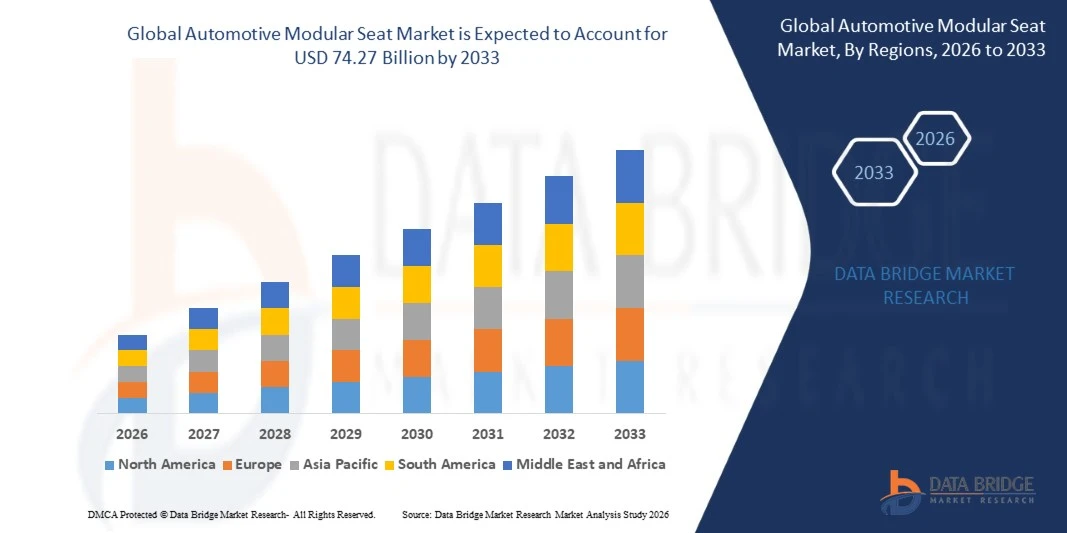
- As per Data Bridge Market Research analysis, the automotive modular seat market was valued at USD 58.18 billion in 2025 and is projected to reach USD 74.27 billion by 2033, growing at a CAGR of 3.10% from 2026 to 2033.
- The market is experiencing consistent growth driven by rising automaker demand for flexible and reconfigurable seating, increasing adoption of modular assembly to cut cost and complexity, and expanding applications across passenger cars, commercial vehicles, and electric vehicle platforms.
- The increasing shift toward platform-based vehicle architectures, comfort-feature personalization, and thinner, lighter seat structures, combined with the growth of electric vehicles, is supporting market adoption. Modular seat designs are being applied across front and rear rows, automotive seating programs, and lightweight materials applications, offering automakers lower assembly time, simpler variant management, and easier upgrades and serviceability.
Market Size & Forecast
- Global Market Value (2025): USD 58.18 Billion
- Expected Market Value (2033): USD 74.27 Billion
- Forecast CAGR (2026–2033): 3.10%
- Leading Region in 2025: Asia-Pacific
- Fastest Growing Region: South America
What are the Major Takeaways of the Automotive Modular Seat Market?
- Asia-Pacific dominated the automotive modular seat market with the largest revenue share of 43.10% in 2025, supported by the world’s largest vehicle production base, strong seat supplier presence, and rapid adoption of modular platforms across China, Japan, India, and South Korea.
- South America is expected to be the fastest-growing region at a CAGR of 4.35% from 2026 to 2033, fueled by recovering vehicle production, expanding local assembly by global automakers, and rising demand for feature-rich seating in new models.
- The front seats segment led the market with a 49.35% share in 2025, driven by higher content per vehicle, adoption of comfort, thermal, and massage modules, and the need for variant-flexible seat architectures.
- Second-row seats are the fastest-growing seat position, projected to register a CAGR of 4.05%, reflecting demand for reconfigurable, slidable, and removable rear seating in SUVs, crossovers, and multi-purpose vehicles.
- The passenger cars segment dominated the vehicle type category with a 71.80% revenue share in 2025, led by high production volumes and wide use of modular seat platforms across multiple models.
- Internal combustion engine vehicles accounted for 58.60% of the market share in 2025, preferred owing to their continued dominance in global vehicle production and established seat platform programs.
- The electric segment is the fastest-growing propulsion type category, with a CAGR of 8.90%, driven by demand for lightweight, thin, and reconfigurable seats on new battery-electric platforms.
Report Scope and Automotive Modular Seat Market Segmentation
|
Attributes |
Automotive Modular Seat Key Market Insights |
|
Segments Covered |
|
|
Countries Covered |
North America
Europe
Asia-Pacific
Middle East and Africa
South America
|
|
Key Market Players |
|
|
Market Opportunities |
|
|
Value Added Data Infosets |
In addition to the market insights such as market value, growth rate, market segments, geographical coverage, market players, and market scenario, the market report curated by the Data Bridge Market Research team includes in-depth expert analysis, import/export analysis, pricing analysis, production consumption analysis, and pestle analysis. |
What is the Key Trend in the Automotive Modular Seat Market?
- Automotive seats are increasingly evolving from fixed, vehicle-specific assemblies into modular platforms, combining standardized frames, interchangeable comfort modules, and offline sub-assembly to reduce complexity, support automation, and simplify variant management across vehicle programs.
- For instance, in February 2025, according to Lear Corporation, the company integrated its ComfortMax Seat technology with General Motors, with an intelligent modular design that streamlines assembly processes and helps reduce part count by up to 50%, highlighting the shift toward modular seat architectures that simplify manufacturing.
- Seat suppliers are also shifting toward thinner, lighter, and more flexible seat structures to improve cabin space, reduce vehicle mass, and support rotating, sliding, and reclining configurations in next-generation electric and autonomous vehicles.
- Integration of heating, ventilation, lumbar, and massage functions as combinable modules is becoming a key differentiator, enabling automakers to offer scalable comfort packages without redesigning core seat structures.
- For instance, in October 2021, according to Autocar Professional, Hyundai Transys signed a joint development agreement with Brose to develop future car seats for autonomous and electric vehicles, covering an autonomous-driving-specialized mechanism that can rotate and move, an ultra-slim and lightweight seat, and seat structure stabilization with a built-in seatbelt, with a target of mass production in 2025.
- As modular architectures, lightweight structures, automation-friendly assembly, and combinable comfort modules continue to advance, automotive modular seats are expected to expand beyond premium models into mainstream passenger cars, commercial vehicles, and purpose-built mobility platforms.
What are the Key Drivers of the Automotive Modular Seat Market?
- The rapid shift toward electric and platform-based vehicles has significantly increased demand for seating that can be configured across multiple models, reduce engineering duplication, and meet changing requirements for weight, space, and comfort.
- For instance, in May 2025, according to the International Energy Agency (IEA), global electric car sales exceeded 17 million in 2024, accounting for more than one in five new cars sold worldwide, increasing demand for lightweight, thin, and reconfigurable seat architectures suited to new vehicle platforms.
- Automakers and seat suppliers are adopting modular designs to reduce assembly time, floor space, and part count, improve quality and warranty outcomes, and offer comfort features as scalable, upgradeable options.
- For instance, in May 2026, according to Lear Corporation’s first-quarter 2026 earnings call, the company won four new awards for ComfortFlex and ComfortMax seat solutions during the quarter, bringing the total to 38, including first module awards with Audi in Europe, demonstrating growing automaker adoption of modular seating solutions.
- With OEMs seeking lower manufacturing cost, greater feature flexibility, and faster program launches, modular seat systems that combine standardized structures, interchangeable modules, and automation-ready assembly are gaining preference across vehicle segments.
What Factors Are Challenging the Growth of the Automotive Modular Seat Market?
- Modular seats require standardized interfaces, multi-function modules, and tight integration with vehicle structures, safety systems, and electronics, increasing engineering effort, validation requirements, and up-front tooling investment.
- For instance, in August 2026, according to Adient’s third-quarter fiscal 2026 earnings call as reported by MarketBeat, the company expected total Middle East-related costs of about USD 35 million to USD 40 million for the fiscal year and roughly 100 basis points of China margin compression, illustrating cost and margin pressures facing seating suppliers.
- These requirements can increase development cost and program risk, especially where automakers change vehicle volumes, specifications, or launch timing after a seat platform has been sourced.
- Volatile raw material, freight, and component costs, along with overcapacity and pricing pressure in some regions, can also limit supplier margins and slow investment in new modular platforms.
- For instance, in August 2026, according to Adient plc’s Form 10-Q filed with the U.S. Securities and Exchange Commission, factors including foreign tariffs, intensifying competition from Chinese imports, overcapacity in EMEA that creates pricing pressure, and slower electric vehicle adoption continued to affect the company’s operating environment.
- The combination of higher engineering complexity, trade and cost volatility, and uncertain vehicle production volumes can constrain adoption among cost-sensitive automakers, particularly where conventional fixed seat designs already satisfy basic comfort and safety requirements.
How is the Automotive Modular Seat Market Segmented?
The automotive modular seat market is segmented on the basis of seat position, vehicle type, propulsion type, and material.
- By Seat Position
On the basis of seat position, the automotive modular seat market is segmented into front seats, second-row seats, and third-row & others. The front seats segment dominated the market with 49.35% share in 2025, supported by higher content per vehicle and the broad use of adjustable, heated, ventilated, and massage-enabled front seats. Modular front seat architectures allow automakers to offer multiple comfort levels on a common structure. They are widely used across passenger cars and light commercial vehicles. Standardized frames and mechanisms reduce engineering duplication across programs. Integration of electronics and comfort modules is further strengthening demand.
The second-row seats segment is projected to register the fastest growth at a CAGR of 4.05% from 2026 to 2033, driven by increasing demand for reconfigurable rear seating in SUVs, crossovers, and multi-purpose vehicles. Slidable, foldable, rotating, and removable second-row seats improve cabin flexibility for passengers and cargo. Modular rear seat designs also support differentiated packages across trim levels. Growing interest in lounge-style and autonomous-ready interiors is creating additional opportunities. Advances in thin, lightweight seat structures are improving rear legroom. Compatibility with common platforms is also improving production efficiency.
- By Vehicle Type
On the basis of vehicle type, the automotive modular seat market is segmented into passenger cars, light commercial vehicles, and heavy commercial vehicles. The passenger cars segment dominated the vehicle type category with 71.80% share in 2025, supported by large production volumes and wide adoption of shared seat platforms across multiple models. Automakers use modular seats to manage trim variations and optional comfort features efficiently. Growing consumer expectations for comfort and personalization are strengthening demand. Seat suppliers are increasingly offering modular frames and subassemblies that can be reused across vehicle programs. Cost reduction and faster launch cycles further support adoption.
The light commercial vehicles segment is projected to register the fastest growth at a CAGR of 4.30% from 2026 to 2033, driven by increasing demand for flexible, durable, and comfortable seating in vans, pickups, and delivery vehicles. Growth of e-commerce logistics, shared mobility, and fleet electrification is creating requirements for configurable cabins. Modular seats allow quick reconfiguration for passenger or cargo use and easier replacement of worn components. Improved driver comfort and ergonomics are also important for fleet operators. Standardized components help lower maintenance and lifecycle costs.
- By Propulsion Type
On the basis of propulsion type, the automotive modular seat market is segmented into internal combustion engine, hybrid, and electric. The internal combustion engine segment dominated the propulsion type category with 58.60% share in 2025, supported by the continued dominance of conventional vehicles in global production and established seat platform programs. Seat suppliers are applying modular architectures to existing platforms to reduce cost and complexity. Features such as ventilated, heated, and powered seats are widely offered as modular options. Large production volumes in emerging markets also support demand. Long-running vehicle programs benefit from shared seat structures.
The electric segment is projected to register the fastest growth at a CAGR of 8.90% from 2026 to 2033, driven by increasing electric vehicle production and the need for lightweight, thin, and flexible seating. Electric vehicle platforms offer flat floors and new cabin layouts that favor rotating, sliding, and reclining seats. Weight reduction is important because it supports driving range. Automakers are using modular seats to offer comfort and personalization on new dedicated platforms. Integration of sensors, thermal comfort, and massage modules is also expanding. Growing electric vehicle launches continue to create opportunities.
- By Material
On the basis of material, the automotive modular seat market is segmented into fabric, genuine leather, synthetic leather, and others. The fabric segment dominated the material category with 52.30% share in 2025, supported by its cost effectiveness, wide design range, breathability, and suitability for mass-market vehicles. Fabric trims are easy to combine with modular seat structures and comfort modules across trim levels. Recycled and bio-based textiles are also gaining acceptance as automakers pursue sustainability goals. Strong demand from entry-level and mid-range passenger cars and commercial vehicles continues to support the segment.
The synthetic leather segment is projected to register the fastest growth at a CAGR of 4.85% from 2026 to 2033, driven by increasing demand for premium appearance, durability, and animal-free interior materials. Synthetic leather offers consistent quality, easy cleaning, and lower cost than genuine leather. Automakers are expanding its use across mid-range and electric vehicle models. Advances in bio-based and low-emission coatings are improving sustainability and cabin air quality. Compatibility with ventilated and heated seat modules is also improving. Growing consumer preference for vegan interiors is creating additional opportunities.
Which Region Holds the Largest Share of the Automotive Modular Seat Market?
- Asia-Pacific dominated the automotive modular seat market with the largest revenue share of 43.10% in 2025, supported by the world’s largest vehicle production base, strong presence of seat suppliers, and rapid adoption of modular platforms across China, Japan, India, and South Korea.
- The region also benefits from high production of passenger cars and electric vehicles, growing local content requirements, and strong investment in automated seat assembly. Increasing demand for comfort features, expanding domestic automakers, and the presence of leading global suppliers continue to strengthen Asia-Pacific’s position in the global market.
U.S. Automotive Modular Seat Market Insight
The U.S. automotive modular seat market is witnessing steady growth due to strong demand for sport utility vehicles, pickup trucks, and comfort-focused vehicles, along with growing interest in modular and automation-friendly seat designs. The country’s large vehicle production base, close relationships between automakers and seat suppliers, and increasing adoption of heated, ventilated, and massage-enabled seats are driving demand. In addition, efforts to reduce assembly complexity, localize supply chains, and support electric vehicle launches are accelerating adoption of modular seating systems.
Asia-Pacific Automotive Modular Seat Market Insight
The Asia-Pacific automotive modular seat market is expected to witness strong growth, driven by high vehicle production, rising consumer demand for comfort and personalization, and increasing electric vehicle launches across countries such as China, India, and Japan. Growing investment in local seat manufacturing and platform-based vehicle programs is supporting regional market expansion. In addition, the region’s strong supplier ecosystem, competitive manufacturing costs, and rapid adoption of automation in seat assembly are accelerating demand for modular seats.
Japan Automotive Modular Seat Market Insight
The Japan automotive modular seat market is witnessing consistent growth due to the country’s advanced automotive industry, emphasis on quality and lightweight engineering, and strong presence of domestic seat suppliers. Automakers are increasingly adopting standardized seat structures, compact comfort modules, and flexible interior layouts for passenger cars and commercial vehicles. Moreover, continuous focus on safety, ergonomics, and manufacturing efficiency is further contributing to the growth of modular seating in Japan.
China Automotive Modular Seat Market Insight
The China automotive modular seat market is growing rapidly, driven by the world’s largest vehicle production base, fast expansion of electric vehicles, and strong demand for comfort-rich interiors. Domestic automakers are launching new models quickly and increasingly rely on modular seat platforms to shorten development cycles and control cost. In addition, strong local seat manufacturing capacity, rising adoption of massage and ventilation functions, and growing exports of vehicles are positioning China as a key growth market for modular seats across Asia-Pacific.
U.K. Automotive Modular Seat Market Insight
The U.K. automotive modular seat market is experiencing steady growth, supported by a diversified vehicle manufacturing base, premium and specialty vehicle production, and growing electrification. Automakers and suppliers are increasingly exploring modular seat architectures to improve manufacturing flexibility, support low-volume variants, and meet evolving comfort expectations. Furthermore, emphasis on sustainable materials, lightweighting, and engineering innovation is supporting wider adoption of modular seating solutions in the U.K.
Germany Automotive Modular Seat Market Insight
The Germany automotive modular seat market is expanding steadily due to the country’s strong automotive engineering base, premium vehicle production, and leading seat and mechanism suppliers. German automakers emphasize comfort, safety, and configurability, driving demand for modular seat structures, thermal comfort systems, and advanced adjustment functions. Continuous advancements in lightweight design, electrification, and automated assembly, along with strong collaboration between automakers and suppliers, are further driving market growth in Germany.
Which are the Top Companies in Automotive Modular Seat Market?
The automotive modular seat industry is primarily led by well-established companies, including:
- Adient plc (Ireland)
- Lear Corporation (U.S.)
- FORVIA SE (France)
- Magna International Inc. (Canada)
- Toyota Boshoku Corporation (Japan)
- Yanfeng Automotive Interiors (China)
- TS Tech Co., Ltd. (Japan)
- Hyundai Transys, Inc. (South Korea)
- Brose Fahrzeugteile SE & Co. KG (Germany)
- Grammer AG (Germany)
- Tachi-S Co., Ltd. (Japan)
- Gentherm Incorporated (U.S.)
- Recaro Automotive Group (Germany)
- NHK Spring Co., Ltd. (Japan)
- Aisin Corporation (Japan)
- Sage Automotive Interiors, Inc. (U.S.)
- Seoyon E-Hwa Co., Ltd. (South Korea)
- Imasen Electric Industrial Co., Ltd. (Japan)
- Bridgewater Interiors, LLC (U.S.)
- Delta Kogyo Co., Ltd. (Japan)
What are Latest Developments in Automotive Modular Seat Market?
- In March 2026, Forvia launched two seating solutions for the construction and mining industries, including a seat with a modular architecture that separates the cushion and backrest into replaceable, upgradeable modules to support repairability, lifecycle extension, and reduced downtime and lifetime costs.
- In January 2026, Adient unveiled ModuTec, a modular seating solution in which seat modules are built offline and integrated into the main assembly line, reducing seat assembly time from minutes to seconds and enabling higher levels of automation while reducing factory floor space requirements.
- In February 2026, Adient raised its fiscal 2026 outlook and stated that new business wins and anticipated wins represent an estimated USD 500 million of incremental revenue, with USD 300 million impacting fiscal 2027 and the full USD 500 million impacting fiscal 2028.
- In August 2025, Adient introduced its ModuGo seat, built on a “one base, multi-use” platform philosophy that allows baseplates and modules to be swapped to configure seat designs for different vehicle models. The company reported that the modular design improves assembly efficiency by 36.3%, reduces processes by 34%, and shortens production line length by 72%.
- In May 2026, Adient reported fiscal second-quarter results in line with expectations and modestly raised its full-year fiscal 2026 outlook, while noting that its EMEA region had executed more than 30 launches so far in the fiscal year.

- Interactive Data Analysis Dashboard
- Company Analysis Dashboard for high growth potential opportunities
- Research Analyst Access for customization & queries
- Competitor Analysis with Interactive dashboard
- Latest News, Updates & Trend analysis
- Harness the Power of Benchmark Analysis for Comprehensive Competitor Tracking
Data collection and base year analysis are done using data collection modules with large sample sizes. The stage includes obtaining market information or related data through various sources and strategies. It includes examining and planning all the data acquired from the past in advance. It likewise envelops the examination of information inconsistencies seen across different information sources. The market data is analysed and estimated using market statistical and coherent models. Also, market share analysis and key trend analysis are the major success factors in the market report. To know more, please request an analyst call or drop down your inquiry.
The key research methodology used by DBMR research team is data triangulation which involves data mining, analysis of the impact of data variables on the market and primary (industry expert) validation. Data models include Vendor Positioning Grid, Market Time Line Analysis, Market Overview and Guide, Company Positioning Grid, Patent Analysis, Pricing Analysis, Company Market Share Analysis, Standards of Measurement, Global versus Regional and Vendor Share Analysis. To know more about the research methodology, drop in an inquiry to speak to our industry experts.
Data Bridge Market Research is a leader in advanced formative research. We take pride in servicing our existing and new customers with data and analysis that match and suits their goal. The report can be customized to include price trend analysis of target brands understanding the market for additional countries (ask for the list of countries), clinical trial results data, literature review, refurbished market and product base analysis. Market analysis of target competitors can be analyzed from technology-based analysis to market portfolio strategies. We can add as many competitors that you require data about in the format and data style you are looking for. Our team of analysts can also provide you data in crude raw excel files pivot tables (Fact book) or can assist you in creating presentations from the data sets available in the report.