


What is the Automotive Multi-Camera System Market Size and Growth Rate?
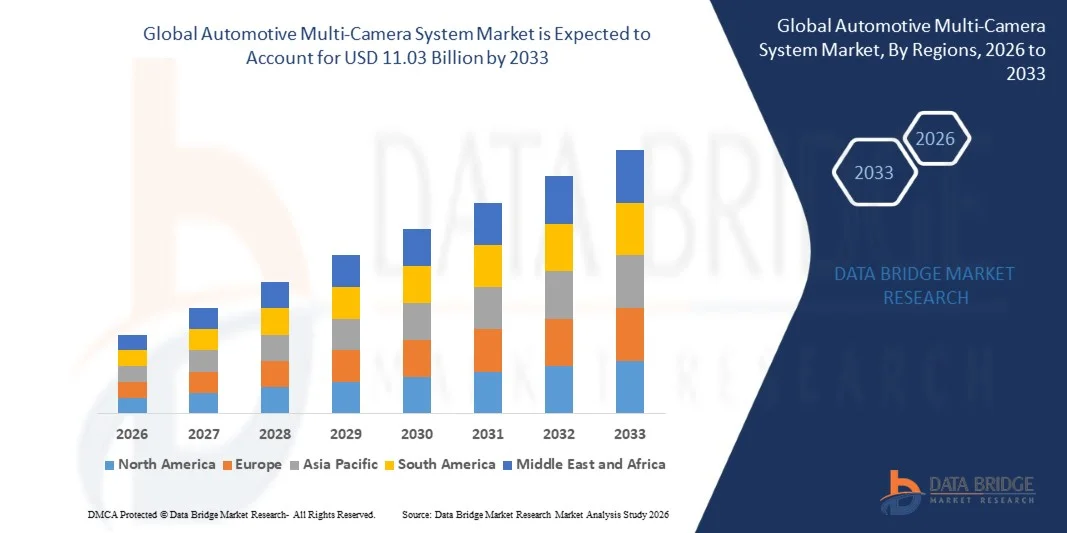
- As per Data Bridge Market Research analysis, the automotive multi-camera system market was valued at USD 3.25 billion in 2025 and is projected to reach USD 11.03 billion by 2033, growing at a CAGR of 16.50% from 2026 to 2033.
- The market is experiencing rapid growth driven by rising adoption of advanced driver assistance systems, tightening vehicle-safety regulations and rating protocols, and increasing demand for surround-view, parking, and driver-monitoring features across passenger and commercial vehicles.
- The increasing shift toward software-defined vehicles and centralized computing, combined with growing integration of cameras with radar and AI-based perception software, is supporting market adoption. Multi-camera systems are being applied across advanced driver assistance systems, parking and surround-view solutions, and driver monitoring systems, offering drivers greater situational awareness and giving automakers scalable safety features built on the automotive camera platform.
Market Size & Forecast
- Global Market Value (2025): USD 3.25 Billion
- Expected Market Value (2033): USD 11.03 Billion
- Forecast CAGR (2026–2033): 16.50%
- Leading Region in 2025: Europe
- Fastest Growing Region: Asia-Pacific
What are the Major Takeaways of the Automotive Multi-Camera System Market?
- Europe dominated the automotive multi-camera system market with the largest revenue share of 33.65% in 2025, supported by stringent vehicle-safety regulations, strong safety-rating protocols, and the presence of leading automakers and Tier 1 camera suppliers.
- Asia-Pacific is expected to be the fastest-growing region at a CAGR of 19.35% from 2026 to 2033, fueled by high vehicle production, rapid ADAS penetration in China and India, and expanding local camera manufacturing capacity.
- The surround view segment led the system type category with a 39.40% share in 2025, driven by growing use of four- and five-camera configurations for parking assistance and blind-spot visualization.
- Interior monitoring is the fastest-growing system type, projected to register a CAGR of 21.80%, reflecting safety-rating and regulatory emphasis on driver and occupant monitoring.
- The passenger cars segment dominated the vehicle type category with a 78.60% revenue share in 2025, led by high production volumes and spread of ADAS features into mid-segment models.
- Advanced driver assistance systems accounted for 46.10% of the market share in 2025, preferred by automakers seeking scalable safety and assisted-driving platforms.
- The driver and occupant monitoring segment is the fastest-growing application category, with a CAGR of 22.40%, driven by safety-rating protocols that reward monitoring of driver attention.
Report Scope and Automotive Multi-Camera System Market Segmentation
|
Attributes |
Automotive Multi-Camera System Key Market Insights |
|
Segments Covered |
|
|
Countries Covered |
North America
Europe
Asia-Pacific
Middle East and Africa
South America
|
|
Key Market Players |
|
|
Market Opportunities |
|
|
Value Added Data Infosets |
In addition to the market insights such as market value, growth rate, market segments, geographical coverage, market players, and market scenario, the market report curated by the Data Bridge Market Research team includes in-depth expert analysis, import/export analysis, pricing analysis, production consumption analysis, and pestle analysis. |
What is the Key Trend in the Automotive Multi-Camera System Market?
- Automotive camera architectures are shifting from single-purpose rear-view and parking cameras toward integrated multi-camera systems that combine forward-facing, surround-view, and in-cabin cameras with radar and centralized computing, enabling software-defined driver-assistance functions across mainstream vehicle segments.
- For instance, in January 2026, according to Mobileye, a U.S.-based automaker selected its EyeQ6H-based Surround ADAS, which uses one forward-looking camera, four corner parking cameras, and multiple radars, with the company estimating future delivery of more than 19 million such systems, including 9 million from the newly announced customer
- Camera and radar fusion is also gaining importance, as suppliers combine surround-view imagery with short-range radar data to improve object detection in low-light and adverse conditions and to reduce the number of separate electronic control units.
- In-cabin cameras for driver and occupant monitoring are being added to the vehicle camera suite, reflecting growing regulatory and safety-rating emphasis on driver attention and enabling personalization and occupant-safety features.
- For instance, in October 2025, according to Aptiv, the company introduced its PULSE sensor architecture, which combines surround-view camera data with short-range radar
- As camera resolution, processing power, and perception software continue to improve, multi-camera systems are expected to evolve from optional convenience features into standard, software-upgradable safety platforms that support assisted and automated driving.
What are the Key Drivers of the Automotive Multi-Camera System Market?
- Safety regulations and vehicle-assessment programs are steadily increasing the number of cameras required or rewarded in new vehicles, from rear-visibility mandates to driver-monitoring and assisted-driving requirements.
- Growing consumer demand for parking assistance, 360-degree visualization, and hands-free driving features in mainstream vehicles is also encouraging automakers to equip more models with multi-camera systems.
- For instance, in January 2026, according to Euro NCAP, its 2026 assessment protocols took effect, with driver monitoring now worth up to 25 points and additional credit for continuous eye and head tracking and for linking driver-state information to the sensitivity of driver-assistance features.
- Declining camera and processor costs, together with consolidation of electronic control units, are making it economically feasible to add multiple cameras to entry- and mid-segment vehicles.
What Factors Are Challenging the Growth of the Automotive Multi-Camera System Market?
- Camera-based perception can be degraded by sun glare, fog, dust, rain, and lens contamination, and systems must reliably detect and alert drivers when camera performance deteriorates.
- For instance, in March 2026, according to NHTSA, the agency upgraded its investigation into Tesla's Full Self-Driving system to an Engineering Analysis covering an estimated 3,203,754 vehicles, finding that the system's degradation detection did not alert drivers when cameras were impaired by sun glare, fog, or airborne dust before crashes occurred.
- Multi-camera systems require precise calibration, time synchronization, high-bandwidth data links, and significant onboard processing power, which increase system complexity and cost, while recalibration after windshield or bumper repairs adds service costs for vehicle owners.
- Data privacy for in-cabin cameras, cybersecurity requirements for connected sensors, and differences in regional regulations also add compliance burdens for automakers and suppliers.
- For instance, in October 2024, according to NHTSA, the agency opened a preliminary evaluation of about 2.4 million Tesla vehicles equipped with Full Self-Driving software after four crashes, including a fatal pedestrian crash, that occurred in reduced roadway visibility conditions such as sun glare, fog, or airborne dust.
- The combination of environmental limitations, integration complexity, and regulatory scrutiny can slow adoption of camera-centric architectures, particularly in programs where automakers must justify the cost of additional cameras against competing sensor options.
How is the Automotive Multi-Camera System Market Segmented?
The automotive multi-camera system market is segmented on the basis of system type, vehicle type, application, and sales channel.
- By System Type
On the basis of system type, the automotive multi-camera system market is segmented into surround view, front camera, rear view, interior monitoring, and others. The surround view segment dominated the market with 39.40% share in 2025, supported by growing use of four- and five-camera configurations for parking assistance, blind-spot visualization, and low-speed maneuvering. Surround-view systems stitch images from cameras placed around the vehicle into a bird's-eye or 3D display, helping drivers avoid collisions in tight spaces. Their integration with radar and ultrasonic sensors, and their role in automated parking, are strengthening adoption across mainstream and premium vehicles.
The interior monitoring segment is projected to register the fastest growth at a CAGR of 21.80% from 2026 to 2033, driven by regulatory and safety-rating requirements for driver monitoring and the rising use of occupant-sensing features. Interior cameras track eye, head, and posture to detect drowsiness and distraction, and can detect child presence and unbuckled passengers. Their data also supports adaptive driver-assistance behavior and hands-free driving features that require confirmation of driver attention. Falling sensor costs and the shift toward software-defined cabins are widening installation across vehicle classes.
- By Vehicle Type
On the basis of vehicle type, the automotive multi-camera system market is segmented into passenger cars, light commercial vehicles, and heavy commercial vehicles. The passenger cars segment dominated the vehicle-type category with 78.60% share in 2025, supported by high production volumes and the rapid spread of ADAS, parking, and driver-monitoring features from premium to mid-segment models. Automakers use multi-camera systems as visible differentiators in safety ratings and customer-facing convenience features. Consumer preference for 360-degree views and automated parking is also increasing the number of cameras per vehicle.
The heavy commercial vehicles segment is projected to register the fastest growth at a CAGR of 18.90% from 2026 to 2033, driven by fleet-safety programs, blind-spot regulations for trucks and buses, and demand to lower accident and insurance costs. Large vehicles have extensive blind zones, making surround-view, side-view, and driver-monitoring cameras highly valuable. Fleet operators are also using camera data for driver coaching and incident analysis. Mirror-replacement camera systems, which improve aerodynamics and visibility, are further supporting adoption.
- By Application
On the basis of application, the automotive multi-camera system market is segmented into advanced driver assistance systems, parking assistance, driver and occupant monitoring, mirror replacement, and others. The advanced driver assistance systems segment dominated the application category with 46.10% share in 2025, supported by expanding use of cameras for lane keeping, emergency braking, traffic-sign recognition, and assisted driving. Camera data is increasingly fused with radar and other sensors to improve detection under varied conditions. Automakers and suppliers are launching scalable ADAS platforms that allow the same architecture to be deployed across multiple vehicle programs.
The driver and occupant monitoring segment is projected to register the fastest growth at a CAGR of 22.40% from 2026 to 2033, driven by safety-rating protocols and regulations that reward or require monitoring of driver attention. Camera-based monitoring is considered more accurate than steering-based inference because it tracks eye and head movement directly. Vehicle makers are also exploring occupant-specific features such as child-presence detection and personalized cabin settings. Integration with assisted-driving functions that depend on confirmed driver engagement is further accelerating demand.
- By Sales Channel
On the basis of sales channel, the automotive multi-camera system market is segmented into OEM and aftermarket. The OEM segment dominated the sales-channel category with 88.30% share in 2025, supported by factory fitment of cameras to meet regulatory requirements, safety-rating criteria, and feature packages. Camera systems integrated at the factory are calibrated to the vehicle and connected to the central computing platform, which improves reliability and enables over-the-air updates. Long-term supply contracts between automakers and Tier 1 suppliers provide stable volumes for this channel.
The aftermarket segment is projected to register the fastest growth at a CAGR of 17.60% from 2026 to 2033, driven by retrofitting of surround-view, dash-camera, and blind-spot systems on older passenger and commercial vehicles. Fleet operators are installing multi-camera kits to improve safety and reduce accident liability. Falling hardware prices and easier installation are widening consumer access. Growth in replacement and recalibration services after windshield and bumper repairs is also supporting aftermarket revenue.
Which Region Holds the Largest Share of the Automotive Multi-Camera System Market?
- Europe dominated the automotive multi-camera system market with the largest revenue share of 33.65% in 2025, supported by stringent vehicle-safety regulations, widely followed safety-rating protocols, and the strong presence of premium automakers and Tier 1 camera suppliers.
- The region also benefits from early adoption of driver-monitoring requirements, advanced parking and assisted-driving features, and strong engineering capabilities in sensors and perception software. Increasing emphasis on vulnerable-road-user protection and driver attention continues to strengthen Europe's position in the global market.
Germany Automotive Multi-Camera System Market Insight
The Germany automotive multi-camera system market is witnessing strong growth due to the presence of leading premium automakers and global Tier 1 suppliers, along with high adoption of surround-view, parking, and assisted-driving systems. Manufacturers are integrating cameras with radar and centralized computing platforms across new vehicle architectures. In addition, strict safety expectations, strong research and development capabilities, and early deployment of driver-monitoring functions are driving demand for advanced multi-camera solutions.
Asia-Pacific Automotive Multi-Camera System Market Insight
The Asia-Pacific automotive multi-camera system market is expected to witness rapid growth, driven by high vehicle production, expanding ADAS adoption, and growing consumer interest in smart-cabin and parking features across China, Japan, India, and South Korea. Local automakers and suppliers are scaling camera manufacturing capacity and offering competitively priced perception platforms. In addition, supportive government safety initiatives and rising demand for connected vehicles are accelerating market expansion.
China Automotive Multi-Camera System Market Insight
The China automotive multi-camera system market is growing rapidly, driven by the world's largest vehicle production base and strong consumer demand for intelligent-driving features. Domestic automakers are fitting multiple cameras as standard in electric and connected vehicles, supported by local camera-module and chip suppliers. Furthermore, government support for intelligent connected vehicles and intense competition on feature content are significantly boosting demand for surround-view and driver-monitoring systems.
India Automotive Multi-Camera System Market Insight
The India automotive multi-camera system market is experiencing strong growth, supported by rising passenger vehicle sales, growing awareness of vehicle safety, and increasing fitment of ADAS and 360-degree cameras in mid-segment cars and commercial vehicles. Global suppliers are establishing local assembly lines and engineering centers to serve domestic and export programs. In addition, evolving safety assessment programs and fleet-safety requirements are encouraging wider adoption.
U.S. Automotive Multi-Camera System Market Insight
The U.S. automotive multi-camera system market is witnessing consistent growth due to mandatory rear-visibility requirements, high consumer demand for trucks and SUVs equipped with surround-view systems, and active development of assisted-driving features. Automakers and suppliers are investing in camera-based driver monitoring and perception software. Moreover, regulatory scrutiny of camera-based driving systems is encouraging redundancy, diagnostics, and improved camera-degradation detection.
U.K. Automotive Multi-Camera System Market Insight
The U.K. automotive multi-camera system market is experiencing steady growth, supported by adoption of European vehicle-safety regulations and strong consumer attention to safety ratings. Automakers selling in the country are equipping vehicles with surround-view, driver-monitoring, and blind-spot camera systems. Furthermore, growth in fleet safety programs and the presence of automotive engineering and testing facilities are supporting demand for advanced multi-camera technologies.
Which are the Top Companies in Automotive Multi-Camera System Market?
The automotive multi-camera system industry is primarily led by well-established companies, including:
- Robert Bosch GmbH (Germany)
- Continental AG (Germany)
- Magna International Inc. (Canada)
- Valeo SA (France)
- Aptiv PLC (Jersey)
- DENSO Corporation (Japan)
- ZF Friedrichshafen AG (Germany)
- Mobileye Global Inc. (Israel)
- Hyundai Mobis Co., Ltd. (South Korea)
- Gentex Corporation (U.S.)
- Sony Semiconductor Solutions Corporation (Japan)
- onsemi (U.S.)
- OMNIVISION (U.S.)
- Samsung Electro-Mechanics Co., Ltd. (South Korea)
- Ficosa International, S.A. (Spain)
- Stoneridge, Inc. (U.S.)
- Hitachi Astemo, Ltd. (Japan)
- Ambarella, Inc. (U.S.)
- LG Innotek Co., Ltd. (South Korea)
- Panasonic Automotive Systems Co., Ltd. (Japan)
What are Latest Developments in Automotive Multi-Camera System Market?
- In May 2026, Magna International announced that it had been awarded a driver and occupant monitoring system program with a European OEM, using a mirror-integrated camera architecture. This development benefits the automotive multi-camera system market by expanding the use of integrated camera solutions for enhanced driver monitoring, occupant detection, and vehicle safety applications.
- In May 2026, Valeo announced that one of India's leading commercial vehicle OEMs had selected its Valeo Smart Safety 360 ADAS platform for deployment in the Indian market. This development benefits the automotive multi-camera system market by supporting the adoption of surround-view and multi-camera ADAS technologies in commercial vehicles and strengthening demand for advanced vehicle vision systems in India.
- In April 2026, Valeo inaugurated a new HD surround-view camera production line at its Sanand facility in Gujarat, India, for high-volume manufacturing of next-generation vision systems for major OEMs. This development benefits the automotive multi-camera system market by increasing regional production capacity for HD camera systems and supporting the large-scale deployment of advanced surround-view technologies by automotive manufacturers.
- In September 2025, Qualcomm and Valeo expanded their partnership to deliver pre-integrated ADAS and automated-driving platforms based on Snapdragon Ride solutions. This development benefits the automotive multi-camera system market by improving the integration of camera-based perception with advanced computing platforms, supporting the development and deployment of sophisticated ADAS and automated-driving functions.
- In April 2025, Bosch presented a modular ADAS product family, including a next-generation multi-purpose camera, that was due to enter passenger-car production in China from mid-2025. This development benefits the automotive multi-camera system market by expanding the availability of scalable camera technologies for passenger vehicles and supporting wider adoption of camera-based ADAS functions.

- Interactive Data Analysis Dashboard
- Company Analysis Dashboard for high growth potential opportunities
- Research Analyst Access for customization & queries
- Competitor Analysis with Interactive dashboard
- Latest News, Updates & Trend analysis
- Harness the Power of Benchmark Analysis for Comprehensive Competitor Tracking
Data collection and base year analysis are done using data collection modules with large sample sizes. The stage includes obtaining market information or related data through various sources and strategies. It includes examining and planning all the data acquired from the past in advance. It likewise envelops the examination of information inconsistencies seen across different information sources. The market data is analysed and estimated using market statistical and coherent models. Also, market share analysis and key trend analysis are the major success factors in the market report. To know more, please request an analyst call or drop down your inquiry.
The key research methodology used by DBMR research team is data triangulation which involves data mining, analysis of the impact of data variables on the market and primary (industry expert) validation. Data models include Vendor Positioning Grid, Market Time Line Analysis, Market Overview and Guide, Company Positioning Grid, Patent Analysis, Pricing Analysis, Company Market Share Analysis, Standards of Measurement, Global versus Regional and Vendor Share Analysis. To know more about the research methodology, drop in an inquiry to speak to our industry experts.
Data Bridge Market Research is a leader in advanced formative research. We take pride in servicing our existing and new customers with data and analysis that match and suits their goal. The report can be customized to include price trend analysis of target brands understanding the market for additional countries (ask for the list of countries), clinical trial results data, literature review, refurbished market and product base analysis. Market analysis of target competitors can be analyzed from technology-based analysis to market portfolio strategies. We can add as many competitors that you require data about in the format and data style you are looking for. Our team of analysts can also provide you data in crude raw excel files pivot tables (Fact book) or can assist you in creating presentations from the data sets available in the report.













