


What is the Automotive Number Plate Market Size and Overview?
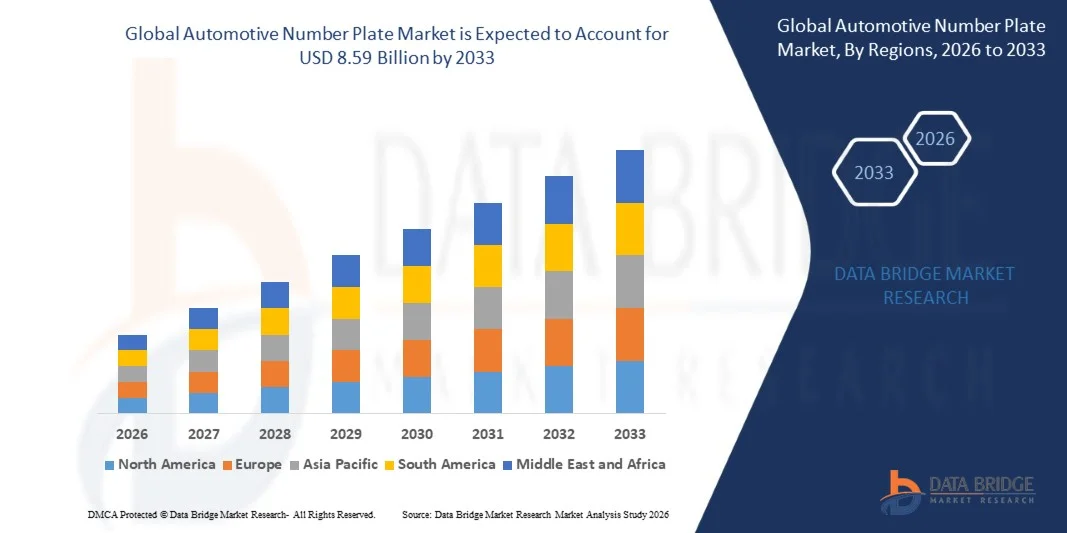
As per Data Bridge Market Research Analysis the Automotive Number Plate Market was valued at USD 5.08 billion in 2025 and is projected to reach USD 8.59 billion by 2033, growing at a CAGR of 6.80% from 2026 to 2033. The market is witnessing steady growth driven by rising vehicle production, increasing demand for vehicle identification and regulatory compliance, and growing adoption of advanced license plate technologies such as high-security registration plates and digital number plates.
The increasing implementation of stringent government regulations for vehicle tracking, road safety, and law enforcement is further accelerating the adoption of standardized and tamper-resistant number plates across both passenger and commercial vehicle segments. In addition, advancements in reflective materials, anti-counterfeit technologies, and RFID-enabled smart plates are enhancing durability, traceability, and overall vehicle security, thereby supporting long-term market expansion.
Key Market Trends & Insights
- North America dominated the automotive number plate market with the largest revenue share of 39.4% in 2025, supported by strong vehicle ownership rates, stringent vehicle registration regulations, and increasing adoption of advanced identification systems such as high-security registration plates (HSRP) and RFID-enabled plates.
- Asia-Pacific automotive number plate market is expected to witness the fastest growth rate from 2026 to 2033, supported by rapid urbanization, rising vehicle production, and increasing government initiatives for vehicle digitization in countries such as China, India, and Japan.
- The Aluminum segment held the largest market revenue share of approximately 68.5% in 2025 driven by its high durability, corrosion resistance, long service life, and widespread compliance with high-security registration plate (HSRP) standards across government regulations in multiple countries. Aluminum plates are preferred due to their tamper-resistant properties and compatibility with embossing, laser marking, and RFID integration technologies used in modern vehicle identification systems.
- The Plastic segment is projected to register the fastest growth at a CAGR of 8.4% from 2026 to 2033, driven by increasing adoption of lightweight and cost-effective number plate solutions, particularly in electric vehicles and two-wheelers. Rising demand for customizable and flexible plate designs, along with advancements in high-strength polymer materials, is further supporting segment expansion.
- The PC segment held the largest market revenue share of approximately 54.2% in 2025 driven by high global passenger vehicle ownership, increasing vehicle registrations, and mandatory compliance with national identification regulations. Rising urban mobility and growing personal vehicle usage continue to support demand for standardized and secure number plates in this segment.
- The Electric Vehicles segment is projected to register the fastest growth at a CAGR of 11.6% from 2026 to 2033, driven by rapid EV adoption, government incentives, and increasing integration of smart identification systems such as RFID-enabled and digital number plates for connected mobility and intelligent transport infrastructure.
- The OEM segment held the largest market revenue share of approximately 61.3% in 2025 driven by mandatory installation of standardized number plates during vehicle manufacturing and registration processes, along with strong partnerships between automotive manufacturers and government-approved plate suppliers. OEM integration ensures compliance with regulatory standards and enhances traceability from the point of vehicle production.
- The Aftermarket segment is projected to register the fastest growth at a CAGR of 7.9% from 2026 to 2033, driven by replacement demand, plate upgrades to high-security registration systems, and increasing retrofitting of RFID-enabled and tamper-proof number plates in existing vehicle fleets across developing and developed regions.
Market Size & Forecast
- Global Market Value (2025): USD 5.08 Billion
- Expected Market Value (2033): USD 8.59 Billion
- Forecast CAGR (2026–2033): 6.80%
- Leading Region in 2025: North America
- Fastest Growing Region: Asia-Pacific
Report Scope and Automotive Number Plate Market Segmentation
|
Attributes |
Automotive Number Plate Key Market Insights |
|
Segments Covered |
|
|
Countries Covered |
North America
Europe
Asia-Pacific
Middle East and Africa
South America
|
|
Key Market Players |
• UTSCH (Germany) |
|
Market Opportunities |
• Expansion Of High-Security Registration Plate Mandates |
|
Value Added Data Infosets |
In addition to the market insights such as market value, growth rate, market segments, geographical coverage, market players, and market scenario, the market report curated by the Data Bridge Market Research team includes in-depth expert analysis, import/export analysis, pricing analysis, production consumption analysis, and pestle analysis. |
What is the Key Trend in the Automotive Number Plate Market ?
Trend: Growth In High-Security Registration Plates And Digital Identification Systems
Increasing demand for secure, tamper-resistant, and standardized vehicle identification solutions across automotive, transport, and law enforcement sectors. Traditional embossed plates are increasingly being replaced due to rising vehicle theft, cloning cases, and the need for centralized vehicle tracking systems, encouraging governments to adopt high-security registration plates and digital number plate technologies.
In modern automotive ecosystems, High-Security Registration Plates (HSRP) are being widely implemented, For instance in India, the Ministry of Road Transport and Highways (MoRTH) mandated HSRP adoption across all vehicles, leading to large-scale retrofitting programs covering millions of vehicles to improve traceability and reduce fraud. In Europe, countries are integrating reflective and laser-etched plates with standardized identifiers to enhance cross-border vehicle recognition under EU mobility frameworks.
The rapid expansion of intelligent transport systems and smart city infrastructure is also increasing demand for RFID-enabled and electronically readable number plates that support automated toll collection, traffic monitoring, and law enforcement analytics. In addition, digital number plate technologies are being tested in select U.S. states and Middle Eastern smart mobility projects to enable real-time vehicle tracking and instant compliance verification. Growing industry validation through pilot smart mobility programs in 2025 integrating RFID-based vehicle identification systems has demonstrated improvement in traffic enforcement efficiency by nearly 20–25% in urban monitoring zones
Automotive Number Plate Market Dynamics
Key Market Driver: Rising Government Regulations And Vehicle Security Requirements
Governments worldwide are implementing stricter vehicle registration and identification regulations to enhance road safety, reduce vehicle-related crimes, and improve transportation management efficiency. Increasing vehicle fleet sizes and cross-border mobility are further driving the need for standardized and secure identification systems that enable real-time tracking and enforcement.
Automotive authorities are actively enforcing high-security registration plate mandates, For instance India’s nationwide HSRP rollout has significantly improved vehicle authentication processes and reduced counterfeit plate usage across millions of registered vehicles. In China, the integration of advanced license plate recognition systems in urban surveillance networks is enhancing traffic law enforcement and congestion management efficiency.
Similarly, increasing adoption of automated toll collection systems and smart highway infrastructure in the U.S. and Europe is accelerating demand for machine-readable and durable number plates. Government benchmarking studies indicate that RFID and ANPR-enabled vehicle identification systems can improve enforcement accuracy by up to 30% compared to traditional visual verification methods.
Key Restraint/Challenge: High Implementation Costs And Fragmented Standardization Across Regions
The automotive number plate market faces challenges due to high implementation costs associated with advanced security features such as RFID chips, laser engraving, and digital tracking integration. Retrofitting existing vehicle fleets with high-security plates requires significant investment, creating affordability concerns in price-sensitive markets.
In addition, lack of global standardization in number plate formats and identification technologies creates interoperability issues across regions, limiting seamless cross-border vehicle tracking and enforcement. Differences in regulatory frameworks and enforcement mechanisms further slow down uniform adoption of advanced number plate systems.
Industry assessments indicate that high-security registration plates can cost up to 2–4 times more than conventional plates, creating financial barriers for large-scale fleet upgrades in developing economies despite long-term security and compliance benefits.
Key Market Opportunity: Expansion Of Smart Mobility And Digital Vehicle Identification Systems
Rapid development of smart cities, intelligent transport systems, and connected mobility ecosystems is creating significant opportunities for RFID-enabled and digital number plate solutions. Increasing adoption of automated traffic management systems and AI-based surveillance is driving demand for real-time vehicle identification and data integration capabilities.
Automotive authorities and technology providers are increasingly deploying smart number plate systems, For instance in the UAE and Singapore, pilot programs integrating digital vehicle identification with smart tolling and traffic monitoring systems have improved congestion management and enforcement efficiency. In the U.S., ongoing trials of digital license plates in selected states are enabling real-time registration updates and theft recovery tracking.
In addition, advancements in cloud-based mobility platforms and AI-driven analytics are enhancing the functionality of vehicle identification systems, enabling predictive traffic management and automated compliance verification. Smart city initiatives in 2025 across Asia-Pacific have demonstrated that integrated digital plate systems can reduce traffic violation response times by nearly 15–20%, supporting long-term adoption across urban transportation networks.
Automotive Number Plate Market Scope
The market is segmented on the basis of material, vehicle type, and distribution channel.
• By Material
On the basis of material, the automotive number plate market is segmented into Aluminum, Plastic, and Others. The Aluminum segment held the largest market revenue share of approximately 68.5% in 2025 driven by its high durability, corrosion resistance, long service life, and widespread compliance with high-security registration plate (HSRP) standards across government regulations in multiple countries. Aluminum plates are preferred due to their tamper-resistant properties and compatibility with embossing, laser marking, and RFID integration technologies used in modern vehicle identification systems.
The Plastic segment is projected to register the fastest growth at a CAGR of 8.4% from 2026 to 2033, driven by increasing adoption of lightweight and cost-effective number plate solutions, particularly in electric vehicles and two-wheelers. Rising demand for customizable and flexible plate designs, along with advancements in high-strength polymer materials, is further supporting segment expansion.
• By Vehicle Type
On the basis of vehicle type, the market is segmented into PC, LCV, HCV, and Electric Vehicles. The PC segment held the largest market revenue share of approximately 54.2% in 2025 driven by high global passenger vehicle ownership, increasing vehicle registrations, and mandatory compliance with national identification regulations. Rising urban mobility and growing personal vehicle usage continue to support demand for standardized and secure number plates in this segment.
The Electric Vehicles segment is projected to register the fastest growth at a CAGR of 11.6% from 2026 to 2033, driven by rapid EV adoption, government incentives, and increasing integration of smart identification systems such as RFID-enabled and digital number plates for connected mobility and intelligent transport infrastructure.
• By Distribution Channel
On the basis of distribution channel, the market is segmented into OEM and Aftermarket. The OEM segment held the largest market revenue share of approximately 61.3% in 2025 driven by mandatory installation of standardized number plates during vehicle manufacturing and registration processes, along with strong partnerships between automotive manufacturers and government-approved plate suppliers. OEM integration ensures compliance with regulatory standards and enhances traceability from the point of vehicle production.
The Aftermarket segment is projected to register the fastest growth at a CAGR of 7.9% from 2026 to 2033, driven by replacement demand, plate upgrades to high-security registration systems, and increasing retrofitting of RFID-enabled and tamper-proof number plates in existing vehicle fleets across developing and developed regions.
Automotive Number Plate Market Regional Analysis
North America Automotive Number Plate Market Insight
North America dominated the automotive number plate market with the largest revenue share of 39.4% in 2025, supported by strong vehicle ownership rates, stringent vehicle registration regulations, and increasing adoption of advanced identification systems such as high-security registration plates (HSRP) and RFID-enabled plates. The region benefits from well-established transportation infrastructure, high enforcement standards, and growing integration of smart mobility and automated traffic monitoring systems, further strengthening demand for durable and tamper-resistant number plates across passenger and commercial vehicles.
U.S. Automotive Number Plate Market Insight
The U.S. automotive number plate market captured the largest revenue share in 2025 within North America, driven by high vehicle registration volumes, strict federal and state-level compliance requirements, and increasing adoption of license plate recognition (LPR) systems. Growing integration of smart transportation technologies, toll automation systems, and digital enforcement solutions is significantly boosting demand for standardized and machine-readable number plates across both OEM and aftermarket channels.
Europe Automotive Number Plate Market Insight
The Europe automotive number plate market is expected to witness the fastest growth rate from 2026 to 2033, primarily driven by strict regulatory frameworks for vehicle identification, rising adoption of intelligent transport systems, and increasing cross-border vehicle movement across EU countries. The region’s strong focus on road safety, emission monitoring, and standardized vehicle tracking systems is accelerating demand for advanced number plate technologies including RFID-enabled and high-security plates.
U.K. Automotive Number Plate Market Insight
The U.K. automotive number plate market is expected to witness steady growth from 2026 to 2033, driven by increasing adoption of high-security registration plates, rising concerns regarding vehicle theft, and expanding use of automated number plate recognition (ANPR) systems. Government enforcement of vehicle compliance regulations and growing integration of smart traffic management infrastructure are further supporting market expansion.
Germany Automotive Number Plate Market Insight
The Germany automotive number plate market is expected to witness strong growth from 2026 to 2033, fueled by increasing emphasis on digital vehicle identification, stringent environmental and safety regulations, and strong automotive manufacturing base. The country’s focus on innovation and smart mobility solutions is driving adoption of RFID-enabled and tamper-proof number plates across both private and commercial vehicle segments.
Asia-Pacific Automotive Number Plate Market Insight
The Asia-Pacific automotive number plate market is expected to witness the fastest growth rate from 2026 to 2033, supported by rapid urbanization, rising vehicle production, and increasing government initiatives for vehicle digitization in countries such as China, India, and Japan. The region’s expanding middle-class population, strong automotive manufacturing base, and growing adoption of smart city infrastructure are significantly boosting demand for advanced number plate systems.
Japan Automotive Number Plate Market Insight
The Japan automotive number plate market is expected to witness steady growth from 2026 to 2033, driven by high technological adoption, strict vehicle compliance regulations, and increasing integration of smart mobility systems. The country’s focus on efficient transport infrastructure and digital identification technologies is supporting adoption of RFID-enabled and high-precision number plates, particularly in urban mobility and intelligent transport systems.
China Automotive Number Plate Market Insight
The China automotive number plate market accounted for the largest market revenue share in Asia-Pacific in 2025, attributed to high vehicle production, rapid urbanization, and strong government push for smart city and intelligent traffic management systems. The widespread deployment of license plate recognition systems and growing adoption of digital vehicle tracking solutions are key factors driving demand for advanced number plate technologies across passenger, commercial, and electric vehicle segments.
Automotive Number Plate Market Share
The Automotive Number Plate industry is primarily led by well-established companies, including:
• UTSCH (Germany)
• ADVICS CO., LTD. (Japan)
• Samar’t UK (U.K.)
• EHA Group (U.K.)
• Bestplate (U.K.)
• SPM Groupe (France)
• Rosmerta Technologies Limited (India)
• Nachiappa Impressions (India)
• Jepson & Co. Ltd (U.K.)
• aiHit Ltd. (U.K.)
• Continental AG (Germany)
• Robert Bosch GmbH (Germany)
• Brembo S.P.A. (Italy)
• TÖNNJES E.A.S.T. INFRASTRUKTUR INVEST GmbH (Germany)
• Orbiz (India)
• Irwin Hodson Group (Nepal)
• Fuwong License Plate (China)

- Interactive Data Analysis Dashboard
- Company Analysis Dashboard for high growth potential opportunities
- Research Analyst Access for customization & queries
- Competitor Analysis with Interactive dashboard
- Latest News, Updates & Trend analysis
- Harness the Power of Benchmark Analysis for Comprehensive Competitor Tracking
Data collection and base year analysis are done using data collection modules with large sample sizes. The stage includes obtaining market information or related data through various sources and strategies. It includes examining and planning all the data acquired from the past in advance. It likewise envelops the examination of information inconsistencies seen across different information sources. The market data is analysed and estimated using market statistical and coherent models. Also, market share analysis and key trend analysis are the major success factors in the market report. To know more, please request an analyst call or drop down your inquiry.
The key research methodology used by DBMR research team is data triangulation which involves data mining, analysis of the impact of data variables on the market and primary (industry expert) validation. Data models include Vendor Positioning Grid, Market Time Line Analysis, Market Overview and Guide, Company Positioning Grid, Patent Analysis, Pricing Analysis, Company Market Share Analysis, Standards of Measurement, Global versus Regional and Vendor Share Analysis. To know more about the research methodology, drop in an inquiry to speak to our industry experts.
Data Bridge Market Research is a leader in advanced formative research. We take pride in servicing our existing and new customers with data and analysis that match and suits their goal. The report can be customized to include price trend analysis of target brands understanding the market for additional countries (ask for the list of countries), clinical trial results data, literature review, refurbished market and product base analysis. Market analysis of target competitors can be analyzed from technology-based analysis to market portfolio strategies. We can add as many competitors that you require data about in the format and data style you are looking for. Our team of analysts can also provide you data in crude raw excel files pivot tables (Fact book) or can assist you in creating presentations from the data sets available in the report.













