


What is the Automotive Open Differential Market Size and Growth Rate?
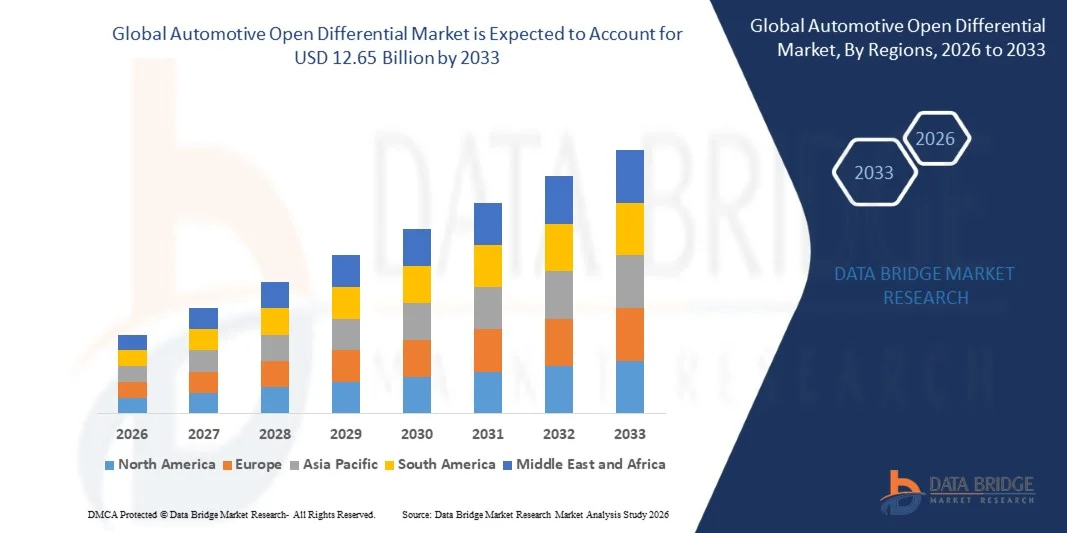
- As per Data Bridge Market Research analysis, the automotive open differential market was valued at USD 9.35 billion in 2025 and is projected to reach USD 12.65 billion by 2033, growing at a CAGR of 3.86% from 2026 to 2033.
- The market is experiencing steady, mature growth driven by continued reliance on open differentials in mass-market passenger cars and light commercial vehicles, their comparatively low manufacturing cost, and their proven mechanical simplicity across high-volume vehicle production platforms.
- Rising vehicle production in cost-sensitive emerging economies, combined with continued demand for affordable entry-level and compact vehicles, is sustaining strong volumes for open differentials even as premium and electric vehicle platforms increasingly shift toward electronic and torque-vectoring alternatives. Open differentials remain the default choice for two-wheel-drive passenger vehicles due to their favorable cost-to-performance ratio.
Market Size & Forecast
- Global Market Value (2025): USD 9.35 Billion
- Expected Market Value (2033): USD 12.65 Billion
- Forecast CAGR (2026-2033): 3.86%
- Leading Region in 2025: Asia-Pacific
- Fastest Growing Region: Asia-Pacific
What are the Major Takeaways of the Automotive Open Differential Market?
- Asia-Pacific dominated the global automotive open differential market with the largest revenue share of 44.6% in 2025, supported by high-volume passenger vehicle production and strong presence of cost-competitive component manufacturers in China and India.
- Asia-Pacific is also expected to remain the fastest-growing region at a CAGR of 4.9% from 2026 to 2033, fueled by rising entry-level vehicle sales, expanding domestic component manufacturing, and increasing two-wheel-drive vehicle production.
- The bevel gear open differential segment led the market with a 52.3% share in 2025, driven by its established design, high torque-handling capability, and widespread use across passenger and commercial vehicle drivetrains.
- The helical gear open differential segment is the fastest-growing type, projected to register a CAGR of 4.9%, reflecting rising demand for smoother, quieter operation in premium and mid-size passenger vehicles.
- The passenger cars segment dominated the vehicle type category with a 49.2% revenue share in 2025, led by continued high-volume production of compact and mid-size vehicles relying on open differentials as a standard drivetrain component.
- The OEM sales channel accounted for 74.8% of the market share in 2025, supported by integration of open differentials during original vehicle assembly across mass-market vehicle platforms.
- The cast iron material segment held the largest share at 47.5% in 2025, owing to its durability, cost efficiency, and widespread use in commercial and entry-level passenger vehicle differentials.
Report Scope and Automotive Open Differential Market Segmentation
|
Attributes |
Open Differential Key Market Insights |
|
Segments Covered |
|
|
Countries Covered |
North America
Europe
Asia-Pacific
Middle East and Africa
South America
|
|
Key Market Players |
|
|
Market Opportunities |
|
|
Value Added Data Infosets |
In addition to the insights on market scenarios such as market value, growth rate, segmentation, geographical coverage, and major players, the market reports curated by the Data Bridge Market Research also include in-depth expert analysis, geographically represented company-wise production and capacity, network layouts of distributors and partners, detailed and updated price trend analysis and deficit analysis of supply chain and demand. |
What is the Key Trend in the Automotive Open Differential Market?
- Component manufacturers are increasingly optimizing open differential designs with lightweight cast and aluminum-alloy housings to help automakers meet fuel-efficiency and emission targets without significantly raising production costs.
- For instance, in April 2025, a leading driveline component supplier expanded its lightweight cast-iron differential case portfolio to support automakers seeking to reduce drivetrain weight in compact and entry-level passenger vehicle platforms.
- Automotive OEMs producing high-volume, two-wheel-drive passenger vehicles continue to standardize on open differential designs due to their proven reliability, low maintenance requirements, and favorable total cost of ownership.
- Growing demand for affordable vehicles in emerging markets is reinforcing the role of open differentials as the default drivetrain solution for compact cars, hatchbacks, and entry-level sedans.
- For instance, in January 2025, a major Asian component manufacturer expanded its open differential production capacity to meet rising domestic and export demand for entry-level passenger vehicle drivetrain components.
- As global vehicle production continues to expand across price-sensitive segments, the adoption of cost-effective open differential systems is expected to remain steady, reinforcing their position as a core drivetrain component in mass-market vehicles.
What are the Key Drivers of the Automotive Open Differential Market?
- The continued high-volume production of compact, entry-level, and mid-size passenger vehicles across global markets is sustaining strong demand for cost-effective open differentials as the standard drivetrain solution for two-wheel-drive configurations.
- For instance, in March 2025, a leading Indian automotive component manufacturer expanded its open differential assembly capacity to support rising domestic passenger vehicle production and growing export orders.
- Automotive OEMs and Tier-1 suppliers continue to rely on open differentials for light commercial vehicles and budget passenger cars due to their mechanical simplicity, ease of manufacturing, and lower total lifecycle costs compared to electronically controlled alternatives.
- For instance, in November 2024, a major driveline component supplier expanded its open differential manufacturing footprint in Southeast Asia to serve growing regional demand from budget and mid-size vehicle segments.
- With global automakers continuing to balance cost efficiency with performance across mass-market vehicle segments, open differentials will remain an essential and widely adopted drivetrain component, particularly across emerging and price-sensitive markets.
Which Factors are Challenging the Growth of the Automotive Open Differential Market?
- The growing shift toward electronic limited-slip and torque-vectoring differentials in premium, performance, and electric vehicle platforms is gradually reducing the relative share of open differentials in higher-value vehicle segments.
- Rising consumer preference for all-wheel-drive and four-wheel-drive vehicles offering enhanced traction and handling is limiting open differential adoption in SUV and crossover segments, where limited-slip designs are increasingly preferred.
- For instance, in August 2024, a leading global automaker highlighted plans to expand torque-vectoring differential adoption across its SUV lineup, illustrating the gradual shift away from conventional open differentials in premium vehicle segments.
- The increasing electrification of vehicle drivetrains and the rising integration of e-axles with built-in electronic differential control continue to limit long-term volume growth for conventional open differentials, particularly in developed automotive markets prioritizing advanced traction technologies.
How is the Automotive Open Differential Market Segmented?
The automotive open differential market is segmented on the basis of type, drive type, vehicle type, component, material, propulsion type, and sales channel.
- By Type
On the basis of type, the global automotive open differential market is segmented into bevel gear open differential, spur gear open differential, and helical gear open differential. The Bevel Gear Open Differential segment dominated the market with a 52.3% share in 2025, owing to its established mechanical design, high torque-handling capability, and extensive use across passenger and commercial vehicle drivetrains.
The Helical Gear Open Differential segment is projected to register the fastest growth at a CAGR of 4.9% from 2026 to 2033, driven by rising demand for smoother, quieter drivetrain operation in mid-size and premium passenger vehicles.
- By Drive Type
On the basis of drive type, the global automotive open differential market is segmented into front-wheel drive, rear-wheel drive, all-wheel drive, and four-wheel drive. The Front-Wheel Drive segment led the market with a 44.8% share in 2025, supported by its widespread use in compact and mid-size passenger cars where open differentials remain the standard drivetrain component.
The All-Wheel Drive segment is expected to experience the fastest growth at a CAGR of 4.6% from 2026 to 2033, driven by increasing use of open center differentials in entry-level AWD-equipped crossover and compact SUV platforms.
- By Vehicle Type
On the basis of vehicle type, the global automotive open differential market is segmented into passenger cars, light commercial vehicles, heavy commercial vehicles, and off-highway vehicles. The Passenger Cars segment dominated the market with a 49.2% share in 2025 due to high-volume global production of compact and mid-size vehicles standardized on open differential drivetrains.
The Light Commercial Vehicles segment is anticipated to witness the fastest CAGR of 4.4% from 2026 to 2033, driven by rising demand for cost-effective drivetrain solutions in last-mile delivery vans and small fleet vehicles.
- By Component
On the basis of component, the global automotive open differential market is segmented into differential case, ring & pinion gear, side gears & pinion gears, bearings & seals, and differential housing. The Ring & Pinion Gear segment dominated the market with a 27.9% share in 2025 due to its essential role in torque transmission and speed reduction within the open differential assembly.
The Differential Case segment is expected to witness the fastest CAGR of 4.5% from 2026 to 2033, this growth is driven by increasing adoption of lightweight cast and aluminum-alloy casings that help reduce overall drivetrain weight without significantly raising manufacturing costs.
- By Material
On the basis of material, the global automotive open differential market is segmented into cast iron, steel alloy, and aluminum alloy. The Cast Iron segment dominated the market with a 47.5% share in 2025 owing to its durability, cost-effectiveness, and extensive use in commercial and entry-level passenger vehicle differentials.
The Aluminum Alloy segment is expected to witness the fastest CAGR of 5.1% from 2026 to 2033, driven by growing lightweighting initiatives among automotive OEMs seeking to improve fuel economy across compact and mid-size vehicle platforms.
- By Propulsion Type
On the basis of propulsion type, the global automotive open differential market is segmented into internal combustion engine vehicles, electric vehicles, and hybrid electric vehicles. The Internal Combustion Engine Vehicles segment dominated the market with a 79.6% share in 2025 due to the continued large installed base of conventional vehicles relying on open differential drivetrains.
The Electric Vehicles segment is expected to witness the fastest CAGR of 5.8% from 2026 to 2033, driven by rising adoption of simplified open differential designs in entry-level and compact electric vehicle platforms seeking cost-efficient drivetrain solutions.
- By Sales Channel
On the basis of sales channel, the global automotive open differential market is segmented into OEM and aftermarket. The OEM segment dominated the market with a 74.8% share in 2025 due to open differentials being integrated during original vehicle assembly across the majority of mass-market vehicle platforms.
The Aftermarket segment is expected to witness the fastest CAGR of 4.3% from 2026 to 2033, this growth is driven by the increasing average age of vehicles on the road and rising demand for differential repair and replacement components in cost-sensitive markets.
Which Region Holds the Largest Share of the Automotive Open Differential Market?
- Asia-Pacific dominated the automotive open differential market and accounted for the largest revenue share of 44.6% in 2025, supported by high-volume passenger and commercial vehicle production, strong presence of cost-competitive component manufacturers, and continued demand for affordable vehicles across China, India, and Southeast Asia.
- The region also benefits from expanding domestic component manufacturing infrastructure, rising two-wheel-drive vehicle production, and growing export demand for cost-effective drivetrain components. Continued growth in entry-level and mid-size vehicle sales continues to strengthen Asia-Pacific's leadership position in the global market.
China Automotive Open Differential Market Insight
The China automotive open differential market is growing steadily, driven by the country's position as the world's largest vehicle producer and continued high-volume manufacturing of compact and mid-size passenger vehicles. Growing investments by domestic component manufacturers in cost-efficient, high-throughput production processes are further strengthening China's position as a key supplier of open differential components globally.
India Automotive Open Differential Market Insight
The India automotive open differential market is expanding steadily, supported by rising domestic passenger vehicle production, strong demand for affordable compact cars, and increasing investments by component manufacturers in precision-forged differential gears and assemblies. Government initiatives promoting local component manufacturing and export-oriented production are further contributing to market growth in India.
Japan Automotive Open Differential Market Insight
The Japan automotive open differential market is witnessing steady growth due to the country's established automotive component manufacturing base and continued production of compact and mid-size passenger vehicles relying on open differential drivetrains. Ongoing focus on manufacturing precision and quality continues to support demand for open differential components in Japan.
Europe Automotive Open Differential Market Insight
The Europe automotive open differential market is witnessing steady growth due to the region's established automotive manufacturing base and continued production of compact and mid-size passenger vehicles, particularly those using front-wheel-drive architectures. The widespread adoption of cost-effective and mechanically simple open differentials, combined with ongoing demand for fuel-efficient and reliable drivetrain systems, continues to support market growth.
North America Automotive Open Differential Market Insight
The North America automotive open differential market is witnessing steady growth due to strong demand for passenger vehicles, SUVs, crossovers, and light commercial vehicles, along with the region's well-established automotive manufacturing base. Continued production of front-wheel-drive passenger vehicles and growing demand for reliable and cost-effective drivetrain systems are supporting the adoption of open differentials, while increasing vehicle production and evolving drivetrain technologies further contribute to market expansion.
Which are the Top Companies in the Automotive Open Differential Market?
The automotive open differential industry is primarily led by well-established companies, including:
- American Axle & Manufacturing, Inc. (U.S.)
- Dana Incorporated (U.S.)
- ZF Friedrichshafen AG (Germany)
- GKN Automotive Limited (U.K.)
- Eaton Corporation plc (Ireland)
- Schaeffler AG (Germany)
- JTEKT Corporation (Japan)
- Hyundai WIA Corporation (South Korea)
- Linamar Corporation (Canada)
- Meritor, Inc. (U.S.)
- Magna International Inc. (Canada)
- Robert Bosch GmbH (Germany)
- Continental AG (Germany)
- Neapco Holdings LLC (U.S.)
- Musashi Seimitsu Industry Co., Ltd. (Japan)
What are Latest Developments in the Automotive Open Differential Market?
- In April 2025, a leading global driveline component supplier expanded its lightweight cast-iron differential case portfolio, enabling automakers to reduce drivetrain weight in compact and entry-level passenger vehicle platforms without significant cost increases.
- In March 2025, a leading Indian automotive component manufacturer expanded its open differential assembly production capacity to support rising domestic passenger vehicle demand and growing export orders to Southeast Asia and Africa.
- In January 2025, a major Asian component manufacturer expanded its open differential production capacity to meet rising domestic and export demand for entry-level passenger vehicle drivetrain components.
- In November 2024, a major driveline component supplier expanded its open differential manufacturing footprint in Southeast Asia to serve growing regional demand from budget and mid-size vehicle segments.
- In March 2024, Sona Comstar surpassed the milestone of 400 million differential gears and 6 million differential assemblies produced, reflecting its scale in the design and manufacture of precision-forged differential gears and driveline components used across passenger, commercial, and electric vehicle applications, including open differential assemblies.

- Interactive Data Analysis Dashboard
- Company Analysis Dashboard for high growth potential opportunities
- Research Analyst Access for customization & queries
- Competitor Analysis with Interactive dashboard
- Latest News, Updates & Trend analysis
- Harness the Power of Benchmark Analysis for Comprehensive Competitor Tracking
Data collection and base year analysis are done using data collection modules with large sample sizes. The stage includes obtaining market information or related data through various sources and strategies. It includes examining and planning all the data acquired from the past in advance. It likewise envelops the examination of information inconsistencies seen across different information sources. The market data is analysed and estimated using market statistical and coherent models. Also, market share analysis and key trend analysis are the major success factors in the market report. To know more, please request an analyst call or drop down your inquiry.
The key research methodology used by DBMR research team is data triangulation which involves data mining, analysis of the impact of data variables on the market and primary (industry expert) validation. Data models include Vendor Positioning Grid, Market Time Line Analysis, Market Overview and Guide, Company Positioning Grid, Patent Analysis, Pricing Analysis, Company Market Share Analysis, Standards of Measurement, Global versus Regional and Vendor Share Analysis. To know more about the research methodology, drop in an inquiry to speak to our industry experts.
Data Bridge Market Research is a leader in advanced formative research. We take pride in servicing our existing and new customers with data and analysis that match and suits their goal. The report can be customized to include price trend analysis of target brands understanding the market for additional countries (ask for the list of countries), clinical trial results data, literature review, refurbished market and product base analysis. Market analysis of target competitors can be analyzed from technology-based analysis to market portfolio strategies. We can add as many competitors that you require data about in the format and data style you are looking for. Our team of analysts can also provide you data in crude raw excel files pivot tables (Fact book) or can assist you in creating presentations from the data sets available in the report.













