


What is the Automotive Operating System Market Size and Growth Rate?
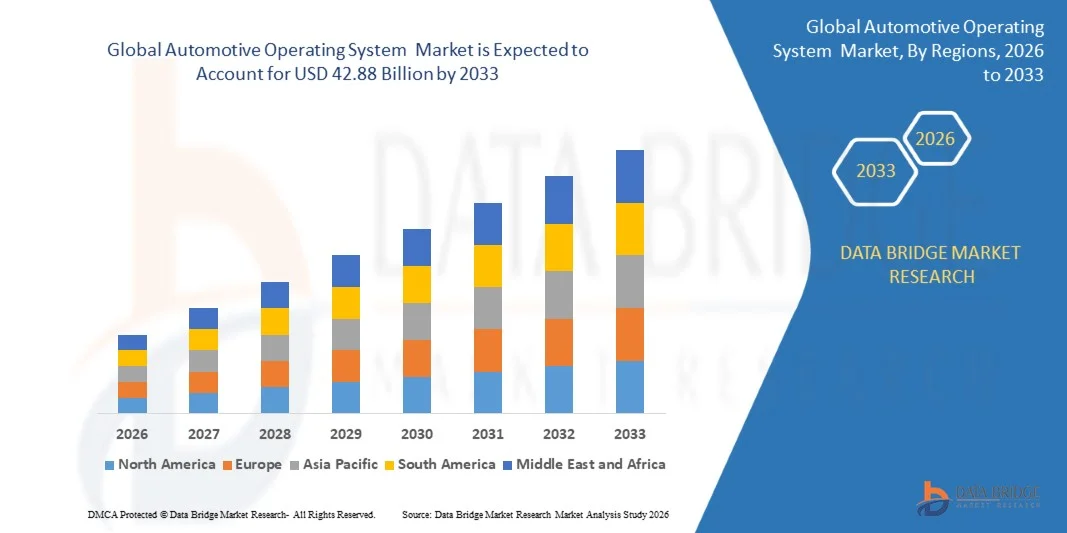
- As per Data Bridge Market Research analysis, the automotive operating system market was valued at USD 15.14 billion in 2025 and is projected to reach USD 42.88 billion by 2033, growing at a CAGR of 13.90% from 2026 to 2033.
- The market is experiencing robust growth as a result of rapid shift toward software-defined vehicles, increasing adoption of electric vehicles and autonomous driving technologies, rising integration of advanced driver assistance systems (ADAS), and growing consumer demand for connected services and advanced infotainment features.
- The global automotive operating system market has evolved significantly, with the operating system transforming from a hidden enabler into a foundational component that orchestrates vehicle functions, connectivity, and safety. The rise of software-defined vehicles has blurred traditional boundaries between hardware and software, demanding operating systems that can manage complex sensor arrays, process real-time data, and deliver seamless over-the-air updates. The global automotive operating system market is poised for continued expansion in the coming years, driven by the escalating need for scalable, secure, and efficient software environments to manage growing system complexity.
Market Size & Forecast
- Global Market Value (2025): USD 15.14 Billion
- Expected Market Value (2033): USD 42.88 Billion
- Forecast CAGR (2026 to 2033): 13.90%
- Leading Region in 2025: Asia-Pacific
- Fastest Growing Region: North America
What are the Major Takeaways of the Automotive Operating System Market?
- Asia-Pacific dominated the global automotive operating system market with the largest revenue share of 44.7% in 2025, supported by the region's position as the world's largest automotive production and consumption hub, rapid adoption of electric vehicles, and strong government initiatives promoting connected and autonomous vehicle technologies.
- North America is the second-largest market for automotive operating systems, holding a revenue share of 38% in 2025, driven by the presence of an advanced tech ecosystem and major players such as NVIDIA and Alphabet. The U.S. dominates the North American market, valued at USD 5.18 billion in 2025, representing 82% of the North American market share.
- The QNX segment accounted for 36.9% share in 2025, maintaining a leading position due to its strong penetration across global vehicle platforms, particularly in safety-critical applications. Google led the market with over 11.5% market share in 2025, while the top 5 players including Google, Tesla, Microsoft, Continental, and Siemens collectively held a market share of 42.6%.
- The global automotive operating system market is witnessing increased adoption of open-source platforms such as Automotive Grade Linux (AGL), with manufacturers leveraging collaborative development to accelerate innovation, reduce costs, and enable customization for specific vehicle models.
- The rising demand for software-defined vehicles and over-the-air (OTA) update capabilities is reshaping the automotive operating system landscape, as manufacturers introduce new features through remote updates rather than traditional recalls, enabling new revenue models without physical servicing.
Report Scope and Automotive Operating System Market Segmentation
|
Attributes |
Automotive Operating System Key Market Insights |
|
Segments Covered |
|
|
Countries Covered |
North America
Europe
Asia-Pacific
Middle East and Africa
South America
|
|
Key Market Players |
|
|
Market Opportunities |
|
|
Value Added Data Infosets |
|
What is the Key Trend in the Automotive Operating System Market?
- The automotive operating system market is experiencing significant transformation as a result of rapid shift toward software-defined vehicles, increasing integration of AI and machine learning capabilities, and the rising emphasis on connectivity, cybersecurity, and over-the-air update capabilities.
- The trend toward software-defined vehicles is reshaping the market landscape, with manufacturers developing advanced operating system solutions that deliver improved flexibility, scalability, and functionality while enabling remote updates and new revenue models.
- The automotive operating system market is witnessing increased adoption of open-source platforms, which have significantly expanded the development options available to automotive manufacturers.
- Artificial intelligence and machine learning are increasingly influencing market trends in automotive operating systems. Advanced driver assistance systems (ADAS) and autonomous driving capabilities are being enhanced through AI-powered sensor fusion, predictive diagnostics, and adaptive cabin environments. maintenance, adaptive cabin environments, and intuitive human-machine interactions.
- Cybersecurity is emerging as a critical trend in automotive operating systems, reflecting the growing threat landscape associated with connected vehicles. As vehicles become more connected and reliant on data exchange, operating systems must incorporate robust security measures to protect against cyber threats and unauthorized access.
- The convergence of automotive operating systems with digital platforms and integrated workflows is accelerating innovation in the market. The introduction of 5G technology into vehicle operating systems is an important trend, offering faster data transfer speeds, lower latency, and greater capacity to enable more robust and reliable communication between vehicles, infrastructure, and the cloud.
What are the Key Drivers of the Automotive Operating System Market?
- The rapid proliferation of Advanced Driver Assistance Systems (ADAS) and autonomous driving features serves as a primary catalyst for the automotive operating system market.
- The rapid electrification of vehicles and the growing adoption of software-defined vehicles are major drivers of market growth. As electric vehicles become mainstream, operating systems are evolving to support the unique requirements of electric powertrains, battery management, and energy optimization, facilitating real-time monitoring and control of electric vehicle components.
- The rising complexity of in-vehicle electronics and the increasing integration of electronic systems and software control functions characterize the modern automotive landscape, driving demand for advanced automotive operating systems.
- Regulatory push for vehicle safety and electrification is significantly driving market growth. Governments across multiple regions are accelerating regulatory frameworks that encourage the integration of advanced driver assistance technologies, which directly elevates demand for robust automotive operating systems.
- The increasing demand for connected services and advanced infotainment features is driving the adoption of automotive operating systems. Modern consumers expect advanced infotainment and connectivity features in their vehicles, including in-car entertainment, navigation systems, smartphone integration, and connectivity to external devices and networks.
Which Factors are Challenging the Growth of the Automotive Operating System Market?
- The inherent complexity associated with integrating automotive operating systems across diverse hardware and software ecosystems serves as a significant restraint on market growth. This necessitates rigorous customization and extensive validation processes to ensure seamless interoperability and consistent performance across differing vehicle architectures, prolonging development cycles and inflating costs.
- Strict data protection laws and regulatory fragmentation across different countries and regions pose significant challenges for the automotive operating system market. The stringent data protection laws from various countries lead to a rise in compliance costs and slow down the software deployment time.
- Data security and privacy concerns with the integration of connected car technologies present significant challenges. The increasing complexity of modern vehicles requiring more sophisticated operating systems, combined with the need for seamless interoperability between different systems and components within vehicles, creates challenges for market expansion.
- Rapid technological advancements and the shift toward electric and autonomous vehicles pose challenges in terms of adapting operating systems to meet evolving requirements.
- The high research and development costs associated with advanced operating system technologies create barriers for market entry and expansion. The development of secure, scalable, and high-performance automotive operating systems requires substantial investment in R&D and specialized software engineering capabilities.
How is the Automotive Operating System Market Segmented?
The automotive operating system market is segmented on the basis of operating system type, vehicle type, and application.
- By Operating System Type
On the basis of operating system type, the global automotive operating system market is segmented into QNX, Linux, Windows, Android, and others. The QNX segment accounted for 36.9% share in 2025, maintaining a leading position due to its strong penetration across global vehicle platforms, particularly in safety-critical applications such as ADAS and autonomous driving systems. QNX is widely adopted by automotive manufacturers for its reliability, real-time performance, and functional safety certifications.
The Android segment, led by Google's Android Automotive OS, is experiencing significant growth, with Google holding over 11.5% market share in 2025. Android Automotive OS is gaining traction due to its familiar user interface, extensive app ecosystem, and strong integration with Google services, making it a preferred choice for infotainment and connected services applications. The Linux segment, including Automotive Grade Linux (AGL), is witnessing increased adoption driven by the shift toward open-source platforms. Open-source operating systems enable collaborative development, accelerate innovation, and reduce costs, making them attractive to manufacturers seeking flexibility and customization.
- By Vehicle Type
On the basis of vehicle type, the global automotive operating system market is segmented into passenger cars and commercial vehicles. The passenger cars segment dominated the market in 2025, accounting for a revenue share of 52%, driven by the high volume of passenger vehicle production, increasing consumer demand for connected and autonomous features, and the rapid adoption of electric vehicles. The passenger cars segment is expected to maintain its dominance through the forecast period, supported by ongoing innovation in infotainment, ADAS, and autonomous driving technologies.
The commercial vehicles segment is also experiencing significant growth, driven by the increasing adoption of telematics, fleet management solutions, and autonomous driving technologies in trucks, buses, and delivery vehicles.
- By Application
On the basis of application, the global automotive operating system market is segmented into ADAS and safety systems, autonomous driving, infotainment systems, connected services, body control and comfort systems, powertrain control, and others. The infotainment systems segment is projected to grow at a CAGR of 13.7% during the forecast period. The non-safety systems segment, including infotainment and connected services, held 57.2% share in 2025 and is expected to grow at a CAGR of 11.9% between 2026 and 2035.
The ADAS and safety systems segment represents a significant portion of the market, driven by the increasing integration of advanced driver assistance features and regulatory mandates requiring safety systems in new vehicles. The autonomous driving segment is expected to witness the fastest growth, driven by the development of Level 4 and Level 5 autonomous vehicles and the need for sophisticated operating systems capable of managing complex sensor arrays and real-time decision-making.
Which Region Holds the Largest Share of the Automotive Operating System Market?
- Asia-Pacific dominated the automotive operating system market with the largest revenue share of 44.7% in 2025, supported by the region's position as the world's largest automotive production and consumption hub. The Asia Pacific region contributed 44.7% of global automotive operating system demand in 2025, with Chinese smart vehicle brands leading in the deployment of cockpit-driving integrated operating systems.
- Asia Pacific represents the fastest-growing region in the Automotive Operating System Market, with China's market reaching USD 28.6 billion in 2025, accounting for 68% of the Asia Pacific market.
- North America is the second-largest market for automotive operating systems, holding a revenue share of 38% in 2025, driven by the presence of an advanced tech ecosystem and major players such as NVIDIA and Alphabet. The U.S. dominates the North American market, valued at USD 5.18 billion in 2025, representing 82% of the North American market share.
Asia Pacific Automotive Operating System Market Insight
The Asia Pacific automotive operating system market is the largest and fastest-growing regional market globally, driven by the region's position as the world's largest automotive production and consumption hub. According to IIM information, the Asia Pacific region's share reached 40% in 2025, with China's market reaching USD 28.6 billion, accounting for 68% of the Asia Pacific market. The Asia Pacific region contributed 44.7% of global automotive operating system demand in 2025. Chinese smart vehicle brands are leading globally in the deployment of cockpit-driving integrated operating systems. According to IIM, more than 55% of mass-produced models launched by Chinese OEMs and Tier1 suppliers in 2025 were equipped with self-developed or deeply customized automotive OS. The global smart cockpit operating system market in China reached approximately RMB 48 billion (approximately USD 6.6 billion) in 2025, accounting for 26% of the global share. Japan, South Korea, and India form the other major growth pillars in the region, with strong automotive manufacturing bases and advanced technology ecosystems.
North America Automotive Operating System Market Insight
North America is the second-largest market for automotive operating systems, holding a revenue share of 38% in 2025, driven by the presence of an advanced tech ecosystem, major players such as NVIDIA and Alphabet, and strong consumer demand for connected and autonomous features. According to IIM, the North American market maintained a steady growth rate of approximately 15% in 2025. The U.S. dominates the North American automotive operating system market. The North American market is characterized by strong emphasis on innovation, with Tesla leading the vertical integration model and contributing significant growth to the region.
Europe Automotive Operating System Market Insight
Europe is a significant market for automotive operating systems, with Germany, France, and the U.K. leading in adoption across passenger car and commercial vehicle applications. According to IIM information, the European market was valued at USD 5.4 billion in 2025, driven by ISO 26262 second edition and UN R155/156 cybersecurity regulations, and is expected to grow to USD 6.2 billion in 2026. Germany accounts for 42% of European automotive operating system market activity, driven by the concentrated presence of premium OEMs investing billions in proprietary OS strategies. The European market benefits from a deep traditional Tier 1 ecosystem and functional safety standards advantages. France is expected to grow at a CAGR of 11.8%.
China Automotive Operating System Market Insight
The China automotive operating system market is the largest in the Asia Pacific region and one of the fastest-growing globally, driven by the country's position as the world's largest automotive market and its strong focus on electric and connected vehicle technologies. The Chinese market reached USD 28.6 billion in 2025, accounting for 68% of the Asia Pacific market. The China automotive operating system market is benefiting from strong government support for new energy vehicles, including purchase tax exceptions for NEVs, and the rapid expansion of domestic technology providers. According to IIM, China's automotive OS standard system white paper published in 2025 clarified the "Basic OS + Safety OS + Application OS" tiered architecture.
India Automotive Operating System Market Insight
The India automotive operating system market is emerging as a significant growth opportunity, driven by rapid digitalization, expanding automotive manufacturing, and increasing adoption of connected and electric vehicle technologies. According to IndexBox, the India Android Automotive OS (AAOS) market is projected to grow from an estimated USD 85-110 million in 2026 to USD 480-620 million by 2035, reflecting a CAGR of approximately 19-22%. India is forecast to grow at a CAGR of 11.4%, driven by volume OEM adoption and the expansion of local integration capabilities. The Indian market is benefiting from government initiatives such as the Digital Personal Data Protection Act, 2023, and the push for ADAS mandates in new vehicles.
Germany Automotive Operating System Market Insight
Germany represents a significant market for automotive operating systems in Europe, with the country benefiting from its position as Europe's largest automotive manufacturing hub. Germany leads the European region with a 42.8% share in 2025. The German automotive operating system market is characterized by an emphasis on quality, precision, and high-performance operating system solutions. The market benefits from strong demand across passenger car and commercial vehicle applications, supported by stringent EU regulatory frameworks and a strong focus on autonomous driving and Industry 4.0 initiatives. Germany is expected to be a key growth driver in the European market, with major players including BMW AG, Mercedes-Benz Group AG, Continental AG, and Siemens AG headquartered in the country.
U.K. Automotive Operating System Market Insight
The U.K. automotive operating system market is developing steadily, supported by robust demand across passenger car and commercial vehicle applications. The U.K. accounts for 23.1% of the European central computing architecture vehicle OS market in 2025. The U.K. benefits from a strong automotive and technology industry and increasing consumer focus on connected and autonomous vehicle technologies. The UK demand for Android Automotive OS is set to rise from USD 16.8 million in 2025 to USD 34.2 million by 2035, growing at a CAGR of 7.7%. The market is witnessing growing adoption across infotainment and ADAS applications, with a focus on developing innovative and reliable operating system solutions that meet stringent safety and cybersecurity requirements.
South America Automotive Operating System Market Insight
South America represents a key growth opportunity in the automotive operating system market, driven by the region's expanding automotive manufacturing sector and increasing consumer awareness regarding connected and autonomous vehicle technologies. Brazil anchors the South American automotive operating system market, accounting for a significant share of regional demand. According to industry reports, the Latin America automotive operating system market is projected to grow steadily through the forecast period. Stellantis and Volkswagen are introducing connected cockpit platforms across locally produced models in the region. Government tax incentives for connected and electrified vehicles are expanding the addressable base for OS integration in the region.
Which are the Top Companies in Automotive Operating System Market?
The automotive operating system industry is primarily led by well-established companies, including:
- BlackBerry Limited (Canada)
- Google LLC (U.S.)
- Apple Inc. (U.S.)
- Microsoft Corporation (U.S.)
- Tesla, Inc. (U.S.)
- Continental AG (Germany)
- Siemens AG (Germany)
- BMW AG (Germany)
- Mercedes-Benz Group AG (Germany)
- NVIDIA Corporation (U.S.)
- Green Hills Software LLC (U.S.)
- Wind River Systems, Inc. (U.S.)
- Automotive Grade Linux (U.S.)
- HARMAN International (U.S.)
What are Latest Developments in Automotive Operating System Market?
- In August 2026, BlackBerry QNX announced the expansion of its QNX operating system capabilities for software-defined vehicles, enabling automakers to accelerate the development of safe, secure, and reliable automotive systems. The new capabilities are designed to support the increasing complexity of ADAS, autonomous driving, and connected vehicle applications.
- In July 2026, Google announced the expansion of its Android Automotive OS platform with new features for enhanced connectivity, over-the-air updates, and integration with Google services. The expansion includes new partnerships with multiple automotive manufacturers to deploy Android Automotive OS in next-generation vehicle models.
- In June 2026, Microsoft announced a strategic partnership with a leading automotive manufacturer to develop cloud-connected operating system solutions for electric and autonomous vehicles. The partnership focuses on leveraging Microsoft's Azure cloud platform to enable advanced telematics, predictive maintenance, and over-the-air update capabilities.
- In May 2026, Tesla announced significant updates to its vehicle operating system, introducing new AI-powered features for enhanced autonomous driving capabilities, improved user interface, and expanded entertainment options. The updates demonstrate Tesla's continued leadership in software-defined vehicle technology.
- In April 2026, Continental AG announced the launch of a new automotive operating system platform designed to support the growing complexity of software-defined vehicles. The platform leverages containerization and microservices architecture to enable faster deployment of new features and improved scalability across vehicle models.
- In March 2026, NVIDIA announced the expansion of its DRIVE operating system platform with new AI capabilities for autonomous driving applications. The expansion includes enhanced sensor fusion, predictive analytics, and real-time decision-making capabilities for next-generation autonomous vehicles.

- Interactive Data Analysis Dashboard
- Company Analysis Dashboard for high growth potential opportunities
- Research Analyst Access for customization & queries
- Competitor Analysis with Interactive dashboard
- Latest News, Updates & Trend analysis
- Harness the Power of Benchmark Analysis for Comprehensive Competitor Tracking
Data collection and base year analysis are done using data collection modules with large sample sizes. The stage includes obtaining market information or related data through various sources and strategies. It includes examining and planning all the data acquired from the past in advance. It likewise envelops the examination of information inconsistencies seen across different information sources. The market data is analysed and estimated using market statistical and coherent models. Also, market share analysis and key trend analysis are the major success factors in the market report. To know more, please request an analyst call or drop down your inquiry.
The key research methodology used by DBMR research team is data triangulation which involves data mining, analysis of the impact of data variables on the market and primary (industry expert) validation. Data models include Vendor Positioning Grid, Market Time Line Analysis, Market Overview and Guide, Company Positioning Grid, Patent Analysis, Pricing Analysis, Company Market Share Analysis, Standards of Measurement, Global versus Regional and Vendor Share Analysis. To know more about the research methodology, drop in an inquiry to speak to our industry experts.
Data Bridge Market Research is a leader in advanced formative research. We take pride in servicing our existing and new customers with data and analysis that match and suits their goal. The report can be customized to include price trend analysis of target brands understanding the market for additional countries (ask for the list of countries), clinical trial results data, literature review, refurbished market and product base analysis. Market analysis of target competitors can be analyzed from technology-based analysis to market portfolio strategies. We can add as many competitors that you require data about in the format and data style you are looking for. Our team of analysts can also provide you data in crude raw excel files pivot tables (Fact book) or can assist you in creating presentations from the data sets available in the report.













