


Automotive Plain Carbon Electric Resistance Welding (ERW) Tubes Market Overview
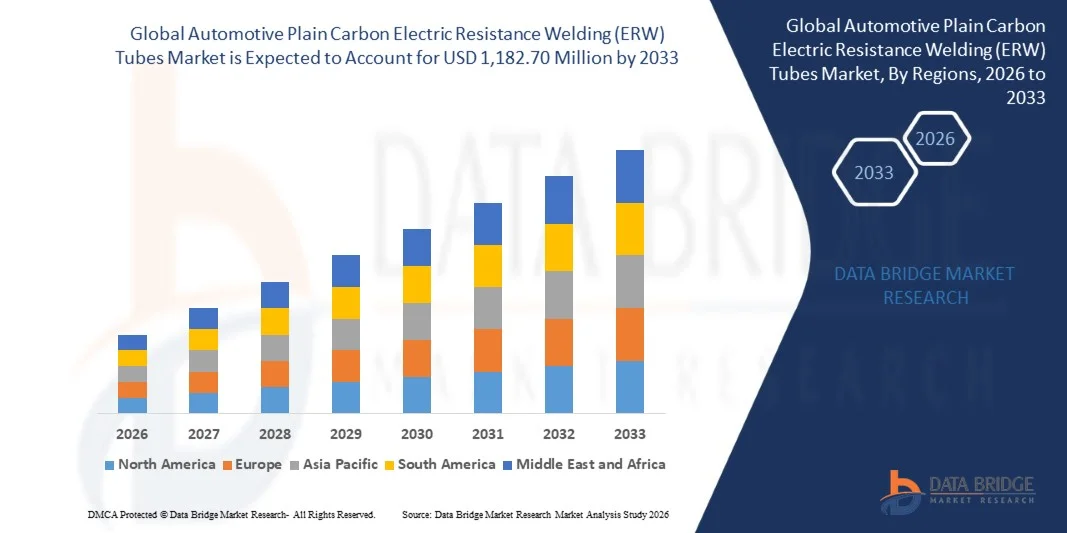
As per Data Bridge Market Research analysis the automotive plain carbon electric resistance welding (ERW) tubes market was valued at USD 800.50 million in 2025 and is projected to reach USD 1,182.70 million by 2033, growing at a CAGR of 5.00% from 2026 to 2033. The market is witnessing steady growth driven by increasing vehicle production worldwide, rising demand for lightweight and cost-efficient structural components, and expanding applications of ERW tubes in chassis systems, exhaust assemblies, steering columns, and automotive frames.
Market Size & Forecast
- Global Market Value (2025): USD 800.50 million
- Expected Market Value (2033): USD 1,182.70 million
- Forecast CAGR (2026–2033): 5.00%
The growing emphasis on fuel efficiency, stringent vehicle safety regulations, and the automotive industry's continued focus on optimizing manufacturing costs are encouraging OEMs and component manufacturers to increase the adoption of plain carbon ERW tubes. In addition, advancements in tube manufacturing technologies, coupled with the rising production of passenger and commercial vehicles across emerging economies, are supporting market expansion. ERW tubes continue to gain traction due to their superior dimensional accuracy, high strength-to-weight ratio, and suitability for high-volume automotive production environments.
What are the Major Takeaways of Automotive Plain Carbon Electric Resistance Welding (ERW) Tubes Market?
- North America accounted for a significant revenue share of the automotive plain carbon electric resistance welding (ERW) tubes market in 2025, supported by strong automotive manufacturing activities, increasing vehicle production, and rising demand for lightweight and durable structural components.
- Asia-Pacific automotive plain carbon ERW tubes market is expected to witness the fastest growth rate from 2026 to 2033, supported by expanding automotive production, rapid industrialization, and increasing demand for affordable and fuel-efficient vehicles.
- The frames segment held the largest market revenue share in 2025, driven by the extensive use of ERW tubes in vehicle chassis structures, body frames, and safety reinforcement components. Automotive manufacturers prefer ERW tubes for frame applications due to their high strength-to-weight ratio, dimensional accuracy, cost efficiency, and ability to support lightweight vehicle designs while maintaining structural durability.
- The suspension segment is projected to register the fastest growth at a CAGR from 2026 to 2033, driven by increasing demand for durable and lightweight suspension components that enhance vehicle stability, handling performance, and ride comfort. Rising adoption of advanced suspension systems in passenger vehicles and commercial vehicles is accelerating segment expansion.
- The passenger car segment held the largest market revenue share in 2025, driven by increasing global passenger vehicle production, rising consumer demand for fuel-efficient vehicles, and extensive utilization of ERW tubes in chassis, exhaust systems, and structural assemblies. The growing adoption of lightweight materials in passenger vehicles is further supporting the demand for welded steel tube solutions.
- The commercial vehicle segment is projected to register the fastest growth at a CAGR from 2026 to 2033, driven by increasing demand for heavy-duty vehicles, logistics transportation, and infrastructure development activities. The rising production of trucks, buses, and utility vehicles is creating significant demand for strong and durable ERW tubes used in frames, suspension systems, and load-bearing structures.
Report Scope and Automotive Plain Carbon Electric Resistance Welding (ERW) Tubes Market Segmentation
|
Attributes |
Automotive Plain Carbon Electric Resistance Welding (ERW) Tubes Key Market Insights |
|
Segments Covered |
|
|
Countries Covered |
North America
Europe
Asia-Pacific
Middle East and Africa
South America
|
|
Key Market Players |
|
|
Market Opportunities |
|
|
Value Added Data Infosets |
In addition to the market insights such as market value, growth rate, market segments, geographical coverage, market players, and market scenario, the market report curated by the Data Bridge Market Research team includes in-depth expert analysis, import/export analysis, pricing analysis, production consumption analysis, and pestle analysis. |
What is the Key Trend in the Automotive Plain Carbon Electric Resistance Welding (ERW) Tubes Market?
Trend: Rising Adoption Of Lightweight And High-Strength Automotive Structural Components
The increasing focus on vehicle weight reduction, fuel efficiency improvement, and enhanced structural safety is accelerating the adoption of plain carbon electric resistance welding (ERW) tubes across the automotive industry. Automotive manufacturers are increasingly utilizing ERW tubes in chassis frames, suspension components, exhaust systems, steering assemblies, and structural reinforcements due to their high strength, dimensional accuracy, cost-effectiveness, and suitability for large-scale production. The growing transition toward lightweight vehicle designs and advanced manufacturing processes is further supporting the integration of welded steel tubes across passenger vehicles, commercial vehicles, and electric vehicle platforms.
The expansion of global automotive production, combined with rising investments in advanced steel manufacturing capabilities, is creating sustained demand for automotive-grade ERW tubes. According to the International Organization of Motor Vehicle Manufacturers (OICA), global motor vehicle production reached approximately 75.5 million units in 2023, reflecting continued recovery and growth in automotive manufacturing activities worldwide. Increasing vehicle production volumes are directly supporting demand for steel-based structural components used in automotive assembly applications.
For instance, in May 2025, Tata Steel inaugurated the Phase II expansion of its Kalinganagar steel manufacturing facility in Odisha, India, increasing crude steel capacity from 3 million tonnes per annum to 8 million tonnes per annum. The expansion focuses on producing advanced steel products for automotive and other high-performance applications, supporting the growing demand for durable and lightweight steel components used by automotive manufacturers.
The growing demand for lightweight automotive structures, increasing vehicle production, and continuous advancements in steel manufacturing technologies are expected to reinforce long-term demand for automotive plain carbon ERW tubes, enabling manufacturers to benefit from rising requirements for durable, cost-efficient, and high-performance tubular components.
Automotive Plain Carbon Electric Resistance Welding (ERW) Tubes Market Dynamics
Key Market Driver: Increasing Vehicle Production And Demand For Cost-Efficient Structural Components
The global automotive industry continues to experience rising demand for efficient and economical manufacturing solutions that provide high strength, durability, and improved vehicle performance. Plain carbon ERW tubes are widely used in automotive applications due to their ability to withstand mechanical stress, maintain consistent dimensions, and support automated production processes. Their extensive utilization in chassis systems, structural frames, exhaust assemblies, and safety components is increasing as automotive manufacturers focus on optimizing vehicle weight while maintaining structural integrity.
The growing production of passenger vehicles, commercial vehicles, and electric vehicles is further strengthening market demand. According to OICA, global motor vehicle production increased significantly in recent years, reaching approximately 75.5 million units in 2023, supported by recovery in automotive manufacturing activities and increasing consumer demand. This growth is generating additional requirements for steel-based components, including welded tubes used in automotive structures and assemblies.
For instance, Tata Steel has expanded its automotive-grade steel production capabilities through investments in advanced manufacturing facilities to meet increasing demand from automotive OEMs. The company's Kalinganagar expansion strengthens its ability to supply high-quality steel products for automotive applications, supporting the broader ecosystem of automotive component manufacturers, including ERW tube producers.
As automotive manufacturers continue increasing production capacity and adopting cost-efficient steel solutions, the demand for plain carbon ERW tubes is expected to grow, supported by their affordability, manufacturing flexibility, and suitability for high-volume automotive applications.
Key Restraint/Challenge: Volatility In Steel Prices And Raw Material Procurement Risks
Automotive plain carbon ERW tube manufacturers remain highly dependent on steel availability and pricing, making the market vulnerable to fluctuations in iron ore prices, energy costs, and global steel supply conditions. Changes in raw material costs, transportation expenses, and geopolitical uncertainties can increase production expenses and create challenges for manufacturers operating under competitive pricing pressures.
In addition, steel producers and downstream automotive component manufacturers continue to face uncertainty due to changing demand patterns and cost pressures across the global steel value chain. According to ArcelorMittal’s 2024 Annual Report, fluctuations in raw material prices, energy costs, and market conditions remain important factors influencing steel production costs and profitability.
For instance, ArcelorMittal highlighted in its 2024 Annual Report that raw material availability, energy pricing, and market volatility continue to influence operational performance across its steel manufacturing business. These factors create challenges for automotive ERW tube manufacturers in maintaining stable production costs and ensuring consistent supply of quality steel inputs.
Despite strong demand from the automotive sector, fluctuations in steel prices, supply chain disruptions, and rising production costs are expected to remain significant restraints, affecting profitability and increasing operational challenges for manufacturers throughout the forecast period.
Key Market Opportunity: Expansion Of Electric Vehicle Manufacturing And Lightweight Automotive Technologies
The rapid growth of electric vehicles (EVs) and increasing adoption of lightweight automotive manufacturing technologies are creating significant opportunities for automotive plain carbon ERW tube manufacturers. EV producers require durable and lightweight structural components to improve vehicle efficiency, battery performance, and overall driving range. ERW tubes are gaining importance in electric vehicle platforms due to their strength, reliability, and suitability for chassis and structural applications.
The increasing adoption of electric mobility worldwide is encouraging investments in automotive manufacturing ecosystems and creating new opportunities for suppliers of advanced steel components. According to the International Energy Agency (IEA), global electric car sales exceeded 17 million units in 2024, representing continued growth in EV adoption and increasing demand for lightweight vehicle components.
For instance, according to the IEA Global EV Outlook 2025, electric vehicles accounted for more than 20% of global new car sales in 2024, highlighting the rapid transformation of the automotive industry toward electrification. This shift is expected to increase demand for lightweight and high-strength structural materials, including steel tubular components used in vehicle frames and assemblies.
As electric vehicle production expands and automotive manufacturers continue investing in lightweight structural solutions, increasing adoption of durable steel tubular components is expected to create substantial growth opportunities for the global automotive plain carbon ERW tubes market.
How is the Automotive Plain Carbon Electric Resistance Welding (ERW) Tubes Market Segmented?
The market is segmented on the basis of application and vehicle type.
- By Application
On the basis of application, the automotive plain carbon electric resistance welding (ERW) tubes market is segmented into frames, suspension, exhaust, and others. The frames segment held the largest market revenue share in 2025, driven by the extensive use of ERW tubes in vehicle chassis structures, body frames, and safety reinforcement components. Automotive manufacturers prefer ERW tubes for frame applications due to their high strength-to-weight ratio, dimensional accuracy, cost efficiency, and ability to support lightweight vehicle designs while maintaining structural durability.
The suspension segment is projected to register the fastest growth at a CAGR from 2026 to 2033, driven by increasing demand for durable and lightweight suspension components that enhance vehicle stability, handling performance, and ride comfort. Rising adoption of advanced suspension systems in passenger vehicles and commercial vehicles is accelerating segment expansion.
- By Vehicle Type
On the basis of vehicle type, the automotive plain carbon electric resistance welding (ERW) tubes market is segmented into passenger car and commercial vehicle. The passenger car segment held the largest market revenue share in 2025, driven by increasing global passenger vehicle production, rising consumer demand for fuel-efficient vehicles, and extensive utilization of ERW tubes in chassis, exhaust systems, and structural assemblies. The growing adoption of lightweight materials in passenger vehicles is further supporting the demand for welded steel tube solutions.
The commercial vehicle segment is projected to register the fastest growth at a CAGR from 2026 to 2033, driven by increasing demand for heavy-duty vehicles, logistics transportation, and infrastructure development activities. The rising production of trucks, buses, and utility vehicles is creating significant demand for strong and durable ERW tubes used in frames, suspension systems, and load-bearing structures.
Which Region Holds the Largest Share of the Automotive Plain Carbon Electric Resistance Welding (ERW) Tubes Market?
North America Automotive Plain Carbon Electric Resistance Welding (ERW) Tubes Market Insight
North America accounted for a significant revenue share of the automotive plain carbon electric resistance welding (ERW) tubes market in 2025, supported by strong automotive manufacturing activities, increasing vehicle production, and rising demand for lightweight and durable structural components. The region’s well-established automotive ecosystem, presence of major vehicle manufacturers, and growing adoption of advanced steel solutions are driving the utilization of ERW tubes in chassis frames, suspension systems, exhaust components, and other automotive applications. In addition, increasing investments in electric vehicle manufacturing and vehicle lightweighting initiatives are further strengthening market growth across the region.
U.S. Automotive Plain Carbon Electric Resistance Welding (ERW) Tubes Market Insight
The U.S. automotive plain carbon ERW tubes market held the largest revenue share in North America in 2025, driven by high vehicle production volumes, advanced automotive manufacturing infrastructure, and increasing demand for cost-effective steel tubular components. The country’s strong presence of automotive OEMs and component suppliers is supporting widespread adoption of ERW tubes in vehicle frames, exhaust systems, and structural assemblies. Furthermore, growing investments in electric vehicle production facilities and lightweight vehicle technologies are increasing demand for high-strength steel components, contributing to market expansion.
Europe Automotive Plain Carbon Electric Resistance Welding (ERW) Tubes Market Insight
The Europe automotive plain carbon ERW tubes market is expected to witness steady growth from 2026 to 2033, driven by increasing focus on vehicle lightweighting, stringent automotive safety standards, and rising adoption of advanced manufacturing technologies. European automotive manufacturers are increasingly incorporating high-quality steel tubular components to improve vehicle efficiency and structural performance. The region’s strong automotive production base, combined with growing electric vehicle adoption and sustainability-focused manufacturing practices, is supporting demand for ERW tubes across passenger cars and commercial vehicles.
Germany Automotive Plain Carbon Electric Resistance Welding (ERW) Tubes Market Insight
The Germany automotive plain carbon ERW tubes market is expected to experience significant growth from 2026 to 2033, supported by the country’s strong automotive manufacturing industry, technological innovation, and high demand for precision-engineered vehicle components. Germany’s leading position in automotive production is driving the adoption of ERW tubes for chassis structures, exhaust systems, and suspension components. Moreover, increasing investments in electric mobility, lightweight vehicle architectures, and advanced steel solutions are contributing to market expansion across automotive manufacturing applications.
U.K. Automotive Plain Carbon Electric Resistance Welding (ERW) Tubes Market Insight
The U.K. automotive plain carbon ERW tubes market is projected to grow from 2026 to 2033, driven by increasing investments in automotive production, electric vehicle development, and demand for lightweight structural materials. The country’s transition toward low-emission vehicles and growing focus on efficient manufacturing processes are encouraging the adoption of advanced steel components. In addition, the presence of automotive manufacturing facilities and increasing demand for durable tubular solutions in passenger and commercial vehicles are supporting market growth.
Asia-Pacific Automotive Plain Carbon Electric Resistance Welding (ERW) Tubes Market Insight
The Asia-Pacific automotive plain carbon ERW tubes market is expected to witness the fastest growth rate from 2026 to 2033, supported by expanding automotive production, rapid industrialization, and increasing demand for affordable and fuel-efficient vehicles. Countries such as China, India, Japan, and South Korea are experiencing significant growth in vehicle manufacturing, creating strong demand for ERW tubes used in chassis, suspension, and exhaust applications. The region’s growing electric vehicle ecosystem, availability of steel manufacturing capabilities, and increasing investments by automotive OEMs are further accelerating market expansion.
China Automotive Plain Carbon Electric Resistance Welding (ERW) Tubes Market Insight
The China automotive plain carbon ERW tubes market accounted for the largest revenue share in Asia-Pacific in 2025, driven by the country’s position as the world’s largest automotive manufacturing hub and its rapidly expanding electric vehicle industry. The increasing production of passenger cars, commercial vehicles, and new energy vehicles is creating substantial demand for steel tubular components. In addition, China’s strong domestic steel industry, extensive automotive supply chain network, and government support for advanced mobility solutions are contributing to the widespread adoption of ERW tubes across automotive applications.
Japan Automotive Plain Carbon Electric Resistance Welding (ERW) Tubes Market Insight
The Japan automotive plain carbon ERW tubes market is expected to grow from 2026 to 2033, supported by the country’s advanced automotive manufacturing capabilities, focus on precision engineering, and increasing adoption of lightweight vehicle technologies. Japanese automakers emphasize high-quality and durable components to enhance vehicle performance and efficiency, supporting demand for ERW tubes in structural and mechanical applications. Furthermore, the expansion of hybrid and electric vehicle production, along with continuous innovation in automotive materials, is expected to strengthen market growth.
Which are the Top Companies in Automotive Plain Carbon Electric Resistance Welding (ERW) Tubes Market?
The automotive plain carbon electric resistance welding (ERW) tubes industry is primarily led by well-established companies, including:
- JFE Steel Corporation (Japan)
- Cleveland-Cliffs Inc. (U.S.)
- Innovative Industries Limited (India)
- Hyundai Steel Company (South Korea)
- Pearlite Steel (India)
- JSW Steel Ltd. (India)
- Nippon Steel Corporation (Japan)
- Permanent Steel Manufacturing Co., Ltd. (China)
- Tata Steel Limited (India)
- Jindal SAW Limited (India)
- ArcelorMittal (Luxembourg)
- Tubular Steel Inc. (U.S.)
- Rexal Tubes (India)
- Nucor Corporation (U.S.)
- POSCO (South Korea)
What are Latest Developments in Automotive Plain Carbon Electric Resistance Welding (ERW) Tubes Market?
- In November 2025, Tata Steel Limited (India) announced a strategic collaboration with an automotive industry partner to develop advanced lightweight steel solutions for vehicle applications. The initiative focuses on improving vehicle performance through high-strength and weight-optimized materials. This development supports the automotive industry's shift toward lightweight structures and is expected to strengthen Tata Steel’s position as a key supplier of advanced steel products for automotive manufacturers.
- In October 2025, Nippon Steel Corporation (Japan) expanded its automotive steel manufacturing capabilities through investments in advanced production technologies for high-performance steel products. The development aims to address increasing demand from automakers for stronger, lighter, and safer vehicle components. This investment is expected to enhance Nippon Steel’s competitiveness and support the growing adoption of advanced welded tube and structural steel applications in the automotive sector.
- In September 2025, JFE Steel Corporation (Japan) introduced new sustainability initiatives focused on reducing carbon emissions across its steel manufacturing operations. The company is implementing low-carbon production technologies to support environmentally responsible steel manufacturing and meet increasing demand from automotive customers for sustainable materials. This initiative is expected to strengthen JFE Steel’s market position as automakers increasingly prioritize low-emission supply chains.

- Interactive Data Analysis Dashboard
- Company Analysis Dashboard for high growth potential opportunities
- Research Analyst Access for customization & queries
- Competitor Analysis with Interactive dashboard
- Latest News, Updates & Trend analysis
- Harness the Power of Benchmark Analysis for Comprehensive Competitor Tracking
Data collection and base year analysis are done using data collection modules with large sample sizes. The stage includes obtaining market information or related data through various sources and strategies. It includes examining and planning all the data acquired from the past in advance. It likewise envelops the examination of information inconsistencies seen across different information sources. The market data is analysed and estimated using market statistical and coherent models. Also, market share analysis and key trend analysis are the major success factors in the market report. To know more, please request an analyst call or drop down your inquiry.
The key research methodology used by DBMR research team is data triangulation which involves data mining, analysis of the impact of data variables on the market and primary (industry expert) validation. Data models include Vendor Positioning Grid, Market Time Line Analysis, Market Overview and Guide, Company Positioning Grid, Patent Analysis, Pricing Analysis, Company Market Share Analysis, Standards of Measurement, Global versus Regional and Vendor Share Analysis. To know more about the research methodology, drop in an inquiry to speak to our industry experts.
Data Bridge Market Research is a leader in advanced formative research. We take pride in servicing our existing and new customers with data and analysis that match and suits their goal. The report can be customized to include price trend analysis of target brands understanding the market for additional countries (ask for the list of countries), clinical trial results data, literature review, refurbished market and product base analysis. Market analysis of target competitors can be analyzed from technology-based analysis to market portfolio strategies. We can add as many competitors that you require data about in the format and data style you are looking for. Our team of analysts can also provide you data in crude raw excel files pivot tables (Fact book) or can assist you in creating presentations from the data sets available in the report.













