


What is the Automotive Position Sensor Market Size and Overview?
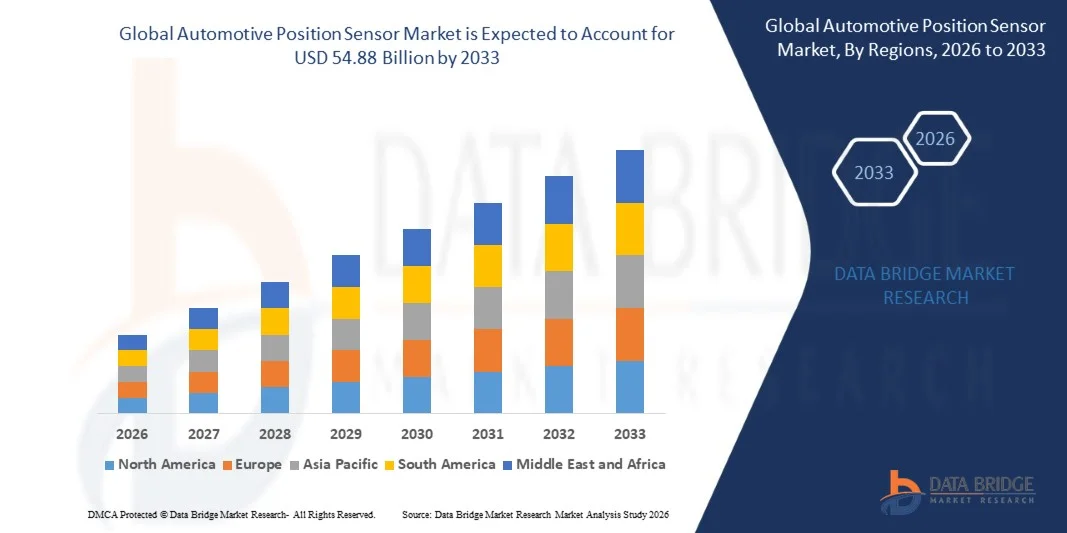
As per Data Bridge Market Research analysis The Automotive Position Sensor Market was valued at USD 31.80 billion in 2025 and is projected to reach USD 54.88 billion by 2033, growing at a CAGR of 7.06% from 2026 to 2033. The market is experiencing steady growth driven by increasing vehicle electrification, rising adoption of advanced driver assistance systems (ADAS), and growing demand for precise engine and transmission control technologies across passenger and commercial vehicles.
The expansion of electric and hybrid vehicle production, coupled with stringent emission regulations and fuel-efficiency standards, is accelerating the deployment of high-performance position sensors in automotive applications. Throttle position sensors, steering angle sensors, pedal position sensors, and transmission position sensors play a critical role in ensuring vehicle safety, performance, and operational efficiency. Furthermore, ongoing advancements in sensor miniaturization, contactless sensing technologies, and integration with autonomous driving systems are supporting broader adoption across next-generation vehicle platforms.
Key Market Trends & Insights
- North America dominated the Automotive Position Sensor Market with the largest revenue share of 34.26% in 2025, supported by strong automotive technology adoption, high penetration of ADAS-equipped vehicles, and the presence of leading automotive OEMs and sensor manufacturers.
- The Rotary Position Sensors segment led the market with a 52.84% share in 2025, driven by its extensive use in throttle position sensing, steering angle detection, transmission control, and pedal position monitoring across modern vehicles
- Asia-Pacific is expected to be the fastest-growing region at a CAGR of 7.8% from 2026 to 2033, fueled by rising vehicle production volumes, rapid EV penetration, and increasing investments in automotive sensor technologies.
- Linear Type are the fastest-growing type, projected to register a CAGR of 7.9%, reflecting the surge in adoption in electric actuators, suspension systems, battery management applications, and advanced vehicle control mechanisms
- The Non-Contact Type segment dominated the contact type category with a 64.37% revenue share in 2025, led by its superior durability, higher accuracy, and ability to operate effectively in harsh automotive environments.
- Analog Output accounted for 57.46% of the market, preferred by its extensive utilization in conventional automotive systems requiring continuous position monitoring and real-time feedback.
- The Robotics segment is the fastest-growing application category, with a CAGR of 7.8%, driven by the increasing adoption of automation in automotive manufacturing and assembly operations.
Market Size & Forecast
- Global Market Value (2025): USD 31.80 Billion
- Expected Market Value (2033): USD 54.88 Billion
- Forecast CAGR (2026–2033): 7.06%
- Leading Region in 2025: North America
- Fastest Growing Region: Asia Pacific
Report Scope and Automotive Position Sensor Market Segmentation
|
Attributes |
Automotive Position Sensor Key Market Insights |
|
Segments Covered |
|
|
Countries Covered |
North America · U.S. · Canada · Mexico Europe · Germany · France · U.K. · Netherlands · Switzerland · Belgium · Russia · Italy · Spain · Turkey · Rest of Europe Asia-Pacific · China · Japan · India · South Korea · Singapore · Malaysia · Australia · Thailand · Indonesia · Philippines · Rest of Asia-Pacific Middle East and Africa · Saudi Arabia · U.A.E. · South Africa · Egypt · Israel · Rest of Middle East and Africa South America · Brazil · Argentina · Rest of South America |
|
Key Market Players |
· TE Connectivity Ltd. (Switzerland) · Sensata Technologies, Inc. (U.S.) · Allegro MicroSystems, Inc. (U.S.) · ams-OSRAM AG (Austria) · Infineon Technologies AG (Germany) · TDK Corporation (Japan) · NXP B.V. (Netherlands) · Melexis NV (Belgium) · STMicroelectronics International N.V. (Switzerland) · ROHM Co., Ltd. (Japan) · Renesas Electronics Corporation (Japan) · Microchip Technology Inc. (U.S.) · Texas Instruments Incorporated (U.S.) · Analog Devices, Inc. (U.S.) · Honeywell International Inc. (U.S.) · Panasonic Holdings Corporation (Japan) · Bosch Sensortec GmbH (Germany) · Continental AG (Germany) · DENSO CORPORATION (Japan) · Bourns, Inc. (U.S.) |
|
Market Opportunities |
· Expansion of autonomous and software-defined vehicles · Growing electrification of commercial vehicles and off-highway equipment · Increasing adoption of steer-by-wire and brake-by-wire technologies |
|
Value Added Data Infosets |
In addition to the market insights such as market value, growth rate, market segments, geographical coverage, market players, and market scenario, the market report curated by the Data Bridge Market Research team includes in-depth expert analysis, import/export analysis, pricing analysis, production consumption analysis, and pestle analysis. |
What is the Key Trend in the Automotive Position Sensor Market?
Trend: Rising Adoption of Contactless Sensing Technologies
Automotive manufacturers are increasingly adopting contactless position sensors to improve measurement accuracy, durability, and long-term reliability in modern vehicles. Technologies such as Hall-effect and magnetoresistive sensors enable precise position detection while minimizing mechanical wear and maintenance requirements. These sensors are being widely integrated into throttle control systems, steering mechanisms, transmission assemblies, and electric powertrain components, while supporting enhanced vehicle performance, safety, and energy efficiency across conventional and electrified vehicle platforms.
For instance, in March 2024, Infineon Technologies expanded its XENSIV sensor portfolio for automotive applications, strengthening the industry's transition toward advanced contactless sensing solutions for next-generation vehicle systems.
Automotive Position Sensor Market Dynamics
Key Market Driver: Growing Electrification of Vehicles and Advanced Electronic Systems
The rapid expansion of electric vehicles and electronically controlled automotive systems has created substantial demand for high-precision position sensors that monitor critical vehicle functions in real time. Automotive OEMs and Tier-1 suppliers are increasingly deploying these sensors across electric powertrains, steering systems, battery management units, and braking platforms to enhance vehicle efficiency, safety, and operational performance. Their ability to deliver accurate feedback supports advanced control strategies, reduces energy losses, and enables the reliable functioning of increasingly complex vehicle architectures.
For instance, in 2024, Bosch continued expanding its electrification technologies portfolio, increasing demand for precision sensing components integrated within electric mobility platforms.
Key Restraint/Challenge: Stringent Performance Requirements and Cost Pressures
A significant restraint in the Automotive Position Sensor Market is the need to balance high sensing accuracy with cost-effective manufacturing. Modern automotive sensors must withstand harsh operating conditions including vibration, temperature fluctuations, moisture exposure, and electromagnetic interference while maintaining consistent performance throughout vehicle lifecycles. The challenge is further intensified by pricing pressures from automotive OEMs, requiring suppliers to continuously improve sensor capabilities, reliability, and miniaturization without significantly increasing production costs.
For instance, the growing adoption of advanced driver assistance systems and electric vehicles has increased performance expectations for sensor suppliers, reflecting the broader challenge of delivering high-reliability sensing solutions within competitive automotive cost structures.
Key Market Opportunity: Expansion of Autonomous Driving and Software-Defined Vehicles
The advancement of autonomous driving technologies presents a significant market opportunity for automotive position sensors. High-accuracy sensing solutions are essential for supporting steer-by-wire systems, brake-by-wire architectures, autonomous vehicle controls, and software-defined vehicle platforms. The increasing integration of intelligent electronics, real-time diagnostics, and predictive maintenance capabilities is further expanding sensor deployment across next-generation mobility ecosystems, creating substantial growth opportunities for manufacturers developing compact, precise, and highly reliable position sensing technologies.
For instance, in 2024, NXP Semiconductors continued investing in automotive sensing and vehicle intelligence technologies, supporting the industry's transition toward autonomous and software-defined vehicle architectures.
How is the Automotive Position Sensor Market Segmented?
The automotive position sensor market is segmented on the basis of type, contact type, output, application, and end user.
- By Type
On the basis of type, the Automotive Position Sensor Market is segmented into linear type, rotary position sensors, and other sensors. The Rotary Position Sensors segment dominated the market with a 52.84% share in 2025, owing to its extensive use in throttle position sensing, steering angle detection, transmission control, and pedal position monitoring across modern vehicles. These sensors provide precise rotational movement measurement, making them critical for engine management and vehicle control systems. Their widespread deployment in both internal combustion engine vehicles and electric vehicles contributes significantly to market leadership. Automotive manufacturers increasingly prefer rotary sensors due to their high reliability, compact design, and compatibility with advanced electronic control units. Continuous improvements in contactless sensing technologies are further enhancing their performance and lifespan. The growing integration of ADAS and vehicle automation technologies continues to strengthen the segment’s dominance globally.
The Linear Type segment is projected to register the fastest growth at a CAGR of 7.9% from 2026 to 2033, driven by increasing adoption in electric actuators, suspension systems, battery management applications, and advanced vehicle control mechanisms. These sensors provide accurate linear displacement measurement required for precise motion control and system optimization. The rising production of electric and hybrid vehicles is creating new opportunities for linear sensing solutions. Manufacturers are increasingly incorporating linear sensors into smart vehicle architectures to improve efficiency and safety. Advancements in miniaturization and sensor accuracy are making them suitable for a wider range of automotive applications. Growing demand for intelligent vehicle systems and electronic control technologies is expected to accelerate segment growth throughout the forecast period.
- By Contact Type
On the basis of contact type, the Automotive Position Sensor Market is segmented into non-contact type and contact type. The Non-Contact Type segment dominated the market with a 64.37% share in 2025 due to its superior durability, higher accuracy, and ability to operate effectively in harsh automotive environments. These sensors eliminate mechanical wear and friction, resulting in longer service life and reduced maintenance requirements. Automotive OEMs increasingly prefer non-contact technologies such as Hall-effect and magnetoresistive sensors for critical vehicle systems. Their reliability under extreme temperature and vibration conditions makes them ideal for modern automotive applications. The growing shift toward electrified and autonomous vehicles is further driving adoption. Continuous technological advancements are also improving sensing precision and operational efficiency.
The Non-Contact Type segment is also expected to witness the fastest growth at a CAGR of 8.1% from 2026 to 2033, supported by rising demand for highly reliable sensing solutions in electric vehicles and advanced driver assistance systems. Increasing integration of electronic control systems requires precise and maintenance-free position measurement technologies. Automotive manufacturers are prioritizing contactless sensors to improve vehicle safety, efficiency, and long-term performance. The expansion of steer-by-wire, brake-by-wire, and autonomous driving technologies is creating substantial growth opportunities. Enhanced resistance to environmental stress and electromagnetic interference further strengthens adoption. Ongoing innovation in magnetic and inductive sensing technologies is expected to sustain rapid market expansion.
- By Output
On the basis of output, the Automotive Position Sensor Market is segmented into digital output and analog output. The Analog Output segment dominated the market with a 57.46% share in 2025 owing to its extensive utilization in conventional automotive systems requiring continuous position monitoring and real-time feedback. Analog sensors offer simple integration, cost-effectiveness, and proven reliability across various vehicle applications. They are widely deployed in throttle position sensors, transmission systems, and pedal monitoring functions. Many automotive platforms continue to rely on analog sensing solutions due to established infrastructure and compatibility with existing control units. Their ability to provide smooth and continuous signal output remains a key advantage. Strong adoption across both passenger and commercial vehicles supports the segment’s leading position.
The Digital Output segment is anticipated to register the fastest growth at a CAGR of 8.3% from 2026 to 2033 due to increasing vehicle digitalization and the rapid adoption of advanced electronic architectures. Digital sensors offer superior signal integrity, enhanced noise immunity, and improved communication with modern electronic control units. The transition toward connected, autonomous, and software-defined vehicles is significantly boosting demand for digital sensing technologies. Automotive manufacturers are increasingly utilizing digital outputs for high-precision applications requiring advanced diagnostics and real-time data processing. Improvements in semiconductor technologies are further enhancing sensor capabilities. Growing investment in intelligent mobility solutions is expected to accelerate segment expansion.
- By Application
On the basis of application, the Automotive Position Sensor Market is segmented into machine tools, robotics, motion systems, material handling, test equipment, and others. The Motion Systems segment dominated the market with a 35.91% share in 2025 owing to the widespread use of position sensors in steering systems, throttle control mechanisms, braking systems, and powertrain operations. Accurate position measurement is essential for ensuring smooth vehicle operation, safety, and performance optimization. Automotive manufacturers increasingly rely on advanced motion control technologies to support vehicle electrification and automation. Position sensors play a critical role in monitoring and controlling moving components throughout the vehicle. The growing integration of electronic control systems is further strengthening demand. Continuous advancements in vehicle dynamics and intelligent control platforms support the segment’s leadership.
The Robotics segment is expected to experience the fastest growth at a CAGR of 7.8% from 2026 to 2033, driven by increasing adoption of automation in automotive manufacturing and assembly operations. Position sensors are essential components in robotic systems used for welding, painting, material handling, and precision assembly tasks. The automotive industry's focus on smart factories and Industry 4.0 initiatives is accelerating demand for robotic solutions. Manufacturers are investing heavily in automated production lines to improve productivity and reduce operational costs. High-precision sensing technologies are enabling enhanced robotic accuracy and efficiency. The growing need for flexible and intelligent manufacturing systems is expected to drive robust segment growth.
- By End User
On the basis of end user, the Automotive Position Sensor Market is segmented into manufacturing, automotive, aerospace, packaging, healthcare, electronics, and others. The Automotive segment dominated the market with a 46.72% share in 2025 due to extensive deployment of position sensors across engine management systems, transmission controls, steering assemblies, braking systems, and electric vehicle components. The increasing complexity of modern vehicles is creating significant demand for accurate and reliable sensing technologies. Automotive OEMs continue to invest heavily in advanced electronics to enhance safety, performance, and regulatory compliance. Growing adoption of electric vehicles and ADAS technologies is further increasing sensor integration rates. Position sensors are becoming indispensable for vehicle automation and intelligent mobility solutions. Continuous innovation in automotive electronics supports the segment’s dominant market position.
The Electronics segment is projected to register the fastest growth at a CAGR of 8.0% from 2026 to 2033, supported by rapid advancements in semiconductor technologies and increasing demand for intelligent sensing solutions. Electronics manufacturers are developing highly compact, energy-efficient, and precise sensor platforms for next-generation automotive applications. The growing trend toward vehicle connectivity and software-defined architectures is expanding the role of advanced electronics throughout the automotive ecosystem. Investments in sensor miniaturization and digital integration are accelerating product innovation. Rising demand for high-performance electronic components in electric and autonomous vehicles is creating substantial opportunities. Continuous technological evolution is expected to drive strong growth within the segment during the forecast period.
Which Region Holds the Largest Share of the Automotive Position Sensor Market?
North America dominated the Automotive Position Sensor Market with the largest revenue share of 34.26% in 2025, supported by strong automotive technology adoption, high penetration of ADAS-equipped vehicles, and the presence of leading automotive OEMs and sensor manufacturers. The region also benefits from increasing investments in electric vehicles, advanced driver assistance systems (ADAS), and autonomous driving technologies, which require highly accurate position sensing solutions. Growing emphasis on vehicle safety, fuel efficiency, and emissions compliance continues to drive sensor integration across multiple vehicle platforms. Rising demand for connected and software-defined vehicles further accelerates market expansion. Continuous innovation in automotive electronics and sensing technologies continues to strengthen North America’s leadership position in the global market.
U.S. Automotive Position Sensor Market Insight
The U.S. automotive position sensor market is witnessing strong growth due to rising investments in vehicle electrification, advanced driver assistance systems (ADAS), and autonomous driving technologies. The country’s mature automotive ecosystem, along with increasing adoption of connected vehicles, electric vehicles, and intelligent mobility solutions, is driving demand across passenger and commercial vehicle segments. In addition, growing emphasis on vehicle safety, fuel efficiency, and emissions reduction standards is accelerating the integration of advanced position sensors across modern automotive platforms.
Europe Automotive Position Sensor Market Insight
The Europe automotive position sensor market remains a major contributor to global revenue, driven by strong automotive manufacturing capabilities, technological innovation, and high demand for advanced vehicle electronics. The widespread adoption of electric vehicles, ADAS technologies, and precision sensing solutions is supporting market expansion across the region. Increasing investments in automotive electrification, coupled with stringent emission regulations and a highly developed automotive supply chain, continue to enhance the adoption of automotive position sensors throughout Europe.
U.K. Automotive Position Sensor Market Insight
The U.K. automotive position sensor market is experiencing steady growth, supported by rising adoption of electric vehicles, advanced automotive electronics, and connected mobility technologies. Increasing investments in next-generation vehicle platforms and growing demand for high-accuracy sensing solutions are contributing to market growth. Furthermore, integration of intelligent control systems, ADAS functionalities, and software-defined vehicle architectures is improving vehicle performance and operational efficiency, positioning the U.K. as a key innovation hub in the automotive position sensor industry.
Germany Automotive Position Sensor Market Insight
The Germany automotive position sensor market is expanding steadily due to the country’s strong automotive manufacturing base, advanced engineering capabilities, and increasing adoption of vehicle electrification technologies. Automotive manufacturers and component suppliers are increasingly utilizing position sensors for engine management, steering systems, transmission controls, and electric vehicle applications. Continuous advancements in sensor miniaturization, contactless sensing technologies, and vehicle automation systems, along with strong government focus on sustainable mobility and innovation, are further driving market growth in Germany.
Asia-Pacific Automotive Position Sensor Market Insight
The Asia-Pacific automotive position sensor market is expected to witness rapid growth, driven by increasing vehicle production, expanding electric vehicle adoption, and rising investments in automotive technology across countries such as China, India, and Japan. Growing demand for fuel-efficient vehicles, increasing integration of advanced electronics, and rising adoption of intelligent sensing technologies are supporting regional market expansion. In addition, the growing presence of automotive manufacturing facilities and component suppliers is accelerating position sensor adoption across passenger and commercial vehicle segments.
Japan Automotive Position Sensor Market Insight
The Japan automotive position sensor market is witnessing consistent growth due to rising investments in automotive innovation, vehicle electrification, and advanced safety technologies. Automotive manufacturers and technology companies are increasingly adopting high-precision position sensors for electric powertrains, steering systems, and autonomous driving applications. Moreover, increasing integration of intelligent vehicle technologies and the country’s focus on efficient, safe, and sustainable mobility solutions are further contributing to market growth.
China Automotive Position Sensor Market Insight
The China automotive position sensor market is growing rapidly, driven by increasing vehicle production, expanding electric mobility infrastructure, and rising government support for advanced automotive technologies. Growing adoption of intelligent sensing solutions across electric vehicles, connected vehicles, and autonomous driving platforms is significantly boosting market demand. In addition, rising investments in automotive R&D, increasing focus on energy-efficient transportation, and rapid technological advancements are positioning China as one of the fastest-growing markets for automotive position sensors globally.
Which are the Top Companies in Automotive Position Sensor Market?
The automotive position sensor industry is primarily led by well-established companies, including:
- TE Connectivity Ltd. (Switzerland)
- Sensata Technologies, Inc. (U.S.)
- Allegro MicroSystems, Inc. (U.S.)
- ams-OSRAM AG (Austria)
- Infineon Technologies AG (Germany)
- TDK Corporation (Japan)
- NXP B.V. (Netherlands)
- Melexis NV (Belgium)
- STMicroelectronics International N.V. (Switzerland)
- ROHM Co., Ltd. (Japan)
- Renesas Electronics Corporation (Japan)
- Microchip Technology Inc. (U.S.)
- Texas Instruments Incorporated (U.S.)
- Analog Devices, Inc. (U.S.)
- Honeywell International Inc. (U.S.)
- Panasonic Holdings Corporation (Japan)
- Bosch Sensortec GmbH (Germany)
- Continental AG (Germany)
- DENSO CORPORATION (Japan)
- Bourns, Inc. (U.S.)
What are Latest Developments in Automotive Position Sensor Market?
- In July 2025, Infineon Technologies announced the launch of the third-generation XENSIV™ 3D magnetic Hall-effect sensor family, designed for high-precision linear and angular position measurement in automotive applications. The new sensors feature integrated diagnostics supporting functional safety up to ASIL-B and are optimized for vehicle controls, pedal position sensing, and valve position detection. This launch highlights the growing demand for advanced contactless position sensing technologies in modern vehicles
- In February 2025, ams OSRAM introduced the AS5173 magnetic position sensor, specifically developed for advanced automotive chassis control systems. The sensor delivers high-resolution position measurement for suspension and ride-height control applications, supporting the increasing adoption of electrified vehicles that require precise chassis management. This development reflects the industry's focus on vehicle safety, comfort, and efficiency
- In November 2022, Allegro MicroSystems announced the A31316 3D Hall-effect magnetic position sensor, a PCB-less sensing solution designed for automotive safety and ADAS applications. The sensor enables highly accurate contactless position sensing in harsh operating environments, including powertrain, chassis, and shifter systems. The launch strengthened Allegro’s position in the growing market for advanced automotive sensing technologies
- In July 2022, TDK Corporation launched the TAS4240 TMR-based angle sensor, a compact redundant analog sensor developed for safety-relevant automotive applications such as electric power steering motors. The solution provides highly accurate rotor position measurement with strong temperature stability and long-term reliability, supporting the automotive industry's increasing emphasis on functional safety and electrification
- In May 2021, Allegro MicroSystems introduced the A31315 3DMAG™ magnetic position sensor, designed to support next-generation ADAS and autonomous driving systems. The sensor combines planar and vertical Hall-effect technologies to enable true 3D magnetic sensing for rotary and linear position detection. This development addressed the growing need for high-accuracy position sensing solutions in safety-critical automotive applications

- Interactive Data Analysis Dashboard
- Company Analysis Dashboard for high growth potential opportunities
- Research Analyst Access for customization & queries
- Competitor Analysis with Interactive dashboard
- Latest News, Updates & Trend analysis
- Harness the Power of Benchmark Analysis for Comprehensive Competitor Tracking
Data collection and base year analysis are done using data collection modules with large sample sizes. The stage includes obtaining market information or related data through various sources and strategies. It includes examining and planning all the data acquired from the past in advance. It likewise envelops the examination of information inconsistencies seen across different information sources. The market data is analysed and estimated using market statistical and coherent models. Also, market share analysis and key trend analysis are the major success factors in the market report. To know more, please request an analyst call or drop down your inquiry.
The key research methodology used by DBMR research team is data triangulation which involves data mining, analysis of the impact of data variables on the market and primary (industry expert) validation. Data models include Vendor Positioning Grid, Market Time Line Analysis, Market Overview and Guide, Company Positioning Grid, Patent Analysis, Pricing Analysis, Company Market Share Analysis, Standards of Measurement, Global versus Regional and Vendor Share Analysis. To know more about the research methodology, drop in an inquiry to speak to our industry experts.
Data Bridge Market Research is a leader in advanced formative research. We take pride in servicing our existing and new customers with data and analysis that match and suits their goal. The report can be customized to include price trend analysis of target brands understanding the market for additional countries (ask for the list of countries), clinical trial results data, literature review, refurbished market and product base analysis. Market analysis of target competitors can be analyzed from technology-based analysis to market portfolio strategies. We can add as many competitors that you require data about in the format and data style you are looking for. Our team of analysts can also provide you data in crude raw excel files pivot tables (Fact book) or can assist you in creating presentations from the data sets available in the report.













